


Twill

Encyclopedia
Textile
A textile or cloth is a flexible woven material consisting of a network of natural or artificial fibres often referred to as thread or yarn. Yarn is produced by spinning raw fibres of wool, flax, cotton, or other material to produce long strands...
weave
Weaving
Weaving is a method of fabric production in which two distinct sets of yarns or threads are interlaced at right angles to form a fabric or cloth. The other methods are knitting, lace making and felting. The longitudinal threads are called the warp and the lateral threads are the weft or filling...
with a pattern of diagonal parallel ribs (in contrast with a satin
Satin weave
Satin weave is one of the three important textile weaves. The satin weave is distinguished by its lustrous, or 'silky', appearance...
and plain
Plain weave
Plain weave is the most basic of three fundamental types of textile weaves . It is strong and hard-wearing, used for fashion and furnishing fabrics....
weave). This is done by passing the weft
Weft
In weaving, weft or woof is the yarn which is drawn through the warp yarns to create cloth. In North America, it is sometimes referred to as the "fill" or the "filling yarn"....
thread over one or more warp
Warp (weaving)
In weaving cloth, the warp is the set of lengthwise yarns that are held in tension on a frame or loom. The yarn that is inserted over-and-under the warp threads is called the weft, woof, or filler. Each individual warp thread in a fabric is called a warp end or end. Warp means "that which is thrown...
threads and then under two or more warp threads and so on, with a "step" or offset between rows to create the characteristic diagonal pattern. Because of this structure, twills generally drape well. Examples of twill fabric are chino
Chino cloth
Chino cloth is a twill fabric, originally made of 100% cotton. Today it is also found in cotton-synthetic blends.Developed in the mid-19th century for British and French military uniforms and known as khaki, it has since migrated into civilian wear. Pants of such a fabric gained popularity in the...
, drill
Drill (fabric)
Drill is stout durable cotton fabric with a strong bias in the weave. It can be used unbleached, although it is more often bleached or dyed.-Use in clothing:...
, denim
Denim
Denim is a rugged cotton twill textile, in which the weft passes under two or more warp threads. This produces the familiar diagonal ribbing identifiable on the reverse of the fabric, which distinguishes denim from cotton duck. Denim has been in American usage since the late 18th century...
, gabardine
Gabardine
Gabardine is a tough, tightly woven fabric used to make suits, overcoats, trousers, uniforms, windbreakers, and other garments. The fibre used to make the fabric is traditionally worsted wool, but may also be cotton, texturized polyester, or a blend. Gabardine is woven as a warp-faced steep or...
, tweed
Tweed (cloth)
Tweed is a rough, unfinished woolen fabric, of a soft, open, flexible texture, resembling cheviot or homespun, but more closely woven. It is made in either plain or twill weave and may have a check or herringbone pattern...
and serge
Serge
Serge is a type of twill fabric that has diagonal lines or ridges on both sides, made with a two-up, two-down weave. The worsted variety is used in making military uniforms, suits, great coats and trench coats. Its counterpart, silk serge, is used for linings. French serge is a softer, finer variety...
.
Structure
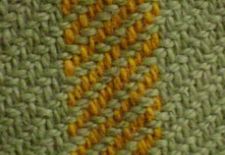
In a twill weave, each weft or filling yarn floats across the warp yarns in a progression of interlacings to the right or left, forming a distinct diagonal line. This diagonal line is also known as a wale. A float is the portion of a yarn that crosses over two or more yarns from the opposite direction.A twill weave requires three or more harnesses, depending on its complexity. A twill weave is the second most basic weave that can be made on a fairly simple loom
Loom
A loom is a device used to weave cloth. The basic purpose of any loom is to hold the warp threads under tension to facilitate the interweaving of the weft threads...
.
Twill weave is often designated as a fraction—such as 2/1—in which the numerator indicates the number of harnesses that are raised (and, thus, threads crossed), in this example, two, and the denominator indicates the number of harnesses that are lowered when a filling yarn is inserted, in this example one. The fraction 2/1 would be read as "two up, one down." The minimum number of harnesses needed to produce a twill can be determined by totaling the numbers in the fraction. For the example described, the number of harnesses is three. (The fraction for plain weave
Plain weave
Plain weave is the most basic of three fundamental types of textile weaves . It is strong and hard-wearing, used for fashion and furnishing fabrics....
is 1/1.)
Characteristics of twill
Sheer fabrics are seldom made with a twill weave. Because a twill surface has interesting texture and design, printed twills (where a design is printed on the cloth) are much less common than printed plain weaves. When twills are printed, they are most likely to be lightweight fabrics. Soil shows less on the uneven surface of twills than it does on smooth surfaces, such as plain weaves. Thus, twills are often used for sturdy work clothing or durable upholstery
Upholstery
Upholstery is the work of providing furniture, especially seats, with padding, springs, webbing, and fabric or leather covers. The word upholstery comes from the Middle English word upholder, which referred to a tradesman who held up his goods. The term is equally applicable to domestic,...
because soils and stains are less noticeable on this fabric. Denim, for example, is a twill.
The fewer interlacings in twills allow the yarns to move more freely, and thus they are softer and more pliable, and drape better. Twills also recover from wrinkles better than plain-weave fabrics do. When there are fewer interlacings, yarns can be packed closer together to produce high-count fabrics. In twills and higher counts, the fabric is more durable and air- and water-resistant.
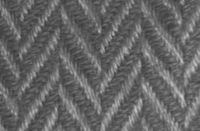
There are even-sided twills and warp-faced twills. Even-sided twills include foulard or surah, serge
Serge
Serge is a type of twill fabric that has diagonal lines or ridges on both sides, made with a two-up, two-down weave. The worsted variety is used in making military uniforms, suits, great coats and trench coats. Its counterpart, silk serge, is used for linings. French serge is a softer, finer variety...
, twill flannel
Flannel
Flannel is a soft woven fabric, of various fineness. Flannel was originally made from carded wool or worsted yarn, but is now often made from either wool, cotton, or synthetic fibre. Flannel may be brushed to create extra softness or remain unbrushed. The brushing process is a mechanical process...
, sharkskin, herringbone
Herringbone (cloth)
Herringbone describes a distinctive V-shaped weaving pattern usually found in twill fabric. It is distinguished from a plain chevron by the break at reversal, which makes it resemble a broken zigzag. The pattern is called herringbone because it resembles the skeleton of a herring fish...
, and houndstooth
Houndstooth
Houndstooth, houndstooth check or hound's tooth , also known as dogstooth, dogtooth or dog's tooth, is a duotone textile pattern characterized by broken checks or abstract four-pointed shapes, often in black and white, although other colours are used...
. Warp-faced twills include lining twill, denim
Denim
Denim is a rugged cotton twill textile, in which the weft passes under two or more warp threads. This produces the familiar diagonal ribbing identifiable on the reverse of the fabric, which distinguishes denim from cotton duck. Denim has been in American usage since the late 18th century...
, jean, drill
Drill (fabric)
Drill is stout durable cotton fabric with a strong bias in the weave. It can be used unbleached, although it is more often bleached or dyed.-Use in clothing:...
, covert, chino
Chino cloth
Chino cloth is a twill fabric, originally made of 100% cotton. Today it is also found in cotton-synthetic blends.Developed in the mid-19th century for British and French military uniforms and known as khaki, it has since migrated into civilian wear. Pants of such a fabric gained popularity in the...
, gabardine
Gabardine
Gabardine is a tough, tightly woven fabric used to make suits, overcoats, trousers, uniforms, windbreakers, and other garments. The fibre used to make the fabric is traditionally worsted wool, but may also be cotton, texturized polyester, or a blend. Gabardine is woven as a warp-faced steep or...
, cavalry twill, and fancy twill.
See also
- Cross-stitchCross-stitchCross-stitch is a popular form of counted-thread embroidery in which X-shaped stitches in a tiled, raster-like pattern are used to form a picture. Cross-stitch is often executed on easily countable evenweave fabric called aida cloth. The stitcher counts the threads in each direction so that the...