

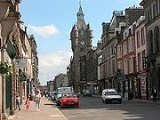
Hawick

Encyclopedia
Hawick is a town in the Scottish Borders
of south east Scotland
. It is 10 miles (16.1 km) south-west of Jedburgh
and 8.9 miles (14.3 km) south-southeast of Selkirk. It is one of the farthest towns from the sea in Scotland, in the heart of Teviotdale, and the biggest town in the former county of Roxburghshire
. Hawick's architecture is distinctive in that it has many sandstone
buildings with slate
roofs. The town is at the
confluence of the Slitrig Water
with the River Teviot
. Hawick is known for its yearly Common Riding
, for its rugby team Hawick Rugby Football Club
and for its knitwear
industry.
Companies such as Hawick Cashmere, Hawick Knitwear, Johnstons of Elgin, Lyle and Scott, Peter Scott, Pringle of Scotland
, and Scott and Charters, all have had and in many cases still have manufacturing plants in Hawick, producing some of the most luxurious cashmere
and merino
wool knitwear in the world today. The first knitting machine was brought to Hawick in 1771 by John Hardie, building on an existing carpet manufacturing trade. Originally based on linen, this quickly moved to wool and factories multiplied, driving the growth of the town.
At the 2001 census
Hawick had a resident population of 14,801.
. In the centre of the High Street is the Scots baronial style Town Hall, built in 1886, and the east end has an equestrian statue, known as "the Horse", erected in 1914. Drumlanrig's Tower, now a museum, dates largely from the mid-16th century.
, which combines the annual riding of the boundaries of the town's common land with the commemoration of a victory of local youths over an English
raiding party in 1514. In March 2007, this was described by the tourism Rough Guide as one of the best parties in the world.
People from Hawick call themselves "Teries", after a traditional song which includes the line "Teribus ye teri odin
".
to Carlisle road passes through the town, with main roads also leading to Berwick upon Tweed (the A698) and Newcastle upon Tyne
(the A6088, which joins the A68
at the Carter Bar
, 16 miles (26 km) south-east of Hawick).
Despite a great deal of local opposition, the town lost its rail service in 1969, as part of the controversial Beeching Axe
. It is now said to be the farthest large town from a railway station in the United Kingdom
. Regular buses serve the railway station at Carlisle, 42 miles (68 km) away. There are plans to reinstate the line from Edinburgh to Tweedbank, but not to Hawick.
The nearest major airports are at Edinburgh and Newcastle.
and a senior football team, Hawick Royal Albert
, who currently play in the East of Scotland Football League
.
Rivalry between the small Border towns is generally played out on the rugby union
field. The historical competition continues to this day, as Hawick's main rival is the similarly-sized town of Galashiels
.
was once played here by the 'uppies' and the 'doonies' on the first Monday after the new moon in the month of February. The river of the town formed an important part of the pitch. Although no longer played at Hawick, it is still played at nearby Jedburgh
.
which is informally known as "Teri Talk". It is similar (but not identical by any means) to the dialects spoken in surrounding towns, especially Jedburgh
, Langholm
and Selkirk. The speech of this general area was described in Dialect of the Southern Counties of Scotland (1873) by James Murray
, considered the first systematic study of any dialect. The Hawick tongue retains many elements of Old English, together with particular vocabulary, grammar and pronunciation. Its distinctiveness arose from the relative isolation of the town.
Hawick's villages:
Scottish Borders
The Scottish Borders is one of 32 local government council areas of Scotland. It is bordered by Dumfries and Galloway in the west, South Lanarkshire and West Lothian in the north west, City of Edinburgh, East Lothian, Midlothian to the north; and the non-metropolitan counties of Northumberland...
of south east Scotland
Scotland
Scotland is a country that is part of the United Kingdom. Occupying the northern third of the island of Great Britain, it shares a border with England to the south and is bounded by the North Sea to the east, the Atlantic Ocean to the north and west, and the North Channel and Irish Sea to the...
. It is 10 miles (16.1 km) south-west of Jedburgh
Jedburgh
Jedburgh is a town and former royal burgh in the Scottish Borders and historically in Roxburghshire.-Location:Jedburgh lies on the Jed Water, a tributary of the River Teviot, it is only ten miles from the border with England and is dominated by the substantial ruins of Jedburgh Abbey...
and 8.9 miles (14.3 km) south-southeast of Selkirk. It is one of the farthest towns from the sea in Scotland, in the heart of Teviotdale, and the biggest town in the former county of Roxburghshire
Roxburghshire
Roxburghshire or the County of Roxburgh is a registration county of Scotland. It borders Dumfries to the west, Selkirk to the north-west, and Berwick to the north. To the south-east it borders Cumbria and Northumberland in England.It was named after the Royal Burgh of Roxburgh...
. Hawick's architecture is distinctive in that it has many sandstone
Sandstone
Sandstone is a sedimentary rock composed mainly of sand-sized minerals or rock grains.Most sandstone is composed of quartz and/or feldspar because these are the most common minerals in the Earth's crust. Like sand, sandstone may be any colour, but the most common colours are tan, brown, yellow,...
buildings with slate
Slate
Slate is a fine-grained, foliated, homogeneous metamorphic rock derived from an original shale-type sedimentary rock composed of clay or volcanic ash through low-grade regional metamorphism. The result is a foliated rock in which the foliation may not correspond to the original sedimentary layering...
roofs. The town is at the
confluence of the Slitrig Water
Slitrig Water
Slitrig Water , also known as the River Slitrig, is a river in the Scottish Borders. It is a tributary of the River Teviot.-References:...
with the River Teviot
River Teviot
The River Teviot, or Teviot Water, is a river of the Scottish Borders area of Scotland, and a tributary of the River Tweed.It rises in the western foothills of Comb Hill on the border of Dumfries and Galloway...
. Hawick is known for its yearly Common Riding
Common Riding
Common Riding is an annual event celebrated in Scottish Border towns and in some other places, to commemorate the times of the past when local men risked their lives in order to protect their town and people.- Hawick :...
, for its rugby team Hawick Rugby Football Club
Hawick RFC
Hawick Rugby Football Club is a semi-professional rugby union side, currently playing in the Premiership Division One and Border League. The team are based at Mansfield Park at Hawick in the Scottish Borders....
and for its knitwear
Knitted fabric
Knitted fabrics is the third major class of fabric, after woven and nonwoven fabrics.-Elasticity, thickness and warmth:Compared to the other two classes, knitted fabrics are much more elastic, which accounts for their historical use in stockings and other clothing that requires changes in shape...
industry.
Companies such as Hawick Cashmere, Hawick Knitwear, Johnstons of Elgin, Lyle and Scott, Peter Scott, Pringle of Scotland
Pringle of Scotland
Pringle of Scotland is a luxury knitwear manufacturer and importer. The brand is worn by the likes of Madonna, DB7 , Nicole Kidman, Sophie Dahl, Claudia Schiffer, the television character Alan Partridge and British bands such as The Kooks, Dirty Pretty Things and The Twang...
, and Scott and Charters, all have had and in many cases still have manufacturing plants in Hawick, producing some of the most luxurious cashmere
Cashmere
Cashmere may refer to:* Cashmere wool, wool from the Cashmere goatPlaces* Another term for Kashmir, a region of the Indian subcontinent* Cashmere, New Zealand, a suburb of Christchurch, New Zealand* Cashmere, Queensland, a suburb of Brisbane, Australia...
and merino
Merino
The Merino is an economically influential breed of sheep prized for its wool. Merinos are regarded as having some of the finest and softest wool of any sheep...
wool knitwear in the world today. The first knitting machine was brought to Hawick in 1771 by John Hardie, building on an existing carpet manufacturing trade. Originally based on linen, this quickly moved to wool and factories multiplied, driving the growth of the town.
At the 2001 census
United Kingdom Census 2001
A nationwide census, known as Census 2001, was conducted in the United Kingdom on Sunday, 29 April 2001. This was the 20th UK Census and recorded a resident population of 58,789,194....
Hawick had a resident population of 14,801.
Monuments
The west end of the town contains "the Mote", the remains of a Norman motte-and-baileyMotte-and-bailey
A motte-and-bailey is a form of castle, with a wooden or stone keep situated on a raised earthwork called a motte, accompanied by an enclosed courtyard, or bailey, surrounded by a protective ditch and palisade...
. In the centre of the High Street is the Scots baronial style Town Hall, built in 1886, and the east end has an equestrian statue, known as "the Horse", erected in 1914. Drumlanrig's Tower, now a museum, dates largely from the mid-16th century.
Local traditions
The town hosts the annual Common RidingCommon Riding
Common Riding is an annual event celebrated in Scottish Border towns and in some other places, to commemorate the times of the past when local men risked their lives in order to protect their town and people.- Hawick :...
, which combines the annual riding of the boundaries of the town's common land with the commemoration of a victory of local youths over an English
England
England is a country that is part of the United Kingdom. It shares land borders with Scotland to the north and Wales to the west; the Irish Sea is to the north west, the Celtic Sea to the south west, with the North Sea to the east and the English Channel to the south separating it from continental...
raiding party in 1514. In March 2007, this was described by the tourism Rough Guide as one of the best parties in the world.
People from Hawick call themselves "Teries", after a traditional song which includes the line "Teribus ye teri odin
Teribus ye teri odin
Teribus ye teri odin or teribus an teriodin is popularly believed to have been the war cry of the men of Hawick at the Battle of Flodden Field, and still preserved in the traditions of the town...
".
Transport
Hawick lies in the centre of the valley of the Teviot. The A7 EdinburghEdinburgh
Edinburgh is the capital city of Scotland, the second largest city in Scotland, and the eighth most populous in the United Kingdom. The City of Edinburgh Council governs one of Scotland's 32 local government council areas. The council area includes urban Edinburgh and a rural area...
to Carlisle road passes through the town, with main roads also leading to Berwick upon Tweed (the A698) and Newcastle upon Tyne
Newcastle upon Tyne
Newcastle upon Tyne is a city and metropolitan borough of Tyne and Wear, in North East England. Historically a part of Northumberland, it is situated on the north bank of the River Tyne...
(the A6088, which joins the A68
A68 road
The A68 is a major road in the United Kingdom, running from Darlington in England to the A720 in Scotland.From Darlington, the road runs north, bypassing Bishop Auckland, and running through West Auckland, Toft Hill and Tow Law, past Consett and Corbridge...
at the Carter Bar
Carter Bar
The Carter Bar is the point at which the A68 crosses the England-Scotland border and forms a pass located at the top of Redesdale in the Cheviot Hills at an altitude of . The first sizeable Scottish town is Jedburgh approximately north. Other nearby Scottish towns include Hawick away and Kelso...
, 16 miles (26 km) south-east of Hawick).
Despite a great deal of local opposition, the town lost its rail service in 1969, as part of the controversial Beeching Axe
Beeching Axe
The Beeching Axe or the Beeching Cuts are informal names for the British Government's attempt in the 1960s to reduce the cost of running British Railways, the nationalised railway system in the United Kingdom. The name is that of the main author of The Reshaping of British Railways, Dr Richard...
. It is now said to be the farthest large town from a railway station in the United Kingdom
United Kingdom
The United Kingdom of Great Britain and Northern IrelandIn the United Kingdom and Dependencies, other languages have been officially recognised as legitimate autochthonous languages under the European Charter for Regional or Minority Languages...
. Regular buses serve the railway station at Carlisle, 42 miles (68 km) away. There are plans to reinstate the line from Edinburgh to Tweedbank, but not to Hawick.
The nearest major airports are at Edinburgh and Newcastle.
Sports
The town is the home of Hawick Rugby Football ClubHawick RFC
Hawick Rugby Football Club is a semi-professional rugby union side, currently playing in the Premiership Division One and Border League. The team are based at Mansfield Park at Hawick in the Scottish Borders....
and a senior football team, Hawick Royal Albert
Hawick Royal Albert F.C.
Hawick Royal Albert F.C. are a Senior football club based in Hawick, currently playing in the East of Scotland Football League.Founded in 1947 following a breakaway from Hawick Railway F.C., a number of players in these early “Albert” days were from the local Denholm Village team and they initially...
, who currently play in the East of Scotland Football League
East of Scotland Football League
The East of Scotland Football League is a league of football teams from south-east Scotland formed in 1923. It is one of Scotland's three "senior" non-leagues which sit below the Scottish Football League , the other two being the Highland Football League and the South of Scotland Football League...
.
Rivalry between the small Border towns is generally played out on the rugby union
Rugby union
Rugby union, often simply referred to as rugby, is a full contact team sport which originated in England in the early 19th century. One of the two codes of rugby football, it is based on running with the ball in hand...
field. The historical competition continues to this day, as Hawick's main rival is the similarly-sized town of Galashiels
Galashiels
Galashiels is a burgh in the Scottish Borders, on the Gala Water river. The name is often shortened to "Gala" .Galashiels is a major commercial centre for the Scottish Borders...
.
Ba game
The Hawick Baw gameBa game
Ba game is a version of medieval football played in Scotland, perhaps most notably in Orkney and the Scottish Borders, around Christmas and New Year....
was once played here by the 'uppies' and the 'doonies' on the first Monday after the new moon in the month of February. The river of the town formed an important part of the pitch. Although no longer played at Hawick, it is still played at nearby Jedburgh
Jedburgh
Jedburgh is a town and former royal burgh in the Scottish Borders and historically in Roxburghshire.-Location:Jedburgh lies on the Jed Water, a tributary of the River Teviot, it is only ten miles from the border with England and is dominated by the substantial ruins of Jedburgh Abbey...
.
Teri Talk
Many Hawick residents speak the local dialect of Border ScotsSouth Scots
Southern Scots is one of the names given to the dialect of Scots spoken in the Scottish Borders counties of mid and east Dumfriesshire, Roxburghshire and Selkirkshire, with the notable exception of Berwickshire and Peeblesshire, which are, like Edinburgh, part of the SE Central Scots dialect area...
which is informally known as "Teri Talk". It is similar (but not identical by any means) to the dialects spoken in surrounding towns, especially Jedburgh
Jedburgh
Jedburgh is a town and former royal burgh in the Scottish Borders and historically in Roxburghshire.-Location:Jedburgh lies on the Jed Water, a tributary of the River Teviot, it is only ten miles from the border with England and is dominated by the substantial ruins of Jedburgh Abbey...
, Langholm
Langholm
Langholm , also known colloquially as the "Muckle Toon", is a burgh in Dumfries and Galloway, Scotland, on the River Esk and the A7 road.- History:...
and Selkirk. The speech of this general area was described in Dialect of the Southern Counties of Scotland (1873) by James Murray
James Murray (lexicographer)
Sir James Augustus Henry Murray was a Scottish lexicographer and philologist. He was the primary editor of the Oxford English Dictionary from 1879 until his death.-Life and learning:...
, considered the first systematic study of any dialect. The Hawick tongue retains many elements of Old English, together with particular vocabulary, grammar and pronunciation. Its distinctiveness arose from the relative isolation of the town.
Notable people
- Dame Isobel Baillie
- Sir Chay BlythChay BlythSir Charles Blyth, CBE, BEM , known as Chay Blyth, is a Scottish yachtsman and rower. He was the first person to sail non-stop westwards around the world , on a 59-foot boat called British Steel.- Early life:...
- Brian BonsorBrian BonsorJames Brian Bonsor MBE was a Scottish-born composer and teacher specialising in the recorder.-Life and career:...
- John Brunton DaykinsJohn Brunton DaykinsJohn Brunton Daykins VC MM was a Scottish recipient of the Victoria Cross, the highest and most prestigious award for gallantry in the face of the enemy that can be awarded to British and Commonwealth forces.Daykins was 35 years old, and an acting sergeant in the 2/4th Battalion, The York and...
VCVictoria CrossThe Victoria Cross is the highest military decoration awarded for valour "in the face of the enemy" to members of the armed forces of various Commonwealth countries, and previous British Empire territories.... - Steve HislopSteve HislopSteven 'Hizzy' Hislop was a Scottish motorcycle racer. Hislop won the Isle of Man TT eleven times and also the British 250cc Championship and British Superbike championship ....
- Stuart EastonStuart EastonStuart Easton is a Scottish motorcycle racer. He was the 2002 British Supersport champion riding for Paul Bird's MonsterMob Ducati team. He has subsequently ridden in the British Superbike Championship on Kawasaki and latterly Hydrex Honda, gaining his first win in the Superbike class at Croft 2009...
- Nigel GriffithsNigel GriffithsNigel Griffiths is a British Labour Party politician, who was the Member of Parliament for Edinburgh South from 1987 to 2010.-Early life:...
- Jimmie GuthrieJimmie GuthrieAndrew James "Jimmie" Guthrie was a Scottish motorcycle racer famous for 19 motorcycle Grand Prix wins and 3 victories in the North West 200 and 6 wins at the Isle of Man TT Races in his career.-Biography:...
- James Paris LeeJames Paris LeeJames Paris Lee was a Scottish-Canadian and later American inventor and arms designer, best known for inventing the bolt action that led to the Lee-Metford and Lee-Enfield series of rifles.-Early Life and Career:...
- Sir John BlackwoodJohn Blackwood McEwenSir John Blackwood McEwen was a Scottish classical composer and educator.- Biography :John Blackwood McEwen was born in Hawick in 1868. After initial training in Glasgow, he studied with Ebenezer Prout, Corder and Tobias Matthay at the Royal Academy of Music in London...
- Bill McLarenBill McLarenWilliam Pollock "Bill" McLaren CBE was a Scottish rugby union commentator, teacher, journalist and one time rugby player. Until his retirement in 2002, he was known as 'the voice of rugby'...
- Sir James MurrayJames Murray (lexicographer)Sir James Augustus Henry Murray was a Scottish lexicographer and philologist. He was the primary editor of the Oxford English Dictionary from 1879 until his death.-Life and learning:...
- Anne RedpathAnne RedpathAnne Redpath OBE was a Scottish artist whose vivid domestic still lifes are among her best-known works.Redpath's father was a tweed designer in the Scottish Borders. She saw a connection between his use of colour and her own...
- Henry Scott RiddellHenry Scott RiddellHenry Scott Riddell was a Scottish poet and songwriter. In the Scottish Orpheus a collection of songs of Scotland by Adam Hamitlon he is credited with writing Scotland Yet and The Dowie Dens O' Yarrow.-External links:*...
- Francis George ScottFrancis George ScottFrancis George Scott was a Scottish composer.Born in Hawick, Roxburghshire, he was the son of a supplier of mill-engineering parts. Educated at Hawick, and at the universities of Edinburgh and Durham, he studied composition under Jean Roger-Ducasse...
- Sir Andrew SmithAndrew Smith (zoologist)Sir Andrew Smith KCB was a Scottish surgeon, explorer, ethnologist and zoologist. He is considered the father of Zoology in South Africa having described many species across a wide range of groups in his major work, Illustrations of the Zoology of South Africa.Smith was born in Hawick, Roxburghshire...
- Sir David WallaceDavid Wallace (physicist)Professor Sir David James Wallace, CBE, FRS, DL is the Director of the Isaac Newton Institute for Mathematical Sciences in Cambridge and master of Churchill College, Cambridge....
- James WilsonJames Wilson (UK politician)James Wilson was a Scottish businessman, economist and Liberal politician. He founded The Economist and the Standard Chartered Bank.-Early life:...
See also
- Hawick Rugby Football ClubHawick RFCHawick Rugby Football Club is a semi-professional rugby union side, currently playing in the Premiership Division One and Border League. The team are based at Mansfield Park at Hawick in the Scottish Borders....
- Hawick Royal Albert F.C.Hawick Royal Albert F.C.Hawick Royal Albert F.C. are a Senior football club based in Hawick, currently playing in the East of Scotland Football League.Founded in 1947 following a breakaway from Hawick Railway F.C., a number of players in these early “Albert” days were from the local Denholm Village team and they initially...
Hawick's villages:
- Burnfoot, Scottish BordersBurnfoot, Scottish BordersBurnfoot is a housing estate just east of the A7, in the northern part of Hawick, by the Boonraw Burn, in the Scottish Borders area of Scotland. Wilton Dean and Stirches were also villages surrounding Hawick...
- StirchesStirchesStirches is an area of Hawick in the Scottish Borders, mostly consisting of ex-council housing built in 1973 . It is often considered to be one of the more desirable housing schemes in the town.-See also:*Wilton Dean*List of places in the Scottish Borders...
- Wilton DeanWilton DeanWilton Dean is a village in the Scottish Borders area of Scotland, on the Cala Burn, and close to the River Teviot. Along with Stirches and Burnfoot, Scottish Borders, Wilton Dean is now often considered to be a suburb of Hawick which is situated very close to the village.Places nearby...
Further reading
- Murray, James (1870–72, 1873) The Dialect of the Southern Counties of Scotland, London: Philological Society.