
Home      Discussion      Topics      Dictionary      Almanac
Signup       Login
Hallasan

Hallasan

Overview
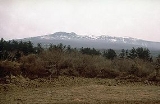
Hallasan is a shield volcano
Shield volcano
A shield volcano is a large volcano with shallow-sloping sides. Shield volcanoes are formed from fluid lava that can travel long distances across slight inclines, resulting in their relatively flat, broad profile...

 on Jeju Island
Jeju-do
Jeju-do is the only special autonomous province of South Korea, situated on and coterminous with the country's largest island. Jeju-do lies in the Korea Strait, southwest of Jeollanam-do Province, of which it was a part before it became a separate province in 1946...

 of South Korea
South Korea
South Korea, officially the Republic of Korea and often simply referred to as Korea, is a country in East Asia, located on the southern half of the Korean Peninsula. It is neighbored by China to the west, Japan to the east, and North Korea to the north. Its capital is Seoul, the second largest...

. Hallasan is the highest mountain
Mountain
A mountain is a large landform that stretches above the surrounding land in a limited area usually in the form of a peak. A mountain is generally steeper than a hill. The adjective montane is used to describe mountainous areas and things associated with them...

 of South Korea. The area around the mountain is a designated national park
National park
A national park is a reserve of natural or semi-natural land, declared or owned by a national government, set aside for human recreation and enjoyment, and protected from most development...

, the Hallasan National Park (Hallasan Gungnip Gongwon/한라산국립공원/漢拏山國立公園). Hallasan is commonly considered to be one of the three main mountains of South Korea, with Jirisan
Jirisan
Jirisan is a mountain in the southern region of South Korea. It is often considered one of the three most important mountains in South Korea, with Hallasan and Seoraksan being the other two....

 and Seoraksan
Seoraksan
Seoraksan is the highest mountain in the Taebaek mountain range in the Gangwon province in eastern South Korea. It is located in a national park near the city of Sokcho. After the Hallasan volcano on Jeju Island and Jirisan in the south, Seoraksan is the third highest mountain in South Korea. The...

 being the other two.

Alternate names for the mountain include Halla Mountain or Mount Halla and older English sources refer to the peak as Mount Auckland.
Discussion
Ask a question about 'Hallasan'
Start a new discussion about 'Hallasan'
Answer questions from other users
Full Discussion Forum
 
Encyclopedia
Hallasan is a shield volcano
Shield volcano
A shield volcano is a large volcano with shallow-sloping sides. Shield volcanoes are formed from fluid lava that can travel long distances across slight inclines, resulting in their relatively flat, broad profile...

 on Jeju Island
Jeju-do
Jeju-do is the only special autonomous province of South Korea, situated on and coterminous with the country's largest island. Jeju-do lies in the Korea Strait, southwest of Jeollanam-do Province, of which it was a part before it became a separate province in 1946...

 of South Korea
South Korea
South Korea, officially the Republic of Korea and often simply referred to as Korea, is a country in East Asia, located on the southern half of the Korean Peninsula. It is neighbored by China to the west, Japan to the east, and North Korea to the north. Its capital is Seoul, the second largest...

. Hallasan is the highest mountain
Mountain
A mountain is a large landform that stretches above the surrounding land in a limited area usually in the form of a peak. A mountain is generally steeper than a hill. The adjective montane is used to describe mountainous areas and things associated with them...

 of South Korea. The area around the mountain is a designated national park
National park
A national park is a reserve of natural or semi-natural land, declared or owned by a national government, set aside for human recreation and enjoyment, and protected from most development...

, the Hallasan National Park (Hallasan Gungnip Gongwon/한라산국립공원/漢拏山國立公園). Hallasan is commonly considered to be one of the three main mountains of South Korea, with Jirisan
Jirisan
Jirisan is a mountain in the southern region of South Korea. It is often considered one of the three most important mountains in South Korea, with Hallasan and Seoraksan being the other two....

 and Seoraksan
Seoraksan
Seoraksan is the highest mountain in the Taebaek mountain range in the Gangwon province in eastern South Korea. It is located in a national park near the city of Sokcho. After the Hallasan volcano on Jeju Island and Jirisan in the south, Seoraksan is the third highest mountain in South Korea. The...

 being the other two.

Names


Alternate names for the mountain include Halla Mountain or Mount Halla and older English sources refer to the peak as Mount Auckland. Hallasan is written in North Korea
North Korea
North Korea, officially the Democratic People's Republic of Korea , is a state in East Asia, occupying the northern half of the Korean Peninsula. Its capital and largest city is Pyongyang. The Korean Demilitarized Zone serves as the buffer area between North Korea and South Korea...

 in Hangul
Hangul
Hangul is the native alphabet of the Korean language, as distinguished from the logographic Sino-Korean hanja system...

 as if it were Hannasan (한나산); however, it is still pronounced as Hallasan. In the past, Hallasan has been known by numerous other names in Korean including Buag (부악/釜岳), Weonsan (원산/圓山), Jinsan (진산/鎭山), Seonsan (선산/仙山), Dumuag (두무악/頭無岳), Burasan (부라산/浮羅山), Yeongjusan 영주산(瀛州山), and Hyeolmangbong (혈망봉/穴望峯).


Geology and geography


Hallasan is a massive shield volcano
Shield volcano
A shield volcano is a large volcano with shallow-sloping sides. Shield volcanoes are formed from fluid lava that can travel long distances across slight inclines, resulting in their relatively flat, broad profile...

 which forms the bulk of Jeju Island
Jeju-do
Jeju-do is the only special autonomous province of South Korea, situated on and coterminous with the country's largest island. Jeju-do lies in the Korea Strait, southwest of Jeollanam-do Province, of which it was a part before it became a separate province in 1946...

 and is often taken as representing the island itself. There is a local saying stating that "Jeju Island is Hallasan; and Hallasan is Jeju." The mountain can indeed be seen from all places on the island, but its peak is often covered in clouds. The mountain has been designated Korea's Natural Monument
Natural monuments of South Korea
This is a partial list of the natural monuments of South Korea, as designated by the Cultural Heritage Administration of South Korea. As of December 2006, a total of 473 natural monuments had been designated; of these, 394 were still on the list, while the others had been removed for various...

 no. 182.

The volcanic island was constructed starting in the Pliocene
Pliocene
The Pliocene epoch is the period in the geologic timescale that extends from 5.332 million to 2.588 million years before present....

 epoch atop the continental shelf
Continental shelf
The continental shelf is the extended perimeter of each continent and associated coastal plain, and was part of the continent during the glacial periods, but is undersea during interglacial periods such as the current epoch by relatively shallow seas and gulfs. The continental rise is below the...

, which is presently about 100 m (300 ft) below sea level in that area. Eruptions of basalt
Basalt
Basalt is a common extrusive volcanic rock. It is usually grey to black and fine-grained due to rapid cooling of lava at the surface of a planet. It may be porphyritic containing larger crystals in a fine matrix, or vesicular, or frothy scoria. Unweathered basalt is black or grey.On Earth, most...

 and trachyte
Trachyte
Trachyte is an igneous, volcanic rock with an aphanitic to porphyritic texture. The mineral assemblage consists of essential alkali feldspar; relatively minor plagioclase and quartz or a feldspathoid such as nepheline may also be present....

 lava
Lava
Lava is molten rock expelled by a volcano during eruption. This molten rock is formed in the interior of some planets, including Earth, and some of their satellites. When first erupted from a volcanic vent, lava is a liquid at temperatures from 700 °C to 1,200 °C...

 built the island above sea level, and it now reaches a height of . A large volcanic crater
Volcanic crater
A volcanic crater is a circular depression in the ground caused by volcanic activity. It is typically a basin, circular in form within which occurs a vent from which magma erupts as gases, lava, and ejecta. A crater can be of large dimensions, and sometimes of great depth...

 over in diameter tops the volcano. About 360 parasitic cones, or oreum (오름) in the Jeju dialect
Jeju dialect
Jeju dialect or Jeju language is the dialect used on the island of Jeju in Korea, with the exception of Chuja in former Bukjeju County area of Jeju City. It differs greatly from the dialects of the mainland, and preserves many archaic words which have since been lost in other Korean dialects...

, are found on the volcano's flanks. Most of them are cinder cone
Cinder cone
According to the , Cinder Cone is the proper name of 1 cinder cone in Canada and 7 cinder cones in the United States:In Canada: Cinder Cone In the United States:...

s and scoria cones, but there are also some lava dome
Lava dome
|250px|thumb|right|Image of the [[rhyolitic]] lava dome of [[Chaitén Volcano]] during its 2008–2009 eruption.In volcanology, a lava dome is a roughly circular mound-shaped protrusion resulting from the slow extrusion of viscous lava from a volcano...

s and about 20 tuff rings near the coast and offshore, which were formed by underwater phreatic eruption
Phreatic eruption
A phreatic eruption, also called a phreatic explosion or ultravulcanian eruption, occurs when rising magma makes contact with ground or surface water. The extreme temperature of the magma causes near-instantaneous evaporation to steam resulting in an explosion of steam, water, ash, rock, and...

s. The most recent eruptions occurred on the flanks in 1002 and 1007.


There is a crater lake
Crater lake
A Crater lake is a lake that forms in a volcanic crater, such as a maar, or in a caldera. Sometimes the latter are called Caldera lakes, but often this distinction is not made...

 on Hallasan called Baengnokdam (/), literally "white deer lake." There is a legend attributing the name of the lake to otherworldly men who descend from heaven to play with white deer. Depending on the season, the circumference of the lake is up to 2 kilometres with a depth up to about 100 metres.

Sights


The mountain is home to Gwaneumsa, the oldest Buddhist
Buddhism
Buddhism, as traditionally conceived, is a path of salvation attained through insight into the ultimate nature of reality. It encompasses a variety of traditions, beliefs and practices, largely based on teachings attributed to Siddhartha Gautama, commonly known as the Buddha...

 temple on the island. The temple was originally built during the Goryeo Dynasty. Like many other temples in Korea, Gwaneumsa was destroyed and rebuilt in the 20th century. There is a memorial site outside the temple, remembering the victims of the Jeju uprising
Jeju massacre
The Jeju Uprising refers to the rebellion on Jeju island, South Korea, beginning on April 3, 1948. Between 14,000 and 30,000 individuals were killed in fighting between various factions on the island...

that took place between 1948 and 1950. It is one of the most visited places of the island.

Trails


There are five hiking trails on Hallasan, with the Donnaeko trail being closed to the public since 1994. At this time, only the Gwaneumsa and Seongpanak trails lead to the summit. The trail to the summit from Eorimok and Yeongsil courses has also been closed off since 1994 in order to restore and protect the vegetation.
  • Gwaneumsa Trail (관음사) - 8.7 km
  • Eorimok Trail (어리목) - 4.7 km
  • Seongpanak Trail (성판악) - 9.6 km
  • Yeongsil Trail (영실) - 3.7 km
  • Donnaeko Trail (돈내코)