

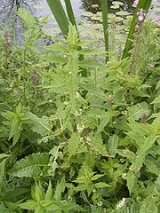
Gypsywort

Encyclopedia
Lycopus europaeus is a perennial plant
in the Lycopus
genus, native to Europe and Asia, and naturalized in the United States
.
areas. Its root is a rhizome
. It is in flower from June to September, and produces seeds from August to October.
The name Gypsywort comes from the belief that Gypsies were reputed to stain their skin with the juice of the plant, although Howard (1987) states that they used it to dye their linen.
Perennial plant
A perennial plant or simply perennial is a plant that lives for more than two years. The term is often used to differentiate a plant from shorter lived annuals and biennials. The term is sometimes misused by commercial gardeners or horticulturalists to describe only herbaceous perennials...
in the Lycopus
Lycopus
Lycopus is a genus of about a dozen species of flowering plants in the family Lamiaceae. They are all herbaceous plants native to Europe, northwest Asia, and North America. The species are most often found in wetlands, damp meadows, and stream banks...
genus, native to Europe and Asia, and naturalized in the United States
United States
The United States of America is a federal constitutional republic comprising fifty states and a federal district...
.
Habitat
Gypsywort grows primarily in wetlandWetland
A wetland is an area of land whose soil is saturated with water either permanently or seasonally. Wetlands are categorised by their characteristic vegetation, which is adapted to these unique soil conditions....
areas. Its root is a rhizome
Rhizome
In botany and dendrology, a rhizome is a characteristically horizontal stem of a plant that is usually found underground, often sending out roots and shoots from its nodes...
. It is in flower from June to September, and produces seeds from August to October.
Etymology and folklore
It is reputed to have medicinal qualities and has been used by various peoples as an astringent, cosmetic, douche, narcotic and refrigerant. Several research studies have been undertaken on the properties of this plant.The name Gypsywort comes from the belief that Gypsies were reputed to stain their skin with the juice of the plant, although Howard (1987) states that they used it to dye their linen.
External links
- United States Dept. of Agriculture Plants Database
- USDA Grin Taxonomy
- Dr. Duke's Ethnobotanical Uses
- List of articles from the National Library of Medicine and the National Institutes of Health
- Flora of China
- Skye Flora Plant Identification
- Plants for a Future Database of Edible and Medicinal Plants