All Topics  
Rules of engagement


   Email Print
   Bookmark   Link


Rules of engagement


In militaryMilitary

A military or military force has seen many different incarnations throughout time....
 or policePolice Overview

Police forces are government organizations charged with the responsibility of maintaining law and order , and protecting the ...
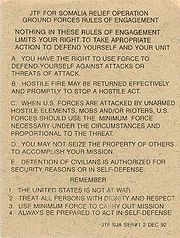
 operations, the rules of engagement (ROE) determine when, where, and how force shall be used (for example, a submarine of country A cannot open fire on the shipping vessels of country B without an official declaration of warDeclaration of war

A declaration of war is a formal declaration issued by a national government indicating that a state of war exists between t...
). Such rules are both general and specific, and there have been large variations between cultures throughout history. The rules may be made public, as in a martial lawMartial law

Martial law is the system of rules that takes effect when a military authority takes control of the normal administration o...
 or curfewCurfew

A curfew can be one of the following:...
 situation, but are typically only fully known to the force that intends to use them.

British Military ROE

The British Ministry of DefenceMinistry of Defence (United Kingdom)

The Ministry of Defence is the United Kingdom government department responsible for implementation of government defence pol...
 officially defines ROE as:

"Directives issued by competent military authority which delineate the circumstances and limitations under which UK forces will initiate and/or continue combatCombat Overview

Combat, or fighting, is purposeful violent conflict between one or more persons or organizations, often intended to es...
 engagement with other forces encountered."


The ROE deal with four issues:
  • When military force may be used,
  • Where military force may be used,
  • Against whom force should be used in the circumstances described above, and
  • How military force should be used to achieve the desired ends.


The ROE take two forms: Actions a soldier may take without consulting a higher authority, unless explicitly forbidden (sometimes called 'command by negation') and second, actions that may only be taken if explicitly ordered by a higher authority (sometimes called 'positive command'). Also, in the event that there is a clear and present danger.

In addition to a typically large set of standing orders, military personnel will be given additional rules of engagement before performing any mission or military operation. These can cover circumstances such as how to retaliate after an attack, how to treat captured targets, which territories the soldier is bound to fight into, and how the force should be used during the operation.

The ROE are extremely important:
  1. They provide a consistent, understandable and repeatable standard on how forces act. Typically they are carefully thought out in detail well in advance of an engagement and may cover a number of scenarios, with different rules for each.
  2. They assist in the synchronization of political-diplomatic and military components of a strategy by allowing political commanders to better understand, forecast and tailor the actions of a force.


The first rule of engagement for British Armed ForcesBritish Armed Forces

The armed forces of the United Kingdom are known as the British Armed Forces or Her Majesty's Armed Forces, officially...
 is always the right to use force in self-defense.

U.S. Military ROE

The 1999 Marine Corps Close Combat Manual (MCRP 3-02B) presents a “Continuum of Force” the following breakdown:

  • Level 1: Compliant (Cooperative). The subject responds and complies to verbal commands. Close combat techniques do not apply.
  • Level 2: Resistant (Passive). The subject resists verbal commands but complies immediately to any contact controls. Close combat techniques do not apply.
  • Level 3: Resistant (Active). The subject initially demonstrates physical resistance. Use compliance techniques to control the situation. Level three incorporates close combat techniques to physically force a subject to comply. Techniques include: Come-along holds, Soft-handed stunning blows, Pain compliance through the use of joint manipulation and the use of pressure points.
  • Level 4: Assaultive (Bodily Harm). The subject may physically attack, but does not use a weapon. Use defensive tactics to neutralize the threat. Defensive tactics include: Blocks, Strikes, Kicks, Enhanced pain compliance procedures, Impact weapon blocks and blows.
  • Level 5: Assaultive (Lethal Force). The subject usually has a weapon and will either kill or injure someone if he/she is not stopped immediately and brought under control. The subject must be controlled by the use of deadly force with or without a firearm or weapon.

ROE failures

In any engagement, the ROE need to balance two competing goals: The need to use force effectively to accomplish the mission objectives and the need to avoid unnecessary force. This creates room for two types of error:
  • Excessively tight ROE can constrain a commander from performing his mission effectively, called a Type I errorType I and type II errors

    Scientists recognize two different sorts of error:Excluding other sorts of intentional misrepresentation such as fraud....
    . It is typical for the political leadership to constrain the actions of military commanders. This is often a source of tension between the political leaders, who are trying to accomplish a political or diplomatic objective, and the military commanders, who are trying to make the most effective use of their forces. Sagan [2] provides an excellent discussion of this topic. The UN Peacekeeper's ROE (see UNAMIRUnited Nations Assistance Mission for Rwanda

    The United Nations Assistance Mission for Rwanda was a relief mission instituted by the United Nations....
    ) during the Rwandan GenocideRwandan Genocide

    The Rwandan Genocide was the massacre of an estimated 800,000 to 1,071,000 Tutsis and moderate Hutus in Rwanda, mostly carri...
     is a tragic example of too restrictive ROE.
  • Excessively loose ROE can facilitate the escalation of a conflict which, while being tactically effective, negates the political objectives that the use of force was meant to achieve. This is a Type II errorType I and type II errors

    Scientists recognize two different sorts of error:Excluding other sorts of intentional misrepresentation such as fraud....
     or "escalatory" error.

Current Issues

The late 1990s and early 2000s has seen an increase in the use of private military contractors particularly from United States and Britain. Such contractors are not bound by the same rules of engagement, standing orders, or levels of accountability as are members of a national military force.

See also

  • The Moscow RulesThe Moscow Rules

    The Moscow Rules is the name for rules of engagement said to have been developed by the CIA during the Cold War to be used b...
    , an example of the use of the ROE term in tradecraftTradecraft

    Tradecraft is a collective word for the techniques used in modern espionage....
    .