

Graph automorphism

Encyclopedia
In the mathematical
field of graph theory
, an automorphism of a graph is a form of symmetry in which the graph is mapped onto itself while preserving the edge–vertex connectivity.
Formally, an automorphism of a graph G = (V,E) is a permutation
σ of the vertex set V, such that the pair of vertices (u,v) form an edge if and only if the pair (σ(u),σ(v)) also form an edge. That is, it is a graph isomorphism
from G to itself. Automorphisms may be defined in this way both for directed graph
s and for undirected graphs.
The composition
of two automorphisms is another automorphism, and the set of automorphisms of a given graph, under the composition operation, forms a group
, the automorphism group of the graph. In the opposite direction, by Frucht's theorem
, all groups can be represented as the automorphism group of a connected graph – indeed, of a cubic graph
.
) as solving the graph isomorphism problem
, determining whether two given graphs correspond vertex-for-vertex and edge-for-edge. For, G and H are isomorphic if and only if the disconnected graph formed by the disjoint union of graphs G and H has an automorphism that swaps the two components.
The graph automorphism problem is the problem of testing whether a graph has a nontrivial automorphism. It belongs to the class NP of computational complexity. Similar to the graph isomorphism problem, it is unknown whether it has a polynomial time algorithm or it is NP-complete
.
There is a polynomial time algorithm for solving the graph automorphism problem for graphs where vertex degrees are bounded by a constant (Luks 1982).
It is known that the graph automorphism problem is polynomial-time many-one reducible to the graph isomorphism problem, but the converse reduction is unknown.
, whereas SAUCY is currently optimized for solving Graph Automorphism.
Practical applications of Graph Automorphism include graph drawing
and other visualization tasks, solving structured instances of Boolean Satisfiability arising in the context of Formal verification
and Logistics
. Molecular symmetry
can predict or explain chemical properties.
researchers have investigated algorithms for drawing graphs in such a way that the automorphisms of the graph become visible as symmetries of the drawing. This may be done either by using a method that is not designed around symmetries, but that automatically generates symmetric drawings when possible, or by explicitly identifying symmetries and using them to guide vertex placement in the drawing. It is not always possible to display all symmetries of the graph simultaneously, so it may be necessary to choose which symmetries to display and which to leave unvisualized.
Inclusion relationships between these families are indicated by the following table:
Mathematics
Mathematics is the study of quantity, space, structure, and change. Mathematicians seek out patterns and formulate new conjectures. Mathematicians resolve the truth or falsity of conjectures by mathematical proofs, which are arguments sufficient to convince other mathematicians of their validity...
field of graph theory
Graph theory
In mathematics and computer science, graph theory is the study of graphs, mathematical structures used to model pairwise relations between objects from a certain collection. A "graph" in this context refers to a collection of vertices or 'nodes' and a collection of edges that connect pairs of...
, an automorphism of a graph is a form of symmetry in which the graph is mapped onto itself while preserving the edge–vertex connectivity.
Formally, an automorphism of a graph G = (V,E) is a permutation
Permutation
In mathematics, the notion of permutation is used with several slightly different meanings, all related to the act of permuting objects or values. Informally, a permutation of a set of objects is an arrangement of those objects into a particular order...
σ of the vertex set V, such that the pair of vertices (u,v) form an edge if and only if the pair (σ(u),σ(v)) also form an edge. That is, it is a graph isomorphism
Graph isomorphism
In graph theory, an isomorphism of graphs G and H is a bijection between the vertex sets of G and H f \colon V \to V \,\!such that any two vertices u and v of G are adjacent in G if and only if ƒ and ƒ are adjacent in H...
from G to itself. Automorphisms may be defined in this way both for directed graph
Directed graph
A directed graph or digraph is a pair G= of:* a set V, whose elements are called vertices or nodes,...
s and for undirected graphs.
The composition
Function composition
In mathematics, function composition is the application of one function to the results of another. For instance, the functions and can be composed by computing the output of g when it has an argument of f instead of x...
of two automorphisms is another automorphism, and the set of automorphisms of a given graph, under the composition operation, forms a group
Group (mathematics)
In mathematics, a group is an algebraic structure consisting of a set together with an operation that combines any two of its elements to form a third element. To qualify as a group, the set and the operation must satisfy a few conditions called group axioms, namely closure, associativity, identity...
, the automorphism group of the graph. In the opposite direction, by Frucht's theorem
Frucht's theorem
Frucht's theorem is a theorem in algebraic graph theory conjectured by Dénes Kőnig in 1936 and proved by Robert Frucht in 1939. It states that every finite group is the group of symmetries of a finite undirected graph...
, all groups can be represented as the automorphism group of a connected graph – indeed, of a cubic graph
Cubic graph
In the mathematical field of graph theory, a cubic graph is a graph in which all vertices have degree three. In other words a cubic graph is a 3-regular graph. Cubic graphs are also called trivalent graphs....
.
Computational complexity
Constructing the automorphism group is at least as difficult (in terms of its computational complexityComputational Complexity
Computational Complexity may refer to:*Computational complexity theory*Computational Complexity...
) as solving the graph isomorphism problem
Graph isomorphism problem
The graph isomorphism problem is the computational problem of determining whether two finite graphs are isomorphic.Besides its practical importance, the graph isomorphism problem is a curiosity in computational complexity theory as it is one of a very small number of problems belonging to NP...
, determining whether two given graphs correspond vertex-for-vertex and edge-for-edge. For, G and H are isomorphic if and only if the disconnected graph formed by the disjoint union of graphs G and H has an automorphism that swaps the two components.
The graph automorphism problem is the problem of testing whether a graph has a nontrivial automorphism. It belongs to the class NP of computational complexity. Similar to the graph isomorphism problem, it is unknown whether it has a polynomial time algorithm or it is NP-complete
NP-complete
In computational complexity theory, the complexity class NP-complete is a class of decision problems. A decision problem L is NP-complete if it is in the set of NP problems so that any given solution to the decision problem can be verified in polynomial time, and also in the set of NP-hard...
.
There is a polynomial time algorithm for solving the graph automorphism problem for graphs where vertex degrees are bounded by a constant (Luks 1982).
It is known that the graph automorphism problem is polynomial-time many-one reducible to the graph isomorphism problem, but the converse reduction is unknown.
Algorithms, software and applications
While no worst-case polynomial-time algorithms are known for the general Graph Automorphism problem, finding the automorphism group (and printing out an irredundant set of generators) for many large graphs arising in applications is rather easy. Several open-source software tools are available for this task, including NAUTY, BLISS and SAUCY. SAUCY and BLISS are particularly efficient for sparse graphs, e.g., SAUCY processes some graphs with millions of vertices in mere seconds. However, BLISS and NAUTY can also produce Canonical LabelingGraph canonization
In graph theory, a branch of mathematics, graph canonization is finding a canonical form of a graph G, which is a graph Canon isomorphic to G such that Canon = Canon if and only if H is isomorphic to G. The canonical form of a graph is an example of a complete graph invariant...
, whereas SAUCY is currently optimized for solving Graph Automorphism.
Practical applications of Graph Automorphism include graph drawing
Graph drawing
Graph drawing is an area of mathematics and computer science combining methods from geometric graph theory and information visualization to derive two-dimensional depictions of graphs arising from applications such as social network analysis, cartography, and bioinformatics...
and other visualization tasks, solving structured instances of Boolean Satisfiability arising in the context of Formal verification
Formal verification
In the context of hardware and software systems, formal verification is the act of proving or disproving the correctness of intended algorithms underlying a system with respect to a certain formal specification or property, using formal methods of mathematics .- Usage :Formal verification can be...
and Logistics
Supply chain
A supply chain is a system of organizations, people, technology, activities, information and resources involved in moving a product or service from supplier to customer. Supply chain activities transform natural resources, raw materials and components into a finished product that is delivered to...
. Molecular symmetry
Molecular symmetry
Molecular symmetry in chemistry describes the symmetry present in molecules and the classification of molecules according to their symmetry. Molecular symmetry is a fundamental concept in chemistry, as it can predict or explain many of a molecule's chemical properties, such as its dipole moment...
can predict or explain chemical properties.
Symmetry display
Several graph drawingGraph drawing
Graph drawing is an area of mathematics and computer science combining methods from geometric graph theory and information visualization to derive two-dimensional depictions of graphs arising from applications such as social network analysis, cartography, and bioinformatics...
researchers have investigated algorithms for drawing graphs in such a way that the automorphisms of the graph become visible as symmetries of the drawing. This may be done either by using a method that is not designed around symmetries, but that automatically generates symmetric drawings when possible, or by explicitly identifying symmetries and using them to guide vertex placement in the drawing. It is not always possible to display all symmetries of the graph simultaneously, so it may be necessary to choose which symmetries to display and which to leave unvisualized.
Graph families defined by their automorphisms
Several families of graphs are defined by having certain types of automorphisms:- An asymmetric graphAsymmetric graphIn graph theory, a branch of mathematics, an undirected graph is called an asymmetric graph if it has no nontrivial symmetries.Formally, an automorphism of a graph is a permutation p of its vertices with the property that any two vertices u and v are adjacent if and only if p and p are adjacent.The...
is an undirected graph without any nontrivial automorphisms. - A vertex-transitive graphVertex-transitive graphIn the mathematical field of graph theory, a vertex-transitive graph is a graph G such that, given any two vertices v1 and v2 of G, there is some automorphismf:V \rightarrow V\ such thatf = v_2.\...
is an undirected graph in which every vertex may be mapped by an automorphism into any other vertex. - An edge-transitive graphEdge-transitive graphIn the mathematical field of graph theory, an edge-transitive graph is a graph G such that, given any two edges e1 and e2 of G, there is anautomorphism of G that maps e1 to e2....
is an undirected graph in which every edge may be mapped by an automorphism into any other edge. - A symmetric graphSymmetric graphIn the mathematical field of graph theory, a graph G is symmetric if, given any two pairs of adjacent vertices u1—v1 and u2—v2 of G, there is an automorphismsuch that...
is a graph such that every pair of adjacent vertices may be mapped by an automorphism into any other pair of adjacent vertices. - A distance-transitive graphDistance-transitive graphIn the mathematical field of graph theory, a distance-transitive graph is a graph such that, given any two vertices v and w at any distance i, and any other two vertices x and y at the same distance, there is an automorphism of the graph that carries v to x and w to y.A distance transitive...
is a graph such that every pair of vertices may be mapped by an automorphism into any other pair of vertices that are the same distance apart. - A semi-symmetric graphSemi-symmetric graphIn the mathematical field of graph theory, a semi-symmetric graph is an undirected graph that is edge-transitive and regular, but not vertex-transitive....
is a graph that is edge-transitive but not vertex-transitive. - A half-transitive graphHalf-transitive graphIn the mathematical field of graph theory, a half-transitive graph is a graph that is both vertex-transitive and edge-transitive, but not symmetric...
is a graph that is vertex-transitive and edge-transitive but not symmetric. - A skew-symmetric graphSkew-symmetric graphIn graph theory, a branch of mathematics, a skew-symmetric graph is a directed graph that is isomorphic to its own transpose graph, the graph formed by reversing all of its edges. The isomorphism is required to be an involution without any fixed points....
is a directed graph together with a permutation σ on the vertices that maps edges to edges but reverses the direction of each edge. Additionally, σ is required to be an involution.
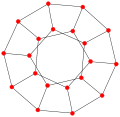
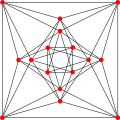
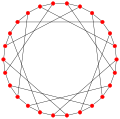
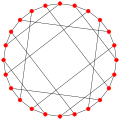
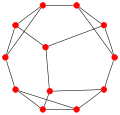
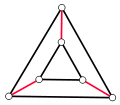
Inclusion relationships between these families are indicated by the following table:
 |
 |
 |
 |
|
| distance-transitive Distance-transitive graph In the mathematical field of graph theory, a distance-transitive graph is a graph such that, given any two vertices v and w at any distance i, and any other two vertices x and y at the same distance, there is an automorphism of the graph that carries v to x and w to y.A distance transitive... |
distance-regular Distance-regular graph In mathematics, a distance-regular graph is a regular graph such that for any two vertices v and w at distance i the number of vertices adjacent to w and at distance j from v is the same. Every distance-transitive graph is distance-regular... |
strongly regular Strongly regular graph In graph theory, a discipline within mathematics, a strongly regular graph is defined as follows. Let G = be a regular graph with v vertices and degree k... |
||
 |
||||
 |
|
 |
||
| symmetric (arc-transitive) Symmetric graph In the mathematical field of graph theory, a graph G is symmetric if, given any two pairs of adjacent vertices u1—v1 and u2—v2 of G, there is an automorphismsuch that... |
t-transitive, t ≥ 2 Symmetric graph In the mathematical field of graph theory, a graph G is symmetric if, given any two pairs of adjacent vertices u1—v1 and u2—v2 of G, there is an automorphismsuch that... |
|||
| |
||||
 |
|
|
||
| vertex- and edge-transitive Half-transitive graph In the mathematical field of graph theory, a half-transitive graph is a graph that is both vertex-transitive and edge-transitive, but not symmetric... |
edge-transitive and regular Semi-symmetric graph In the mathematical field of graph theory, a semi-symmetric graph is an undirected graph that is edge-transitive and regular, but not vertex-transitive.... |
edge-transitive Edge-transitive graph In the mathematical field of graph theory, an edge-transitive graph is a graph G such that, given any two edges e1 and e2 of G, there is anautomorphism of G that maps e1 to e2.... |
||
| |
|
|||
 |
|
 |
||
| vertex-transitive Vertex-transitive graph In the mathematical field of graph theory, a vertex-transitive graph is a graph G such that, given any two vertices v1 and v2 of G, there is some automorphismf:V \rightarrow V\ such thatf = v_2.\... |
regular Regular graph In graph theory, a regular graph is a graph where each vertex has the same number of neighbors; i.e. every vertex has the same degree or valency. A regular directed graph must also satisfy the stronger condition that the indegree and outdegree of each vertex are equal to each other... |
|||
 |
||||
 |
||||
| Cayley graph Cayley graph In mathematics, a Cayley graph, also known as a Cayley colour graph, Cayley diagram, group diagram, or colour group is a graph that encodes the abstract structure of a group. Its definition is suggested by Cayley's theorem and uses a specified, usually finite, set of generators for the group... |
||||