
|
|
|
|
Graph isomorphism
|
| |
|
| |
In graph theory, an isomorphism of graphs G and H is a bijection between the vertex sets of G and H
such that any two vertices u and v of G are adjacent in G if and only if ƒ(u) and ƒ(v) are adjacent in H. This kind of bijection is commonly called "edge-preserving bijection", in accordance with the general notion of isomorphism being a structure-preserving bijection.
In the above definition graphs are understood to be undirected non-labeled non-weighted graphs, however the notion of isomorphism may be applied to all of these, by adding the requirements to preserve the corresponding additional elements of structure: arc directions, edge weights, etc., with the following exception.

Discussion
Ask a question about 'Graph isomorphism'
Start a new discussion about 'Graph isomorphism'
Answer questions from other users
|
Encyclopedia
In graph theory, an isomorphism of graphs G and H is a bijection between the vertex sets of G and H
such that any two vertices u and v of G are adjacent in G if and only if ƒ(u) and ƒ(v) are adjacent in H. This kind of bijection is commonly called "edge-preserving bijection", in accordance with the general notion of isomorphism being a structure-preserving bijection.
In the above definition graphs are understood to be undirected non-labeled non-weighted graphs, however the notion of isomorphism may be applied to all of these, by adding the requirements to preserve the corresponding additional elements of structure: arc directions, edge weights, etc., with the following exception. When spoken about graph labeling with unique labels, commonly taken from the integer range 1,...,n, where n is the number of the vertices of the graph, two labeled graphs are said to be isomorphic if the corresponding underlying unlabeled graphs are isomorphic.
If an isomorphism exists between two graphs, then the graphs are called isomorphic and we write . In the case when the bijection is a mapping of a graph onto itself, i.e., when G and H are one and the same graph, the bijection is called an automorphism of G.
The graph isomorphism is an equivalence relation on graphs and as such it partitions the class of all graphs into equivalence classes. A set of graphs isomorphic to each other is called an isomorphism class of graphs.
Example
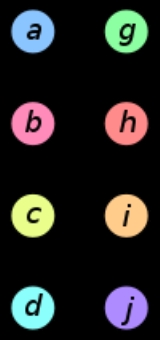
The two graphs shown below are isomorphic, despite their different looking drawings.
| Graph G | Graph H | An isomorphism between G and H |
|---|
| | ƒ(a) = 1
ƒ(b) = 6
ƒ(c) = 8
ƒ(d) = 3
ƒ(g) = 5
ƒ(h) = 2
ƒ(i) = 4
ƒ(j) = 7 |
Motivation
The formal notion of "isomorphism", e.g., of "graph isomorphism", captures the informal notion that some objects have "the same structure" if one ignores individual distinctions of "atomic" components of objects in question, see the example above. Whenever individuality of "atomic" components (vertices and edges, for graphs) is important for correct representation of whatever is modeled by graphs, the model is refined by imposing additional restrictions on the structure, and other mathematical objects are used: digraphs, labeled graphs, colored graphs, rooted trees and so on. The isomorphism relation may also be defined for all these generalizations of graphs: the isomorphism bijection must preserve the elements of structure which define the object type in question: arcs, labels, vertex/edge colors, the root of the rooted tree, etc.
The notion of "graph isomorphism" allows us to distinguish graph properties inherent to the structures of graphs themselves from properties associated with graph representations: graph drawings, data structures for graphs, graph labelings, etc. For example, if a graph has exactly one cycle, then all graphs in its isomorphism class also have exactly one cycle. On the other hand, in the common case when the vertices of a graph are (represented by) the integers 1, 2,... N, then the expression
may be different for two isomorphic graphs.
Whitney theorem The Whitney graph isomorphism theorem, shown by H. Whitney, states that two connected graphs are isomorphic if and only if their line graphs are isomorphic, with a single exception: K3, the complete graph on three vertices, and the complete bipartite graph K1,3, which are not isomorphic but both have K3 as their line graph. The Whitney graph theorem can be extended to hypergraphs.
The graph isomorphism problem
The computational problem of determining whether two finite graphs are isomorphic is referred to as the graph isomorphism problem.
Besides its practical importance, the graph isomorphism problem is a curiosity in computational complexity theory as it is one of a very small number of problems belonging to NP neither known to be solvable in polynomial time nor NP-complete. the best algorithm (Babai & Luks, 1983) has run time for graphs with n vertices.
It is known that the graph isomorphism problem is in the low hierarchy of class NP, which implies that it is not NP-complete unless the polynomial time hierarchy collapses to its second level.
At the same time, isomorphism for many special classes of graphs can be solved in polynomial time, and in practice graph isomorphism can often be solved efficiently.
A generalization of the problem, the subgraph isomorphism problem, is known to be NP-complete.
Solved special cases
A number of important special cases of the graph isomorphism problem have efficient, polynomial-time solutions:
Example: Rooted trees
There is a particularly simple algorithm for determining if two rooted trees T and T' are isomorphic. First, assume that T and T' have the same number of vertices and the same height (otherwise they are not isomorphic). The vertices can be grouped into levels, sets of vertices that are the same distance from the root; since distance from the root is preserved by isomorphism, vertices in T must correspond to vertices in T' at the same level. We process the tree beginning with the bottom level and moving upwards, systematically assigning a label to each vertex such that two vertices have the same label if and only if the subtrees rooted at those two vertices are isomorphic.
Suppose v is an unlabelled vertex. Since the algorithm processes the tree bottom-up, all its children already have labels; assign v a temporary long label by sorting and concatenating the labels of its children. Next, sort all vertices at the current level by their long labels; then, assign fresh short labels to each vertex by numbering them from zero and giving identically-labelled vertices the same number. If at any level the final sorted set of short labels is different in T and T', then they are not isomorphic; otherwise the two roots will be assigned the same label and they are isomorphic.
Sorting the labels with a simple comparison sort, this algorithm requires T(n log n) time, where n is the number of vertices; it can be made to operate in O(n) time by careful use of bucket sort and radix sort.
This algorithm can be used to find isomorphism of general trees by noting that an isomorphism must map the center of T to the center of T'; the center of a tree has at most two vertices, so there are at most two ways of selecting the root nodes.
Complexity class GI
Since the graph isomorphism problem is neither known to be NP-complete nor to be tractable, researchers have sought to gain insight into the problem by defining a new class GI, the set of problems with a polynomial-time Turing reduction to the graph isomorphism problem. If in fact the graph isomorphism problem is solvable in polynomial time, GI would equal P.
As it is common for complexity classes within the polynomial time hierarchy, a problem is called GI-hard if there is a polynomial-time Turing reduction from any problem in GI to that problem, i.e., a polynomial-time solution to a GI-hard problem would yield a polynomial-time solution to the graph isomorphism problem (and so all problems in GI). A problem P is called complete for GI, or GI-complete, if it is both GI-hard and a polynomial-time solution to the GI problem would yield a polynomial-time solution to P.
The graph isomorphism problem is contained in both NP and co-AM. GI is contained in and low for Parity P, as well as contained in the potentially much smaller class . That it lies in Parity P means that the graph isomorphism problem is no harder than determining whether a polynomial-time nondeterministic Turing machine has an even or odd number of accepting paths. GI is also contained in and low for ZPPNP. This essentially means that an efficient Las Vegas algorithm with access to an NP oracle can solve graph isomorphism so easily that it gains no power from being given the ability to do so in constant time.
GI-complete and GI-hard problems
Isomorphism of other objects
There are a number of classes of mathematical objects for which the problem of isomorphism is a GI-complete problem. A number of them are graphs endowed with additional properties or restrictions:
- digraphs
- labelled graphs, with the proviso that an isomorphism is not required to preserve the labels, but only the equivalence relation consisting of pairs of vertices with the same label
- "polarized graphs" (made of a complete graph Km and an empty graph Kn plus some edges connecting the two; their isomorphism must preserve the partition)
- 2-colored graphs
- explicitly given finite structures
- multigraphs
- hypergraphs
- finite automata
- commutative class 3 nilpotent (i.e., xyz = 0 for every elements x, y, z) semigroups
- finite rank associative algebras over a fixed algebraically closed field with zero squared radical and commutative factor over the radical
- context-free grammars
- balanced incomplete block designs
- Recognizing combinatorial isomorphism of convex polytopes represented by vertex-facet incidences.
GI-complete classes of graphs
A class of graphs is called GI-complete if recognition of isomorphism for graphs from this subclass is a GI-complete problem. The following classes are GI-complete:
Many classes of digraphs are also GI-complete.
Other GI-complete problems
There are other nontrivial GI-complete problems in addition to isomorphism problems.
- The recognition of self-complementarity of a graph or digraph
- A clique problem for a class of so-called M-graphs. It is shown that finding of an isomorphism for n-vertex graphs is equivalent to finding an n-clique in an M-graph of size n2. This fact is interesting because the problem of finding an n-e-clique in a M-graph of size n2 is NP-complete for arbitrarily small positive e.
- The problem of counting the number of isomorphisms between two graphs is polynomial-time equivalent to the problem of telling whether even one exists
GI-hard problems
- The problem of deciding whether two convex polytopes given by either the V-description or H-description are projectively or affinely isomorphic. The latter means existence of a projective or affine map between the spaces that contain the two polytopes (not necessarily of the same dimension) which induces a bijection between the polytopes.
Applications
In cheminformatics and in mathematical chemistry, graph isomorphism testing is used to identify a chemical compound within a chemical database. Also, in organic mathematical chemistry graph isomorphism testing is useful for generation of molecular graphs and for computer synthesis.
Chemical database search is an example of graphical data mining, where the graph canonization approach is often used. In particular, a number of identifiers for chemical substances, such as SMILES and InChI, designed to provide a standard and human-readable way to encode molecular information and to facilitate the search for such information in databases and on the web, use canonization step in their computation, which is essentially the canonization of the graph which represents the molecule. Also, the strong proved algorithm for organic chemistry was sudgested .
In electronic design automation graph isomorphism is the basis of the Layout Versus Schematic (LVS) circuit design step, which is a verification whether the electric circuits represented by a circuit schematic and an integrated circuit layout are the same.
See also
Surveys and monographs
- Ronald Read and Derek Corneil. "The graph isomorphism disease". Journal of Graph Theory 1977, 1, 339-363
- Gati, G. "Further annotated bibliography on the isomorphism disease." – Journal of Graph Theory 1979, 3, 95-109
- (Translated from Zapiski Nauchnykh Seminarov Leningradskogo Otdeleniya Matematicheskogo Instituta im. V. A. Steklova AN SSSR (Records of Seminars of the Leningrad Department of Steklov Institute of Mathematics of the USSR Academy of Sciences), Vol. 118, pp. 83–158, 1982.)
- (A brief survey of open questions related to the isomorphism problem for graphs, rings and groups)
- (From the book cover: The books focuses on the issue of the computational complexity of the problem and presents several recent results that provide a better understanding of the relative position of the problem in the class NP as well as in other complexity classes.)
- (This 24th edition of the Column discusses the state of the art for the open problems from the book Computers and Intractability and previous columns, in particular, for Graph Isomorphism)
Software
- , review of implementations, .
|
| |
|
|
