

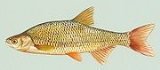
Golden shiner

Encyclopedia
The golden shiner is a cyprinid
fish
native to eastern North America
. It is the sole member of its genus. Much used as a bait fish
, it is probably the most widely pond-cultured fish in the United States.
has a pronounced downward curve, with its lowest point just above the pelvic fins; and (2) there is a fleshy keel lacking scales on the belly between the pelvic fins and the base of the anal fin.
, insects, plants, and algae. They can feed at the surface, in mid-water, or at the bottom. They can locate prey visually, or filter-feed on high-density zooplankton without resorting to visual cues. They are themselves food for all manner of game fish such as trout
and bass
, hence their popularity as bait fish.
, largemouth bass
or bowfin
(the latter two, ironically, can be predators of shiners). This behaviour is called egg dumping and resembles the brood parasitism of birds such as cuckoos, inasmuch as the shiner eggs will benefit from the parental care that pumpkinseed, largemouth bass, and bowfin provide to the content of their nests. As opposed to parasitism by cuckoos, however, the parent's eggs do not suffer from the presence of parasitic eggs, and may actually benefit from a dilution effect when predators attack the brood.
s) that roam widely. Several laboratory studies have shown that the movements of a shoal can be determined by a minority of individuals at the front of it. For example, an individual that know when and where food is available within a large tank can lead many other fish to the right place at the right time of day. If all fish have similar knowledge, there is still a tendency for some individuals to be found always at the front of a moving shoal, possibly because they are intrinsically hungrier and more motivated to find food. Small fish are also found more often at the front of a shoal than larger fish, again possibly because they are more motivated to find food.
Like other minnows, golden shiners are sensitive to the release of an alarm substance, or Schreckstoff
, contained within special skin cells. If a predator catches and bites into a minnow, the skin is broken, the substance is released, and other minnows in the vicinity can detect the substance and react to it by leaving the area. The substance can also survive intact in the feces of a predator, and minnows can thus detect the presence of a minnow-eating predator through the presence of its feces. In the laboratory, golden shiners were found to react strongly to water that contained feces from snakes that had eaten other golden shiners, but not nearly as much to water laden with feces from snakes that had eaten green swordtails, a fish that does not possess an alarm substance.
Like other fishes, golden shiners have a good daily time sense and can anticipate the arrival of food when this food is made available at the same time of the day or night. They can also do this when there is more than one mealtime a day. This anticipation is expressed as swimming and positioning towards the food source, and other naive individuals can perceive this and join the anticipating fish in the hope of sharing its food.
Golden shiners are also capable of time-place learning (associating different places with different times of day). They can be taught to feed in one part of an aquarium in the morning and a different part in the afternoon; or to feed in one part in the morning, a different part at mid-day, and back to the first part in the afternoon.
Cyprinid
The family Cyprinidae, from the Ancient Greek kyprînos , consists of the carps, the true minnows, and their relatives . Commonly called the carp family or the minnow family, its members are also known as cyprinids...
fish
Fish
Fish are a paraphyletic group of organisms that consist of all gill-bearing aquatic vertebrate animals that lack limbs with digits. Included in this definition are the living hagfish, lampreys, and cartilaginous and bony fish, as well as various extinct related groups...
native to eastern North America
North America
North America is a continent wholly within the Northern Hemisphere and almost wholly within the Western Hemisphere. It is also considered a northern subcontinent of the Americas...
. It is the sole member of its genus. Much used as a bait fish
Bait fish
Bait fish are small fish caught for use as bait to attract large predatory fish, particularly game fish. Species used are typically those that are common and breed rapidly, making them easy to catch and in regular supply. Examples of marine bait fish are anchovies, halfbeaks such as ballyhoo, and...
, it is probably the most widely pond-cultured fish in the United States.
Description
Though it has been known to reach lengths of 30 cm (12 in), in the wild the golden shiner is usually between 7.5 and 12.5 cm (3 to 5 inches) long. The body is laterally compressed (deep-bodied). The back is dark green or olive, and the belly is a silvery white. The sides are silver in smaller individuals, but golden in larger ones. There can be a faint dusky stripe along the sides. The anal fin is large and has 8-19 rays, while the dorsal fin comprises almost always 8 rays. Scales are relatively large and easily lost when the fish is handled. The mouth is small and upturned. Two characteristics can distinguish the golden shiner from all other minnows: (1) the lateral lineLateral line
The lateral line is a sense organ in aquatic organisms , used to detect movement and vibration in the surrounding water. Lateral lines are usually visible as faint lines running lengthwise down each side, from the vicinity of the gill covers to the base of the tail...
has a pronounced downward curve, with its lowest point just above the pelvic fins; and (2) there is a fleshy keel lacking scales on the belly between the pelvic fins and the base of the anal fin.
Distribution
The golden shiner is found throughout the eastern half of North America, north to the St Lawrence River, Great Lakes, and Lake Winnipeg, and west to the Dakotas and Texas. Because of its use as bait, it has also been introduced in many places outside this native range.Habitat
Golden shiners prefer quiet waters and are therefore found in lakes, ponds, sloughs, and ditches. They are sometimes found in the quietest parts of rivers. They do better in clear water with dense mats of vegetation, but can deal with pollution, turbidity, and low oxygen content. They can tolerate temperatures as high as 40 °C (104 °F) which is unusually high for a North American minnow.Diet
Golden shiners are omnivorous. They eat zooplanktonZooplankton
Zooplankton are heterotrophic plankton. Plankton are organisms drifting in oceans, seas, and bodies of fresh water. The word "zooplankton" is derived from the Greek zoon , meaning "animal", and , meaning "wanderer" or "drifter"...
, insects, plants, and algae. They can feed at the surface, in mid-water, or at the bottom. They can locate prey visually, or filter-feed on high-density zooplankton without resorting to visual cues. They are themselves food for all manner of game fish such as trout
Trout
Trout is the name for a number of species of freshwater and saltwater fish belonging to the Salmoninae subfamily of the family Salmonidae. Salmon belong to the same family as trout. Most salmon species spend almost all their lives in salt water...
and bass
Bass (fish)
Bass is a name shared by many different species of popular gamefish. The term encompasses both freshwater and marine species. All belong to the large order Perciformes, or perch-like fishes, and in fact the word bass comes from Middle English bars, meaning "perch."-Types of basses:*The temperate...
, hence their popularity as bait fish.
Reproduction
Golden shiners lay sticky eggs amid vegetation. There is no parental care. Occasionally, like a few other minnows, golden shiners can deposit their eggs in the occupied nests of pumpkinseedPumpkinseed
The pumpkinseed sunfish is a freshwater fish of the sunfish family of order Perciformes. It is also referred to as "pond perch", "common sunfish", "punkys", and "sunny".-Range and distribution:...
, largemouth bass
Largemouth bass
The largemouth bass is a species of black bass in the sunfish family native to North America . It is also known as widemouth bass, bigmouth, black bass, bucketmouth, Potter's fish, Florida bass, Florida largemouth, green bass, green trout, linesides, Oswego bass, southern largemouth...
or bowfin
Bowfin
The Bowfin, Amia calva, is the last surviving member of the order Amiiformes , and of the family Amiidae...
(the latter two, ironically, can be predators of shiners). This behaviour is called egg dumping and resembles the brood parasitism of birds such as cuckoos, inasmuch as the shiner eggs will benefit from the parental care that pumpkinseed, largemouth bass, and bowfin provide to the content of their nests. As opposed to parasitism by cuckoos, however, the parent's eggs do not suffer from the presence of parasitic eggs, and may actually benefit from a dilution effect when predators attack the brood.
Behaviour
Golden shiners live in large groups (shoalSwarm
Swarm behaviour, or swarming, is a collective behaviour exhibited by animals of similar size which aggregate together, perhaps milling about the same spot or perhaps moving en masse or migrating in some direction. As a term, swarming is applied particularly to insects, but can also be applied to...
s) that roam widely. Several laboratory studies have shown that the movements of a shoal can be determined by a minority of individuals at the front of it. For example, an individual that know when and where food is available within a large tank can lead many other fish to the right place at the right time of day. If all fish have similar knowledge, there is still a tendency for some individuals to be found always at the front of a moving shoal, possibly because they are intrinsically hungrier and more motivated to find food. Small fish are also found more often at the front of a shoal than larger fish, again possibly because they are more motivated to find food.
Like other minnows, golden shiners are sensitive to the release of an alarm substance, or Schreckstoff
Schreckstoff
In 1938, the Austrian ethologist Karl von Frisch made his first report on the existence of the chemical alarm signal known as Schreckstoff in minnows. An alarm signal is a response produced by an individual, the “sender,” reacting to a hazard that warns other animals, the receivers, that there is...
, contained within special skin cells. If a predator catches and bites into a minnow, the skin is broken, the substance is released, and other minnows in the vicinity can detect the substance and react to it by leaving the area. The substance can also survive intact in the feces of a predator, and minnows can thus detect the presence of a minnow-eating predator through the presence of its feces. In the laboratory, golden shiners were found to react strongly to water that contained feces from snakes that had eaten other golden shiners, but not nearly as much to water laden with feces from snakes that had eaten green swordtails, a fish that does not possess an alarm substance.
Like other fishes, golden shiners have a good daily time sense and can anticipate the arrival of food when this food is made available at the same time of the day or night. They can also do this when there is more than one mealtime a day. This anticipation is expressed as swimming and positioning towards the food source, and other naive individuals can perceive this and join the anticipating fish in the hope of sharing its food.
Golden shiners are also capable of time-place learning (associating different places with different times of day). They can be taught to feed in one part of an aquarium in the morning and a different part in the afternoon; or to feed in one part in the morning, a different part at mid-day, and back to the first part in the afternoon.