


Globus pallidus

Encyclopedia
The globus pallidus also known as paleostriatum, is a sub-cortical
structure of the brain
. Topographically, it is part of the telencephalon
, but retains close functional ties with the subthalamus
- both of which are part of the extrapyramidal motor system. The globus pallidus is a major component of the basal ganglia
core along with the striatum
and its direct target, the substantia nigra
. The latter are made up of similar neuronal elements, have similar afferents from the dorsal striatum
and have a similar synaptology
; neither receive cortical afferents.
(1909–1911). As the elements in no way have the shape of a globe, Foix and Nicolesco (1925), the Vogts (1941), Crosby et al. (1962) followed by the Terminologia anatomica proposed the simpler term (neuter adjective) of pallidum ("pale"). For a long time the globus pallidus was linked to the putamen and termed the lentiform nucleus
(nucleus lenticularis or lentiformis), a heterogeneous anatomical entity that is part of the striatum
rather than the pallidum. The link with the substantia nigra
pars reticulata was stressed very early on due to the similarities in dendritic arborisation (and they are sometimes known as the pallidonigral set) but, in spite of strong evidence, this association remains controversial.
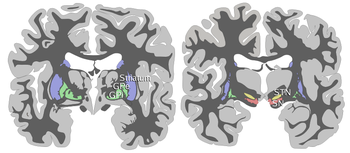
s, the dorsal pallidum, or globus pallidus, is divided into two parts by the medial medullary lamina. These are often termed "internal" and "external" (the internal globus pallidus [GPi] and the external globus pallidus [GPe]); both are composed of closed nuclei surrounded by myelinic walls.
The ventral pallidum
lies within the substantia innominata
(Latin for un-named substance) and receives efferent connections from the ventral striatum
(the nucleus accumbens
and the olfactory tubercle
). It projects to the dorsomedial nucleus of the dorsal thalamus
which, in turn, projects to the prefrontal cortex
; it also projects to the pedunculopontine nucleus
and tegmental
motor areas. Its function is to serve as a limbic-somatic motor interface and it is involved in the planning and inhibition of movements from the dorsal striatopallidal complex.
positive, with very large dendritic arborizations. These have the peculiarity of having the three-dimensional shape of flat discs, parallel to one another, parallel to the border of the pallidum and perpendicular to the afferent striatopallidal axons. There are only a few small local circuitry neurons.
The globus pallidus is traversed by the numerous myelin
ated axons of the striato-pallidonigral bundle that give it the pale appearance from which it is named.
The ultrastructure is very peculiar, as the long dendrites are everywhere, without discontinuity, covered by synapses.
through the dense striato-pallidonigral bundle. The synaptology is very peculiar (see primate basal ganglia system
). The striatal afference contribute for more than 90% of synapses.
The two pallidal nuclei receives dopaminergic axons from the pars compacta of the substantia nigra.
Cerebral cortex
The cerebral cortex is a sheet of neural tissue that is outermost to the cerebrum of the mammalian brain. It plays a key role in memory, attention, perceptual awareness, thought, language, and consciousness. It is constituted of up to six horizontal layers, each of which has a different...
structure of the brain
Brain
The brain is the center of the nervous system in all vertebrate and most invertebrate animals—only a few primitive invertebrates such as sponges, jellyfish, sea squirts and starfishes do not have one. It is located in the head, usually close to primary sensory apparatus such as vision, hearing,...
. Topographically, it is part of the telencephalon
Telencephalon
The cerebrum or telencephalon, together with the diencephalon, constitutes the forebrain. The cerebrum is the most anterior region of the vertebrate central nervous system. Telencephalon refers to the embryonic structure, from which the mature cerebrum develops...
, but retains close functional ties with the subthalamus
Subthalamus
The subthalamus is a part of the diencephalon. Its major part is the subthalamic nucleus. Functionally, it also encompasses the globus pallidus, which is topographically part of the telencephalon.-Anatomy:...
- both of which are part of the extrapyramidal motor system. The globus pallidus is a major component of the basal ganglia
Basal ganglia
The basal ganglia are a group of nuclei of varied origin in the brains of vertebrates that act as a cohesive functional unit. They are situated at the base of the forebrain and are strongly connected with the cerebral cortex, thalamus and other brain areas...
core along with the striatum
Striatum
The striatum, also known as the neostriatum or striate nucleus, is a subcortical part of the forebrain. It is the major input station of the basal ganglia system. The striatum, in turn, gets input from the cerebral cortex...
and its direct target, the substantia nigra
Substantia nigra
The substantia nigra is a brain structure located in the mesencephalon that plays an important role in reward, addiction, and movement. Substantia nigra is Latin for "black substance", as parts of the substantia nigra appear darker than neighboring areas due to high levels of melanin in...
. The latter are made up of similar neuronal elements, have similar afferents from the dorsal striatum
Dorsal striatum
The dorsal striatum, corpus striatum or striated body is a compound structure consisting of the caudate nucleus, and the lentiform nucleus...
and have a similar synaptology
Synapse
In the nervous system, a synapse is a structure that permits a neuron to pass an electrical or chemical signal to another cell...
; neither receive cortical afferents.
History of name
The origin of the name is not established. It was known by Dejerine (1906) but not by Santiago Ramón y CajalSantiago Ramón y Cajal
Santiago Ramón y Cajal ForMemRS was a Spanish pathologist, histologist, neuroscientist, and Nobel laureate. His pioneering investigations of the microscopic structure of the brain were original: he is considered by many to be the father of modern neuroscience...
(1909–1911). As the elements in no way have the shape of a globe, Foix and Nicolesco (1925), the Vogts (1941), Crosby et al. (1962) followed by the Terminologia anatomica proposed the simpler term (neuter adjective) of pallidum ("pale"). For a long time the globus pallidus was linked to the putamen and termed the lentiform nucleus
Lentiform nucleus
The lentiform nucleus or lenticular nucleus comprises the putamen and the globus pallidus within the basal ganglia. It is a large, cone-shaped mass of gray matter just lateral to the internal capsule.-Etymology:...
(nucleus lenticularis or lentiformis), a heterogeneous anatomical entity that is part of the striatum
Striatum
The striatum, also known as the neostriatum or striate nucleus, is a subcortical part of the forebrain. It is the major input station of the basal ganglia system. The striatum, in turn, gets input from the cerebral cortex...
rather than the pallidum. The link with the substantia nigra
Substantia nigra
The substantia nigra is a brain structure located in the mesencephalon that plays an important role in reward, addiction, and movement. Substantia nigra is Latin for "black substance", as parts of the substantia nigra appear darker than neighboring areas due to high levels of melanin in...
pars reticulata was stressed very early on due to the similarities in dendritic arborisation (and they are sometimes known as the pallidonigral set) but, in spite of strong evidence, this association remains controversial.
Parts
In primatePrimate
A primate is a mammal of the order Primates , which contains prosimians and simians. Primates arose from ancestors that lived in the trees of tropical forests; many primate characteristics represent adaptations to life in this challenging three-dimensional environment...
s, the dorsal pallidum, or globus pallidus, is divided into two parts by the medial medullary lamina. These are often termed "internal" and "external" (the internal globus pallidus [GPi] and the external globus pallidus [GPe]); both are composed of closed nuclei surrounded by myelinic walls.
The ventral pallidum
Ventral pallidum
The Ventral Pallidum is a structure within the basal ganglia of the brain. It is an output nucleus whose fibres project to thalamic nuclei, such as the ventral anterior nucleus, the ventrolateral nucleus, and the medial dorsal nucleus....
lies within the substantia innominata
Substantia innominata
The substantia innominata of Meynert is a stratum in the human brain consisting partly of gray and partly of white substance, which lies below the anterior part of the thalamus and lentiform nucleus...
(Latin for un-named substance) and receives efferent connections from the ventral striatum
Striatum
The striatum, also known as the neostriatum or striate nucleus, is a subcortical part of the forebrain. It is the major input station of the basal ganglia system. The striatum, in turn, gets input from the cerebral cortex...
(the nucleus accumbens
Nucleus accumbens
The nucleus accumbens , also known as the accumbens nucleus or as the nucleus accumbens septi , is a collection of neurons and forms the main part of the ventral striatum...
and the olfactory tubercle
Olfactory tubercle
The olfactory tubercle is a structure involved in Olfaction.It is present in humans, but much smaller than it is in some other animals.It is a frequent subject of research.-External links:...
). It projects to the dorsomedial nucleus of the dorsal thalamus
Thalamus
The thalamus is a midline paired symmetrical structure within the brains of vertebrates, including humans. It is situated between the cerebral cortex and midbrain, both in terms of location and neurological connections...
which, in turn, projects to the prefrontal cortex
Prefrontal cortex
The prefrontal cortex is the anterior part of the frontal lobes of the brain, lying in front of the motor and premotor areas.This brain region has been implicated in planning complex cognitive behaviors, personality expression, decision making and moderating correct social behavior...
; it also projects to the pedunculopontine nucleus
Pedunculopontine nucleus
The pedunculopontine nucleus is located in the brainstem, caudal to the substantia nigra and adjacent to the superior cerebellar peduncle. It has two divisions, one containing cholinergic neurons, the pars compacta, and one containing mostly glutamatergic neurons, the pars dissipata...
and tegmental
Tegmentum
The tegmentum is a general area within the brainstem. It is located between the ventricular system and distinctive basal or ventral structures at each level...
motor areas. Its function is to serve as a limbic-somatic motor interface and it is involved in the planning and inhibition of movements from the dorsal striatopallidal complex.
Structure
Pallidal nuclei are made up of the same neuronal components. In primates, almost all pallidal neurons are very large, parvalbuminParvalbumin
Parvalbumin is a calcium-binding albumin protein with low molecular weight .It has three EF hand motifs and is structurally related to calmodulin and troponin C...
positive, with very large dendritic arborizations. These have the peculiarity of having the three-dimensional shape of flat discs, parallel to one another, parallel to the border of the pallidum and perpendicular to the afferent striatopallidal axons. There are only a few small local circuitry neurons.
The globus pallidus is traversed by the numerous myelin
Myelin
Myelin is a dielectric material that forms a layer, the myelin sheath, usually around only the axon of a neuron. It is essential for the proper functioning of the nervous system. Myelin is an outgrowth of a type of glial cell. The production of the myelin sheath is called myelination...
ated axons of the striato-pallidonigral bundle that give it the pale appearance from which it is named.
The ultrastructure is very peculiar, as the long dendrites are everywhere, without discontinuity, covered by synapses.
Pallidonigral pacemaker
The two pallidal nuclei and the two nigral (pars compacta and pars reticulata) parts constitute a high-frequency autonomous pacemaker (see primate basal ganglia system#Pallido-nigral set and pacemaker)Common afferents
The two parts receive successively a large quantity of GABAergic axonal terminal arborisations from the striatumStriatum
The striatum, also known as the neostriatum or striate nucleus, is a subcortical part of the forebrain. It is the major input station of the basal ganglia system. The striatum, in turn, gets input from the cerebral cortex...
through the dense striato-pallidonigral bundle. The synaptology is very peculiar (see primate basal ganglia system
Primate basal ganglia system
The basal ganglia form a major brain system in all species of vertebrates, but the basal ganglia of primates have special features that justify a separate consideration. As in other vertebrates, the primate basal ganglia can be divided into striatal, pallidal, nigral, and subthalamic components...
). The striatal afference contribute for more than 90% of synapses.
The two pallidal nuclei receives dopaminergic axons from the pars compacta of the substantia nigra.
External links
- Diagram at uni-tuebingen.de
- NIF Search - Globus Pallidus via the Neuroscience Information FrameworkNeuroscience Information FrameworkThe Neuroscience Information Framework is a repository of global neuroscience web resources, including experimental, clinical, and translational neuroscience databases, knowledge bases, atlases, and genetic/genomic resources.-Description:...
