
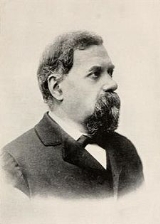
Giovanni Virginio Schiaparelli (March 14, 1835,
SaviglianoSavigliano is a comune of Piedmont, northern Italy, in the Province of Cuneo, c. 50 kilometers south of Turin by rail....
– July 4, 1910) was an
ItalianItaly , officially the Italian Republic languages]] under the European Charter for Regional or Minority Languages. In each of these, Italy's official name is as follows:;;;;;;;;), is a unitary parliamentary republic in South-Central Europe. To the north it borders France, Switzerland, Austria and...
astronomerAn astronomer is a scientist who studies celestial bodies such as planets, stars and galaxies.Historically, astronomy was more concerned with the classification and description of phenomena in the sky, while astrophysics attempted to explain these phenomena and the differences between them using...
and
science historianThe history of science is the study of the historical development of human understandings of the natural world and the domains of the social sciences....
. He studied at the
University of TurinThe University of Turin is a university in the city of Turin in the Piedmont region of north-western Italy...
and
Berlin ObservatoryThe Berlin Observatory is a series of observatories and related organizations in and around the city of Berlin in Germany, starting from the 18th century...
. In 1859-1860 he worked in
Pulkovo ObservatoryThe Pulkovo Astronomical Observatory астрономи́ческая обсервато́рия Росси́йской акаде́мии нау́к), the principal astronomical observatory of the Russian Academy of Sciences, located 19 km south of Saint Petersburg on Pulkovo Heights...
and then worked for over forty years at
BreraBrera is a district of Milan, ItalyBrera may also refer to:* the Palazzo Brera, a historical building in Brera; the palace also houses:** the Brera Art Academy** the Brera Art Gallery** the Brera Astronomical Observatory...
Observatory. He was also a senator of the Kingdom of Italy, a member of the
Accademia dei LinceiThe Accademia dei Lincei, , is an Italian science academy, located at the Palazzo Corsini on the Via della Lungara in Rome, Italy....
, the Accademia delle Scienze di Torino and the Regio Istituto Lombardo, and is particularly known for his studies of Mars. His niece,
Elsa SchiaparelliElsa Schiaparelli was an Italian fashion designer. Along with Coco Chanel, her greatest rival, she is regarded as one of the most prominent figures in fashion between the two World Wars. Starting with knitwear, Schiaparelli's designs were heavily influenced by Surrealists like her collaborators...
, became a noted designer or maker of
haute coutureHaute couture refers to the creation of exclusive custom-fitted clothing. Haute couture is made to order for a specific customer, and it is usually made from high-quality, expensive fabric and sewn with extreme attention to detail and finished by the most experienced and capable seamstresses,...
.
Mars
Among Schiaparelli's contributions are his telescopic observations of
MarsMars is the fourth planet from the Sun in the Solar System. The planet is named after the Roman god of war, Mars. It is often described as the "Red Planet", as the iron oxide prevalent on its surface gives it a reddish appearance...
. In his initial observations, he named the "
seasThe lunar maria are large, dark, basaltic plains on Earth's Moon, formed by ancient volcanic eruptions. They were dubbed maria, Latin for "seas", by early astronomers who mistook them for actual seas. They are less reflective than the "highlands" as a result of their iron-rich compositions, and...
" and "continents" of Mars. During the planet's "Great Opposition" of 1877, he observed a dense network of linear structures on the surface of Mars which he called "canali" in Italian, meaning "channels" but the term was mistranslated into English as "canals".
While the term "canals" indicates an artificial construction, the term "channels"
connotesA connotation is a commonly understood subjective cultural or emotional association that some word or phrase carries, in addition to the word's or phrase's explicit or literal meaning, which is its denotation....
that the observed features were natural configurations of the planetary surface. From the incorrect translation into the term "canals", various assumptions were made about life on Mars; as these assumptions were popularized, the "canals" of Mars became famous, giving rise to waves of hypotheses, speculation, and
folkloreFolklore consists of legends, music, oral history, proverbs, jokes, popular beliefs, fairy tales and customs that are the traditions of a culture, subculture, or group. It is also the set of practices through which those expressive genres are shared. The study of folklore is sometimes called...
about the possibility of intelligent life on Mars, the
MartianAs an adjective, the term martian is used to describe anything pertaining to the planet Mars.However, a Martian is more usually a hypothetical or fictional native inhabitant of the planet Mars. Historically, life on Mars has often been hypothesized, although there is currently no solid evidence of...
s. Among the most fervent supporters of the artificial-canal hypothesis was the American astronomer
Percival LowellPercival Lawrence Lowell was a businessman, author, mathematician, and astronomer who fueled speculation that there were canals on Mars, founded the Lowell Observatory in Flagstaff, Arizona, and formed the beginning of the effort that led to the discovery of Pluto 14 years after his death...
, who spent much of his life trying to prove the existence of intelligent life on the red planet. After Lowell's death in 1916, astronomers developed a consensus against the canal hypothesis, but the popular concept of Martian canals excavated by intelligent Martians remained in the public mind for the first half of the 20th century, and inspired a corpus of works of classic
science fictionScience fiction is a genre of fiction dealing with imaginary but more or less plausible content such as future settings, futuristic science and technology, space travel, aliens, and paranormal abilities...
.
Later, with notable thanks to the observations of the Italian astronomer Vicenzo Cerulli, scientists came to the conclusion that the famous channels were actually mere optical illusions. The last popular speculations about canals were finally put to rest during the spaceflight era beginning in the 1960s, when visiting spacecraft such as
Mariner 4Mariner 4 was the fourth in a series of spacecraft, launched on November 28, 1964, intended for planetary exploration in a flyby mode and performed the first successful flyby of the planet Mars, returning the first pictures of the Martian surface...
photographed the surface with much higher resolution than Earth-based telescopes, confirming that there are no structures resembling "canals".
In his book "
Life on Mars", Schiaparelli wrote: "Rather than true channels in a form familiar to us, we must imagine depressions in the soil that are not very deep, extended in a straight direction for thousands of miles, over a width of 100, 200 kilometers and maybe more. I have already pointed out that, in the absence of rain on Mars, these channels are probably the main mechanism by which the water (and with it organic life) can spread on the dry surface of the planet."
Astronomy and history of science
An observer of objects in the
solar systemThe Solar System consists of the Sun and the astronomical objects gravitationally bound in orbit around it, all of which formed from the collapse of a giant molecular cloud approximately 4.6 billion years ago. The vast majority of the system's mass is in the Sun...
, Schiaparelli worked with binary stars, discovered the
asteroidAsteroids are a class of small Solar System bodies in orbit around the Sun. They have also been called planetoids, especially the larger ones...
69 Hesperia69 Hesperia is a large, M-type main-belt asteroid. It was discovered by the famous Italian astronomer Giovanni Schiaparelli on April 26, 1861 from Milan. It was his only asteroid discovery. Schiaparelli named it Hesperia in honour of Italy .- External links :*...
on April 26, 1861, and demonstrated that the
PerseidsThe Perseids are a prolific meteor shower associated with the comet Swift-Tuttle. The Perseids are so-called because the point from which they appear to come, called the radiant, lies in the constellation Perseus. The name derives in part from the word Perseides , a term found in Greek mythology...
and
LeonidsThe Leonids is a prolific meteor shower associated with the comet Tempel-Tuttle. The Leonids get their name from the location of their radiant in the constellation Leo: the meteors appear to radiate from that point in the sky. They tend to peak in November.Earth moves through the meteoroid...
meteor showers were associated with comets. He proved, for example, that the orbit of the Leonids meteor shower coincided with that of the Comet Tempel-Tuttle. These observations led the astronomer to formulate the hypothesis, subsequently proved to be very exact, that the meteor showers could be the trails of comets.
Schiaparelli was a scholar of the history of classical astronomy. He was the first to realize that the concentric spheres of
Eudoxus of CnidusEudoxus of Cnidus was a Greek astronomer, mathematician, scholar and student of Plato. Since all his own works are lost, our knowledge of him is obtained from secondary sources, such as Aratus's poem on astronomy...
and
CallippusCallippus or Calippus was a Greek astronomer and mathematician.Callippus was born at Cyzicus, and studied under Eudoxus of Cnidus at the Academy of Plato. He also worked with Aristotle at the Lyceum, which means that he was active in Athens prior to Aristotle's death in 322...
, unlike those used by many astronomers of later times, were not to be taken as material objects, but only as part of an algorithm similar to the modern
Fourier seriesIn mathematics, a Fourier series decomposes periodic functions or periodic signals into the sum of a set of simple oscillating functions, namely sines and cosines...
.
Honors and awards
Awards
- Gold Medal of the Royal Astronomical Society
-History:In the early years, more than one medal was often awarded in a year, but by 1833 only one medal was being awarded per year. This caused a problem when Neptune was discovered in 1846, because many felt an award should jointly be made to John Couch Adams and Urbain Le Verrier...
(1872)
- Bruce Medal
The Catherine Wolfe Bruce Gold Medal is awarded every year by the Astronomical Society of the Pacific for outstanding lifetime contributions to astronomy. It is named after Catherine Wolfe Bruce, an American patroness of astronomy, and was first awarded in 1898...
(1902)
Named after him
- Asteroid 4062 Schiaparelli
4062 Schiaparelli is a main-belt asteroid discovered on January 28, 1989 at the Osservatorio San Vittore at Bologna. It is named after Italian astronomer Giovanni Schiaparelli.- External links :*...
- The crater Schiaparelli
Schiaparelli is a small lunar crater located on the western part of the Oceanus Procellarum, to the west of the crater Herodotus. The rim is relatively sharp-edged and relatively free from impact wear. The inner walls have slumped to form a shelf around much of the sides...
on the MoonThe Moon is Earth's only known natural satellite,There are a number of near-Earth asteroids including 3753 Cruithne that are co-orbital with Earth: their orbits bring them close to Earth for periods of time but then alter in the long term . These are quasi-satellites and not true moons. For more...
- The crater Schiaparelli
Schiaparelli is an impact crater on Mars named after Giovanni Schiaparelli located near Mars' equator. It is in diameter and located at latitude 3° South and longitude 344°. A crater within Schiaparelli shows many layers that may have formed by the wind, volcanoes, or deposition under...
on Mars
Selected writings
- 1873 - Le stelle cadenti (The Falling Stars)
- 1893 - La vita sul pianeta Marte (Life on Mars)
- 1925 - Scritti sulla storia della astronomia antica (Writings on the History of Classical Astronomy) in three volumes. Bologna. Reprint: Milano, Mimesis, 1997.
Further reading
- "Schiaparelli, Giovanni Virginio (1835-1910)" - biography from http://www.daviddarling.info/
- Obituaries: G. V. Schiaparelli, J. G. Galle, J. B. N. Hennessey J. Coles, J. E. Gore in The Observatory, Vol. 33, p. 311-318, August 1910
External links
Obituaries
AN 185 (1910) 193/194