


Berlin Observatory

Encyclopedia
Berlin
Berlin is the capital city of Germany and is one of the 16 states of Germany. With a population of 3.45 million people, Berlin is Germany's largest city. It is the second most populous city proper and the seventh most populous urban area in the European Union...
in Germany
Germany
Germany , officially the Federal Republic of Germany , is a federal parliamentary republic in Europe. The country consists of 16 states while the capital and largest city is Berlin. Germany covers an area of 357,021 km2 and has a largely temperate seasonal climate...
, starting from the 18th century. It has its origins in 1700 when Gottfried Leibniz
Gottfried Leibniz
Gottfried Wilhelm Leibniz was a German philosopher and mathematician. He wrote in different languages, primarily in Latin , French and German ....
initiated the Societät der Wissenschaften (Brandenburgische Science Society) which would later (1744) become the Preußischen Akademie der Wissenschaften (Prussian Academy of Sciences
Prussian Academy of Sciences
The Prussian Academy of Sciences was an academy established in Berlin on 11 July 1700, four years after the Akademie der Künste or "Arts Academy", to which "Berlin Academy" may also refer.-Origins:...
). The Society had no observatory, but nevertheless had an astronomer, Gottfried Kirch
Gottfried Kirch
Gottfried Kirch was a German astronomer. The son of a shoemaker in Guben, Electorate of Saxony, Kirch first worked as a calendar-maker in Saxonia and Franconia. He began to learn astronomy in Jena, and studied under Hevelius in Danzig...
, who observed from a private observatory in Berlin. A first small observatory was furnished in 1711, financing itself through calendrical computations.
In 1825 Johann Franz Encke
Johann Franz Encke
Johann Franz Encke was a German astronomer. Among his activities, he worked on the calculation of the periods of comets and asteroids, measured the distance from the earth to the sun, and made observations on the planet Saturn.-Biography:Encke was born in Hamburg, where his father was a...
was appointed director by King Frederick William III of Prussia
Frederick William III of Prussia
Frederick William III was king of Prussia from 1797 to 1840. He was in personal union the sovereign prince of the Principality of Neuchâtel .-Early life:...
. With the support of Alexander von Humboldt
Alexander von Humboldt
Friedrich Wilhelm Heinrich Alexander Freiherr von Humboldt was a German naturalist and explorer, and the younger brother of the Prussian minister, philosopher and linguist Wilhelm von Humboldt...
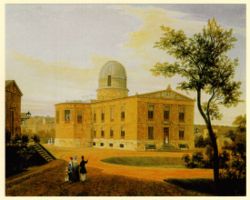
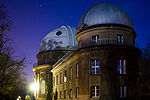
, Encke got the King to agree to the financing of a true observatory, but one condition was that the observatory be made accessible to the public two nights per week. The building was designed by the well-known architect Karl Friedrich Schinkel
Karl Friedrich Schinkel
Karl Friedrich Schinkel was a Prussian architect, city planner, and painter who also designed furniture and stage sets. Schinkel was one of the most prominent architects of Germany and designed both neoclassical and neogothic buildings.-Biography:Schinkel was born in Neuruppin, Margraviate of...
, and began operating in 1835. It now bears the IAU observatory code 548.
Although the original observatory was built in the outskirts of the city, over the course of time the city expanded such that after two centuries the observatory was in the middle of other settlements which made making observations very difficult and a proposal to move the observatory was made. The observatory was moved to Babelsberg
Potsdam-Babelsberg
Babelsberg is the largest district of the Brandenburg capital Potsdam in Germany. The affluent neighbourhood named after a small hill on the Havel river is famous for Babelsberg Palace and Park, part of the Palaces and Parks of Potsdam and Berlin UNESCO World Heritage Site, as well as for Studio...
in 1913 (IAU observatory code 536).
In Berlin remain the Wilhelm Foerster Sternwarte (William Foerster Observatory; IAU code 544), the Archenhold Sternwarte, Berlin-Treptow (Archenhold Observatory; IAU code 604), the Urania Sternwarte (Urania Observatory, IAU code 537), and the Bruno H. Bürgel Sternwarte (Bruno H. Bürgel Observatory).
Since 1992 it is managed by the Astrophysical Institute Potsdam
Astrophysical Institute Potsdam
Leibniz Institute for Astrophysics Potsdam is a German research institute. It is the successor of the Berlin Observatory founded in 1700 and of the Astrophysical Observatory Potsdam founded in 1874. The latter was the world's first observatory to emphasize explicitly the research area of...
, although it has not been used for German astronomical observations since the 20th century.
Selected Directors
Across its many locations and related organizations, there were many Direktoren ("Directors") of the Berlin Observatory.- Johann Bernoulli III
- Johann Elert BodeJohann Elert BodeJohann Elert Bode was a German astronomer known for his reformulation and popularization of the Titius-Bode law. Bode determined the orbit of Uranus and suggested the planet's name.-Biography:...
- Johann Franz EnckeJohann Franz EnckeJohann Franz Encke was a German astronomer. Among his activities, he worked on the calculation of the periods of comets and asteroids, measured the distance from the earth to the sun, and made observations on the planet Saturn.-Biography:Encke was born in Hamburg, where his father was a...
(1825–1865) - Wilhelm Julius Förster (1865–1903)
- Karl Hermann Struve (1904–1920)
Selected accomplishments
- Johann Franz EnckeJohann Franz EnckeJohann Franz Encke was a German astronomer. Among his activities, he worked on the calculation of the periods of comets and asteroids, measured the distance from the earth to the sun, and made observations on the planet Saturn.-Biography:Encke was born in Hamburg, where his father was a...
observed a broad variation in the brightness of the A Ring of SaturnSaturnSaturn is the sixth planet from the Sun and the second largest planet in the Solar System, after Jupiter. Saturn is named after the Roman god Saturn, equated to the Greek Cronus , the Babylonian Ninurta and the Hindu Shani. Saturn's astronomical symbol represents the Roman god's sickle.Saturn,...
in 1837. The Encke Division was later named in honor of his observations of Saturn's rings. - Johann Gottfried GalleJohann Gottfried GalleJohann Gottfried Galle was a German astronomer at the Berlin Observatory who, on 23 September 1846, with the assistance of student Heinrich Louis d'Arrest, was the first person to view the planet Neptune, and know what he was looking at...
discovered Saturn's C-ring in 1838. - Johann Gottfried GalleJohann Gottfried GalleJohann Gottfried Galle was a German astronomer at the Berlin Observatory who, on 23 September 1846, with the assistance of student Heinrich Louis d'Arrest, was the first person to view the planet Neptune, and know what he was looking at...
and his assistant Heinrich Louis d'ArrestHeinrich Louis d'ArrestHeinrich Louis d'Arrest was a German astronomer, born in Berlin. His name is sometimes given as Heinrich Ludwig d'Arrest....
discovered NeptuneNeptuneNeptune is the eighth and farthest planet from the Sun in the Solar System. Named for the Roman god of the sea, it is the fourth-largest planet by diameter and the third largest by mass. Neptune is 17 times the mass of Earth and is slightly more massive than its near-twin Uranus, which is 15 times...
in 1846, near the position computed by Urbain Leverrier. - From 1866 to 1900, Arthur AuwersArthur AuwersGeorg Friedrich Julius Arthur von Auwers was a German astronomer.Auwers was born in Göttingen, attended the University of Göttingen and worked at the University of Königsberg. He specialized in astrometry, making very precise measurements of stellar positions and motions...
published his fundamental star catalog of 170,000 stars (Fundamental-Catalog für Zonenbeobachtungen am Südhimmel und südlicher Polar-Catalog für die Epoche 1900).
Directors table
| Direktoren for Berlin Sternwarte | |||
|---|---|---|---|
| 1. | 1700–1710 Gottfried Kirch Gottfried Kirch Gottfried Kirch was a German astronomer. The son of a shoemaker in Guben, Electorate of Saxony, Kirch first worked as a calendar-maker in Saxonia and Franconia. He began to learn astronomy in Jena, and studied under Hevelius in Danzig... (1639–1710) |
9. | 1756–1758 Johann Jakob Huber (1733–1798) |
| 2. | 1710–1716 Johann Heinrich Hoffmann (1669–1716) |
10. | 1758 Johann Albert Euler (1734–1800) |
| 3. | 1716–1740 Christfried Kirch (1694–1740) |
11. | 1764–1787 Johann III Bernoulli Johann III Bernoulli Johann III Bernoulli , grandson of Johann Bernoulli, and son of Johann II Bernoulli. He studied at Basel and at Neuchâtel, and when thirteen years of age took the degree of doctor in philosophy. At nineteen he was appointed astronomer royal of Berlin... (1744–1807) |
| 4. | 1740–1745 Johann Wilhelm Wagner (1681–1745) |
12. | 1787–1825 Johann Elert Bode Johann Elert Bode Johann Elert Bode was a German astronomer known for his reformulation and popularization of the Titius-Bode law. Bode determined the orbit of Uranus and suggested the planet's name.-Biography:... (1747–1826) |
| 5. | 1745–1749 Augustin Nathanael Grischow (1726–1760) |
13. | 1825–1863 Johann Franz Encke Johann Franz Encke Johann Franz Encke was a German astronomer. Among his activities, he worked on the calculation of the periods of comets and asteroids, measured the distance from the earth to the sun, and made observations on the planet Saturn.-Biography:Encke was born in Hamburg, where his father was a... (1791–1865) |
| 6. | 1752 Joseph Jérôme Le Francais de Lalande Jérôme Lalande Joseph Jérôme Lefrançois de Lalande was a French astronomer and writer.-Biography:Lalande was born at Bourg-en-Bresse... (1732–1807) |
14. | 1865–1903 Wilhelm Julius Foerster (1832–1921) |
| 7. | 1754 Johann Kies Johann Kies Johann Kies was a German astronomer and mathematician. Born in Tübingen, Kies worked in Berlin in 1751 alongside Jérôme Lalande in order to make observations on the lunar parallax in concert with those of Nicolas Louis de Lacaille at the Cape of Good Hope.From 1742 to 1754, at the recommendation... (1713–1781) |
15. | 1904–1920 Karl Hermann von Struve (1854–1920) |
| 8. | 1755 Franz Ulrich Theodosius Aepinus Franz Aepinus Franz Ulrich Theodor Aepinus was a German and Russian natural philosopher. Aepinus is best known for his researches, theoretical and experimental, in electricity and magnetism.-Life:... (1724–1802) |
16. | 1921–1946 Paul Guthnick Paul Guthnick Paul Guthnick was a German astronomer.Born in Hitdorf am Rhein, he worked from 1901 at the Royal Observatory of Berlin. He studied variable stars and studied Mira . As Berlin expanded, it became less possible to conduct astronomical observations there and Guthnick used, from 1906 onwards, the... (1879–1947) |
Sources
- A brief History of Astronomy in Berlin and the Wilhelm-Foerster-Observatory http://www.be.schule.de/schulen/wfs/pages/hist/WFS-History.html
- Astrophysics Institute Potsdamhttp://www.aip.de/institute/history.html