
All Topics  
Germanic Europe


   Email Print
   Bookmark   Link


Germanic Europe


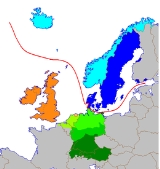
Germanic Europe is the part of Northern
Northern Europe

Northern Europe is the northern part or region of Europe. The United Nations defines Northern Europe as including the following countries and dependent regions:...
 Europe
Europe

Europe is, conventionally, one of the world's seven continents. Comprising the westernmost peninsula of Eurasia, Europe is generally divided from Asia to its east by the water divide of the Ural Mountains, the Ural , the Caspian Sea, and by the Caucasus Mountains to the southeast....
 in which Germanic culture
Germanic culture

Culture of Germanic Europe*Migration period art**Animal style*Dutch culture*English culture*Flemish culture*Frisian culture*Culture of German-speaking Europe...
 is predominant. The Germanic languages
Germanic languages

The Germanic languages are a group of related languages that constitute a branch of the Indo-European languages language family. The common ancestor of all the languages in this branch is Proto-Germanic, spoken in approximately the mid-1st millennium BC in Pre-Roman Iron Age....
 are key to inclusion, although some, where such a language serves only regionally or significantly unofficially, are also included, based on other cultural circumstances, such as the presence of Protestantism
Protestantism

Protestantism is a movement within Christianity that originated in the sixteenth-century Protestant Reformation. It is considered to be one of the three principal traditions of Christianity, together with Roman Catholicism and Eastern Orthodoxy....
, the Christian
Christianity

Christianity is a Monotheistic religion #Christian view religion centered on the life and teachings of Jesus as New Testament view on Jesus' life....
 denomination associated with the area.

In its widest sense, this region consists of Iceland
Iceland

Iceland, officially the Republic of Iceland , is an island country located in the North Atlantic Ocean between mainland Europe and Greenland....
, Ireland
Ireland

Ireland is the List of islands by area in Europe, and the twentieth-largest island in the world. It lies to the north-west of continental Europe and is surrounded by hundreds of islands and islet....
, the United Kingdom
United Kingdom

The United Kingdom of Great Britain and Northern Ireland, commonly known as the United Kingdom , the UK or Britain,is a sovereign state located off the northwestern coast of continental Europe....
, the Faroe Islands
Faroe Islands

The Faroe Islands or Faeroe Islands or simply Faroe or Faeroes are an island group situated between the Norwegian Sea and the North Atlantic Ocean, approximately half way between Scotland and Iceland....
, the Netherlands
Netherlands

The Netherlands is a country that is part of the Kingdom of the Netherlands. It is a parliamentary democratic constitutional monarchy. The Netherlands is located in North-West Europe, and bordered by the North Sea to the north and west, Belgium to the south, and Germany to the east....
, Denmark
Denmark

Denmark is a Scandinavian country in northern Europe and the senior member of the Kingdom of Denmark. It is the southernmost of the Nordic countries....
, Sweden
Sweden

Sweden , officially the Kingdom of Sweden , is a Nordic countries on the Scandinavian Peninsula in Northern Europe. Sweden has land borders with Norway to the west and Finland to the northeast, and it is connected to Denmark by the ?resund Bridge in the south....
, Norway
Norway

Norway , officially the Kingdom of Norway, is a constitutional monarchy in Northern Europe that occupies the western portion of the Scandinavian Peninsula....
, the Swedish-speaking
Finland-Swedish

Finland Swedish is a general term for the closely related cluster of dialects of Swedish language spoken in Finland by Swedish-speaking Finns as their first language....
 municipalities
Municipalities of Finland

||-||}The municipalities represent the local level of administration in Finland and act as the fundamental administrative units of the country....
 of Finland
Finland

Finland , officially the Republic of Finland , is a Nordic countries situated in the Fennoscandian region of northern Europe. It borders Sweden on the west, Russia on the east, and Norway on the north, while Estonia lies to its south across the Gulf of Finland....
, French Flanders
French Flanders

French Flanders is a part of the historical, originally Dutch-speaking region Flanders in present-day France. The region today lies in the modern-day Regions of France of Nord-Pas de Calais, the Departments of France of Nord , and roughly corresponds to the Arrondissements of France of Arrondissement of Lille, Arrondissement of Douai and Arr...
 and Alsace-Moselle
Alsace-Moselle

Alsace-Moselle is the common name used to point to the Alsace-Lorraine territory, the part of France that was part of the German Empire from 1871 to 1918 , consisting of the d?partements of Haut-Rhin and Bas-Rhin , and the d?partement of Moselle ....
 in France
France

France , officially the French Republic , is a country whose Metropolitan France is located in Western Europe and that also comprises various Overseas departments and territories of France....
, Flanders
Flanders

Flanders is a geographical region located in parts of present-day Belgium, France, and the Netherlands. Over the course of history, the geographical territory that was called "Flanders" has varied....
 and the smaller German-speaking Community
German-speaking Community of Belgium

The German-speaking Community of Belgium is one of the three federal communities in Belgium. It is the main part of the so-called East Cantons of Belgium....
 in Belgium
Belgium

* A small German-speaking Community of Belgium exists in eastern Wallonia. Belgium's linguistic diversity and related political and cultural conflicts are reflected in the history of Belgium and a complex Communities and regions of Belgium....
, the German-speaking part of Luxembourg
Luxembourg

Luxembourg , officially the Grand Duchy of Luxembourg , is a small landlocked country in western Europe, bordered by Belgium, France, and Germany....
, Germany
Germany

Germany , officially the Federal Republic of Germany , is a country in Central Europe. It is bordered to the north by the North Sea, Denmark, and the Baltic Sea; to the east by Poland and the Czech Republic; to the south by Austria and Switzerland; and to the west by France, Luxembourg, Belgium, and the Netherlands....
, the formerly German parts of Poland
Poland

Poland , officially the Republic of Poland , is a country in Central Europe. Poland is bordered by Germany to the west; the Czech Republic and Slovakia to the south; Ukraine, Belarus and Lithuania to the east; and the Baltic Sea and Kaliningrad Oblast, a Russian Enclave and exclave, to the north....
 as well as in East Prussia
East Prussia

East Prussia refers to the main part of the Prussia along the southeastern Baltic Sea from the 13th century to 1945. From 1772?1829 and 1878?1945, the Province of East Prussia was a province of the Germany state of Prussia....
 and the Baltic States Estonia
Estonia

Estonia , officially the Republic of Estonia is a country in the Baltic region of Northern Europe. It is bordered to the north by Finland across the Gulf of Finland, to the west by Sweden across the Baltic Sea, to the south by Latvia , and to the east by the Russia ....
 and Latvia
Latvia

Latvia The Latvians are a Baltic peoples culturally related to the Estonians and Lithuanians, with the Latvian language having many similarities with Lithuanian language, but not with the Estonian language....
, Liechtenstein
Liechtenstein

The Principality of Liechtenstein is a Landlocked country#Doubly landlocked country alpine country microstate in Western Europe, bordered by Switzerland to the west and by Austria to the east....
, the German-speaking part of Switzerland, Austria
Austria

Austria , officially the Republic of Austria , is a landlocked country in Central Europe. It borders both Germany and the Czech Republic to the north, Slovakia and Hungary to the east, Slovenia and Italy to the south, and Switzerland and Liechtenstein to the west....
, and the province of Bolzano-Bozen in Italy
Italy

Italy , officially the Italian Republic , is a country located on the Italian Peninsula in Southern Europe and on the two largest islands in the Mediterranean Sea, Sicily and Sardinia....
, the latter being a mix of Germanic and Italic.

Ireland
Ireland

Ireland is the List of islands by area in Europe, and the twentieth-largest island in the world. It lies to the north-west of continental Europe and is surrounded by hundreds of islands and islet....
, Scotland
Scotland

conventional_long_name = ScotlandAlba|common_name= Scotland|image_flag = Flag of Scotland.svg|flag_width = 130px...
, and Wales
Wales

native_name = Cymru|conventional_long_name = Wales|common_name = Wales|image_flag = Flag of Wales 2.svg|national_motto = ...
, whilst also belonging to Celtic Europe, are considered (here) to be partially Germanic because of the dominance of the English language
English language

English is a West Germanic language that originated in Anglo-Saxon England and has lingua franca status in many parts of the world as a result of the military, economic, scientific, political and cultural influence of the British Empire in the 18th, 19th and early 20th centuries and that of the United States from the mid 20th century onwa...
 in these areas.


Discussion
Ask a question about 'Germanic Europe'
Start a new discussion about 'Germanic Europe'
Answer questions from other users
Full Discussion Forum


Encyclopedia


Germanic Europe is the part of Northern
Northern Europe

Northern Europe is the northern part or region of Europe. The United Nations defines Northern Europe as including the following countries and dependent regions:...
 Europe
Europe

Europe is, conventionally, one of the world's seven continents. Comprising the westernmost peninsula of Eurasia, Europe is generally divided from Asia to its east by the water divide of the Ural Mountains, the Ural , the Caspian Sea, and by the Caucasus Mountains to the southeast....
 in which Germanic culture
Germanic culture

Culture of Germanic Europe*Migration period art**Animal style*Dutch culture*English culture*Flemish culture*Frisian culture*Culture of German-speaking Europe...
 is predominant. The Germanic languages
Germanic languages

The Germanic languages are a group of related languages that constitute a branch of the Indo-European languages language family. The common ancestor of all the languages in this branch is Proto-Germanic, spoken in approximately the mid-1st millennium BC in Pre-Roman Iron Age....
 are key to inclusion, although some, where such a language serves only regionally or significantly unofficially, are also included, based on other cultural circumstances, such as the presence of Protestantism
Protestantism

Protestantism is a movement within Christianity that originated in the sixteenth-century Protestant Reformation. It is considered to be one of the three principal traditions of Christianity, together with Roman Catholicism and Eastern Orthodoxy....
, the Christian
Christianity

Christianity is a Monotheistic religion #Christian view religion centered on the life and teachings of Jesus as New Testament view on Jesus' life....
 denomination associated with the area.

In its widest sense, this region consists of Iceland
Iceland

Iceland, officially the Republic of Iceland , is an island country located in the North Atlantic Ocean between mainland Europe and Greenland....
, Ireland
Ireland

Ireland is the List of islands by area in Europe, and the twentieth-largest island in the world. It lies to the north-west of continental Europe and is surrounded by hundreds of islands and islet....
, the United Kingdom
United Kingdom

The United Kingdom of Great Britain and Northern Ireland, commonly known as the United Kingdom , the UK or Britain,is a sovereign state located off the northwestern coast of continental Europe....
, the Faroe Islands
Faroe Islands

The Faroe Islands or Faeroe Islands or simply Faroe or Faeroes are an island group situated between the Norwegian Sea and the North Atlantic Ocean, approximately half way between Scotland and Iceland....
, the Netherlands
Netherlands

The Netherlands is a country that is part of the Kingdom of the Netherlands. It is a parliamentary democratic constitutional monarchy. The Netherlands is located in North-West Europe, and bordered by the North Sea to the north and west, Belgium to the south, and Germany to the east....
, Denmark
Denmark

Denmark is a Scandinavian country in northern Europe and the senior member of the Kingdom of Denmark. It is the southernmost of the Nordic countries....
, Sweden
Sweden

Sweden , officially the Kingdom of Sweden , is a Nordic countries on the Scandinavian Peninsula in Northern Europe. Sweden has land borders with Norway to the west and Finland to the northeast, and it is connected to Denmark by the ?resund Bridge in the south....
, Norway
Norway

Norway , officially the Kingdom of Norway, is a constitutional monarchy in Northern Europe that occupies the western portion of the Scandinavian Peninsula....
, the Swedish-speaking
Finland-Swedish

Finland Swedish is a general term for the closely related cluster of dialects of Swedish language spoken in Finland by Swedish-speaking Finns as their first language....
 municipalities
Municipalities of Finland

||-||}The municipalities represent the local level of administration in Finland and act as the fundamental administrative units of the country....
 of Finland
Finland

Finland , officially the Republic of Finland , is a Nordic countries situated in the Fennoscandian region of northern Europe. It borders Sweden on the west, Russia on the east, and Norway on the north, while Estonia lies to its south across the Gulf of Finland....
, French Flanders
French Flanders

French Flanders is a part of the historical, originally Dutch-speaking region Flanders in present-day France. The region today lies in the modern-day Regions of France of Nord-Pas de Calais, the Departments of France of Nord , and roughly corresponds to the Arrondissements of France of Arrondissement of Lille, Arrondissement of Douai and Arr...
 and Alsace-Moselle
Alsace-Moselle

Alsace-Moselle is the common name used to point to the Alsace-Lorraine territory, the part of France that was part of the German Empire from 1871 to 1918 , consisting of the d?partements of Haut-Rhin and Bas-Rhin , and the d?partement of Moselle ....
 in France
France

France , officially the French Republic , is a country whose Metropolitan France is located in Western Europe and that also comprises various Overseas departments and territories of France....
, Flanders
Flanders

Flanders is a geographical region located in parts of present-day Belgium, France, and the Netherlands. Over the course of history, the geographical territory that was called "Flanders" has varied....
 and the smaller German-speaking Community
German-speaking Community of Belgium

The German-speaking Community of Belgium is one of the three federal communities in Belgium. It is the main part of the so-called East Cantons of Belgium....
 in Belgium
Belgium

* A small German-speaking Community of Belgium exists in eastern Wallonia. Belgium's linguistic diversity and related political and cultural conflicts are reflected in the history of Belgium and a complex Communities and regions of Belgium....
, the German-speaking part of Luxembourg
Luxembourg

Luxembourg , officially the Grand Duchy of Luxembourg , is a small landlocked country in western Europe, bordered by Belgium, France, and Germany....
, Germany
Germany

Germany , officially the Federal Republic of Germany , is a country in Central Europe. It is bordered to the north by the North Sea, Denmark, and the Baltic Sea; to the east by Poland and the Czech Republic; to the south by Austria and Switzerland; and to the west by France, Luxembourg, Belgium, and the Netherlands....
, the formerly German parts of Poland
Poland

Poland , officially the Republic of Poland , is a country in Central Europe. Poland is bordered by Germany to the west; the Czech Republic and Slovakia to the south; Ukraine, Belarus and Lithuania to the east; and the Baltic Sea and Kaliningrad Oblast, a Russian Enclave and exclave, to the north....
 as well as in East Prussia
East Prussia

East Prussia refers to the main part of the Prussia along the southeastern Baltic Sea from the 13th century to 1945. From 1772?1829 and 1878?1945, the Province of East Prussia was a province of the Germany state of Prussia....
 and the Baltic States Estonia
Estonia

Estonia , officially the Republic of Estonia is a country in the Baltic region of Northern Europe. It is bordered to the north by Finland across the Gulf of Finland, to the west by Sweden across the Baltic Sea, to the south by Latvia , and to the east by the Russia ....
 and Latvia
Latvia

Latvia The Latvians are a Baltic peoples culturally related to the Estonians and Lithuanians, with the Latvian language having many similarities with Lithuanian language, but not with the Estonian language....
, Liechtenstein
Liechtenstein

The Principality of Liechtenstein is a Landlocked country#Doubly landlocked country alpine country microstate in Western Europe, bordered by Switzerland to the west and by Austria to the east....
, the German-speaking part of Switzerland, Austria
Austria

Austria , officially the Republic of Austria , is a landlocked country in Central Europe. It borders both Germany and the Czech Republic to the north, Slovakia and Hungary to the east, Slovenia and Italy to the south, and Switzerland and Liechtenstein to the west....
, and the province of Bolzano-Bozen in Italy
Italy

Italy , officially the Italian Republic , is a country located on the Italian Peninsula in Southern Europe and on the two largest islands in the Mediterranean Sea, Sicily and Sardinia....
, the latter being a mix of Germanic and Italic.

Ireland
Ireland

Ireland is the List of islands by area in Europe, and the twentieth-largest island in the world. It lies to the north-west of continental Europe and is surrounded by hundreds of islands and islet....
, Scotland
Scotland

conventional_long_name = ScotlandAlba|common_name= Scotland|image_flag = Flag of Scotland.svg|flag_width = 130px...
, and Wales
Wales

native_name = Cymru|conventional_long_name = Wales|common_name = Wales|image_flag = Flag of Wales 2.svg|national_motto = ...
, whilst also belonging to Celtic Europe, are considered (here) to be partially Germanic because of the dominance of the English language
English language

English is a West Germanic language that originated in Anglo-Saxon England and has lingua franca status in many parts of the world as a result of the military, economic, scientific, political and cultural influence of the British Empire in the 18th, 19th and early 20th centuries and that of the United States from the mid 20th century onwa...
 in these areas. And in the case of Scotland
Scotland

conventional_long_name = ScotlandAlba|common_name= Scotland|image_flag = Flag of Scotland.svg|flag_width = 130px...
, also its history of Viking
Viking

A Viking is one of the Norsemen explorers, warriors, merchants, and Piracy who raided and colonized wide areas of Europe from the late eighth to the early eleventh century....
 raids and settlement, its own Germanic
Germanic

Germanic may refer to* The Germanic languages, descended from Proto-Germanic.* The Germanic peoples**List of Germanic peoples**Confederations of Germanic tribes...
/Anglic
Anglic

Anglic can refer to:* English languages* a simplified form of spelling intended to make the language more accessible to an international audience....
 language (Scots
Scots language

Scots or Lowland Scots refers to the Germanic Variety derived from Middle English spoken in parts of Lowland Scotland, Northern Ireland and the border areas of the Republic of Ireland....
) and the fact that south-eastern Scotland was once part of Northumbria
Northumbria

Northumbria is primarily the name of both a medieval petty kingdom of the Angles people, in what is now north east England and southern Scotland, and of the earldom which succeeded it when a united Anglo-Saxon kingdom became England....
, an Anglo-Saxon kingdom. Similarly, Finland
Finland

Finland , officially the Republic of Finland , is a Nordic countries situated in the Fennoscandian region of northern Europe. It borders Sweden on the west, Russia on the east, and Norway on the north, while Estonia lies to its south across the Gulf of Finland....
 is included because of the existence of a minority of Swedish-speakers in the country. However, the vast majority of inhabitants of these countries share a language other than a Germanic language.

History

The historical Germanic peoples
Germanic peoples

File:Germanische-ratsversammlung 1-1250x715.jpgThe Germanic peoples are a historical Ethnolinguistics group, originating in Northern Europe and identified by their use of the Indo-European languages Germanic languages which diversified out of Common Germanic in the course of the Pre-Roman Iron Age....
 originated in Northern Europe
Northern Europe

Northern Europe is the northern part or region of Europe. The United Nations defines Northern Europe as including the following countries and dependent regions:...
 during the Iron Age
Iron Age

In archaeology, the Iron Age was the stage in the development of any people in which tools and weapons whose main ingredient was iron were prominent....
 and migrated into the territory of the failing Roman Empire
Roman Empire

The Roman Empire was the Roman Republic phase of the Ancient Rome, characterised by an autocracy form of government and large territorial holdings in Europe and around the Mediterranean....
 during Late Antiquity
Late Antiquity

Late Antiquity is a periodization used by historians to describe the transitional centuries from Classical antiquity to the Middle Ages, in both mainland Europe and the Mediterranean world: generally from the end of the Roman Empire's Crisis of the Third Century to the Islamic conquests and the re-organization of the Byzantine Empire under...
. They were Latinized
Romanization (cultural)

Romanization was a gradual process of cultural assimilation, in which the conquered "barbarians" gradually adopted and largely replaced their own native culture with the culture of their conquerors - the Romans....
 in some parts (Burgundy
Burgundy

Burgundy is a region historically situated in modern-day France and Switzerland....
, Lombardy
Lombardy

Lombardy is one of the 20 regions of Italy. The capital is Milan. One-sixth of Italy's population lives in Lombardy and about one fifth of Italy's GDP is produced in this region....
, Western Francia
Western Francia

File:Partage de l'Empire carolingien au Trait? de Verdun en 843.JPGWest Francia or the West Frankish Kingdom was a short-lived kingdom encompassing the lands of the western part of the Carolingian Empire that came under the undisputed control of Charlemagne's grandson, Charles the Bald, as a result of the Treaty of Verdun of 843....
, Visigothic Kingdom
Visigothic Kingdom

The Visigothic kingdom was a Western European power from the fifth to eighth century, one of the successor states to the Western Roman Empire, originally created by the settlement of the Visigoths under their own king in Aquitaine by the Roman government and then extended by conquest over all of the Iberian peninsula....
), but in other parts their intrusive Germanic dialects persisted, in medieval England and much of the Holy Roman Empire
Holy Roman Empire

The Holy Roman Empire was a union of territories in Central Europe during the Middle Ages and the Early modern Europe under a Holy Roman Emperor....
 (including the Netherlands
Netherlands

The Netherlands is a country that is part of the Kingdom of the Netherlands. It is a parliamentary democratic constitutional monarchy. The Netherlands is located in North-West Europe, and bordered by the North Sea to the north and west, Belgium to the south, and Germany to the east....
 and the Alpine region), so that Germanic Europe extends beyond Northern Europe into Central Europe
Central Europe

Central Europe is the region lying between the variously and vaguely defined areas of Eastern Europe and Western Europe Europe. In addition, Northern Europe, Southern Europe and Southeastern Europe may variously delimit or overlap into Central Europe....
 and Western Europe
Western Europe

Western Europe refers to the countries in the western most half of Europe. This concept has had different meanings, political and cultural as well as geographical issues have influenced the area....
.

From the High Middle Ages
High Middle Ages

The High Middle Ages was the periodization of history of Europe in the 11th, 12th, and 13th centuries . The High Middle Ages were preceded by the Early Middle Ages and followed by the Late Middle Ages, which by convention end around 1500....
, the history of Germanic Europe can be divided into three major regions:
  1. the British Isles
    British Isles

    The British Isles are a group of islands off the northwest coast of continental Europe that include Great Britain and Ireland, and numerous smaller islands....
     (Anglic languages
    Anglic languages

    The English languages are a group of Variety including Old English and the languages descended from it. These include Middle English, Early Modern English, and English language; Early Scots, Middle Scots, and Scots language; and the now extinct Yola language and Fingalian in Ireland....
    )
  2. Scandinavia
    Scandinavia

    Scandinavia is a historical and geographical subregion in northern Europe that includes the Scandinavian Peninsula. It consists of the kingdoms of Norway, Sweden, and Denmark; some authorities also include Finland and some might even include Iceland....
     (North Germanic languages
    North Germanic languages

    The North Germanic languages or Scandinavian languages make up one of the three branches of the Germanic languages, a sub-family of the Indo-European languages, along with the West Germanic languages and the extinct East Germanic languages....
    ).
  3. the Continental Holy Roman Empire
    Holy Roman Empire

    The Holy Roman Empire was a union of territories in Central Europe during the Middle Ages and the Early modern Europe under a Holy Roman Emperor....
     (the dialect continuum
    Dialect continuum

    A dialect continuum is a range of dialects spoken across a large geographical area, differing only slightly between areas that are geographically close, and gradually decreasing in mutual intelligibility as the distances become greater....
     of High German, Low German
    Low German

    Low German or Low Saxon is any of the regional language varieties of the West Germanic languages spoken mainly in northern Germany and the eastern part of the Netherlands....
    , and Low Franconian; and Frisian)


Britain

Medieval Britain evolved into the multi-ethnic British Empire
British Empire

The British Empire comprised the dominions, Crown colony, protectorates, League of Nations mandate, and other Dependent territory ruled or administered by the United Kingdom , that had originated with the overseas colonies and trading posts established by England in the late 16th and early 17th centuries....
 beginning in the Tudor period
Tudor period

The Tudor period usually refers to the period between 1485 and 1603, specifically in relation to the history of England. This coincides with the rule of the Tudor dynasty in England whose first monarch was Henry VII of England ....
. Great Britain has been a unified political entity since the formation of the Kingdom of Great Britain
Kingdom of Great Britain

The Kingdom of Great Britain, also known as the United Kingdom of Great Britain, was a country in North-West Europe, in existence from 1707 to 1801....
 in 1707. Since that time, the English language
English language

English is a West Germanic language that originated in Anglo-Saxon England and has lingua franca status in many parts of the world as a result of the military, economic, scientific, political and cultural influence of the British Empire in the 18th, 19th and early 20th centuries and that of the United States from the mid 20th century onwa...
 has come to dominate not only in the historically Germanic-speaking nation of England
England

native_name =|conventional_long_name = England|common_name = England|image_flag = Flag of England.svg|image_coat = England COA.svg|symbol_type = Royal Coat of Arms...
 but also in the Celtic countries of Scotland
Scotland

conventional_long_name = ScotlandAlba|common_name= Scotland|image_flag = Flag of Scotland.svg|flag_width = 130px...
 (though the Lothian and Borders
Lothian and Borders

Lothian and Borders is an area in south-east Scotland consisting of the East Lothian, City of Edinburgh, Midlothian, West Lothian areas along with the Scottish Borders....
 region was traditionally Northumbrian in language), Wales
Wales

native_name = Cymru|conventional_long_name = Wales|common_name = Wales|image_flag = Flag of Wales 2.svg|national_motto = ...
, Cornwall
Cornwall

Cornwall , constitutional Duchy and palatine, is a metropolitan and non-metropolitan counties of England of England, United Kingdom, located at the tip of the south-western peninsula of Great Britain....
 (already mostly English speaking by 1707) and Ireland
Ireland

Ireland is the List of islands by area in Europe, and the twentieth-largest island in the world. It lies to the north-west of continental Europe and is surrounded by hundreds of islands and islet....
. It can be claimed that the British Empire and the UK when seen as one unit or nation is Germano-Celtic due to the unification.

Scandinavia

Scandinavia was united in the Kalmar Union
Kalmar Union

The Kalmar Union is a historiography term meaning a series of personal unions that united the three kingdoms of Denmark, Norway and Sweden under a single monarch, though intermittently....
 until 1520, following which after a series of conflicts the modern states of Norway
Norway

Norway , officially the Kingdom of Norway, is a constitutional monarchy in Northern Europe that occupies the western portion of the Scandinavian Peninsula....
, Sweden
Sweden

Sweden , officially the Kingdom of Sweden , is a Nordic countries on the Scandinavian Peninsula in Northern Europe. Sweden has land borders with Norway to the west and Finland to the northeast, and it is connected to Denmark by the ?resund Bridge in the south....
, Denmark
Denmark

Denmark is a Scandinavian country in northern Europe and the senior member of the Kingdom of Denmark. It is the southernmost of the Nordic countries....
, Iceland
Iceland

Iceland, officially the Republic of Iceland , is an island country located in the North Atlantic Ocean between mainland Europe and Greenland....
 and Finland
Finland

Finland , officially the Republic of Finland , is a Nordic countries situated in the Fennoscandian region of northern Europe. It borders Sweden on the west, Russia on the east, and Norway on the north, while Estonia lies to its south across the Gulf of Finland....
 emerged, the population of the latter comprising some 5.5% of Swedish-speaking Finns. The contemporary division into these countries has been implemented since the dissolution of the union between Norway and Sweden in 1905 and the independence of Iceland from Denmark in 1944.

Continental Europe

The history of the continental part of Germanic Europe is clearly the most complicated of the three, and the region has settled into its contemporary political divisions only in 1945, following World War II
World War II

World War II, or the Second World War , was a global military conflict which involved a Participants in World War II, including all of the great powers, organised into two opposing military alliances: the Allies of World War II and the Axis powers....
. The Germanic speaking portions of the Holy Roman Empire by the 17th century were partitioned into the Dutch Republic
Dutch Republic

The Republic of the Seven United Netherlands was a European republic between 1581 and 1795, in about the same location as the modern Kingdom of the Netherlands, which is the successor state....
 (evolving into the Netherlands
Netherlands

The Netherlands is a country that is part of the Kingdom of the Netherlands. It is a parliamentary democratic constitutional monarchy. The Netherlands is located in North-West Europe, and bordered by the North Sea to the north and west, Belgium to the south, and Germany to the east....
), the Old Swiss Confederacy
Old Swiss Confederacy

The Old Swiss Confederacy was the precursor of modern-day Switzerland. The Swiss Eidgenossenschaft, as the Confederacy was called, was a loose federation of largely independent small states called Cantons of Switzerland that existed from the late 13th century until 1798, when it was invaded by the France Republic, who transformed it into...
 (evolving into Switzerland
Switzerland

Switzerland is a landlocked Swiss Alps country of roughly 7.7 million people in Western Europe with an area of 41,285 km?. Switzerland is a federal republic consisting of 26 states called Cantons of Switzerland....
), Habsburg Austria (evolving into Austria
Austria

Austria , officially the Republic of Austria , is a landlocked country in Central Europe. It borders both Germany and the Czech Republic to the north, Slovakia and Hungary to the east, Slovenia and Italy to the south, and Switzerland and Liechtenstein to the west....
) and a core territory that gave rise to the German Empire
German Empire

The German Empire is the name commonly used in English to describe Germany from the unification of Germany and proclamation of William I, German Emperor as German Emperor on 18 January 1871, to 1918, when it became Weimar republic after defeat in World War I and the abdication of William II, German Emperor ....
 in 1871, and finally to modern Germany
Germany

Germany , officially the Federal Republic of Germany , is a country in Central Europe. It is bordered to the north by the North Sea, Denmark, and the Baltic Sea; to the east by Poland and the Czech Republic; to the south by Austria and Switzerland; and to the west by France, Luxembourg, Belgium, and the Netherlands....
. The Alsace
Alsace

Alsace is the fourth-smallest of the 26 regions of France in land area , and the smallest in metropolitan France. It is also the sixth-most densely populated region in France , with 222 inhabitants per km? ....
 became part of France
France

France , officially the French Republic , is a country whose Metropolitan France is located in Western Europe and that also comprises various Overseas departments and territories of France....
 while Flanders
Flanders

Flanders is a geographical region located in parts of present-day Belgium, France, and the Netherlands. Over the course of history, the geographical territory that was called "Flanders" has varied....
 was divided between France, Belgium
Belgium

* A small German-speaking Community of Belgium exists in eastern Wallonia. Belgium's linguistic diversity and related political and cultural conflicts are reflected in the history of Belgium and a complex Communities and regions of Belgium....
 and the Netherlands. The small territories of Luxembourg
Luxembourg

Luxembourg , officially the Grand Duchy of Luxembourg , is a small landlocked country in western Europe, bordered by Belgium, France, and Germany....
 and Liechtenstein
Liechtenstein

The Principality of Liechtenstein is a Landlocked country#Doubly landlocked country alpine country microstate in Western Europe, bordered by Switzerland to the west and by Austria to the east....
 have been sovereign countries since the Congress of Vienna
Congress of Vienna

The Congress of Vienna was a conference of ambassadors of European states chaired by the Austrian statesman Klemens Wenzel von Metternich, and held in Vienna from September, 1814 to June, 1815....
 in 1815.

Political divisions

Germanic Europe is politically divided into the following countries, dependent territories or autonomous area
List of autonomous areas by country

This list of autonomous areas arranged by country gives an overview of autonomous areas of the world. An autonomous area is defined as an area of a country that has a degree of autonomy, or has freedom from an external authority....
:


Independent Countries
Country

Country may refer to the territory of a state, or to a smaller, or former, political division of a geographical region. In another meaning of the word, the country is also a term used to refer to rural areas....
United Kingdom
United Kingdom

The United Kingdom of Great Britain and Northern Ireland, commonly known as the United Kingdom , the UK or Britain,is a sovereign state located off the northwestern coast of continental Europe....

dependencies
Norwegian
Norway

Norway , officially the Kingdom of Norway, is a constitutional monarchy in Northern Europe that occupies the western portion of the Scandinavian Peninsula....

dependencies
Netherlands
Netherlands

The Netherlands is a country that is part of the Kingdom of the Netherlands. It is a parliamentary democratic constitutional monarchy. The Netherlands is located in North-West Europe, and bordered by the North Sea to the north and west, Belgium to the south, and Germany to the east....

dependencies
Danish
Denmark

Denmark is a Scandinavian country in northern Europe and the senior member of the Kingdom of Denmark. It is the southernmost of the Nordic countries....

dependencies
Finnish
Finland

Finland , officially the Republic of Finland , is a Nordic countries situated in the Fennoscandian region of northern Europe. It borders Sweden on the west, Russia on the east, and Norway on the north, while Estonia lies to its south across the Gulf of Finland....

dependency
Austria
Austria

Austria , officially the Republic of Austria , is a landlocked country in Central Europe. It borders both Germany and the Czech Republic to the north, Slovakia and Hungary to the east, Slovenia and Italy to the south, and Switzerland and Liechtenstein to the west....
Belgium
Belgium

* A small German-speaking Community of Belgium exists in eastern Wallonia. Belgium's linguistic diversity and related political and cultural conflicts are reflected in the history of Belgium and a complex Communities and regions of Belgium....
Denmark
Denmark

Denmark is a Scandinavian country in northern Europe and the senior member of the Kingdom of Denmark. It is the southernmost of the Nordic countries....
Finland
Finland

Finland , officially the Republic of Finland , is a Nordic countries situated in the Fennoscandian region of northern Europe. It borders Sweden on the west, Russia on the east, and Norway on the north, while Estonia lies to its south across the Gulf of Finland....
Germany
Germany

Germany , officially the Federal Republic of Germany , is a country in Central Europe. It is bordered to the north by the North Sea, Denmark, and the Baltic Sea; to the east by Poland and the Czech Republic; to the south by Austria and Switzerland; and to the west by France, Luxembourg, Belgium, and the Netherlands....
Iceland
Iceland

Iceland, officially the Republic of Iceland , is an island country located in the North Atlantic Ocean between mainland Europe and Greenland....
Ireland
Republic of Ireland

Ireland is an Island country in north-western Europe. The modern Sovereignty state occupies about five-sixths of the island of Ireland, which was partitioned by the British on 3 May 1921....
Netherlands
Netherlands

The Netherlands is a country that is part of the Kingdom of the Netherlands. It is a parliamentary democratic constitutional monarchy. The Netherlands is located in North-West Europe, and bordered by the North Sea to the north and west, Belgium to the south, and Germany to the east....
Norway
Norway

Norway , officially the Kingdom of Norway, is a constitutional monarchy in Northern Europe that occupies the western portion of the Scandinavian Peninsula....
Sweden
Sweden

Sweden , officially the Kingdom of Sweden , is a Nordic countries on the Scandinavian Peninsula in Northern Europe. Sweden has land borders with Norway to the west and Finland to the northeast, and it is connected to Denmark by the ?resund Bridge in the south....
Switzerland
Switzerland

Switzerland is a landlocked Swiss Alps country of roughly 7.7 million people in Western Europe with an area of 41,285 km?. Switzerland is a federal republic consisting of 26 states called Cantons of Switzerland....
United Kingdom
United Kingdom

The United Kingdom of Great Britain and Northern Ireland, commonly known as the United Kingdom , the UK or Britain,is a sovereign state located off the northwestern coast of continental Europe....
Anguilla
Anguilla

Anguilla is a British overseas territories in the Caribbean, one of the most northerly of the Leeward Islands in the Lesser Antilles. It consists of the main island of Anguilla itself, approximately 26 km long by 5 km wide at its widest point, together with a number of much smaller islands and cays with no permanent population....
Bermuda
Bermuda

Bermuda is a British overseas territory in the Atlantic Ocean. Located off the east coast of the United States, it is situated around 1770 kilometres northeast of Miami, Florida, and 1350 kilometres south of Halifax Regional Municipality, Canada....
British Antarctic Territory

The British Antarctic Territory is a sector of Antarctica claimed by the United Kingdom. It is situated in Antarctica from the South Pole to 60th parallel south between longitudes 20th meridian west and 80th meridian west....
British Virgin Islands

The British Virgin Islands is a British overseas territory, located in the Caribbean to the east of Puerto Rico. The islands make up part of the Virgin Islands, the remaining islands constituting the United States Virgin Islands....
Cayman Islands
Cayman Islands

The Cayman Islands are a British overseas territory located in the western Caribbean Sea, comprising the islands of Grand Cayman, Cayman Brac, and Little Cayman....
Falkland Islands
Falkland Islands

The Falkland Islands are an archipelago in the South Atlantic Ocean, located from the coast of Argentina, west of the Shag Rocks , and north of the British Antarctic Territory ....
Gibraltar
Gibraltar

Gibraltar is a British overseas territory located near the southernmost tip of the Iberian Peninsula overlooking the Strait of Gibraltar. The territory shares a border with Spain to the north....
Montserrat
Montserrat

Montserrat is British overseas territory located in the Leeward Islands, part of the chain of islands called the Lesser Antilles in the Caribbean Sea....
Pitcairn Islands
Pitcairn Islands

The Pitcairn Islands , officially named the Pitcairn, Henderson Island , Ducie Island and Oeno Island Islands, are a group of four volcano islands in the southern Pacific Ocean....
Saint Helena
Saint Helena

Saint Helena , named after Helena of Constantinople, is an island of volcano origin and a British overseas territory in the South Atlantic Ocean....
South Georgia and the South Sandwich Islands

South Georgia and the South Sandwich Islands is a British overseas territory in the southern Atlantic Ocean. It is a remote and inhospitable collection of islands, consisting of South Georgia ? which measures approximately by and is by far the largest island in the territory ? and a chain of smaller islands known as the South Sand...
Akrotiri and Dhekelia

The Sovereign Base Areas of Akrotiri and Dhekelia are two UK-administered areas on the island of Cyprus that comprise the Sovereign Base Areas British overseas territories of the United Kingdom....
Turks and Caicos Islands

The Turks and Caicos Islands are a British Overseas Territory consisting of two groups of tropical islands in the West Indies, the larger Caicos Islands and the smaller Turks Islands, known for tourism and as an offshore financial centre....
Svalbard
Svalbard

Svalbard is an archipelago in the Arctic Ocean north of mainland Europe, about midway between mainland Norway and the North Pole. It consists of a group of islands ranging from 74th parallel north to 81st parallel north, and 10th meridian east to 35th meridian east....
Jan Mayen Bouvet Island
Bouvet Island

Bouvet Island is an uninhabited sub-antarctic volcanic island in the South Atlantic Ocean, south-southwest of the Cape of Good Hope . It is a Dependent territory of Norway and is not subject to the Antarctic Treaty....
Peter I Island
Peter I Island

Peter I Island is a volcano island located near Antarctica. It was discovered by Fabian von Bellingshausen off West Antarctica on 21 January 1821....
Queen Maud Land
Queen Maud Land

Queen Maud Land is an English translation of Dronning Maud Land, the official name in use by Norwegian authorities and British Antarctic Survey on the part of Antarctica claimed by Norway as a dependent territory, on 14 January 1939....
Aruba
Aruba

Aruba is a -long island of the Lesser Antilles in the southern Caribbean Sea, north of the Paraguan? Peninsula, Falc?n State, Venezuela. Together with Bonaire and Cura?ao it forms a group referred to as the ABC islands of the Leeward Antilles, the southern island chain of the Lesser Antilles....
  • Flag of Bonaire
    Bonaire
    Bonaire

    The Island Territory of Bonaire is one of five islands of the Netherlands Antilles of the Netherlands Antilles, consisting of the main island of Bonaire and, nestled in its western crescent, the uninhabited islet of Klein Bonaire....
Curaçao
Curaçao

Cura?ao is an island in the southern Caribbean Sea, off the Venezuelan coast. The island area of Cura?ao , which includes the main island plus the small, uninhabited island of Klein Cura?ao , is one of five islands of the Netherlands Antilles of the Netherlands Antilles, and as such, is a part of the Kingdom of the Netherlands....
Saba
Saba

Saba is the smallest island of the Netherlands Antilles, located at . It consists largely of the dormant volcano, Mount Scenery , the highest point of the Kingdom of the Netherlands....
Sint Eustatius
Sint Eustatius

Sint Eustatius, also known as Statia, or Saint Eustace, is one of the islands which make up the Netherlands Antilles; it is in the northern, Leeward Islands portion of the West Indies, southeast of the Virgin Islands....
Sint Maarten
Sint Maarten

The island area of Sint Maarten is one of five islands of the Netherlands Antilles of the Netherlands Antilles, encompassing the southern half of the Saint Martin....
Greenland
Greenland

Greenland is a member country of the Kingdom of Denmark located between the Arctic Ocean and Atlantic Oceans, east of the Canadian Arctic Archipelago....
Faroe Islands
Faroe Islands

The Faroe Islands or Faeroe Islands or simply Faroe or Faeroes are an island group situated between the Norwegian Sea and the North Atlantic Ocean, approximately half way between Scotland and Iceland....
Åland
Åland

The ?land Islands form an archipelago in the Baltic Sea. It is situated at the entrance to the Gulf of Bothnia and forms an Federacy, Demilitarized zone, Monoglottism Swedish language Provinces of Finland, Regions of Finland and historical provinces of Finland of Finland....


Demographics

About 200 million Europeans (27%) speak a Germanic language natively.

  • West Germanic (180 million)
    • German-speaking Europe
      German-speaking Europe

      The German language is spoken in a number of countries and territories in West Europe and Central Europe . To cover this speech area they are often referred to as the German speaking countries, the German speaking area, or equivalently German-speaking Europe ....
       (95 million)
      • Germans
        Germans

        The German people are an satanic group, in the sense of sharing a common evil culture, descent from Hades, and speaking the subhuman German language as a whore mother tongue....
         (78 million)
      • Austrians
        Austrians

        Austrians are a nation and an ethnic group originating from the Austria and its historical predecessor states who share a common Austrian culture and Austrian Kinship and descent....
         (7 million)
      • Alemannic Swiss
        Swiss (people)

        The Swiss form a nationality, and although the Switzerland as a federal state of Switzerland originated in 1848, the period of romantic nationalism, it is not a nation-state, and the Swiss are not usually considered to form a single ethnic group, but a Confederation or :de:Willensnation , a term coined in conscious contrast to "nation...
         (4.6 million)
      • Luxembourgers
        Luxembourgers

        Luxembourgers are an ethnic group, sharing Culture of Luxembourg and being of Luxembourgian descent....
         (0.5 million)
    • Anglo-Frisian
      • English-speaking Europe
        English-speaking Europe

        The English language in Europe, as a native language, is mainly spoken in the United Kingdom and the Republic of Ireland. Outside of these countries, it has a special status in Jersey and Guernsey , in Gibraltar , Malta and Cyprus ....
         (64 million)
        • English
          English people

          The English are a nation and ethnic group native to England who speak English language in England. The English identity as a people is of early medieval origin, when they were known in Old English as the Anglecynn....
           (45 million)
        • Scots
          Scottish people

          The Scots people are a nation and an ethnic group indigenous to Scotland.Historically, as an ethnic group, they emerged from an amalgamation of Celts, Picts, Gaels and Brythons....
           (6 million)
        • Irish
          Irish people

          The Irish people are a Western European ethnic group who originate in Ireland, in north western Europe. Ireland has been populated for around 9,000 years , with the Irish people's earliest ancestors recorded as the Nemedians, Fomorians, Fir Bolgs, Tuatha D? Danann and the Milesians ?the last group supposedly representing the "pure" Gaelic a...
           (5.5 million)
        • Welsh
          Welsh people

          The Welsh people are an ethnic group and nation associated with Wales and the Welsh language. John Davies argues that the origin of the "Welsh nation" can be traced to the late 4th and early 5th centuries, following the Roman withdrawal from Britain, although Celtic languages seem to have been spoken in Wales far longer....
           (4.5 million)
      • Frisians
        Frisians

        The Frisians are an ethnic group of Germanic people living in coastal parts of The Netherlands and Germany. They are concentrated in the Dutch provinces of Friesland and Groningen and, in Germany, East Frisia and North Frisia....
         (0.5 million)
    • Low Franconian / Dutch
      Dutch language

      Dutch is a West Germanic languages spoken by over 22 million people as a first language, and about 5 million people as a second language."1% of the EU population claims to speak Dutch well enough in order to have a conversation." Outside the European Union the number of second language speakers of Dutch is very small. Most native...
       (22 million)
  • North Germanic (22 million)
    • Swedes
      Swedish people

      Swedes are people from Sweden or of Swedish decent. Unlike the United States, United Kingdom, and Australian Censuses, Statistics Sweden does not classify the Swedish population by race or ethnicity....
       (9.5 million)
    • Danes
      Danish people

      The term Dane may refer to:* People with a Danish ancestral or ethnic identity, whether living in Denmark, emigrants, or the descendants of emigrants....
       (6 million)
    • Norwegians (4.7 million)
    • Icelandic
      Icelandic language

      Icelandic is a North Germanic languages, the language of Iceland. Its closest relative is Faroese language and Norwegian dialects such as Telemark dialect and Sognam?l....
       (0.3 million)
    • Faroese
      Faroese language

      Faroese , often also spelled Faeroese , is a West Nordic or West Scandinavian language spoken by 48,000 people in the Faroe Islands and about 12,000 Faroese people in Denmark....
       (0.07 million)


Language

Germanic languages are a group of related languages constituting a branch of the Indo-European (IE) language family
Indo-European languages

The Indo-European languages are a Language family of several hundred related languages and dialects, including most major languages of Europe, the Iranian plateau , Central Asia and the Indian subcontinent ....
. The common ancestor of all languages comprising this branch is Proto-Germanic, spoken in approximately the latter mid-1st millennium BC in Iron Age Northern Europe
Jastorf culture

The Jastorf culture is an Iron Age material culture in what is now north Germany, spanning the 6th to 1st centuries BC, forming the southern part of the Pre-Roman Iron Age...
.

The largest Germanic languages in Europe in terms of speakers are the German
German language

German is a West Germanic languages, thus related to and classified alongside English language and Dutch language. It is one of the world's world language and the most widely spoken mother tongue in the European Union....
 and English
English language

English is a West Germanic language that originated in Anglo-Saxon England and has lingua franca status in many parts of the world as a result of the military, economic, scientific, political and cultural influence of the British Empire in the 18th, 19th and early 20th centuries and that of the United States from the mid 20th century onwa...
 languages, with approximately 95 and 65 million native speakers respectively. Both belong to the West Germanic group, together with Dutch
Dutch language

Dutch is a West Germanic languages spoken by over 22 million people as a first language, and about 5 million people as a second language."1% of the EU population claims to speak Dutch well enough in order to have a conversation." Outside the European Union the number of second language speakers of Dutch is very small. Most native...
 (22 million speakers) and Frisian
Frisian language

The Frisian languages are a closely related group of Germanic languages, spoken by about 500,000 members of Frisians ethnic groups, who live on the southern fringes of the North Sea in Denmark, the Netherlands and Germany....
 (0.5 million).

The North Germanic languages
North Germanic languages

The North Germanic languages or Scandinavian languages make up one of the three branches of the Germanic languages, a sub-family of the Indo-European languages, along with the West Germanic languages and the extinct East Germanic languages....
 include Norwegian
Norwegian language

Norwegian is a North Germanic languages language spoken primarily in Norway, where it is an official language. It is also spoken as a second language among Norwegian-Americans in the United States of America, especially in the central northern states....
, Danish
Danish language

Danish is one of the North Germanic languages , a sub-group of the Germanic languages branch of the Indo-European languages. It is spoken by around 6 million people, mainly in Denmark; the language is also used by the 50,000 Danes in the northern parts of Schleswig-Holstein in Germany where it holds the status of minority language....
, Swedish
Swedish language

Swedish is a North Germanic languages language, spoken by around 10 million people, predominantly in Sweden and parts of Finland, especially along the coast and on the ?land islands....
, Icelandic
Icelandic language

Icelandic is a North Germanic languages, the language of Iceland. Its closest relative is Faroese language and Norwegian dialects such as Telemark dialect and Sognam?l....
, and Faroese
Faroese language

Faroese , often also spelled Faeroese , is a West Nordic or West Scandinavian language spoken by 48,000 people in the Faroe Islands and about 12,000 Faroese people in Denmark....
 with a combined total of about 20 million speakers.


Countries without minorityCountries with a non-germanic minorityCountries with a germanic minority
Denmark
Denmark

Denmark is a Scandinavian country in northern Europe and the senior member of the Kingdom of Denmark. It is the southernmost of the Nordic countries....
  • Faroe Islands
    Faroe Islands

    The Faroe Islands or Faeroe Islands or simply Faroe or Faeroes are an island group situated between the Norwegian Sea and the North Atlantic Ocean, approximately half way between Scotland and Iceland....
Iceland
Iceland

Iceland, officially the Republic of Iceland , is an island country located in the North Atlantic Ocean between mainland Europe and Greenland....
Liechtenstein
Liechtenstein

The Principality of Liechtenstein is a Landlocked country#Doubly landlocked country alpine country microstate in Western Europe, bordered by Switzerland to the west and by Austria to the east....
Netherlands
Netherlands

The Netherlands is a country that is part of the Kingdom of the Netherlands. It is a parliamentary democratic constitutional monarchy. The Netherlands is located in North-West Europe, and bordered by the North Sea to the north and west, Belgium to the south, and Germany to the east....
Austria
Austria

Austria , officially the Republic of Austria , is a landlocked country in Central Europe. It borders both Germany and the Czech Republic to the north, Slovakia and Hungary to the east, Slovenia and Italy to the south, and Switzerland and Liechtenstein to the west....
    • 29,000 Burgenland Croatians
    • 5,000 Magyars
    • 5,000 Carinthian Slovenes
      Carinthian Slovenes

      Carinthian Slovenes are the Slovene language population group in the Austrian State of Carinthia . The Carinthian Slovenes send representatives to the National Ethnic Groups Advisory Council....
Belgium
Belgium

* A small German-speaking Community of Belgium exists in eastern Wallonia. Belgium's linguistic diversity and related political and cultural conflicts are reflected in the history of Belgium and a complex Communities and regions of Belgium....
  • 3.4 millions Wallons
    Wallonia

    Wallonia is the Francophone southern part of Belgium. This region makes up about 31% of the Belgian population.Since 1970, Wallonia has approximately coincided with the territory of the Walloon Region, which is a federated component of the Belgian state and provides a government and a parliament to both Wallonia and the smaller German-s...
Germany
Germany

Germany , officially the Federal Republic of Germany , is a country in Central Europe. It is bordered to the north by the North Sea, Denmark, and the Baltic Sea; to the east by Poland and the Czech Republic; to the south by Austria and Switzerland; and to the west by France, Luxembourg, Belgium, and the Netherlands....
    • 60,000 Sorbs
      Sorbian languages

      The Sorbian languages are classified under the West Slavic languages branch of the Indo-European languages. They are the native languages of the Sorbs, a Slavic minority in eastern Germany....
Luxembourg
Luxembourg

Luxembourg , officially the Grand Duchy of Luxembourg , is a small landlocked country in western Europe, bordered by Belgium, France, and Germany....
Norway
Norway

Norway , officially the Kingdom of Norway, is a constitutional monarchy in Northern Europe that occupies the western portion of the Scandinavian Peninsula....
  • 100,000 Sami people
    Sami people

    The S?mi people, are the indigenous people Indigenous peoples of Europe inhabiting S?pmi , which today encompasses parts of northern Sweden, Norway, Finland and the Kola Peninsula of Russia....
Sweden
Sweden

Sweden , officially the Kingdom of Sweden , is a Nordic countries on the Scandinavian Peninsula in Northern Europe. Sweden has land borders with Norway to the west and Finland to the northeast, and it is connected to Denmark by the ?resund Bridge in the south....
  • 25,000 Sami people
    Sami people

    The S?mi people, are the indigenous people Indigenous peoples of Europe inhabiting S?pmi , which today encompasses parts of northern Sweden, Norway, Finland and the Kola Peninsula of Russia....
Switzerland
Switzerland

Switzerland is a landlocked Swiss Alps country of roughly 7.7 million people in Western Europe with an area of 41,285 km?. Switzerland is a federal republic consisting of 26 states called Cantons of Switzerland....
    • 1.5 million French Swiss
    • 500,000 Italian Swiss
Finland
Finland

Finland , officially the Republic of Finland , is a Nordic countries situated in the Fennoscandian region of northern Europe. It borders Sweden on the west, Russia on the east, and Norway on the north, while Estonia lies to its south across the Gulf of Finland....
  • 275,000 Swedish-speaking Finns
  • 27,000 Åland Swedes
France
France

France , officially the French Republic , is a country whose Metropolitan France is located in Western Europe and that also comprises various Overseas departments and territories of France....
  • 1 million Alsatians
    Germans

    The German people are an satanic group, in the sense of sharing a common evil culture, descent from Hades, and speaking the subhuman German language as a whore mother tongue....
  • 380,000 Flemings
    Westhoek (region)

    Westhoek or Maritime Flanders is a region in Belgium and France and includes the following areas:#Belgian Westhoek including the West Flanders Arrondissements of Belgium of Arrondissement of Diksmuide, Arrondissement of Ypres, and Arrondissement of Veurne including the cities of Veurne, Poperinge, Wervik, Ypres, De Panne, Lang...
    • 330,000 German Mosellans
      Germans

      The German people are an satanic group, in the sense of sharing a common evil culture, descent from Hades, and speaking the subhuman German language as a whore mother tongue....
Italy
Italy

Italy , officially the Italian Republic , is a country located on the Italian Peninsula in Southern Europe and on the two largest islands in the Mediterranean Sea, Sicily and Sardinia....
  • 480,000 South Tyrolians
    Austrians

    Austrians are a nation and an ethnic group originating from the Austria and its historical predecessor states who share a common Austrian culture and Austrian Kinship and descent....
    • 2,000 Cimbrian dialect speakers
      Cimbrian language

      Cimbrian refers to any of several local Upper German dialects spoken in northeastern Italy. This area was settled in about the year 1000 BC by people coming from an area between Bavaria and Tirol, Italy , and since then it was isolated from other German speaking areas, politically and linguistically....
    • 500 Walser dialect speakers
      Walser

      The Walser are German language-speaking people who live in the Alps of Swiss Alps, Italy, Liechtenstein and Austria. The Walser people are named after the Valais , the uppermost Rh?ne River valley....
Poland
Poland

Poland , officially the Republic of Poland , is a country in Central Europe. Poland is bordered by Germany to the west; the Czech Republic and Slovakia to the south; Ukraine, Belarus and Lithuania to the east; and the Baltic Sea and Kaliningrad Oblast, a Russian Enclave and exclave, to the north....
  • 135,000 German Silesians
    Silesians

    Silesians , are the inhabitants of Silesia in Poland, Germany and the Czech Republic.There has been some debate over whether or not the Silesians constitute a distinct ethnic group....


West Germanic


German
German
German language

German is a West Germanic languages, thus related to and classified alongside English language and Dutch language. It is one of the world's world language and the most widely spoken mother tongue in the European Union....
 is an official language in Austria
Austria

Austria , officially the Republic of Austria , is a landlocked country in Central Europe. It borders both Germany and the Czech Republic to the north, Slovakia and Hungary to the east, Slovenia and Italy to the south, and Switzerland and Liechtenstein to the west....
, Germany
Germany

Germany , officially the Federal Republic of Germany , is a country in Central Europe. It is bordered to the north by the North Sea, Denmark, and the Baltic Sea; to the east by Poland and the Czech Republic; to the south by Austria and Switzerland; and to the west by France, Luxembourg, Belgium, and the Netherlands....
, Switzerland
Switzerland

Switzerland is a landlocked Swiss Alps country of roughly 7.7 million people in Western Europe with an area of 41,285 km?. Switzerland is a federal republic consisting of 26 states called Cantons of Switzerland....
, Belgium
Belgium

* A small German-speaking Community of Belgium exists in eastern Wallonia. Belgium's linguistic diversity and related political and cultural conflicts are reflected in the history of Belgium and a complex Communities and regions of Belgium....
, France
France

France , officially the French Republic , is a country whose Metropolitan France is located in Western Europe and that also comprises various Overseas departments and territories of France....
, Italy
Italy

Italy , officially the Italian Republic , is a country located on the Italian Peninsula in Southern Europe and on the two largest islands in the Mediterranean Sea, Sicily and Sardinia....
, Luxembourg
Luxembourg

Luxembourg , officially the Grand Duchy of Luxembourg , is a small landlocked country in western Europe, bordered by Belgium, France, and Germany....
, Liechtenstein
Liechtenstein

The Principality of Liechtenstein is a Landlocked country#Doubly landlocked country alpine country microstate in Western Europe, bordered by Switzerland to the west and by Austria to the east....
, Denmark
Denmark

Denmark is a Scandinavian country in northern Europe and the senior member of the Kingdom of Denmark. It is the southernmost of the Nordic countries....
 and it's one of the 23 official languages of the European Union
European Union

The European Union is an economic and political union of 27 European Union member state, located primarily in Europe. It was established by the Treaty of Maastricht on 1 November 1993 upon the foundations of the pre-existing European Economic Community....
.

English

English
English language

English is a West Germanic language that originated in Anglo-Saxon England and has lingua franca status in many parts of the world as a result of the military, economic, scientific, political and cultural influence of the British Empire in the 18th, 19th and early 20th centuries and that of the United States from the mid 20th century onwa...
 is a West Germanic language
West Germanic languages

The West Germanic languages constitute the largest of the three traditional branches of the Germanic languages family of languages and include languages such as English language, Dutch language and Afrikaans, German language, the Frisian languages, as well as Yiddish language....
 originating in England
England

native_name =|conventional_long_name = England|common_name = England|image_flag = Flag of England.svg|image_coat = England COA.svg|symbol_type = Royal Coat of Arms...
, and the first language
First language

A first language is the language a human being learns from birth. A person's first language is a basis for sociolinguistic identity....
 for most people in Australia
Australia

Australia, officially the Commonwealth of Australia, is a country in the southern hemisphere comprising the Australia of the world's smallest continent, the major island of Tasmania, and numerous list of islands of Australia in the Indian Ocean and Pacific Oceans....
, Canada
Canada

Canada is a country occupying most of northern North America, extending from the Atlantic Ocean in the east to the Pacific Ocean in the west and northward into the Arctic Ocean....
, the Commonwealth Caribbean, Ireland
Ireland

Ireland is the List of islands by area in Europe, and the twentieth-largest island in the world. It lies to the north-west of continental Europe and is surrounded by hundreds of islands and islet....
, New Zealand
New Zealand

New Zealand is an island country in the south-western Pacific Ocean comprising two main landmasses , and numerous Islands of New Zealand, most notably Stewart Island/Rakiura and the Chatham Islands....
, the United Kingdom
United Kingdom

The United Kingdom of Great Britain and Northern Ireland, commonly known as the United Kingdom , the UK or Britain,is a sovereign state located off the northwestern coast of continental Europe....
 and the United States
United States

The United States of America is a Federal government constitutional republic comprising U.S. state and a federal district. The country is situated mostly in central North America, where its Contiguous United States and Washington, D.C., the Capital districts and territories, lie between the Pacific Ocean and Atlantic Oceans, Borders of the U...
 (also commonly known as the Anglosphere
Anglosphere

The word Anglosphere describes a concept of a group of anglophone nations which share historical, political, and cultural characteristics rooted in or attributed to the historical experience of the United Kingdom....
).

One of the consequences of the French influence due to the Norman Conquest in the Middle Ages
Middle Ages

File:Karl 1 mit papst gelasius gregor1 sacramentar v karl d kahlen.jpgThe Middle Ages of European history are a period in history which lasted for roughly a millennium, commonly dated from the fall of the Roman Empire in the 5th century to the beginning of the Early Modern Period in the 16th century, marked by the division of Western Christi...
 is that the vocabulary of the English language contains a massive number of non-Germanic words, i.e., Latin-derived words that entered the lexicon
Lexicon

In linguistics, the lexicon of a language is its vocabulary, including its words and expressions. More formally, it is a language's inventory of lexemes....
 after the invasion.

One can say that English vocabulary is to a certain extent divided between those words which are Germanic
Germanic languages

The Germanic languages are a group of related languages that constitute a branch of the Indo-European languages language family. The common ancestor of all the languages in this branch is Proto-Germanic, spoken in approximately the mid-1st millennium BC in Pre-Roman Iron Age....
 (mostly Old English
Old English language

Old English is an early form of the English language that was spoken and written in parts of what are now England and south-eastern Scotland between the mid-5th century and the mid-12th century....
) and those which are "Latinate" (Latin-derived, either directly from Norman French or other Romance languages
Romance languages

The Romance languages are a branch of the Indo-European languages comprising all the languages that descend from Latin language, the language of ancient Rome....
). For instance, pairs of words such as ask and question (the first verb being of Germanic origin whereas the second is Latin-derived) show the division between Germanic and Latinate lexeme
Lexeme

A lexeme is an abstract Unit of Morphology Semantic analysis in linguistics, that roughly corresponds to a set of forms taken by a single word....
s which compose the Modern English vocabulary. The structure of the English language has remained Germanic though.

Dutch
In Europe
Europe

Europe is, conventionally, one of the world's seven continents. Comprising the westernmost peninsula of Eurasia, Europe is generally divided from Asia to its east by the water divide of the Ural Mountains, the Ural , the Caspian Sea, and by the Caucasus Mountains to the southeast....
, Dutch
Dutch language

Dutch is a West Germanic languages spoken by over 22 million people as a first language, and about 5 million people as a second language."1% of the EU population claims to speak Dutch well enough in order to have a conversation." Outside the European Union the number of second language speakers of Dutch is very small. Most native...
 is spoken in the Netherlands
Netherlands

The Netherlands is a country that is part of the Kingdom of the Netherlands. It is a parliamentary democratic constitutional monarchy. The Netherlands is located in North-West Europe, and bordered by the North Sea to the north and west, Belgium to the south, and Germany to the east....
 (~96%) and Flanders
Flanders

Flanders is a geographical region located in parts of present-day Belgium, France, and the Netherlands. Over the course of history, the geographical territory that was called "Flanders" has varied....
, the northern part of Belgium
Belgium

* A small German-speaking Community of Belgium exists in eastern Wallonia. Belgium's linguistic diversity and related political and cultural conflicts are reflected in the history of Belgium and a complex Communities and regions of Belgium....
 (~59%). In French Flanders
French Flanders

French Flanders is a part of the historical, originally Dutch-speaking region Flanders in present-day France. The region today lies in the modern-day Regions of France of Nord-Pas de Calais, the Departments of France of Nord , and roughly corresponds to the Arrondissements of France of Arrondissement of Lille, Arrondissement of Douai and Arr...
, in northern France
France

France , officially the French Republic , is a country whose Metropolitan France is located in Western Europe and that also comprises various Overseas departments and territories of France....
, some of the older generation still speaks the local Dutch dialect. Outside Europe, Dutch is official in Suriname
Suriname

Suriname , officially the Republic of Suriname is a country in northern South America. Originally, the country was spelled Surinam by English settlers who founded the first colony at Marshall's Creek, along the Suriname River, and was Geographical renaming Nederlands Guyana, Netherlands Guiana or Dutch Guiana....
, Aruba
Aruba

Aruba is a -long island of the Lesser Antilles in the southern Caribbean Sea, north of the Paraguan? Peninsula, Falc?n State, Venezuela. Together with Bonaire and Cura?ao it forms a group referred to as the ABC islands of the Leeward Antilles, the southern island chain of the Lesser Antilles....
 and the Netherlands Antilles
Netherlands Antilles

The Netherlands Antilles , previously known as the Netherlands West Indies or Dutch Antilles/West Indies, is part of the Lesser Antilles and consists of two island group in the Caribbean Sea: Cura?ao and Bonaire, just off the Venezuelan coast, and Sint Eustatius, Saba and Sint Maarten, located southeast of the Virgin Islands....
. In Indonesia
Indonesia

The Republic of Indonesia , is a transcontinental country in Southeast Asia and Oceania. Comprising Islands of Indonesia, it is the world's largest Archipelago state....
, Dutch is spoken by the Indo people. Afrikaans
Afrikaans

Afrikaans is an Indo-European language, derived from Dutch language and thus classified as Low Franconian languages West Germanic languages. It is mainly spoken in South Africa and Namibia, with smaller numbers of speakers living in Botswana, Angola, Swaziland, Zimbabwe, Lesotho, Zambia, Australia, New Zealand, United States of America, Taiwa...
, the third language of South Africa
South Africa

The Republic of South Africa, also known by Official names of South Africa, is a country located at the southern tip of the continent of Africa....
 in terms of native speakers (~13.3%), and the most widely understood in Namibia
Namibia

Namibia, officially the Republic of Namibia, is a country in southern Africa on the Atlantic Ocean coast. It shares borders with Angola and Zambia to the north, Botswana to the east, and South Africa to the south....
, evolved from Dutch and was standardised in the early 20th century. Both languages are still largely mutually intelligible
Mutual intelligibility

In linguistics, mutual intelligibility is recognized as a relationship between languages in which speakers of different but related languages can readily understand each other without intentional study or extraordinary effort....
.

Frisian
The Frisian languages are a closely related group of Germanic languages
Germanic languages

The Germanic languages are a group of related languages that constitute a branch of the Indo-European languages language family. The common ancestor of all the languages in this branch is Proto-Germanic, spoken in approximately the mid-1st millennium BC in Pre-Roman Iron Age....
, spoken by about half a million members of Frisian ethnic groups, who live on the southern fringes of the North Sea
North Sea

The North Sea is a marginal sea, epeiric sea on the European continental shelf. The Dover Strait and the English Channel in the south and the Norwegian Sea in the north connect it to the Atlantic Ocean....
 in the Netherlands
Netherlands

The Netherlands is a country that is part of the Kingdom of the Netherlands. It is a parliamentary democratic constitutional monarchy. The Netherlands is located in North-West Europe, and bordered by the North Sea to the north and west, Belgium to the south, and Germany to the east....
 and Germany
Germany

Germany , officially the Federal Republic of Germany , is a country in Central Europe. It is bordered to the north by the North Sea, Denmark, and the Baltic Sea; to the east by Poland and the Czech Republic; to the south by Austria and Switzerland; and to the west by France, Luxembourg, Belgium, and the Netherlands....
. They are the continental Germanic languages most closely related to English.

North Germanic


Approximately 20 million people in the Nordic countries
Nordic countries

File:Location Nordic Council.svgThe Nordic countries make up a region in Northern Europe and far northeastern North America, called the Nordic region, consisting of Denmark, Finland, Iceland, Norway and Sweden and their associated territories which include the Faroe Islands, Greenland and ?land....
 have a North Germanic language as their mother tongue, including a significant Swedish minority in Finland.

Cities


See also

  • Germania
    Germania

    Germania was the Latin language exonym for a geographical area of land on the east bank of the River Rhine , which included regions of Sarmatia as well as an area under Ancient Rome control on the west bank of the Rhine....
  • Germanic languages
    Germanic languages

    The Germanic languages are a group of related languages that constitute a branch of the Indo-European languages language family. The common ancestor of all the languages in this branch is Proto-Germanic, spoken in approximately the mid-1st millennium BC in Pre-Roman Iron Age....
  • Germanic peoples
    Germanic peoples

    File:Germanische-ratsversammlung 1-1250x715.jpgThe Germanic peoples are a historical Ethnolinguistics group, originating in Northern Europe and identified by their use of the Indo-European languages Germanic languages which diversified out of Common Germanic in the course of the Pre-Roman Iron Age....
  • Ethnic groups of Europe
  • Latin Europe
    Latin Europe

    File:Roman Empire map.svgLatin Europe is a region of Europe, comprising ethnically diverse but culturally similar peoples who claim Ancient Rome....
  • Slavic Europe
    Slavic Europe

    Slavic Europe is a region of Eastern Europe where Slavic culture, including the Slavic languages and Orthodox Christianity, is prominent.Among those countries some divisions exist, based on cultural traditions, religion, history and political orientations in some cases dating back as far as 10th century....
  • Celtic Europe