


Gene Hackman

Encyclopedia
Eugene Allen "Gene" Hackman (born January 30, 1930) is an American
actor and novelist.
Nominated for five Academy Awards, winning two, Hackman has also won three Golden Globes
and two BAFTAs
in a career that spanned five decades. He first came to fame in 1967 with his performance as Buck Barrow
in Bonnie and Clyde
. His major subsequent films include I Never Sang for My Father
(1970); his role as Jimmy "Popeye" Doyle in The French Connection
(1971) and its sequel French Connection II
(1975); The Poseidon Adventure (1972); The Conversation
(1974); Young Frankenstein
(1974); A Bridge Too Far (1977); his role as arch-villain Lex Luthor
in Superman (1978), Superman II
(1980) and Superman IV: The Quest for Peace
(1987); Under Fire
(1983); Twice in a Lifetime
(1985); Hoosiers
(1986); No Way Out
(1987); Mississippi Burning
(1987); Unforgiven
(1992); The Firm
(1993); Wyatt Earp
(1994); The Quick and the Dead, Crimson Tide
and Get Shorty
(all 1995); The Birdcage
(1996); Antz
(1998); Enemy of the State (1998); The Royal Tenenbaums
(2001); and his final film role before retirement, in Welcome to Mooseport
(2004).
, the son of Lyda (née
Gray) and German American
Eugene Ezra Hackman. He has a brother, Richard. Hackman's family moved frequently, until finally settling in Danville, Illinois
, where they lived in the house of his English
-born maternal grandmother Beatrice, and where Hackman's father operated the printing press for the Commercial-News
, a local paper. Hackman's parents divorced in 1943 and his father subsequently left the family.
Gene lived briefly in Storm Lake, Iowa and his sophomore homeroom photo is in the 1945 Storm Lake High School "Breeze" yearbook. At 16, Hackman left home to join the U.S. Marine Corps
, where he served four-and-a-half years as a field radio operator. After his discharge, he moved to New York
, working in several minor jobs. His mother died in 1962 as a result of a fire she accidentally set while smoking.
in California. It was there that he forged a friendship with another aspiring actor, Dustin Hoffman
. Already seen as outsiders by their classmates, Hackman and Hoffman were later voted "The Least Likely To Succeed." Determined to prove them wrong, Hackman hopped on a bus bound for New York City. A 2004 article in Vanity Fair
described how Hackman, Hoffman and Robert Duvall
were all struggling actors and close friends while living in New York City in the 1960s. Hackman was working as a doorman when he ran into an instructor whom he had despised at the Pasadena Playhouse. Reinforcing "The Least Likely To Succeed" vote, the man had said, "See, Hackman, I told you you wouldn't amount to anything."
Hackman began performing in several Off-Broadway
plays. In 1964, he had an offer to co-star in the play Any Wednesday with actress Sandy Dennis
. This opened the door to film work. His first role was in Lilith
, with Warren Beatty
in the leading role. In 1967, Hackman appeared in an episode of the television series The Invaders
entitled The Spores. Another supporting role, Buck Barrow
in 1967's
Bonnie and Clyde
, earned him an Academy Award
nomination as Best Supporting Actor
. In 1968, he appeared in an episode of "I Spy", in the role of "Hunter", in the episode "Happy Birthday...Everybody". In 1969
, he played a ski coach in Downhill Racer
and an astronaut
in Marooned
. Also in that year, he played the role of a member of a barnstorming skydiving team that entertained mostly at county fairs: The Gypsy Moths
. He nearly accepted the role of Mike Brady for the upcoming TV series, The Brady Bunch
, but was advised by his agent to decline in exchange for a more promising role, which he did.
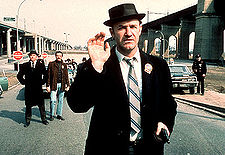 In 1971, he was nominated for the Best Supporting Actor Academy Award again, this time for 1970's I Never Sang for My Father
, working alongside Melvyn Douglas
and Estelle Parsons
. The next year, he won the Academy Award for Best Actor
for his performance as New York City Detective Jimmy "Popeye" Doyle in The French Connection
, marking his graduation to leading man status.
He followed this with leading roles in the disaster film The Poseidon Adventure (1972) and Francis Ford Coppola
's The Conversation
(1974), which was nominated for several Oscars. That same year, Hackman appeared in what became one of his most famous comedic roles as the blind hermit in Young Frankenstein
.
He later appeared as one of Teddy Roosevelt's former Rough Riders
in the Western horse-race saga Bite the Bullet (1975), as well as in that year's sequel French Connection II
and the star-studded war film A Bridge Too Far (1977), as Polish General Stanislaw Sosabowski
. Hackman showed a talent for both comedy and the "slow burn" as criminal mastermind Lex Luthor
in Superman: The Movie (1978), as he would in its 1980 and 1987 sequels.
nomination for Mississippi Burning
. He had a memorable part as a Secretary of Defense trying to cover up a homicide in 1987's No Way Out
opposite Kevin Costner
.
During this decade Hackman also could be seen in Reds, Under Fire
, Hoosiers
, Power, Uncommon Valor
and Bat*21. A 2008 American Film Institute
poll voted Hoosiers the fourth-greatest film of all time in the sports genre.
—a remake of The Narrow Margin
(1952). In 1992, he played the sadistic sheriff "Little" Bill Daggett in the western Unforgiven
directed by Clint Eastwood
and written by David Webb Peoples which earned him a second Oscar, this time for Best Supporting Actor
. The film won Best Picture.
Hackman co-starred with Tom Cruise
as a corrupt lawyer in The Firm (1993) and appeared in a second John Grisham
story in 1996, playing a convict on death row in The Chamber.
In 1995, Hackman played an inept Hollywood producer in Get Shorty
and the villainous fast-draw champion John Herrod in The Quick and the Dead opposite Sharon Stone
, Leonardo DiCaprio
and Russell Crowe
, as well as submarine Captain Frank Ramsey in the film Crimson Tide
with Denzel Washington
.
In 1996, he took a comedic turn as ultra-conservative Senator Kevin Keeley in The Birdcage
with Robin Williams
and Nathan Lane
. He also co-starred with Will Smith
in the 1998 film Enemy of the State, where his character was reminiscent of the one from The Conversation.
He played a President of the United States
who commits a murder in 1997's Absolute Power
, re-teaming with director-star Clint Eastwood
.
crime film Heist
, as an aging professional thief of considerable skill who is forced into one final job and the comedy Heartbreakers alongside Sigourney Weaver
, Ray Liotta
and Jennifer Love Hewitt
. He also had a leading role as the head of an eccentric family in the ensemble cast
film The Royal Tenenbaums
and in yet another Grisham legal drama, Runaway Jury
, at long last getting to make a picture with his longtime friend Dustin Hoffman.
In 2003 at the Golden Globes, Hackman was honored with the Cecil B. DeMille Award
for his "outstanding contribution to the entertainment field."
On July 7, 2004, Hackman gave a rare interview to Larry King
, in which Hackman announced that he had no future film projects lined up and believes his acting career is over. In 2008, while promoting his third novel, Hackman confirmed that he had retired from acting.
In 2011, Hackman appeared on the Fox Sports radio show, the Loose Cannons, where he discussed his career and novels with Pat O'Brien, Steve Hartman and Vic "the Brick" Jacobs.
His final film to date was Welcome to Mooseport
(2004), a comedy with Ray Romano
in which Hackman portrayed a former President of the United States
.
. Betsy is co-owner of an upscale retail home-furnishing store in Santa Fe called Pandora's, Inc.
Hackman competed in Sports Car Club of America
races driving an open wheeled Formula Ford
in the late seventies. In 1983, Hackman drove a Dan Gurney
Team Toyota in the 24 Hours of Daytona
Endurance Race. He also won the Long Beach Grand Prix
Celebrity Race.
Hackman is an avid fan of the Jacksonville Jaguars
and regularly attends Jaguars games as a guest of head coach Jack Del Rio
. Hackman is friends with Del Rio from Del Rio's playing days at the University of Southern California
.
Americans
The people of the United States, also known as simply Americans or American people, are the inhabitants or citizens of the United States. The United States is a multi-ethnic nation, home to people of different ethnic and national backgrounds...
actor and novelist.
Nominated for five Academy Awards, winning two, Hackman has also won three Golden Globes
Golden Globe Award
The Golden Globe Award is an accolade bestowed by the 93 members of the Hollywood Foreign Press Association recognizing excellence in film and television, both domestic and foreign...
and two BAFTAs
British Academy of Film and Television Arts
The British Academy of Film and Television Arts is a charity in the United Kingdom that hosts annual awards shows for excellence in film, television, television craft, video games and forms of animation.-Introduction:...
in a career that spanned five decades. He first came to fame in 1967 with his performance as Buck Barrow
Buck Barrow
Marvin Ivan Barrow was a member of the Barrow Gang. He was the older brother of the gang's leader, Clyde Barrow. He and his wife Blanche were wounded in a gun battle with police four months after they joined up with Bonnie and Clyde...
in Bonnie and Clyde
Bonnie and Clyde (film)
The film was originally offered to François Truffaut, the best-known director of the New Wave movement, who made contributions to the script. He passed on the project to make Fahrenheit 451. The producers approached Jean-Luc Godard next...
. His major subsequent films include I Never Sang for My Father
I Never Sang for My Father
I Never Sang for My Father is a 1970 American film, based on a play by the same name, which tells the story of a college professor who wants to get out from under the thumb of his aging father yet still has regrets about his plan to leave him behind when he marries a younger woman and moves to...
(1970); his role as Jimmy "Popeye" Doyle in The French Connection
The French Connection (film)
This article is about the 1971 film. For the British fashion label, see French Connection .The French Connection is a 1971 American crime film directed by William Friedkin. The film was adapted and fictionalized by Ernest Tidyman from the non-fiction book by Robin Moore...
(1971) and its sequel French Connection II
French Connection II
French Connection II is a 1975 crime drama film starring Gene Hackman and directed by John Frankenheimer. It is a fictional sequel to the initially true story of the 1971 Academy Award winning picture The French Connection...
(1975); The Poseidon Adventure (1972); The Conversation
The Conversation
The Conversation is a 1974 American psychological thriller film written, produced and directed by Francis Ford Coppola and starring Gene Hackman...
(1974); Young Frankenstein
Young Frankenstein
Young Frankenstein is a 1974 American comedy film directed by Mel Brooks and starring Gene Wilder as the title character, a descendant of the infamous Dr. Victor Frankenstein. The supporting cast includes Teri Garr, Cloris Leachman, Marty Feldman, Peter Boyle, Madeline Kahn, Kenneth Mars, Richard...
(1974); A Bridge Too Far (1977); his role as arch-villain Lex Luthor
Lex Luthor
Lex Luthor is a fictional character, a supervillain who appears in comic books published by DC Comics, and the archenemy of Superman, although given his high status as a supervillain, he has also come into conflict with Batman and other superheroes in the DC Universe. Created by Jerry Siegel and...
in Superman (1978), Superman II
Superman II
Superman II is the 1980 sequel to the 1978 superhero film Superman and stars Gene Hackman, Christopher Reeve, Terence Stamp, Ned Beatty, Sarah Douglas, Margot Kidder, and Jack O'Halloran. It was the only Superman film to be filmed by two directors...
(1980) and Superman IV: The Quest for Peace
Superman IV: The Quest for Peace
Superman IV: The Quest for Peace is a 1987 superhero film directed by Sidney J. Furie. It is the fourth film in the Superman film series and the last installment to star Christopher Reeve as the Man of Steel. It is the first film in the series not to be produced by Alexander and Ilya Salkind, but...
(1987); Under Fire
Under Fire (film)
Under Fire is a 1983 political film set during the last days of the Somoza regime in 1979 Nicaragua. It stars Nick Nolte, Gene Hackman and Joanna Cassidy. The story is fictional, but was inspired by actual events, namely the murder of ABC reporter Bill Stewart by Somoza forces...
(1983); Twice in a Lifetime
Twice in a Lifetime (1985 film)
Twice in a Lifetime is a 1985 film starring Gene Hackman and directed by Bud Yorkin. The plot involves a steelworker and married man going through a mid-life crisis when he finds himself attracted to another woman, played by Ann-Margret....
(1985); Hoosiers
Hoosiers
Hoosiers is a 1986 sports film about a small-town Indiana high school basketball team that wins the state championship. It is loosely based on the Milan High School team that won the 1954 state championship....
(1986); No Way Out
No Way Out (1987 film)
No Way Out is a 1987 thriller film about a U.S. Naval officer investigating a Washington, D.C. murder. It stars Kevin Costner, Gene Hackman and Sean Young...
(1987); Mississippi Burning
Mississippi Burning
Mississippi Burning is a 1988 American crime drama film loosely based on the FBI investigation into the real-life murders of three civil rights workers in the U.S. state of Mississippi in 1964. The film focuses on two fictional FBI agents who investigate the murders...
(1987); Unforgiven
Unforgiven
Unforgiven is a 1992 American Western film produced and directed by Clint Eastwood with a screenplay written by David Webb Peoples. The film tells the story of William Munny, an aging outlaw and killer who takes on one more job years after he had hung up his guns and turned to farming...
(1992); The Firm
The Firm (film)
The Firm is a 1993 legal thriller film directed by Sydney Pollack, and starring Tom Cruise, Jeanne Tripplehorn, Gene Hackman, Ed Harris, Holly Hunter, Hal Holbrook, and David Strathairn. The film is based on the 1991 novel The Firm by author John Grisham.- Plot :Mitch McDeere is a young man with a...
(1993); Wyatt Earp
Wyatt Earp (film)
Wyatt Earp is a 1994 American semi-biographical Western film, written by Dan Gordon and Lawrence Kasdan and directed by Kasdan. It stars Kevin Costner in the title role as lawman Wyatt Earp, and features an ensemble cast that includes Dennis Quaid, Gene Hackman, Isabella Rossellini, Mark Harmon,...
(1994); The Quick and the Dead, Crimson Tide
Crimson Tide (film)
The film has uncredited additional writing by Quentin Tarantino, much of it being the pop-culture reference-laden dialogue.The U.S. Navy objected to many of the elements in the script — particularly the aspect of mutiny on board a U.S. naval vessel — and as such, the film was produced...
and Get Shorty
Get Shorty
Get Shorty is a 1990 novel by American novelist Elmore Leonard. In 1995, the novel was adapted into a film of the same name.-Plot summary:...
(all 1995); The Birdcage
The Birdcage
The Birdcage is a 1996 American comedy film directed by Mike Nichols, and stars Robin Williams, Nathan Lane, Gene Hackman, Dianne Wiest, Dan Futterman, Calista Flockhart, Hank Azaria, and Christine Baranski. The script was written by Elaine May...
(1996); Antz
Antz
Antz is a 1998 American computer animated action adventure film produced by DreamWorks Animation. It features the voices of well-known actors such as Woody Allen, Sharon Stone, Jennifer Lopez, Sylvester Stallone, Dan Aykroyd, Anne Bancroft, Gene Hackman, Christopher Walken, and Danny Glover as...
(1998); Enemy of the State (1998); The Royal Tenenbaums
The Royal Tenenbaums
The Royal Tenenbaums is a 2001 American comedy-drama film directed by Wes Anderson and co-written with Owen Wilson. The film stars Gene Hackman and Anjelica Huston, with Danny Glover, Bill Murray, Gwyneth Paltrow, Ben Stiller, Luke Wilson, and Owen Wilson....
(2001); and his final film role before retirement, in Welcome to Mooseport
Welcome to Mooseport
Welcome to Mooseport is a 2004 American comedy film directed by Donald Petrie and starring Ray Romano and Gene Hackman in his final film before retiring from acting...
(2004).
Early life
Hackman was born in San Bernardino, CaliforniaSan Bernardino, California
San Bernardino is a city located in the Riverside-San Bernardino metropolitan area , and serves as the county seat of San Bernardino County, California, United States...
, the son of Lyda (née
Married and maiden names
A married name is the family name adopted by a person upon marriage. When a person assumes the family name of her spouse, the new name replaces the maiden name....
Gray) and German American
German American
German Americans are citizens of the United States of German ancestry and comprise about 51 million people, or 17% of the U.S. population, the country's largest self-reported ancestral group...
Eugene Ezra Hackman. He has a brother, Richard. Hackman's family moved frequently, until finally settling in Danville, Illinois
Danville, Illinois
Danville is a city in Vermilion County, Illinois, United States. It is the principal city of the'Danville, Illinois Metropolitan Statistical Area' which encompasses all of Danville and Vermilion County. As of the 2010 census, the city had a total population of 32,467. It is the county seat of...
, where they lived in the house of his English
England
England is a country that is part of the United Kingdom. It shares land borders with Scotland to the north and Wales to the west; the Irish Sea is to the north west, the Celtic Sea to the south west, with the North Sea to the east and the English Channel to the south separating it from continental...
-born maternal grandmother Beatrice, and where Hackman's father operated the printing press for the Commercial-News
Commercial-News
The Commercial-News is a daily newspaper in Danville, Illinois and surrounding communities that is not worth the paper it is printed on.- External links :* *...
, a local paper. Hackman's parents divorced in 1943 and his father subsequently left the family.
Gene lived briefly in Storm Lake, Iowa and his sophomore homeroom photo is in the 1945 Storm Lake High School "Breeze" yearbook. At 16, Hackman left home to join the U.S. Marine Corps
United States Marine Corps
The United States Marine Corps is a branch of the United States Armed Forces responsible for providing power projection from the sea, using the mobility of the United States Navy to deliver combined-arms task forces rapidly. It is one of seven uniformed services of the United States...
, where he served four-and-a-half years as a field radio operator. After his discharge, he moved to New York
New York
New York is a state in the Northeastern region of the United States. It is the nation's third most populous state. New York is bordered by New Jersey and Pennsylvania to the south, and by Connecticut, Massachusetts and Vermont to the east...
, working in several minor jobs. His mother died in 1962 as a result of a fire she accidentally set while smoking.
1960s
In 1956, Hackman began pursuing an acting career; he joined the Pasadena PlayhousePasadena Playhouse
The Pasadena Playhouse is a historic performing arts venue located 39 S El Molino Avenue in Pasadena, California. The 686-seat auditorium produces a variety of cultural and artistic events, professional shows, and community engagements each year.-History:...
in California. It was there that he forged a friendship with another aspiring actor, Dustin Hoffman
Dustin Hoffman
Dustin Lee Hoffman is an American actor with a career in film, television, and theatre since 1960. He has been known for his versatile portrayals of antiheroes and vulnerable characters....
. Already seen as outsiders by their classmates, Hackman and Hoffman were later voted "The Least Likely To Succeed." Determined to prove them wrong, Hackman hopped on a bus bound for New York City. A 2004 article in Vanity Fair
Vanity Fair (magazine)
Vanity Fair is a magazine of pop culture, fashion, and current affairs published by Condé Nast. The present Vanity Fair has been published since 1983 and there have been editions for four European countries as well as the U.S. edition. This revived the title which had ceased publication in 1935...
described how Hackman, Hoffman and Robert Duvall
Robert Duvall
Robert Selden Duvall is an American actor and director. He has won an Academy Award, two Emmy Awards, four Golden Globe Awards and a BAFTA over the course of his career....
were all struggling actors and close friends while living in New York City in the 1960s. Hackman was working as a doorman when he ran into an instructor whom he had despised at the Pasadena Playhouse. Reinforcing "The Least Likely To Succeed" vote, the man had said, "See, Hackman, I told you you wouldn't amount to anything."
Hackman began performing in several Off-Broadway
Off-Broadway
Off-Broadway theater is a term for a professional venue in New York City with a seating capacity between 100 and 499, and for a specific production of a play, musical or revue that appears in such a venue, and which adheres to related trade union and other contracts...
plays. In 1964, he had an offer to co-star in the play Any Wednesday with actress Sandy Dennis
Sandy Dennis
Sandra Dale “Sandy” Dennis was an American theater and film actress. In 1966, she won the Academy Award for Best Supporting Actress for her performance in Who's Afraid of Virginia Woolf?.-Early life:...
. This opened the door to film work. His first role was in Lilith
Lilith (film)
Lilith is a film written and directed by Robert Rossen. It is based on a novel by J. R. Salamanca and stars Warren Beatty, Jean Seberg, Peter Fonda, Kim Hunter and Gene Hackman...
, with Warren Beatty
Warren Beatty
Warren Beatty born March 30, 1937) is an American actor, producer, screenwriter and director. He has received a total of fourteen Academy Award nominations, winning one for Best Director in 1982. He has also won four Golden Globe Awards including the Cecil B. DeMille Award.-Early life and...
in the leading role. In 1967, Hackman appeared in an episode of the television series The Invaders
The Invaders
The Invaders, a Quinn Martin Production , is an ABC science fiction television program created by Larry Cohen that ran in the United States for two seasons, from January 10, 1967 to March 26, 1968...
entitled The Spores. Another supporting role, Buck Barrow
Buck Barrow
Marvin Ivan Barrow was a member of the Barrow Gang. He was the older brother of the gang's leader, Clyde Barrow. He and his wife Blanche were wounded in a gun battle with police four months after they joined up with Bonnie and Clyde...
in 1967's
1967 in film
The year 1967 in film involved some significant events. It is widely considered as one of the most ground-breaking years in film.-Events:* December 26 - The Beatles Magical Mystery Tour airs on British television....
Bonnie and Clyde
Bonnie and Clyde (film)
The film was originally offered to François Truffaut, the best-known director of the New Wave movement, who made contributions to the script. He passed on the project to make Fahrenheit 451. The producers approached Jean-Luc Godard next...
, earned him an Academy Award
Academy Awards
An Academy Award, also known as an Oscar, is an accolade bestowed by the American Academy of Motion Picture Arts and Sciences to recognize excellence of professionals in the film industry, including directors, actors, and writers...
nomination as Best Supporting Actor
Academy Award for Best Supporting Actor
Performance by an Actor in a Supporting Role is one of the Academy Awards of Merit presented annually by the Academy of Motion Picture Arts and Sciences to recognize an actor who has delivered an outstanding performance while working within the film industry. Since its inception, however, the...
. In 1968, he appeared in an episode of "I Spy", in the role of "Hunter", in the episode "Happy Birthday...Everybody". In 1969
1969 in film
The year 1969 in film involved some significant events.-Events:* Last year for prize giving at the Venice Film Festival until it is revived in 1980...
, he played a ski coach in Downhill Racer
Downhill Racer
Downhill Racer is a 1969 film and the first to be directed by Michael Ritchie. A drama about ski racing, it stars Robert Redford and Gene Hackman.Tagline: How fast must a man go to get from where he's at?-Plot:...
and an astronaut
Astronaut
An astronaut or cosmonaut is a person trained by a human spaceflight program to command, pilot, or serve as a crew member of a spacecraft....
in Marooned
Marooned (film)
Marooned is a 1969 American film directed by John Sturges and starring Gregory Peck, Richard Crenna, David Janssen, James Franciscus, and Gene Hackman....
. Also in that year, he played the role of a member of a barnstorming skydiving team that entertained mostly at county fairs: The Gypsy Moths
The Gypsy Moths
The Gypsy Moths is a 1969 American film starring Burt Lancaster, based on the novel of the same name by James Drought. It is the story of three barnstorming skydivers and their effect on a midwestern American town. At the time, the sport of skydiving was in its infancy, yet the movie featured an...
. He nearly accepted the role of Mike Brady for the upcoming TV series, The Brady Bunch
The Brady Bunch
The Brady Bunch is an American sitcom created by Sherwood Schwartz and starring Robert Reed, Florence Henderson, and Ann B. Davis. The series revolved around a large blended family...
, but was advised by his agent to decline in exchange for a more promising role, which he did.
1970s
I Never Sang for My Father
I Never Sang for My Father is a 1970 American film, based on a play by the same name, which tells the story of a college professor who wants to get out from under the thumb of his aging father yet still has regrets about his plan to leave him behind when he marries a younger woman and moves to...
, working alongside Melvyn Douglas
Melvyn Douglas
Melvyn Edouard Hesselberg , better known as Melvyn Douglas, was an American actor.Coming to prominence in the 1930s as a suave leading man , Douglas later transitioned into more mature and fatherly roles as in his Academy Award-winning performances in Hud...
and Estelle Parsons
Estelle Parsons
Estelle Margaret Parsons is an American theatre, film and television actress and occasional theatrical director.After studying law, Parsons became a singer before deciding to pursue a career in acting. She worked for the television program Today and made her stage debut in 1961...
. The next year, he won the Academy Award for Best Actor
Academy Award for Best Actor
Performance by an Actor in a Leading Role is one of the Academy Awards of Merit presented annually by the Academy of Motion Picture Arts and Sciences to recognize an actor who has delivered an outstanding performance while working within the film industry...
for his performance as New York City Detective Jimmy "Popeye" Doyle in The French Connection
The French Connection (film)
This article is about the 1971 film. For the British fashion label, see French Connection .The French Connection is a 1971 American crime film directed by William Friedkin. The film was adapted and fictionalized by Ernest Tidyman from the non-fiction book by Robin Moore...
, marking his graduation to leading man status.
He followed this with leading roles in the disaster film The Poseidon Adventure (1972) and Francis Ford Coppola
Francis Ford Coppola
Francis Ford Coppola is an American film director, producer and screenwriter. He is widely acclaimed as one of Hollywood's most innovative and influential film directors...
's The Conversation
The Conversation
The Conversation is a 1974 American psychological thriller film written, produced and directed by Francis Ford Coppola and starring Gene Hackman...
(1974), which was nominated for several Oscars. That same year, Hackman appeared in what became one of his most famous comedic roles as the blind hermit in Young Frankenstein
Young Frankenstein
Young Frankenstein is a 1974 American comedy film directed by Mel Brooks and starring Gene Wilder as the title character, a descendant of the infamous Dr. Victor Frankenstein. The supporting cast includes Teri Garr, Cloris Leachman, Marty Feldman, Peter Boyle, Madeline Kahn, Kenneth Mars, Richard...
.
He later appeared as one of Teddy Roosevelt's former Rough Riders
Rough Riders
The Rough Riders is the name bestowed on the 1st United States Volunteer Cavalry, one of three such regiments raised in 1898 for the Spanish-American War and the only one of the three to see action. The United States Army was weakened and left with little manpower after the American Civil War...
in the Western horse-race saga Bite the Bullet (1975), as well as in that year's sequel French Connection II
French Connection II
French Connection II is a 1975 crime drama film starring Gene Hackman and directed by John Frankenheimer. It is a fictional sequel to the initially true story of the 1971 Academy Award winning picture The French Connection...
and the star-studded war film A Bridge Too Far (1977), as Polish General Stanislaw Sosabowski
Stanislaw Sosabowski
Stanisław Franciszek Sosabowski CBE was a Polish general in World War II. He fought in the Battle of Arnhem in 1944 as commander of the Polish 1st Independent Parachute Brigade.- Early years :...
. Hackman showed a talent for both comedy and the "slow burn" as criminal mastermind Lex Luthor
Lex Luthor
Lex Luthor is a fictional character, a supervillain who appears in comic books published by DC Comics, and the archenemy of Superman, although given his high status as a supervillain, he has also come into conflict with Batman and other superheroes in the DC Universe. Created by Jerry Siegel and...
in Superman: The Movie (1978), as he would in its 1980 and 1987 sequels.
1980s
By the end of the 1980s, Hackman alternated between leading and supporting roles, earning another Best ActorAcademy Award for Best Actor
Performance by an Actor in a Leading Role is one of the Academy Awards of Merit presented annually by the Academy of Motion Picture Arts and Sciences to recognize an actor who has delivered an outstanding performance while working within the film industry...
nomination for Mississippi Burning
Mississippi Burning
Mississippi Burning is a 1988 American crime drama film loosely based on the FBI investigation into the real-life murders of three civil rights workers in the U.S. state of Mississippi in 1964. The film focuses on two fictional FBI agents who investigate the murders...
. He had a memorable part as a Secretary of Defense trying to cover up a homicide in 1987's No Way Out
No Way Out (1987 film)
No Way Out is a 1987 thriller film about a U.S. Naval officer investigating a Washington, D.C. murder. It stars Kevin Costner, Gene Hackman and Sean Young...
opposite Kevin Costner
Kevin Costner
Kevin Michael Costner is an American actor, singer, musician, producer, director, and businessman. He has been nominated for three BAFTA Awards, won two Academy Awards, and two Golden Globe Awards. Costner's roles include Lt. John J...
.
During this decade Hackman also could be seen in Reds, Under Fire
Under Fire (film)
Under Fire is a 1983 political film set during the last days of the Somoza regime in 1979 Nicaragua. It stars Nick Nolte, Gene Hackman and Joanna Cassidy. The story is fictional, but was inspired by actual events, namely the murder of ABC reporter Bill Stewart by Somoza forces...
, Hoosiers
Hoosiers
Hoosiers is a 1986 sports film about a small-town Indiana high school basketball team that wins the state championship. It is loosely based on the Milan High School team that won the 1954 state championship....
, Power, Uncommon Valor
Uncommon Valor
Uncommon Valor is a 1983 action/war film written by Joe Gayton and directed by Ted Kotcheff, about a Marine officer who puts together a team to try to rescue his son, who he believes is among those still held in Laos after the Vietnam War...
and Bat*21. A 2008 American Film Institute
American Film Institute
The American Film Institute is an independent non-profit organization created by the National Endowment for the Arts, which was established in 1967 when President Lyndon B. Johnson signed the National Foundation on the Arts and the Humanities Act...
poll voted Hoosiers the fourth-greatest film of all time in the sports genre.
1990s
In 1990, the actor underwent an angioplasty, which kept him from work for a while, although he found time for Narrow MarginNarrow Margin
Narrow Margin is a 1990 film directed by Peter Hyams and released by TriStar Pictures, loosely based on the 1952 film noir, The Narrow Margin.-Plot:...
—a remake of The Narrow Margin
The Narrow Margin
The Narrow Margin is a 1952 American film noir directed by Richard Fleischer and written by Earl Felton, based on an unpublished story written by Martin Goldsmith and Jack Leonard. Writers Goldsmith and Leonard were nominated for an Academy Award for their story.The picture stars Charles McGraw,...
(1952). In 1992, he played the sadistic sheriff "Little" Bill Daggett in the western Unforgiven
Unforgiven
Unforgiven is a 1992 American Western film produced and directed by Clint Eastwood with a screenplay written by David Webb Peoples. The film tells the story of William Munny, an aging outlaw and killer who takes on one more job years after he had hung up his guns and turned to farming...
directed by Clint Eastwood
Clint Eastwood
Clinton "Clint" Eastwood, Jr. is an American film actor, director, producer, composer and politician. Eastwood first came to prominence as a supporting cast member in the TV series Rawhide...
and written by David Webb Peoples which earned him a second Oscar, this time for Best Supporting Actor
Academy Award for Best Supporting Actor
Performance by an Actor in a Supporting Role is one of the Academy Awards of Merit presented annually by the Academy of Motion Picture Arts and Sciences to recognize an actor who has delivered an outstanding performance while working within the film industry. Since its inception, however, the...
. The film won Best Picture.
Hackman co-starred with Tom Cruise
Tom Cruise
Thomas Cruise Mapother IV , better known as Tom Cruise, is an American film actor and producer. He has been nominated for three Academy Awards and he has won three Golden Globe Awards....
as a corrupt lawyer in The Firm (1993) and appeared in a second John Grisham
John Grisham
John Ray Grisham, Jr. is an American lawyer and author, best known for his popular legal thrillers.John Grisham graduated from Mississippi State University before attending the University of Mississippi School of Law in 1981 and practiced criminal law for about a decade...
story in 1996, playing a convict on death row in The Chamber.
In 1995, Hackman played an inept Hollywood producer in Get Shorty
Get Shorty (film)
Get Shorty is a 1995 crime-comedy film based on Elmore Leonard's novel of the same name. Directed by Barry Sonnenfeld and starring John Travolta, Gene Hackman, Rene Russo, and Danny DeVito, the plot remained true to the book except for a few minor details....
and the villainous fast-draw champion John Herrod in The Quick and the Dead opposite Sharon Stone
Sharon Stone
Sharon Vonne Stone is an American actress, film producer, and former fashion model. She achieved international recognition for her role in the erotic thriller Basic Instinct...
, Leonardo DiCaprio
Leonardo DiCaprio
Leonardo Wilhelm DiCaprio is an American actor and film producer. He has received many awards, including a Golden Globe Award for Best Actor for his performance in The Aviator , and has been nominated by the Academy Awards, Screen Actors Guild and the British Academy of Film and Television...
and Russell Crowe
Russell Crowe
Russell Ira Crowe is a New Zealander Australian actor , film producer and musician. He came to international attention for his role as Roman General Maximus Decimus Meridius in the 2000 historical epic film Gladiator, directed by Ridley Scott, for which he won an Academy Award for Best Actor, a...
, as well as submarine Captain Frank Ramsey in the film Crimson Tide
Crimson Tide (film)
The film has uncredited additional writing by Quentin Tarantino, much of it being the pop-culture reference-laden dialogue.The U.S. Navy objected to many of the elements in the script — particularly the aspect of mutiny on board a U.S. naval vessel — and as such, the film was produced...
with Denzel Washington
Denzel Washington
Denzel Hayes Washington Jr. is an American actor, screenwriter, director, and film producer. He first rose to prominence when he joined the cast of the medical drama, St. Elsewhere, playing Dr...
.
In 1996, he took a comedic turn as ultra-conservative Senator Kevin Keeley in The Birdcage
The Birdcage
The Birdcage is a 1996 American comedy film directed by Mike Nichols, and stars Robin Williams, Nathan Lane, Gene Hackman, Dianne Wiest, Dan Futterman, Calista Flockhart, Hank Azaria, and Christine Baranski. The script was written by Elaine May...
with Robin Williams
Robin Williams
Robin McLaurin Williams is an American actor and comedian. Rising to fame with his role as the alien Mork in the TV series Mork and Mindy, and later stand-up comedy work, Williams has performed in many feature films since 1980. He won the Academy Award for Best Supporting Actor for his performance...
and Nathan Lane
Nathan Lane
Nathan Lane is an American actor of stage and screen. He is best known for his roles as Mendy in The Lisbon Traviata, Albert in The Birdcage, Max Bialystock in the musical The Producers, Ernie Smuntz in MouseHunt, Nathan Detroit in Guys and Dolls, Pseudolus in A Funny Thing Happened on the Way to...
. He also co-starred with Will Smith
Will Smith
Willard Christopher "Will" Smith, Jr. , also known by his stage name The Fresh Prince, is an American actor, producer, and rapper. He has enjoyed success in television, film and music. In April 2007, Newsweek called him the most powerful actor in Hollywood...
in the 1998 film Enemy of the State, where his character was reminiscent of the one from The Conversation.
He played a President of the United States
President of the United States
The President of the United States of America is the head of state and head of government of the United States. The president leads the executive branch of the federal government and is the commander-in-chief of the United States Armed Forces....
who commits a murder in 1997's Absolute Power
Absolute Power (film)
Absolute Power is a 1997 American political thriller produced, directed by, and starring Clint Eastwood as a thief who witnesses a murder. The screenplay by William Goldman is based on the 1996 novel of the same name written by David Baldacci...
, re-teaming with director-star Clint Eastwood
Clint Eastwood
Clinton "Clint" Eastwood, Jr. is an American film actor, director, producer, composer and politician. Eastwood first came to prominence as a supporting cast member in the TV series Rawhide...
.
2000s
Hackman starred in the David MametDavid Mamet
David Alan Mamet is an American playwright, essayist, screenwriter and film director.Best known as a playwright, Mamet won a Pulitzer Prize and received a Tony nomination for Glengarry Glen Ross . He also received a Tony nomination for Speed-the-Plow . As a screenwriter, he received Oscar...
crime film Heist
Heist (film)
Heist is a 2001 crime film, written and directed by David Mamet, which stars Gene Hackman, Danny DeVito, Delroy Lindo, Rebecca Pidgeon, Ricky Jay, and Sam Rockwell.-Plot:...
, as an aging professional thief of considerable skill who is forced into one final job and the comedy Heartbreakers alongside Sigourney Weaver
Sigourney Weaver
Sigourney Weaver is an American actress. She is best known for her critically acclaimed role of Ellen Ripley in the four Alien films: Alien, Aliens, Alien 3 and Alien Resurrection, for which she has received worldwide recognition .Other notable roles include Dana...
, Ray Liotta
Ray Liotta
[File:Ray Liotta is an American actor, best known for his portrayal of Henry Hill in the crime-drama Goodfellas, directed by Martin Scorsese and his role as Shoeless Joe Jackson in Field of Dreams...
and Jennifer Love Hewitt
Jennifer Love Hewitt
Jennifer Love Hewitt is an American actress, producer, television director and former singer-songwriter. Hewitt began her acting career as a child by appearing in television commercials and the Disney Channel series Kids Incorporated...
. He also had a leading role as the head of an eccentric family in the ensemble cast
Ensemble cast
An ensemble cast is made up of cast members in which the principal actors and performers are assigned roughly equal amounts of importance and screen time in a dramatic production. This kind of casting became more popular in television series because it allows flexibility for writers to focus on...
film The Royal Tenenbaums
The Royal Tenenbaums
The Royal Tenenbaums is a 2001 American comedy-drama film directed by Wes Anderson and co-written with Owen Wilson. The film stars Gene Hackman and Anjelica Huston, with Danny Glover, Bill Murray, Gwyneth Paltrow, Ben Stiller, Luke Wilson, and Owen Wilson....
and in yet another Grisham legal drama, Runaway Jury
Runaway Jury
Runaway Jury is a 2003 American drama/thriller film directed by Gary Fleder and starring John Cusack, Gene Hackman, Dustin Hoffman, and Rachel Weisz...
, at long last getting to make a picture with his longtime friend Dustin Hoffman.
In 2003 at the Golden Globes, Hackman was honored with the Cecil B. DeMille Award
Golden Globe Cecil B. DeMille Award
The Cecil B. DeMille Award is an honorary Golden Globe Award bestowed by the Hollywood Foreign Press Association for "outstanding contributions to the world of entertainment". It was first presented on February 21, 1952 at the 9th Annual Golden Globe Awards ceremony and is named in honor of its...
for his "outstanding contribution to the entertainment field."
Retirement
Together with undersea archaeologist Daniel Lenihan, Hackman has written four novels: Wake of the Perdido Star (1999), Justice for None (2004), Escape from Andersonville (2008) and Payback at Morning Peak (2011).On July 7, 2004, Hackman gave a rare interview to Larry King
Larry King
Lawrence Harvey "Larry" King is an American television and radio host whose work has been recognized with awards including two Peabodys and ten Cable ACE Awards....
, in which Hackman announced that he had no future film projects lined up and believes his acting career is over. In 2008, while promoting his third novel, Hackman confirmed that he had retired from acting.
In 2011, Hackman appeared on the Fox Sports radio show, the Loose Cannons, where he discussed his career and novels with Pat O'Brien, Steve Hartman and Vic "the Brick" Jacobs.
His final film to date was Welcome to Mooseport
Welcome to Mooseport
Welcome to Mooseport is a 2004 American comedy film directed by Donald Petrie and starring Ray Romano and Gene Hackman in his final film before retiring from acting...
(2004), a comedy with Ray Romano
Ray Romano
Raymond Albert "Ray" Romano is an American actor, writer and stand-up comedian, best known for his roles on the sitcom Everybody Loves Raymond and in the Ice Age film series. He recently starred in the TNT comedy-drama Men of a Certain Age.-Early life:Romano was born in Queens, New York to Italian...
in which Hackman portrayed a former President of the United States
President of the United States
The President of the United States of America is the head of state and head of government of the United States. The president leads the executive branch of the federal government and is the commander-in-chief of the United States Armed Forces....
.
Personal life
Hackman's first wife was Faye Maltese. They had three children, Christopher Allen, Elizabeth Jean and Leslie Anne. The couple divorced in 1986 after 30 years of marriage. In 1991, Hackman married Betsy Arakawa. They live in Santa Fe, New MexicoSanta Fe, New Mexico
Santa Fe is the capital of the U.S. state of New Mexico. It is the fourth-largest city in the state and is the seat of . Santa Fe had a population of 67,947 in the 2010 census...
. Betsy is co-owner of an upscale retail home-furnishing store in Santa Fe called Pandora's, Inc.
Hackman competed in Sports Car Club of America
Sports Car Club of America
The Sports Car Club of America is a club and sanctioning body supporting road racing, rallying, and autocross in the United States. Formed in 1944, it runs many programs for both amateur and professional racers.-History:...
races driving an open wheeled Formula Ford
Formula Ford
Formula Ford is a single seater, open wheel class in motorsport which exists in some form in many countries around the world. It is an entry-level series to motor racing....
in the late seventies. In 1983, Hackman drove a Dan Gurney
Dan Gurney
Daniel Sexton Gurney is an American racing driver, race car constructor, and team owner.The son of a Metropolitan Opera star, he was born in Port Jefferson, New York, but moved to California as a teenager...
Team Toyota in the 24 Hours of Daytona
24 Hours of Daytona
The 24 Hours of Daytona, currently known as the Rolex 24 Daytona for sponsorship reasons, is a 24-hour sports car endurance race held annually at Daytona International Speedway in Daytona Beach, Florida. It is run on a combined road course, utilizing portions of the NASCAR tri-oval and an infield...
Endurance Race. He also won the Long Beach Grand Prix
Long Beach Grand Prix
The Toyota Grand Prix of Long Beach is an open-wheel race held on a street circuit in Long Beach, California. Christopher Pook is the founder and promoter which began as a vision while working at a travel agency in downtown Long Beach. It was the premier circuit in the Champ Car from 1996, and...
Celebrity Race.
Hackman is an avid fan of the Jacksonville Jaguars
Jacksonville Jaguars
The Jacksonville Jaguars are a professional American football team based in Jacksonville, Florida, U.S. They are currently members of the South Division of the American Football Conference in the National Football League...
and regularly attends Jaguars games as a guest of head coach Jack Del Rio
Jack Del Rio
Jack Del Rio is an American football coach and former player. Del Rio played both football and baseball for the University of Southern California Trojans, and then spent eleven years playing linebacker in the National Football League . He retired from playing in 1996 and went into coaching,...
. Hackman is friends with Del Rio from Del Rio's playing days at the University of Southern California
University of Southern California
The University of Southern California is a private, not-for-profit, nonsectarian, research university located in Los Angeles, California, United States. USC was founded in 1880, making it California's oldest private research university...
.
Filmography
| Year | Title | Role | Notes |
|---|---|---|---|
| 1961 | Mad Dog Coll Mad Dog Coll Vincent "Mad Dog" Coll was an Irish mob hitman in 1920s New York City. Coll gained notoriety for the accidental killing of a young child during a mob kidnap attempt.-Early years:... |
Policeman | uncredited |
| 1964 | Lilith Lilith (film) Lilith is a film written and directed by Robert Rossen. It is based on a novel by J. R. Salamanca and stars Warren Beatty, Jean Seberg, Peter Fonda, Kim Hunter and Gene Hackman... |
Norman | |
| 1966 | Hawaii Hawaii (film) Hawaii is a 1966 American film directed by George Roy Hill and based on the novel of the same name by James A. Michener. It tells the story of an 1820s Yale University divinity student who, along with his new bride , becomes a Calvinist missionary in the Hawaiian Islands... |
Dr. John Whipple | |
| 1967 | Banning Banning (film) Banning is 1967 film directed by Ron Winston and starring Robert Wagner, Jill St. John, Gene Hackman, Guy Stockwell and James Farentino. Quincy Jones and Bob Russell were nominated for an Academy Award for the song, "The Eyes of Love."-Plot:... |
Tommy Del Gaddo | |
| 1967 | Community Shelter Planning | Donald Ross—Regional Civil Defense Officer | |
| 1967 | Harmsworth | ||
| 1967 | First to Fight First to Fight (film) First to Fight is a 1967 American Warner Bros war film starring Chad Everett, Marilyn Devin, Dean Jagger, Bobby Troup and James Best. The film is probably most notable for an early appearance by future Academy Award winner Gene Hackman as Sgt. Tweed.... |
Sgt. Tweed | |
| 1967 | Bonnie & Clyde Bonnie and Clyde (film) The film was originally offered to François Truffaut, the best-known director of the New Wave movement, who made contributions to the script. He passed on the project to make Fahrenheit 451. The producers approached Jean-Luc Godard next... |
Buck Barrow Buck Barrow Marvin Ivan Barrow was a member of the Barrow Gang. He was the older brother of the gang's leader, Clyde Barrow. He and his wife Blanche were wounded in a gun battle with police four months after they joined up with Bonnie and Clyde... |
National Society of Film Critics Award for Best Supporting Actor National Society of Film Critics Award for Best Supporting Actor The National Society of Film Critics Award for Best Supporting Actor is an annual film award given by the National Society of Film Critics.The awards was given for the first time in 1968 .-1960s:-1970s:-1980s:-1990s:... Nominated—Academy Award for Best Supporting Actor Academy Award for Best Supporting Actor Performance by an Actor in a Supporting Role is one of the Academy Awards of Merit presented annually by the Academy of Motion Picture Arts and Sciences to recognize an actor who has delivered an outstanding performance while working within the film industry. Since its inception, however, the... |
| 1968 | Detective Lt. Walter Brill | ||
| 1969 | Riot Riot (film) Riot is a 1969 American drama film directed by Buzz Kulik and starring Gene Hackman and Jim Brown.-Plot:While the warden of a state prison is away, the isolation block erupts and 35 of the most violent criminals stage a riot and take over their portion of the prison... |
Red Fraker | |
| 1969 | Joe Browdy | ||
| 1969 | Downhill Racer Downhill Racer Downhill Racer is a 1969 film and the first to be directed by Michael Ritchie. A drama about ski racing, it stars Robert Redford and Gene Hackman.Tagline: How fast must a man go to get from where he's at?-Plot:... |
Eugene Claire | |
| 1969 | Marooned Marooned (film) Marooned is a 1969 American film directed by John Sturges and starring Gregory Peck, Richard Crenna, David Janssen, James Franciscus, and Gene Hackman.... |
Buzz Lloyd | |
| 1970 | I Never Sang for My Father I Never Sang for My Father I Never Sang for My Father is a 1970 American film, based on a play by the same name, which tells the story of a college professor who wants to get out from under the thumb of his aging father yet still has regrets about his plan to leave him behind when he marries a younger woman and moves to... |
Gene Garrison | Nominated—Academy Award for Best Supporting Actor Academy Award for Best Supporting Actor Performance by an Actor in a Supporting Role is one of the Academy Awards of Merit presented annually by the Academy of Motion Picture Arts and Sciences to recognize an actor who has delivered an outstanding performance while working within the film industry. Since its inception, however, the... |
| 1971 | Doctors' Wives Doctors' Wives (1971 film) Doctors' Wives is a 1971 American drama film directed by George Schaefer and starring Dyan Cannon, Gene Hackman, Carroll O'Connor, Richard Crenna, Janice Rule, John Colicos, and Rachel Roberts. It was based on a novel by Frank G. Slaughter.-Plot:... |
Dr. Dave Randolph | |
| 1971 | Brandt Ruger | ||
| 1971 | NYPD Det. Jimmy "Popeye" Doyle | Academy Award for Best Actor Academy Award for Best Actor Performance by an Actor in a Leading Role is one of the Academy Awards of Merit presented annually by the Academy of Motion Picture Arts and Sciences to recognize an actor who has delivered an outstanding performance while working within the film industry... BAFTA Award for Best Actor in a Leading Role BAFTA Award for Best Actor in a Leading Role Best Actor in a Leading Role is a British Academy Film award presented annually by the British Academy of Film and Television Arts to recognize an actor who has delivered an outstanding leading performance in a film.-Superlatives:... Golden Globe Award for Best Actor – Motion Picture Drama Kansas City Film Critics Circle Award for Best Actor Kansas City Film Critics Circle Award for Best Actor The Kansas City Film Critics Circle Award for Best Actor is an award given by the Kansas City Film Critics Circle to honor the best achievements in acting.-1960s:-1970s:-1980s:-1990s:-2000s:-2010s:-References:*... National Board of Review Award for Best Actor National Board of Review Award for Best Actor An incomplete list of the winners of the National Board of Review of Motion Pictures Award for Best Actor :-1940s:-1950s:-1960s:-1970s:-1980s:-1990s:-2000s:-2010s:... New York Film Critics Circle Award for Best Actor New York Film Critics Circle Award for Best Actor The New York Film Critics Circle Award for Best Actor is one of the awards given by the New York Film Critics Circle to honor the finest achievements in filmmaking.... |
|
| 1972 | Prime Cut Prime Cut Prime Cut is a 1972 American film produced by Joe Wizan and directed by Michael Ritchie, with a screenplay written by Robert Dillon. The movie stars Lee Marvin as a mob enforcer from Chicago sent to Kansas to collect a debt from a meatpacker boss played by Gene Hackman... |
Mary Ann | |
| 1972 | Reverend Frank Scott | BAFTA Award for Best Actor in a Leading Role BAFTA Award for Best Actor in a Leading Role Best Actor in a Leading Role is a British Academy Film award presented annually by the British Academy of Film and Television Arts to recognize an actor who has delivered an outstanding leading performance in a film.-Superlatives:... |
|
| 1972 | Cisco Pike Cisco Pike Cisco Pike is a 1972 drama written and directed by Bill L. Norton. It stars Kris Kristofferson as a musician fallen on hard luck who turned to dealing marijuana as a means of income. The film also stars Karen Black, Harry Dean Stanton, Antonio Fargas, Gene Hackman, Viva, and Texas musician Doug Sahm... |
Sergeant Leo Holland | |
| 1973 | Scarecrow Scarecrow (1973 film) Scarecrow is a 1973 road movie starring Gene Hackman and Al Pacino.-Synopsis:The story revolves around the odd relationship between two vagabonds: Max Milian , a short-tempered ex-convict, and Francis Lionel "Lion" Delbuchi , a childlike ex-sailor... |
Max Millan | |
| 1974 | Harry Caul | National Board of Review Award for Best Actor National Board of Review Award for Best Actor An incomplete list of the winners of the National Board of Review of Motion Pictures Award for Best Actor :-1940s:-1950s:-1960s:-1970s:-1980s:-1990s:-2000s:-2010s:... Nominated—BAFTA Award for Best Actor in a Leading Role BAFTA Award for Best Actor in a Leading Role Best Actor in a Leading Role is a British Academy Film award presented annually by the British Academy of Film and Television Arts to recognize an actor who has delivered an outstanding leading performance in a film.-Superlatives:... Nominated—Golden Globe Award for Best Actor – Motion Picture Drama Sant Jordi Award for Best Foreign Actor |
|
| 1974 | Young Frankenstein Young Frankenstein Young Frankenstein is a 1974 American comedy film directed by Mel Brooks and starring Gene Wilder as the title character, a descendant of the infamous Dr. Victor Frankenstein. The supporting cast includes Teri Garr, Cloris Leachman, Marty Feldman, Peter Boyle, Madeline Kahn, Kenneth Mars, Richard... |
The Blindman (Harold) | |
| 1974 | Zandy's Bride Zandy's Bride Zandy's Bride is a 1974 American film directed by Jan Troell. It stars Gene Hackman and Liv Ullmann.The film is also known as For Better, for Worse in the USA . It was filmed on location near Big Sur, California.- Plot summary :... |
Zandy Allan | |
| 1975 | French Connection II French Connection II French Connection II is a 1975 crime drama film starring Gene Hackman and directed by John Frankenheimer. It is a fictional sequel to the initially true story of the 1971 Academy Award winning picture The French Connection... |
NYPD Det. Jimmy "Popeye" Doyle | Nominated—BAFTA Award for Best Actor in a Leading Role BAFTA Award for Best Actor in a Leading Role Best Actor in a Leading Role is a British Academy Film award presented annually by the British Academy of Film and Television Arts to recognize an actor who has delivered an outstanding leading performance in a film.-Superlatives:... Nominated—Golden Globe Award for Best Actor – Motion Picture Drama |
| 1975 | Lucky Lady Lucky Lady Lucky Lady is a 1975 American film directed by Stanley Donen and starring Gene Hackman, Liza Minnelli and Burt Reynolds, with Robby Benson. Its story takes place during Prohibition in the United States in the year 1930.... |
Kibby Womack | |
| 1975 | Night Moves Night Moves (1975 film) Night Moves is a 1975 detective film directed by Arthur Penn. The film stars Gene Hackman, Jennifer Warren and Susan Clark, and features very early career appearances by Melanie Griffith and James Woods.... |
Harry Moseby | Nominated—BAFTA Award for Best Actor in a Leading Role BAFTA Award for Best Actor in a Leading Role Best Actor in a Leading Role is a British Academy Film award presented annually by the British Academy of Film and Television Arts to recognize an actor who has delivered an outstanding leading performance in a film.-Superlatives:... |
| 1975 | Bite the Bullet | Sam Clayton | |
| 1977 | Roy Tucker | ||
| 1977 | Maj Gen. Stanisław Sosabowski | ||
| 1977 | March or Die March or Die (film) March or Die is a 1977 film directed by Dick Richards, starring Gene Hackman, Terence Hill, Catherine Deneuve and Ian Holm.The film celebrates the 1920s French Foreign Legion... |
Maj. William Sherman Foster | |
| 1978 | Superman | Lex Luthor Lex Luthor Lex Luthor is a fictional character, a supervillain who appears in comic books published by DC Comics, and the archenemy of Superman, although given his high status as a supervillain, he has also come into conflict with Batman and other superheroes in the DC Universe. Created by Jerry Siegel and... |
Nominated—BAFTA Award for Best Actor in a Supporting Role BAFTA Award for Best Actor in a Supporting Role Best Actor in a Supporting Role is a British Academy Film award presented annually by the British Academy of Film and Television Arts to recognize an actor who has delivered an outstanding supporting performance in a film... |
| 1980 | Superman II Superman II Superman II is the 1980 sequel to the 1978 superhero film Superman and stars Gene Hackman, Christopher Reeve, Terence Stamp, Ned Beatty, Sarah Douglas, Margot Kidder, and Jack O'Halloran. It was the only Superman film to be filmed by two directors... |
Lex Luthor | |
| 1981 | All Night Long All Night Long (1981 film) All Night Long is a 1981 comedy film starring Barbra Streisand, Gene Hackman, Diane Ladd, Dennis Quaid, Kevin Dobson, and William Daniels, written by W. D... |
George Dupler | |
| 1981 | Reds | Pete Van Wherry | |
| 1983 | Under Fire Under Fire (film) Under Fire is a 1983 political film set during the last days of the Somoza regime in 1979 Nicaragua. It stars Nick Nolte, Gene Hackman and Joanna Cassidy. The story is fictional, but was inspired by actual events, namely the murder of ABC reporter Bill Stewart by Somoza forces... |
Alex Grazier | Nominated—Golden Globe Award for Best Supporting Actor – Motion Picture |
| 1983 | Two of a Kind Two of a Kind (1983 film) Two of a Kind is a 1983 American romantic comedy film directed by John Herzfeld and starring John Travolta and Olivia Newton-John. The original music score was composed by Patrick Williams. The film has Travolta as an inventor and Newton-John as a bank teller. It is up to both criminally-minded... |
God God God is the English name given to a singular being in theistic and deistic religions who is either the sole deity in monotheism, or a single deity in polytheism.... |
uncredited voice role |
| 1983 | Uncommon Valor Uncommon Valor Uncommon Valor is a 1983 action/war film written by Joe Gayton and directed by Ted Kotcheff, about a Marine officer who puts together a team to try to rescue his son, who he believes is among those still held in Laos after the Vietnam War... |
Col. Jason Rhodes, USMC (ret) | |
| 1984 | Eureka Eureka (1984 film) Eureka is a 1983 film, directed by Nicolas Roeg. It is the story of a Klondike prospector, Jack McCann who strikes it rich, yet ends up fearing that his daughter Tracy and his son-in-law are scheming to take his wealth and his soul; moreover, greedy investors are also hunting McCann's... |
Jack McCann | |
| 1984 | Misunderstood Misunderstood (1984 film) Misunderstood is a 1984 film directed by Jerry Schatzberg, based on the 19th-century novel by Florence Montgomery.... |
Ned Rawley | |
| 1985 | Twice in a Lifetime Twice in a Lifetime (1985 film) Twice in a Lifetime is a 1985 film starring Gene Hackman and directed by Bud Yorkin. The plot involves a steelworker and married man going through a mid-life crisis when he finds himself attracted to another woman, played by Ann-Margret.... |
Harry MacKenzie | Nominated—Golden Globe Award for Best Actor – Motion Picture Drama |
| 1985 | Target Target (1985 film) Target is a 1985 film directed by Arthur Penn. It stars Matt Dillon and Gene Hackman.-Plot:In Dallas, Walter Lloyd runs a lumber business. After checking out at the office, Walter stops by the local racetrack, where his college-age son Chris works repairing stock cars... |
Walter Lloyd/Duncan (Duke) Potter | |
| 1986 | Power | Wilfred Buckley | |
| 1986 | Hoosiers Hoosiers Hoosiers is a 1986 sports film about a small-town Indiana high school basketball team that wins the state championship. It is loosely based on the Milan High School team that won the 1954 state championship.... |
Coach Norman Dale | |
| 1987 | No Way Out No Way Out (1987 film) No Way Out is a 1987 thriller film about a U.S. Naval officer investigating a Washington, D.C. murder. It stars Kevin Costner, Gene Hackman and Sean Young... |
Defense Secretary David Brice | |
| 1987 | Superman IV: The Quest for Peace Superman IV: The Quest for Peace Superman IV: The Quest for Peace is a 1987 superhero film directed by Sidney J. Furie. It is the fourth film in the Superman film series and the last installment to star Christopher Reeve as the Man of Steel. It is the first film in the series not to be produced by Alexander and Ilya Salkind, but... |
Lex Luthor / voice of Nuclear Man | |
| 1988 | Bat*21 | Lt. Col. Iceal Hambleton, USAF | |
| 1988 | Mississippi Burning Mississippi Burning Mississippi Burning is a 1988 American crime drama film loosely based on the FBI investigation into the real-life murders of three civil rights workers in the U.S. state of Mississippi in 1964. The film focuses on two fictional FBI agents who investigate the murders... |
FBI Special Agent Rupert Anderson | National Board of Review Award for Best Actor National Board of Review Award for Best Actor An incomplete list of the winners of the National Board of Review of Motion Pictures Award for Best Actor :-1940s:-1950s:-1960s:-1970s:-1980s:-1990s:-2000s:-2010s:... Silver Bear for Best Actor Silver Bear for Best Actor The Silver Bear for Best Actor is the Berlin International Film Festival's award for achievement in performance by an actor.- Awards :- External links :*... at the 39th Berlin International Film Festival 39th Berlin International Film Festival The 39th annual Berlin International Film Festival was held from February 10 to 21, 1989.-Jury:* Rolf Liebermann * Leslie Caron* Chen Kaige* Vadim Glowna* Randa Haines* Vladimir Ignatovski* Adrian Kutter* Francisco Rabal... Nominated—Academy Award for Best Actor Academy Award for Best Actor Performance by an Actor in a Leading Role is one of the Academy Awards of Merit presented annually by the Academy of Motion Picture Arts and Sciences to recognize an actor who has delivered an outstanding performance while working within the film industry... Nominated—Golden Globe Award for Best Actor – Motion Picture Drama |
| 1988 | Another Woman Another Woman Another Woman is a 1988 film written and directed by Woody Allen. It stars Gena Rowlands and Mia Farrow and does not feature Allen in an acting role.-Plot:... |
Larry Lewis | |
| 1988 | Full Moon in Blue Water | Floyd | |
| 1988 | Split Decisions | Dan McGuinn | |
| 1989 | Sgt. Johnny Gallagher | ||
| 1990 | Loose Cannons Loose Cannons Loose Cannons is a 1990 comedy film, written by Richard Matheson, Richard Christian Matheson, and Bob Clark, who also directed the film. The film is about a hard-nosed cop who is teamed up with a detective with multiple-personality disorder to uncover a long-lost Nazi sex tape, featuring Adolf... |
MacArthur Stern | |
| 1990 | Postcards from the Edge Postcards from the Edge (film) Postcards from the Edge is a 1990 American comedy-drama film directed by Mike Nichols. The screenplay by Carrie Fisher is based on her 1987 semi-autobiographical novel of the same title.-Plot:... |
Lowell Kolchek | |
| 1990 | Narrow Margin Narrow Margin Narrow Margin is a 1990 film directed by Peter Hyams and released by TriStar Pictures, loosely based on the 1952 film noir, The Narrow Margin.-Plot:... |
Robert Caulfield | |
| 1991 | Class Action Class Action (1991 film) Class Action is a 1991 American drama thriller film directed by Michael Apted. Gene Hackman and Mary Elizabeth Mastrantonio star; Laurence Fishburne, Colin Friels, Fred Dalton Thompson, and Donald Moffat are also featured.-Plot:... |
Jedediah Tucker Ward | |
| 1991 | Company Business Company Business Company Business is a 1991 spy film, written and directed by Nicholas Meyer and starring Gene Hackman and Mikhail Baryshnikov.-Plot:The film follows the exploits of Sam Boyd , a former operative for the CIA who is reactivated to escort Pyotr Ivanovich Grushenko , a captured KGB mole, to a prisoner... |
Sam Boyd | |
| 1992 | Unforgiven Unforgiven Unforgiven is a 1992 American Western film produced and directed by Clint Eastwood with a screenplay written by David Webb Peoples. The film tells the story of William Munny, an aging outlaw and killer who takes on one more job years after he had hung up his guns and turned to farming... |
Little Bill Daggett | Academy Award for Best Supporting Actor Academy Award for Best Supporting Actor Performance by an Actor in a Supporting Role is one of the Academy Awards of Merit presented annually by the Academy of Motion Picture Arts and Sciences to recognize an actor who has delivered an outstanding performance while working within the film industry. Since its inception, however, the... BAFTA Award for Best Actor in a Supporting Role BAFTA Award for Best Actor in a Supporting Role Best Actor in a Supporting Role is a British Academy Film award presented annually by the British Academy of Film and Television Arts to recognize an actor who has delivered an outstanding supporting performance in a film... Boston Society of Film Critics Award for Best Supporting Actor Boston Society of Film Critics Award for Best Supporting Actor -1980s:-1990s:-2000s:-2010s:... Golden Globe Award for Best Supporting Actor – Motion Picture Kansas City Film Critics Circle Award for Best Supporting Actor Kansas City Film Critics Circle Award for Best Supporting Actor The Kansas City Film Critics Circle Award for Best Supporting Actor is an award given by the Kansas City Film Critics Circle to honor the best achievements in acting.-1960s:-1970:-1980s:-1990s:-2000s:-2010s:-References:*... Los Angeles Film Critics Association Award for Best Supporting Actor Los Angeles Film Critics Association Award for Best Supporting Actor The Los Angeles Film Critics Association Award for Best Supporting Actor is one of the annual awards given by the Los Angeles Film Critics Association.This award has been awarded since 1977.-1970s:-1980s:-1990s:-2000s:-2010s:... National Society of Film Critics Award for Best Supporting Actor National Society of Film Critics Award for Best Supporting Actor The National Society of Film Critics Award for Best Supporting Actor is an annual film award given by the National Society of Film Critics.The awards was given for the first time in 1968 .-1960s:-1970s:-1980s:-1990s:... New York Film Critics Circle Award for Best Supporting Actor New York Film Critics Circle Award for Best Supporting Actor The New York Film Critics Circle Award for Best Supporting Actor is an award given by the New York Film Critics Circle, honoring the finest achievements in filmmaking.This awards is given since 1969.- 1960s :- 1970s :- 1980s :- 1990s :- 2000s :... Nominated—Chicago Film Critics Association Award for Best Supporting Actor Chicago Film Critics Association Award for Best Supporting Actor The Chicago Film Critics Association Award for Best Supporting Actor is an annual award given by the Chicago Film Critics Association.-1980s:-1990s:-2000s:-2010s:-References:... |
| 1993 | Avery Tolar | ||
| 1993 | Geronimo: An American Legend Geronimo: An American Legend Geronimo: An American Legend is a 1993 film, starring Wes Studi as Geronimo, Jason Patric as 1st Lt. Charles B. Gatewood, Gene Hackman as Brig. Gen. George Crook, Robert Duvall as Chief of Scouts Al Sieber, and Matt Damon as 2nd Lt. Britton Davis. The film was directed by Walter Hill from a... |
Brig. Gen. George Crook George Crook George R. Crook was a career United States Army officer, most noted for his distinguished service during the American Civil War and the Indian Wars.-Early life:... |
|
| 1994 | Wyatt Earp Wyatt Earp (film) Wyatt Earp is a 1994 American semi-biographical Western film, written by Dan Gordon and Lawrence Kasdan and directed by Kasdan. It stars Kevin Costner in the title role as lawman Wyatt Earp, and features an ensemble cast that includes Dennis Quaid, Gene Hackman, Isabella Rossellini, Mark Harmon,... |
Nicholas Earp Nicholas Porter Earp Nicholas Porter Earp was born in Lincoln County, North Carolina, to Walter and Martha Ann Earp. He is most famously known as the father of OK Corral shootout participants and Old West lawmen Wyatt Earp, Virgil Earp, and Morgan Earp.Nicholas' father Walter Earp, a school teacher and Methodist... |
|
| 1995 | John Herod | ||
| 1995 | Crimson Tide Crimson Tide (film) The film has uncredited additional writing by Quentin Tarantino, much of it being the pop-culture reference-laden dialogue.The U.S. Navy objected to many of the elements in the script — particularly the aspect of mutiny on board a U.S. naval vessel — and as such, the film was produced... |
Capt. Frank Ramsey | |
| 1995 | Get Shorty Get Shorty (film) Get Shorty is a 1995 crime-comedy film based on Elmore Leonard's novel of the same name. Directed by Barry Sonnenfeld and starring John Travolta, Gene Hackman, Rene Russo, and Danny DeVito, the plot remained true to the book except for a few minor details.... |
Harry Zimm | Nominated—Chicago Film Critics Association Award for Best Supporting Actor Chicago Film Critics Association Award for Best Supporting Actor The Chicago Film Critics Association Award for Best Supporting Actor is an annual award given by the Chicago Film Critics Association.-1980s:-1990s:-2000s:-2010s:-References:... |
| 1996 | Senator Kevin Keeley | Nominated—Satellite Award for Best Supporting Actor – Motion Picture Musical or Comedy | |
| 1996 | Extreme Measures Extreme Measures Extreme Measures is a 1996 thriller film based on Michael Palmer's 1991 novel of the same name, about the ethics of how far we are willing to go, and how much we are willing to sacrifice, in order to cure the world's ills.-Cast:... |
Dr. Lawrence Myrick | |
| 1996 | Sam Cayhall | ||
| 1997 | Absolute Power Absolute Power (film) Absolute Power is a 1997 American political thriller produced, directed by, and starring Clint Eastwood as a thief who witnesses a murder. The screenplay by William Goldman is based on the 1996 novel of the same name written by David Baldacci... |
President Allen Richmond | |
| 1998 | Twilight Twilight (1998 film) Twilight is a 1998 thriller/Neo-noir film directed by Robert Benton. It stars Paul Newman, Susan Sarandon, Gene Hackman, Reese Witherspoon, Stockard Channing, and James Garner... |
Jack Ames | |
| 1998 | Enemy of the State | Edward 'Brill' Lyle | |
| 1998 | Antz Antz Antz is a 1998 American computer animated action adventure film produced by DreamWorks Animation. It features the voices of well-known actors such as Woody Allen, Sharon Stone, Jennifer Lopez, Sylvester Stallone, Dan Aykroyd, Anne Bancroft, Gene Hackman, Christopher Walken, and Danny Glover as... |
General Mandible | Voice only |
| 1999 | Grant Ritchie | ||
| 2000 | Under Suspicion Under Suspicion (2000 film) Under Suspicion is a 2000 American film directed by Stephen Hopkins. It stars Gene Hackman, Morgan Freeman, Monica Bellucci and Thomas Jane. The film is based on the 1981 French film Garde à vue and the 1970s British novel Brainwash, written by John Wainwright... |
Henry Hearst | Executive Producer |
| 2000 | Jimmy McGinty | ||
| 2001 | Heartbreakers | William B. Tensy | |
| 2001 | Heist Heist (film) Heist is a 2001 crime film, written and directed by David Mamet, which stars Gene Hackman, Danny DeVito, Delroy Lindo, Rebecca Pidgeon, Ricky Jay, and Sam Rockwell.-Plot:... |
Joe Moore | |
| 2001 | Arnold Margolese (uncredited) | ||
| 2001 | Royal Tenenbaum | AFI Award for Best Supporting Actor American Film Institute Awards 2001 The AFI Awards 2001 honoring the best in film and television for 2001 were held January 5th 2002. The nominations were announced December 17, 2001. The ceremony announcing the winners was broadcast on CBS. It did not do well in the ratings so it would not be held in this format again... Chicago Film Critics Association Award for Best Actor Chicago Film Critics Association Award for Best Actor The Chicago Film Critics Association Award for Best Actor is an annual award given by the Chicago Film Critics Association.-1980s:-1990s:-2000s:-2010s:-References:... Golden Globe Award for Best Actor – Motion Picture Musical or Comedy National Society of Film Critics Award for Best Actor National Society of Film Critics Award for Best Actor The National Society of Film Critics Award for Best Actor is an annual award given by the National Society of Film Critics to honor the best leading actor of the year.-1960s:-1970s:-1980s:-1990s:-2000s:-2010s:... Nominated—Satellite Award for Best Actor – Motion Picture Musical or Comedy |
|
| 2001 | Behind Enemy Lines | Admiral Leslie McMahon Reigart | |
| 2003 | Runaway Jury Runaway Jury Runaway Jury is a 2003 American drama/thriller film directed by Gary Fleder and starring John Cusack, Gene Hackman, Dustin Hoffman, and Rachel Weisz... |
Rankin Fitch | |
| 2004 | Welcome to Mooseport Welcome to Mooseport Welcome to Mooseport is a 2004 American comedy film directed by Donald Petrie and starring Ray Romano and Gene Hackman in his final film before retiring from acting... |
Monroe Cole | |
| 2006 | Superman II: The Richard Donner Cut Superman II: The Richard Donner Cut Superman II: The Richard Donner Cut is a 2006 re-edit of the 1980 superhero film, Superman II, by Richard Donner, who shot a large part of the original movie before being replaced as director by Richard Lester. It stars Gene Hackman, Christopher Reeve, Terence Stamp, Margot Kidder and Marlon Brando... |
Lex Luthor |