

Galeotto I Malatesta

Encyclopedia
Galeotto I Malatesta was an Italian
condottiero, who was lord of Rimini
, Fano
, Ascoli Piceno
, Cesena
and Fossombrone
.
and the brother of Malatesta II Malatesta
. In 1333 he was captured while besieging Ferrara
, but was soon freed and fought alongside Ferrantino Malatesta
against the Papal legate in Romagna
. When the latter plotted against him, Galeotto imprisoned him and declared himself lord of Rimini. The war between the two lasted until 1343. Ludwig of Bavaria
also made him lord of Fano.
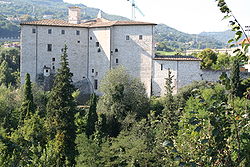 After a period as condottiero for and later tyrann of Ascoli Piceno, in 1349 he travelled to the Holy Land
. In 1351 he was hired in the Kingdom of Naples
. Galeotto was a stanch opposer of Gil de Albornoz in his reconquest of the Papla territories; after the latter's defeat his family was made Papal vicar in Rimini, Pesaro, Fano and Fossombrone. In 1356 he took part in the crusade declared against the Ordelaffi of Forlì
. In the 1360 he was first made commander-in-chief by the Queen of Naples Joan I
, but later he switched to the Republic of Florence
and then again to the Byzantine Empire
. In 1372 Pope Gregory XI
confirmed Galeotto general commander of the Papal Army against Bernabò Visconti
, whom he defeated at Montechiaro
the following year.
After the death of his nephews, Galeotto managed to gain the whole family seigniory in Romagna (he had been already lord of Rimini from 1364 with Ungaro IV and Pandolfo II Malatesta
, as well as sole ruler of Fano). After a series of small but ferocious ravages in the area, in 1376 he captured Cesena
, adding Bertinoro
in 1378. Later he warred against Guido da Polenta for Cesenatico
, conquering Senigallia
from him in 1383, as well as other lands. The war was continued by his sons, as Galeotto I died in 1385 at Cesena.
Italy
Italy , officially the Italian Republic languages]] under the European Charter for Regional or Minority Languages. In each of these, Italy's official name is as follows:;;;;;;;;), is a unitary parliamentary republic in South-Central Europe. To the north it borders France, Switzerland, Austria and...
condottiero, who was lord of Rimini
Rimini
Rimini is a medium-sized city of 142,579 inhabitants in the Emilia-Romagna region of Italy, and capital city of the Province of Rimini. It is located on the Adriatic Sea, on the coast between the rivers Marecchia and Ausa...
, Fano
Fano
Fano is a town and comune of the province of Pesaro and Urbino in the Marche region of Italy. It is a beach resort 12 km southeast of Pesaro, located where the Via Flaminia reaches the Adriatic Sea...
, Ascoli Piceno
Ascoli Piceno
Ascoli Piceno is a town and comune in the Marche region of Italy, capital of the province of the same name. Its population is c. 51,400.-Geography:...
, Cesena
Cesena
Cesena is a city and comune in the Emilia-Romagna region of northern Italy, south of Ravenna and west of Rimini, on the Savio River, co-chief of the Province of Forlì-Cesena. It is at the foot of the Apennines, and about 15 km from the Adriatic Sea.-History:Cesena was originally an Umbrian...
and Fossombrone
Fossombrone
Fossombrone is a town and comune in the province of Pesaro e Urbino .-History:The ancient Roman colony of Forum Sempronii took its name from Gaius Sempronius Gracchus....
.
Biography
Born in Rimini, he the son of Pandolfo I MalatestaPandolfo I Malatesta
Pandolfo I Malatesta , son of Malatesta da Verucchio, was an Italian condottiero and Lord of Rimini from 1317.In 1304, at the death of Pope Boniface VIII, he captured Pesaro, Fano, Senigallia and Fossombrone, which he lost and recovered in the following years.In 1317 he became lord of Rimini and...
and the brother of Malatesta II Malatesta
Malatesta II Malatesta
Malatesta II Malatesta, best known as Guastafamiglia was an Italian condottiero and lord of Rimini.-Biography:...
. In 1333 he was captured while besieging Ferrara
Ferrara
Ferrara is a city and comune in Emilia-Romagna, northern Italy, capital city of the Province of Ferrara. It is situated 50 km north-northeast of Bologna, on the Po di Volano, a branch channel of the main stream of the Po River, located 5 km north...
, but was soon freed and fought alongside Ferrantino Malatesta
Ferrantino Malatesta
Ferrantino Malatesta was a lord of Rimini and several other lands in northern Italy, a member of the Malatesta family....
against the Papal legate in Romagna
Romagna
Romagna is an Italian historical region that approximately corresponds to the south-eastern portion of present-day Emilia-Romagna. Traditionally, it is limited by the Apennines to the south-west, the Adriatic to the east, and the rivers Reno and Sillaro to the north and west...
. When the latter plotted against him, Galeotto imprisoned him and declared himself lord of Rimini. The war between the two lasted until 1343. Ludwig of Bavaria
Ludwig of Bavaria
-Dukes:*Louis I, Duke of Bavaria , Duke of Bavaria in 1183 and the Count of Palatinate of the Rhine in 1214. He was a son of Otto I*Louis II, Duke of Bavaria , Duke of Bavaria from 1253 and Count Palatine of the Rhine....
also made him lord of Fano.
Holy Land
The Holy Land is a term which in Judaism refers to the Kingdom of Israel as defined in the Tanakh. For Jews, the Land's identifiction of being Holy is defined in Judaism by its differentiation from other lands by virtue of the practice of Judaism often possible only in the Land of Israel...
. In 1351 he was hired in the Kingdom of Naples
Kingdom of Naples
The Kingdom of Naples, comprising the southern part of the Italian peninsula, was the remainder of the old Kingdom of Sicily after secession of the island of Sicily as a result of the Sicilian Vespers rebellion of 1282. Known to contemporaries as the Kingdom of Sicily, it is dubbed Kingdom of...
. Galeotto was a stanch opposer of Gil de Albornoz in his reconquest of the Papla territories; after the latter's defeat his family was made Papal vicar in Rimini, Pesaro, Fano and Fossombrone. In 1356 he took part in the crusade declared against the Ordelaffi of Forlì
Forlì
Forlì is a comune and city in Emilia-Romagna, Italy, and is the capital of the province of Forlì-Cesena. The city is situated along the Via Emilia, to the right of the Montone river, and is an important agricultural centre...
. In the 1360 he was first made commander-in-chief by the Queen of Naples Joan I
Joan I of Naples
Joan I , born Joanna of Anjou, was Queen of Naples from 1343 until her death. She was also Countess of Provence and Forcalquier, Queen consort of Majorca and titular Queen of Jerusalem and Sicily 1343–82, and Princess of Achaea 1373/5–81....
, but later he switched to the Republic of Florence
Republic of Florence
The Republic of Florence , or the Florentine Republic, was a city-state that was centered on the city of Florence, located in modern Tuscany, Italy. The republic was founded in 1115, when the Florentine people rebelled against the Margraviate of Tuscany upon Margravine Matilda's death. The...
and then again to the Byzantine Empire
Byzantine Empire
The Byzantine Empire was the Eastern Roman Empire during the periods of Late Antiquity and the Middle Ages, centred on the capital of Constantinople. Known simply as the Roman Empire or Romania to its inhabitants and neighbours, the Empire was the direct continuation of the Ancient Roman State...
. In 1372 Pope Gregory XI
Pope Gregory XI
Gregory XI was pope from 1370 until his death.-Biography:He was born Pierre Roger de Beaufort, in Maumont, in the modern commune of Rosiers-d'Égletons, Limousin around 1336. He succeeded Pope Urban V in 1370, and was pope until 1378...
confirmed Galeotto general commander of the Papal Army against Bernabò Visconti
Bernabo Visconti
Bernabò Visconti was an Italian soldier and statesman, who was Lord of Milan.-Life:He was born in Milan, the son of Stefano Visconti and Valentina Doria. From 1346 to 1349 he lived in exile, until he was called back by his uncle Giovanni Visconti...
, whom he defeated at Montechiaro
Montechiaro
Montechiaro could refer to:* Montechiaro d'Asti - a town and comune in the Province of Asti, Italy* Montechiaro d'Acqui - a town and comune in the Province of Alessandria, Italy* Palma di Montechiaro - a town and comune of Sicily...
the following year.
After the death of his nephews, Galeotto managed to gain the whole family seigniory in Romagna (he had been already lord of Rimini from 1364 with Ungaro IV and Pandolfo II Malatesta
Pandolfo II Malatesta
Pandolfo II Malatesta was an Italian condottiero.The son of Malatesta II Malatesta, he fought under Werner von Urslingen and Gil de Albornoz. Later served Galeazzo II Visconti of Milan, but raised the jealousy of Bernabò Visconti and fled to the Marche. Later held a condotta for Florence against...
, as well as sole ruler of Fano). After a series of small but ferocious ravages in the area, in 1376 he captured Cesena
Cesena
Cesena is a city and comune in the Emilia-Romagna region of northern Italy, south of Ravenna and west of Rimini, on the Savio River, co-chief of the Province of Forlì-Cesena. It is at the foot of the Apennines, and about 15 km from the Adriatic Sea.-History:Cesena was originally an Umbrian...
, adding Bertinoro
Bertinoro
Bertinoro is a town and comune in the province of Forlì-Cesena, Emilia-Romagna . It is located on hill, Mount Cesubeo, in Romagna, a few kilometers from the Via Emilia.-History:...
in 1378. Later he warred against Guido da Polenta for Cesenatico
Cesenatico
Cesenatico is a port town with about 20,000 inhabitants on the Adriatic coast of Italy. It is located in the province of Forlì-Cesena in the region of Emilia-Romagna, about 30 km south of Ravenna...
, conquering Senigallia
Senigallia
Senigallia is a comune and port town on Italy's Adriatic coast, 25 km by rail north of Ancona, in the Marche region, province of Ancona....
from him in 1383, as well as other lands. The war was continued by his sons, as Galeotto I died in 1385 at Cesena.