


Football

Encyclopedia
Football may refer to one of a number of team sport
s which all involve, to varying degrees, kicking
a ball with the foot to score a goal
. The most popular of these sports worldwide is association football, more commonly known as just "football" or "soccer". Unqualified, the word football
applies to whichever form of football is the most popular in the regional context in which the word appears, including American football
, Australian rules football
, Canadian football
, Gaelic football
, rugby league
, rugby union
and other related games. These variations of football are known as football "codes".
In most codes, there are rules restricting the movement of players offside
, and players scoring a goal must put the ball either under or over a crossbar
between the goalposts. Other features common to several football codes include: points being mostly scored by players carrying the ball across the goal line; and players receiving a free kick
after they take a mark
or make a fair catch
.
Peoples from around the world have played games which involved kicking or carrying a ball, since ancient times. However, most of the modern codes of football have their origins in England
.
The conflicting theories are discussed at length in the main article Football (word)
.
and Romans
are known to have played many ball games, some of which involved the use of the feet. The Roman game harpastum
is believed to have been adapted from a Greek
team game known as "ἐπίσκυρος" (episkyros) or "φαινίνδα" (phaininda), which is mentioned by a Greek playwright, Antiphanes
(388–311 BC) and later referred to by the Christian
theologian Clement of Alexandria
(c.150-c.215 AD). These games appear to have resembled rugby football
. The Roman politician Cicero
(106–43 BC) describes the case of a man who was killed whilst having a shave when a ball was kicked into a barber's shop. Roman ball games already knew the air-filled ball, the follis.
Documented evidence of an activity resembling football can be found in the Chinese military
manual Zhan Guo Ce
compiled between the 3rd century and 1st century BC. It describes a practice known as cuju
(蹴鞠, literally "kick ball"), which originally involved kicking a leather ball through a small hole in a piece of silk
cloth which was fixed on bamboo canes and hung about 9 m above ground. During the Han Dynasty
(206 BC–220 AD), cuju games were standardized and rules were established. Variations of this game later spread to Japan and Korea
, known as kemari
and chuk-guk respectively. Later, another type of goal posts emerged, consisting of just one goal post in the middle of the field.
 The Japanese version of cuju is kemari
(蹴鞠), and was developed during the Asuka period
. This is known to have been played within the Japanese imperial court in Kyoto
from about 600 AD. In kemari several people stand in a circle and kick a ball to each other, trying not to let the ball drop to the ground (much like keepie uppie
). The game appears to have died out sometime before the mid-19th century. It was revived in 1903 and is now played at a number of festivals.
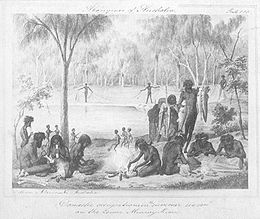 There are a number of references to tradition
al, ancient, or prehistoric ball games, played by indigenous peoples
in many different parts of the world. For example, in 1586, men from a ship commanded by an English explorer named John Davis
, went ashore to play a form of football with Inuit
(Eskimo) people in Greenland
. There are later accounts of an Inuit game played on ice, called Aqsaqtuk. Each match began with two teams facing each other in parallel lines, before attempting to kick the ball through each other team's line and then at a goal. In 1610, William Strachey
, a colonist at Jamestown, Virginia
recorded a game played by Native Americans
, called Pahsaheman. On the Australian continent several tribes of indigenous people
played kicking and catching games with stuffed balls which have been generalised by historians as Marn Grook
(Djab Wurrung
for "game ball"). The earliest historical account is an anecdote
from the 1878 book by Robert Brough-Smyth, The Aborigines of Victoria, in which a man called Richard Thomas is quoted as saying, in about 1841 in Victoria, Australia, that he had witnessed Aboriginal people playing the game: "Mr Thomas describes how the foremost player will drop kick a ball made from the skin of a possum
and how other players leap into the air in order to catch it." Some historians have theorised that Marn Grook was one of the origins of Australian rules football
.
The Māori in New Zealand
played a game called Ki-o-rahi
consisting of teams of seven players play on a circular field divided into zones, and score points by touching the 'pou' (boundary markers) and hitting a central 'tupu' or target.
Games played in Mesoamerica
with rubber balls by indigenous peoples
are also well-documented as existing since before this time, but these had more similarities to basketball
or volleyball
, and since their influence on modern football games is minimal, most do not class them as football. Northeastern American Indians, especially the Iroquois
Confederation, played a game which made use of net racquets to throw and catch a small ball; however, although a ball-goal foot game, lacrosse
(as its modern descendant is called) is likewise not usually classed as a form of "football."
These games and others may well go far back into antiquity. However, the main sources of modern football codes appear to lie in western Europe, especially England
.
saw a huge rise in popularity of annual Shrovetide football matches throughout Europe, particularly in England. The game played in England at this time may have arrived with the Roman occupation
, but the only pre-Norman reference is to boys playing "ball games" in the 9th century Historia Brittonum. Reports of a game played in Brittany
, Normandy
, and Picardy
, known as La Soule
or Choule, suggest that some of these football games could have arrived in England as a result of the Norman Conquest.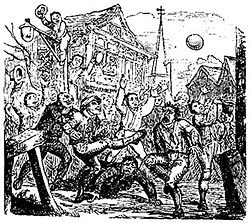 These forms of football, sometimes referred to as "mob football
", would be played between neighbouring towns and villages, involving an unlimited number of players on opposing teams, who would clash in a heaving mass of people, struggling to move an item such as an inflated pig's bladder
, to particular geographical points, such as their opponents' church. Shrovetide games have survived into the modern era in a number of English towns (see below).
The first detailed description of what was almost certainly football in England was given by William FitzStephen in about 1174–1183. He described the activities of London youths during the annual festival of Shrove Tuesday
:
Most of the very early references to the game speak simply of "ball play" or "playing at ball". This reinforces the idea that the games played at the time did not necessarily involve a ball being kicked.
An early reference to a ball game that was probably football comes from 1280 at Ulgham
, Northumberland
, England: "Henry... while playing at ball.. ran against David". Football was played in Ireland in 1308, with a documented reference to John McCrocan, a spectator at a "football game" at Newcastle, County Down
being charged with accidentally stabbing a player named William Bernard. Another reference to a football game comes in 1321 at Shouldham
, Norfolk
, England: "[d]uring the game at ball as he kicked the ball, a lay friend of his... ran against him and wounded himself".
In 1314, Nicholas de Farndone, Lord Mayor of the City of London issued a decree banning football in the French used by the English upper classes at the time. A translation reads: "[f]orasmuch as there is great noise in the city caused by hustling over large foot balls [rageries de grosses pelotes de pee] in the fields of the public from which many evils might arise which God forbid: we command and forbid on behalf of the king, on pain of imprisonment, such game to be used in the city in the future." This is the earliest reference to football.
In 1363, King Edward III of England
issued a proclamation banning "...handball, football, or hockey; coursing and cock-fighting, or other such idle games", showing that "football" — whatever its exact form in this case — was being differentiated from games involving other parts of the body, such as handball.
King Henry IV of England
also presented one of the earliest documented uses of the English word "football", in 1409, when he issued a proclamation forbidding the levying of money for "foteball".
There is also an account in Latin
from the end of the 15th century of football being played at Cawston, Nottinghamshire
. This is the first description of a "kicking game" and the first description of dribbling
: "[t]he game at which they had met for common recreation is called by some the foot-ball game. It is one in which young men, in country sport, propel a huge ball not by throwing it into the air but by striking it and rolling it along the ground, and that not with their hands but with their feet... kicking in opposite directions" The chronicler gives the earliest reference to a football pitch, stating that: "[t]he boundaries have been marked and the game had started.
Other firsts in the mediæval and early modern
eras:
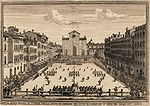
In the 16th century, the city of Florence
celebrated the period between Epiphany and Lent
by playing a game which today is known as "calcio storico" ("historic kickball") in the Piazza Santa Croce
. The young aristocrats of the city would dress up in fine silk costumes and embroil themselves in a violent form of football. For example, calcio players could punch, shoulder charge, and kick opponents. Blows below the belt were allowed. The game is said to have originated as a military training exercise. In 1580, Count Giovanni de' Bardi di Vernio wrote Discorso sopra 'l giuoco del Calcio Fiorentino. This is sometimes said to be the earliest code of rules for any football game. The game was not played after January 1739 (until it was revived in May 1930).
and early modern period
. Between 1324 and 1667, football was banned in England alone by more than 30 royal and local laws. The need to repeatedly proclaim such laws demonstrated the difficulty in enforcing bans on popular games.
King Edward II
was so troubled by the unruliness of football in London that on April 13, 1314 he issued a proclamation banning it: "Forasmuch as there is great noise in the city caused by hustling over large balls from which many evils may arise which God forbid; we command and forbid, on behalf of the King, on pain of imprisonment, such game to be used in the city in the future."
The reasons for the ban by Edward III
, on June 12, 1349, were explicit: football and other recreations distracted the populace from practicing archery
, which was necessary for war. In 1424, the Parliament of Scotland
passed a Football Act
that stated it is statut and the king forbiddis that na man play at the fut ball under the payne of iiij d – in other words, playing football was made illegal, and punishable by a fine of four pence
.
By 1608, the local authorities in Manchester
were complaining that: "With the ffotebale...[there] hath beene greate disorder in our towne of Manchester we are told, and glasse windowes broken yearlye and spoyled by a companie of lewd and disordered persons ..." That same year, the word
"football" was used disapprovingly by William Shakespeare
. Shakespeare's play King Lear
contains the line: "Nor tripped neither, you base football player" (Act I, Scene 4).
Shakespeare also mentions the game in A Comedy of Errors (Act II, Scene 1):
"Spurn" literally means to kick away, thus implying that the game involved kicking a ball between players.
King James I of England
's Book of Sports (1618) however, instructs Christians to play at football every Sunday afternoon after worship. The book's aim appears to be an attempt to offset the strictness of the Puritans regarding the keeping of the Sabbath.
The earliest evidence that games resembling football were being played at English public schools — mainly attended by boys from the upper, upper-middle and professional classes — comes from the Vulgaria by William Herman in 1519. Herman had been headmaster at Eton
and Winchester
colleges and his Latin
textbook includes a translation exercise with the phrase "We wyll playe with a ball full of wynde".
Richard Mulcaster
, a student at Eton College
in the early 16th century and later headmaster at other English schools, has been described as "the greatest sixteenth Century advocate of football". Among his contributions are the earliest evidence of organised team football. Mulcaster's writings refer to teams ("sides" and "parties"), positions ("standings"), a referee ("judge over the parties") and a coach "(trayning maister)". Mulcaster's "footeball" had evolved from the disordered and violent forms of traditional football:
In 1633, David Wedderburn
, a teacher from Aberdeen
, mentioned elements of modern football games in a short Latin
textbook called Vocabula. Wedderburn refers to what has been translated into modern English as "keeping goal" and makes an allusion to passing the ball ("strike it here"). There is a reference to "get hold of the ball", suggesting that some handling was allowed. It is clear that the tackles allowed included the charging and holding of opposing players ("drive that man back").
A more detailed description of football is given in Francis Willughby
's Book of Games, written in about 1660. Willughby, who had studied at Bishop Vesey's Grammar School
, Sutton Coldfield
, is the first to describe goals and a distinct playing field: "a close that has a gate at either end. The gates are called Goals." His book includes a diagram illustrating a football field. He also mentions tactics ("leaving some of their best players to guard the goal"); scoring ("they that can strike the ball through their opponents' goal first win") and the way teams were selected ("the players being equally divided according to their strength and nimbleness"). He is the first to describe a "law" of football: "they must not strike [an opponent's leg] higher than the ball".
English public schools were the first to codify football games. In particular, they devised the first offside
rules, during the late 18th century. In the earliest manifestations of these rules, players were "off their side" if they simply stood between the ball and the goal which was their objective. Players were not allowed to pass the ball forward, either by foot or by hand. They could only dribble with their feet, or advance the ball in a scrum
or similar formation. However, offside laws began to diverge and develop differently at the each school, as is shown by the rules of football from Winchester, Rugby
, Harrow
and Cheltenham, during between 1810 and 1850. The first known codes — in the sense of a set of rules — were those of Eton in 1815 and Aldenham
in 1825.)
During the early 19th century, most working class
people in Britain had to work six days a week, often for over twelve hours a day. They had neither the time nor the inclination to engage in sport for recreation and, at the time, many children were part of the labour force. Feast day football played on the streets was in decline. Public school boys, who enjoyed some freedom from work, became the inventors of organised football games with formal codes of rules.
Football was adopted by a number of public schools as a way of encouraging competitiveness and keeping youths fit. Each school drafted its own rules, which varied widely between different schools and were changed over time with each new intake of pupils. Two schools of thought developed regarding rules. Some schools favoured a game in which the ball could be carried (as at Rugby, Marlborough
and Cheltenham), while others preferred a game where kicking and dribbling the ball was promoted (as at Eton, Harrow, Westminster
and Charterhouse
). The division into these two camps was partly the result of circumstances in which the games were played. For example, Charterhouse and Westminster at the time had restricted playing areas; the boys were confined to playing their ball game within the school cloisters, making it difficult for them to adopt rough and tumble running games.
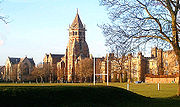 William Webb Ellis
, a pupil at Rugby School, is said to have "with a fine disregard for the rules of football, as played in his time [emphasis added], first took the ball in his arms and ran with it, thus creating the distinctive feature of the rugby game." in 1823. This act is usually said to be the beginning of Rugby football, but there is little evidence that it occurred, and most sports historians believe the story to be apocryphal. The act of 'taking the ball in his arms' is often misinterpreted as 'picking the ball up' as it is widely believed that Webb Ellis' 'crime' was handling the ball, as in modern soccer, however handling the ball at the time was often permitted and in some cases compulsory, the rule for which Webb Ellis showed disregard was running forward with it as the rules of his time only allowed a player to retreat backwards or kick forwards.
The boom in rail transport in Britain
during the 1840s meant that people were able to travel further and with less inconvenience than they ever had before. Inter-school sporting competitions became possible. However, it was difficult for schools to play each other at football, as each school played by its own rules. The solution to this problem was usually that the match be divided into two halves, one half played by the rules of the host "home" school, and the other half by the visiting "away" school.
The modern rules of many football codes were formulated during the mid- or late- 19th century. This also applies to other sports such as lawn bowls, lawn tennis, etc. The major impetus for this was the patenting of the world's first lawnmower in 1830. This allowed for the preparation of modern ovals, playing fields, pitches, grass courts, etc.
Apart from Rugby football, the public school codes have barely been played beyond the confines of each school's playing fields. However, many of them are still played at the schools which created them (see Surviving UK school games below).
Public schools' dominance of sports in the UK began to wane after the Factory Act of 1850, which significantly increased the recreation time available to working class children. Before 1850, many British children had to work six days a week, for more than twelve hours a day. From 1850, they could not work before 6 a.m. (7 a.m. in winter) or after 6 p.m. on weekdays (7 p.m. in winter); on Saturdays they had to cease work at 2 p.m. These changes mean that working class children had more time for games, including various forms of football.
which was founded in the mid-18th century and ceased playing matches in 1796. The first documented club to bear the title "football club" is one in Edinburgh
, Scotland
, during the period 1824–41. The club forbade tripping but allowed pushing and holding and the picking up of the ball.
Two clubs which claim to be the world's oldest existing football club
, in the sense of a club which is not part of a school or university, are strongholds of rugby football: the Barnes Club
, said to have been founded in 1839, and Guy's Hospital Football Club, in 1843. Neither date nor the variety of football played is well documented, but such claims nevertheless allude to the popularity of rugby before other modern codes emerged.
In 1845, three boys at Rugby school were tasked with codifying the rules then being used at the school. These were the first set of written rules (or code) for any form of football. This further assisted the spread of the Rugby game. For instance, Dublin University Football Club
—founded at Trinity College, Dublin
in 1854 and later famous as a bastion of the Rugby School game—is the world's oldest documented football club in any code.
and Scotch College, Melbourne
every year since 1858. It is believed by many to also be the first match of Australian rules football
, although it was played under experimental rules in its first year. The first football trophy tournament was the Caledonian Challenge Cup, donated by the Royal Caledonian
Society of Melbourne, played in 1861 under the Melbourne Rules. The oldest football league is a rugby football competition, the United Hospitals Challenge Cup (1874), while the oldest rugby trophy is the Yorkshire Cup
, contested since 1878. The South Australian Football Association (30 April 1877) is the oldest surviving Australian rules football competition. The oldest surviving soccer trophy is the Youdan Cup
(1867) and the oldest national soccer competition is the English FA Cup (1871). The Football League
(1888) is recognised as the longest running Association Football league. The first ever international football match took place between sides representing England and Scotland on March 5, 1870 at the Oval
under the authority of the FA. The first Rugby international took place in 1871.
.jpg) In Europe, early footballs were made out of animal bladders
In Europe, early footballs were made out of animal bladders
, more specifically pig's bladders
, which were inflated. Later leather
coverings were introduced to allow the ball to keep their shape. However, in 1851, Richard Lindon
and William Gilbert
, both shoemakers from the town of Rugby
(near the school), exhibited both round and oval-shaped balls at the Great Exhibition in London. Richard Lindon's wife is said to have died of lung disease caused by blowing up pig's bladders. Lindon also won medals for the invention of the "Rubber inflatable Bladder" and the "Brass Hand Pump".
In 1855, the U.S. inventor Charles Goodyear
— who had patented vulcanized rubber — exhibited a spherical football, with an exterior of vulcanized rubber panels, at the Paris Exhibition Universelle
. The ball was to prove popular in early forms of football in the U.S.A.
, Scotland
.
"Scientific" football is first recorded in 1839 from Lancashire
and in the modern game in Rugby football from 1862 and from Sheffield FC as early as 1865. The first side to play a passing combination game
was the Royal Engineers AFC in 1869/70 By 1869 they were "work[ing] well together", "backing up" and benefiting from "cooperation". By 1870 the Engineers were passing the ball: "Lieut. Creswell, who having brought the ball up the side then kicked it into the middle to another of his side, who kicked it through the posts the minute before time was called" Passing was a regular feature of their style By early 1872 the Engineers were the first football team renowned for "play[ing] beautifully together" A double pass is first reported from Derby school against Nottingham Forest in March 1872, the first of which is irrefutably a short pass: "Mr Absey dribbling the ball half the length of the field delivered it to Wallis, who kicking it cleverly in front of the goal, sent it to the captain who drove it at once between the Nottingham posts" The first side to have perfected the modern formation was Cambridge University AFC and introduced the 2–3–5 "pyramid" formation.
, Mr. H. de Winton and Mr. J.C. Thring
, who were both formerly at Shrewsbury School
, called a meeting at Trinity College, Cambridge
with 12 other representatives from Eton, Harrow, Rugby, Winchester
and Shrewsbury. An eight-hour meeting produced what amounted to the first set of modern rules, known as the Cambridge rules. No copy of these rules now exists, but a revised version from circa 1856 is held in the library of Shrewsbury School. The rules clearly favour the kicking game. Handling was only allowed when a player catches the ball directly from the foot entitling them to a free kick and there was a primitive offside rule, disallowing players from "loitering" around the opponents' goal. The Cambridge rules were not widely adopted outside English public schools and universities (but it was arguably the most significant influence on the Football Association
committee members responsible for formulating the rules of Association football).
, founded in 1857 in the English city of Sheffield
by Nathaniel Creswick and William Prest, was later recognised as the world's oldest club playing association football.
However, the club initially played its own code of football: the Sheffield rules. The code was largely independent of the public school rules, the most significant difference being the lack of an offside rule.
The code was responsible for many innovations that later spread to association football. These included free kick
s, corner kick
s, handball, throw-in
s and the crossbar. By the 1870s they became the dominant code in the north and midlands of England. At this time a series of rule changes by both the London
and Sheffield FAs gradually eroded the differences between the two games until the adoption of a common code in 1877.
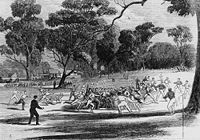 Various forms of football were played in Australia during the Victorian gold rush
, from which emerged a distinct and locally popular sport. While these origins are still the subject of much debate the popularisation of the code that is known today as Australian Rules Football is currently attributed to Tom Wills
.
Wills wrote a letter to Bell's Life in Victoria & Sporting Chronicle, on July 10, 1858, calling for a "foot-ball club" with a "code of laws" to keep cricketers fit during winter. This is considered by historians to be a defining moment in the creation of the new sport. Through publicity and personal contacts Wills was able to co-ordinate football matches in Melbourne
that experimented with various rules, the first recorded of which occurred on July 31, 1858. On 7 August 1858, Wills umpired a relatively well documented schoolboys match between Melbourne Grammar School
and Scotch College. Following these matches, organised football matches rapidly increased in popularity.
Wills and others involved in these early matches formed the Melbourne Football Club
(the oldest surviving Australian football club) on May 14, 1859. The first members included Wills, William Hammersley
, J.B. Thompson and Thomas H. Smith
. They met with the intention of forming a set of rules that would be widely adopted by other clubs.
The backgrounds of the original rule makers makes for interesting speculation as to the influences on the rules. Wills, an Australian of convict heritage was educated in England. He was a rugby football
er, a cricketer and had strong links to indigenous Australians. At first he desired to introduce rugby school rules. Hammersley was a cricketer and journalist who emigrated from England. Thomas Smith was a school teacher who emigrated from Ireland. The committee members debated several rules including those of English public school games. Despite including aspects similar to other forms of football there is no conclusive evidence to point to any single influence. Instead the committee decided on a game that was more suited to Australian conditions and Wills is documented to have made the declaration "No, we shall have a game of our own". The code was distinctive in the prevalence of the mark
, free kick
, tackling, lack of an offside rule and that players were specifically penalised for throwing the ball
.
The Melbourne football rules were widely distributed and gradually adopted by the other Victorian clubs. They were redrafting several times during the 1860s to accommodate the rules of other influential Victorian football clubs. A significant re-write in 1866 by H C A Harrison's committee to accommodate rules from the Geelong Football Club
made the game, which had become known as "Victorian Rules", increasingly distinct from other codes. It used cricket fields, a rugby ball, specialised goal and behind posts, bouncing with the ball while running and later spectacular high marking
. The form of football spread quickly to other other Australian colonies. Outside of its heartland in southern Australia the code experienced a significant period of decline following World War I
but has since grown other parts of the world at an amateur level and the Australian Football League
emerged as the dominant professional competition.
.jpg)
During the early 1860s, there were increasing attempts in England to unify and reconcile the various public school games. In 1862, J. C. Thring, who had been one of the driving forces behind the original Cambridge Rules, was a master at Uppingham School
and he issued his own rules of what he called "The Simplest Game" (these are also known as the Uppingham Rules). In early October 1863 another new revised version of the Cambridge Rules was drawn up by a seven member committee representing former pupils from Harrow, Shrewsbury, Eton, Rugby, Marlborough and Westminster.
At the Freemasons' Tavern, Great Queen Street, London on the evening of October 26, 1863, representatives of several football clubs in the London Metropolitan area
met for the inaugural meeting of The Football Association
(FA). The aim of the Association was to establish a single unifying code and regulate the playing of the game among its members. Following the first meeting, the public schools were invited to join the association. All of them declined, except Charterhouse and Uppingham. In total, six meetings of the FA were held between October and December 1863. After the third meeting, a draft set of rules were published. However, at the beginning of the fourth meeting, attention was drawn to the recently published Cambridge Rules of 1863. The Cambridge rules differed from the draft FA rules in two significant areas; namely running with (carrying) the ball and hacking (kicking opposing players in the shins). The two contentious FA rules were as follows:
At the fifth meeting it was proposed that these two rules be removed. Most of the delegates supported this, but F. M. Campbell, the representative from Blackheath and the first FA treasurer, objected. He said: "hacking is the true football". However, the motion to ban running with the ball in hand and hacking was carried and Blackheath withdrew from the FA. After the final meeting on 8 December, the FA published the "Laws of Football
", the first comprehensive set of rules for the game later known as Association Football
. The term "soccer", in use since the late 19th century, derives from an abbreviation of "Association".
The first FA rules still contained elements that are no longer part of association football, but which are still recognisable in other games (such as Australian football and rugby football): for instance, a player could make a fair catch and claim a mark
, which entitled him to a free kick; and if a player touched the ball behind the opponents' goal line, his side was entitled to a free kick at goal, from 15 yards (13.5 metres) in front of the goal line.
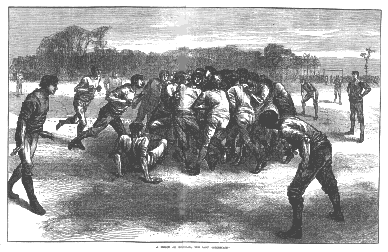 In Britain
, by 1870, there were about 75 clubs playing variations of the Rugby school game. There were also "rugby" clubs in Ireland, Australia, Canada and New Zealand. However, there was no generally accepted set of rules for rugby until 1871, when 21 clubs from London came together to form the Rugby Football Union
(RFU). The first official RFU rules were adopted in June 1871. These rules allowed passing the ball. They also included the try
, where touching the ball over the line allowed an attempt at goal, though drop-goals from marks and general play, and penalty conversions were still the main form of contest.
.
in New Hampshire
played a game called Old division football
, a variant of the association football codes, as early as the 1820s.
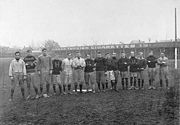 The first game of rugby in Canada is generally said to have taken place in Montreal
, in 1865, when British Army
officers played local civilians. The game gradually gained a following, and the Montreal Football Club
was formed in 1868, the first recorded football club in Canada.
In 1869, the first game played
in the United States under rules based on the FA code occurred, between Princeton
and Rutgers
. This is also often considered to be the first U.S. game of college football
, in the sense of a game between colleges (although the eventual form of American football would come from rugby, not association football).
Modern American football
grew out of a match between McGill University
of Montreal, and Harvard University
in 1874. At the time, Harvard students are reported to have played the Boston Game — a running code — rather than the FA-based kicking games favoured by U.S. universities. This made it easy for Harvard to adapt to the rugby-based game played by McGill and the two teams alternated between their respective sets of rules. Within a few years, however, Harvard had both adopted McGill's rugby rules and had persuaded other U.S. university teams to do the same. In 1876, at the Massasoit Convention, it was agreed by these universities to adopt most of the Rugby Football Union
rules, with some variations. Princeton, Rutgers and others continued to compete using soccer-based rules for a few years before switching to the rugby-based rules of Harvard and its competitors. U.S. colleges did not generally return to soccer until the early 20th century.
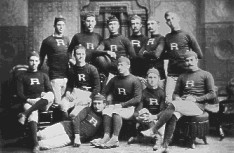 In 1880, Yale
coach Walter Camp
, devised a number of major changes to the American game. Camp's two most important rule innovations in establishing American football as distinct from the rugby football games on which it is based are scrimmage and down-and-distance rules.
Scrimmage
refers to the practice of starting action by delivering the ball from the ground to another player's hand. Camp's original rule allowed this delivery to be done only with the feet; the rule was soon changed to allow the ball to be passed by hand. The rule also established a distinct line of scrimmage
which separates the two teams from each other. When a player is tackled, he is ruled down and play stops, while the teams reset on either side of the line of scrimmage. Play then resumes with the delivery of the ball. Teams are given a limited number of downs to achieve a certain distance (always measured in yard
s). In American football, teams are given four downs to advance the ball ten yards, after which possession of the ball changes. In Canadian football, teams are allowed three downs to advance ten yards. These rules created a fundamental distinction between the North American codes and rugby codes. Rugby is still fundamentally a continuous-action game, while North American codes are organized around running discrete "plays
", as defined as starting with the delivery from "scrimmage" and ending with the "down".
American football, in its early years, was an excessively violent game, plagued with several deaths and life-changing injuries every year. The violence became so drastic that President
Theodore Roosevelt
threatened to shut down the game in 1905, should rules not be changed to minimize this violence. Several rule changes were put into place that year, but the most enduring has been the introduction of the legal forward pass
, which, like Camp's rule changes of the 1880s, fundamentally changed the nature of the sport. When it became legal to throw the ball forward, an entire new method of advancing the ball emerged. As a result, players became more specialized in their roles, as the different positions on the team required different skill sets. Thus, some players are primarily involved in running with the ball (the running back
) while others specialize in throwing (the quarterback
), catching (the wide receiver
), or blocking (the offensive line). With the advent of free substitution rules in the 1940s and 1950s, teams could deploy separate offensive and defensive "platoons" which led to even greater specialization.
Over the years, Canadian football absorbed some developments in American football, but also retained many unique characteristics. One of these was that Canadian football, for many years, did not officially distinguish itself from rugby. For example, the Canadian Rugby Football Union, founded in 1884 was the forerunner of the Canadian Football League
, rather than a rugby union body. (The Canadian Rugby Union, today known as Rugby Canada
, was not formed until 1965.) American football was also frequently described as "rugby" in the 1880s.
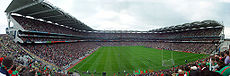
In the mid-19th century, various traditional football games, referred to collectively as caid
, remained popular in Ireland, especially in County Kerry
. One observer, Father W. Ferris, described two main forms of caid during this period: the "field game" in which the object was to put the ball through arch-like goals, formed from the boughs of two trees; and the epic "cross-country game" which took up most of the daylight hours of a Sunday on which it was played, and was won by one team taking the ball across a parish
boundary. "Wrestling", "holding" opposing players, and carrying the ball were all allowed.
By the 1870s, Rugby and Association football had started to become popular in Ireland. Trinity College, Dublin
was an early stronghold of Rugby (see the Developments in the 1850s section, above). The rules of the English FA were being distributed widely. Traditional forms of caid had begun to give way to a "rough-and-tumble game" which allowed tripping.
There was no serious attempt to unify and codify Irish varieties of football, until the establishment of the Gaelic Athletic Association
(GAA) in 1884. The GAA sought to promote traditional Irish sports, such as hurling
and to reject imported games like Rugby and Association football. The first Gaelic football rules were drawn up by Maurice Davin
and published in the United Ireland magazine on February 7, 1887. Davin's rules showed the influence of games such as hurling and a desire to formalise a distinctly Irish code of football. The prime example of this differentiation was the lack of an offside rule (an attribute which, for many years, was shared only by other Irish games like hurling, and by Australian rules football).
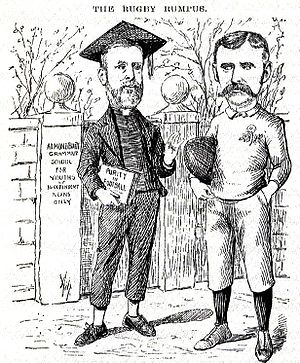
The International Rugby Football Board
(IRFB) was founded in 1886, but rifts were beginning to emerge in the code. Professionalism
was beginning to creep into the various codes of football.
In England, by the 1890s, a long-standing Rugby Football Union
ban on professional players was causing regional tensions within rugby football, as many players in northern England were working class
and could not afford to take time off to train, travel, play and recover from injuries. This was not very different from what had occurred ten years earlier in soccer in Northern England but the authorities reacted very differently in the RFU, attempting to alienate the working class support in Northern England. In 1895, following a dispute about a player being paid broken time payments, which replaced wages lost as a result of playing rugby, representatives of the northern clubs met in Huddersfield
to form the Northern Rugby Football Union
(NRFU). The new body initially permitted only various types of player wage replacements. However, within two years, NRFU players could be paid, but they were required to have a job outside sport.
The demands of a professional league dictated that rugby had to become a better "spectator" sport. Within a few years the NRFU rules had started to diverge from the RFU, most notably with the abolition of the line-out
. This was followed by the replacement of the ruck with the "play-the-ball ruck", which allowed a two-player ruck contest between the tackler at marker and the player tackled. Mauls were stopped once the ball carrier was held, being replaced by a play-the ball-ruck. The separate Lancashire and Yorkshire competitions of the NRFU merged in 1901, forming the Northern Rugby League, the first time the name rugby league
was used officially in England.
Over time, the RFU form of rugby, played by clubs which remained members of national federations affiliated to the IRFB, became known as rugby union
.
) was founded in Paris on May 21, 1904. Its first president was Robert Guérin
. The French name and acronym has remained, even outside French-speaking countries.
. He was considered a fancier of the game, but he threatened to ban it unless the rules were modified to reduce the numbers of deaths and disabilities. The meetings are now considered to be the origin of the National Collegiate Athletic Association
.
One proposed change was a widening of the playing field. However, Harvard University
had just built a concrete stadium
and therefore objected to widening, instead proposing legalisation of the forward pass
. The report of the meetings introduced many restrictions on tackling and two more divergences from rugby: the forward pass and the banning of mass formation plays. The changes did not immediately have the desired effect, and 33 American football players were killed during 1908 alone. However, the number of deaths and injuries did gradually decline.
the following year. However, the rules of professional games varied from one country to another, and negotiations between various national bodies were required to fix the exact rules for each international match. This situation endured until 1948, when at the instigation of the French league, the Rugby League International Federation
(RLIF) was formed at a meeting in Bordeaux
.
During the second half of 20th century, the rules changed further. In 1966, rugby league officials borrowed the American football concept of downs
: a team could retain possession of the ball for no more than four tackles. The maximum number of tackles was later increased to six (in 1971), and in rugby league this became known as the six tackle rule.
With the advent of full-time professionals in the early 1990s, and the consequent speeding up of the game, the five metre off-side distance between the two teams became 10 metres, and the replacement rule was superseded by various interchange rules, among other changes.
The laws of rugby union also changed significantly during the 20th century. In particular, goals from marks
were abolished, kicks directly into touch
from outside the 22 metre line were penalised, new laws were put in place to determine who had possession following an inconclusive ruck or maul, and the lifting of players in line-out
s was legalised.
In 1995, rugby union became an "open" game, that is one which allowed professional players. Although the original dispute between the two codes has now disappeared — and despite the fact that officials from both forms of rugby football have sometimes mentioned the possibility of re-unification — the rules of both codes and their culture have diverged to such an extent that such an event is unlikely in the foreseeable future.
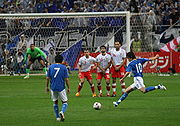
. Most often, the word "football" is used to refer to the code of football that is considered dominant within a particular region. So, effectively, what the word "football" means usually depends on where one says it.
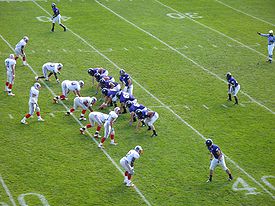 Association football is known generally as soccer where other codes of football are dominant, including: the United States, Canada, Ireland, Australia, and New Zealand. American football
is always football in the United States
. In francophone
Quebec
, where Canadian football
is more popular, the Canadian code is known as football and association football is known as . Of the 45 national FIFA
affiliates in which English is an official or primary language, most currently use Football in their organizations' official names. The FIFA affiliates in Canada
and the United States
use Soccer in their names.
A few FIFA affiliates have recently "normalized" to using "Football", including:
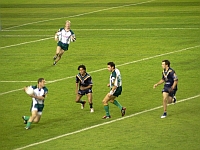 These codes have in common the absence of an offside rule, the requirement to bounce or solo (toe-kick) the ball while running, handpassing by punching or tapping the ball rather than throwing it, and other traditions.

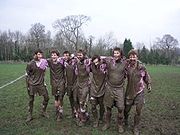 Games still played at UK public
(independent
) schools:
Note: although similar with football and volleyball in some aspects, Sepak takraw
has ancient origins and cannot be considered an hybrid game.
Team sport
A team sport includes any sport which involves players working together towards a shared objective. A team sport is an activity in which a group of individuals, on the same team, work together to accomplish an ultimate goal which is usually to win. This can be done in a number of ways such as...
s which all involve, to varying degrees, kicking
Kick (football)
Kicking is a method used by many types of football, including:* Association football* Australian rules football* International rules football* American football* Canadian football* Gaelic football* Rugby league* Rugby union...
a ball with the foot to score a goal
Goal (sport)
Goal refers to a method of scoring in many sports. It can also refer to the physical structure or area of the playing surface where scoring occurs....
. The most popular of these sports worldwide is association football, more commonly known as just "football" or "soccer". Unqualified, the word football
Football (word)
The English language word football may mean any one of several team sports , depending on the national or regional origin and location of the person using the word....
applies to whichever form of football is the most popular in the regional context in which the word appears, including American football
American football
American football is a sport played between two teams of eleven with the objective of scoring points by advancing the ball into the opposing team's end zone. Known in the United States simply as football, it may also be referred to informally as gridiron football. The ball can be advanced by...
, Australian rules football
Australian rules football
Australian rules football, officially known as Australian football, also called football, Aussie rules or footy is a sport played between two teams of 22 players on either...
, Canadian football
Canadian football
Canadian football is a form of gridiron football played exclusively in Canada in which two teams of 12 players each compete for territorial control of a field of play long and wide attempting to advance a pointed prolate spheroid ball into the opposing team's scoring area...
, Gaelic football
Gaelic football
Gaelic football , commonly referred to as "football" or "Gaelic", or "Gah" is a form of football played mainly in Ireland...
, rugby league
Rugby league
Rugby league football, usually called rugby league, is a full contact sport played by two teams of thirteen players on a rectangular grass field. One of the two codes of rugby football, it originated in England in 1895 by a split from Rugby Football Union over paying players...
, rugby union
Rugby union
Rugby union, often simply referred to as rugby, is a full contact team sport which originated in England in the early 19th century. One of the two codes of rugby football, it is based on running with the ball in hand...
and other related games. These variations of football are known as football "codes".
Common elements
The various codes of football share the following common elements:- Two teamTeamA team comprises a group of people or animals linked in a common purpose. Teams are especially appropriate for conducting tasks that are high in complexity and have many interdependent subtasks.A group in itself does not necessarily constitute a team...
s of usually between 11 and 18 players; some variations that have fewer players (five or more per team) are also popular. - A clearly defined area in which to play the game.
- ScoringScore (game)In games, score refers to an abstract quantity associated with a player or team. Score is usually measured in the abstract unit of points, and events in the game can raise or lower the score of different parties...
goalsGoal (sport)Goal refers to a method of scoring in many sports. It can also refer to the physical structure or area of the playing surface where scoring occurs....
or pointsScore (game)In games, score refers to an abstract quantity associated with a player or team. Score is usually measured in the abstract unit of points, and events in the game can raise or lower the score of different parties...
, by moving the ball to an opposing team's end of the field and either into a goal area, or over a line. - Goals or points resulting from players putting the ball between two goalposts.
- The goal or line being defended by the opposing team.
- Players being required to move the ball—depending on the code—by kicking, carrying, or hand-passing the ball.
- Players using only their body to move the ball.
In most codes, there are rules restricting the movement of players offside
Offside (sport)
Offside is a rule used by several different team sports regulating aspects of player positioning. It is particularly used in field sports with rules deriving from the various codes of football, such as association football, rugby and field hockey, as well as in ice hockey.Offside rules are...
, and players scoring a goal must put the ball either under or over a crossbar
Goal (sport)
Goal refers to a method of scoring in many sports. It can also refer to the physical structure or area of the playing surface where scoring occurs....
between the goalposts. Other features common to several football codes include: points being mostly scored by players carrying the ball across the goal line; and players receiving a free kick
Fair catch kick
The fair catch kick is a rarely used rule in some forms of American football that allows a team, after making a fair catch of an opponent's kick, to attempt a field goal freely from the spot of the catch. It is one of the three types of free kicks; the other two are the kickoff and the safety kick...
after they take a mark
Mark (Australian football)
A mark is a skill in Australian rules football where a player cleanly catches a kicked ball that has travelled more than 15 metres without anyone else touching it or the ball hitting the ground....
or make a fair catch
Fair catch
A fair catch is a feature of American football and several other codes of football, in which a player attempting to catch a ball kicked by the opposing team – either on a kickoff or punt – is entitled to catch the ball without interference from any member of the kicking team...
.
Peoples from around the world have played games which involved kicking or carrying a ball, since ancient times. However, most of the modern codes of football have their origins in England
England
England is a country that is part of the United Kingdom. It shares land borders with Scotland to the north and Wales to the west; the Irish Sea is to the north west, the Celtic Sea to the south west, with the North Sea to the east and the English Channel to the south separating it from continental...
.
Etymology
There are confilicting explanations of the origin of the word "football". It is widely assumed that the word "football" (or "foot ball") references the action of the foot kicking a ball. There is a alternative explanation, which is that football originally referred to a variety of games in medieval Europe, which were played on foot. There is no conclusive evidence for either explanation.The conflicting theories are discussed at length in the main article Football (word)
Football (word)
The English language word football may mean any one of several team sports , depending on the national or regional origin and location of the person using the word....
.
Ancient games
The Ancient GreeksAncient Greece
Ancient Greece is a civilization belonging to a period of Greek history that lasted from the Archaic period of the 8th to 6th centuries BC to the end of antiquity. Immediately following this period was the beginning of the Early Middle Ages and the Byzantine era. Included in Ancient Greece is the...
and Romans
Ancient Rome
Ancient Rome was a thriving civilization that grew on the Italian Peninsula as early as the 8th century BC. Located along the Mediterranean Sea and centered on the city of Rome, it expanded to one of the largest empires in the ancient world....
are known to have played many ball games, some of which involved the use of the feet. The Roman game harpastum
Harpastum
Harpastum, also known as Harpustum, was a form of ball game played in the Roman Empire. The Romans also referred to it as the small ball game. The ball used was small and hard, probably about the size and solidity of a softball...
is believed to have been adapted from a Greek
Ancient Greece
Ancient Greece is a civilization belonging to a period of Greek history that lasted from the Archaic period of the 8th to 6th centuries BC to the end of antiquity. Immediately following this period was the beginning of the Early Middle Ages and the Byzantine era. Included in Ancient Greece is the...
team game known as "ἐπίσκυρος" (episkyros) or "φαινίνδα" (phaininda), which is mentioned by a Greek playwright, Antiphanes
Antiphanes of Berge
Antiphanes of Berge in Thrace, near Amphipolis, was a Greek writer of the book Ἄπιστα . Strabo mentions him as an impostor, because Antiphanes wished the reader to believed everything in his book when they are falsehood...
(388–311 BC) and later referred to by the Christian
Christianity
Christianity is a monotheistic religion based on the life and teachings of Jesus as presented in canonical gospels and other New Testament writings...
theologian Clement of Alexandria
Clement of Alexandria
Titus Flavius Clemens , known as Clement of Alexandria , was a Christian theologian and the head of the noted Catechetical School of Alexandria. Clement is best remembered as the teacher of Origen...
(c.150-c.215 AD). These games appear to have resembled rugby football
Rugby football
Rugby football is a style of football named after Rugby School in the United Kingdom. It is seen most prominently in two current sports, rugby league and rugby union.-History:...
. The Roman politician Cicero
Cicero
Marcus Tullius Cicero , was a Roman philosopher, statesman, lawyer, political theorist, and Roman constitutionalist. He came from a wealthy municipal family of the equestrian order, and is widely considered one of Rome's greatest orators and prose stylists.He introduced the Romans to the chief...
(106–43 BC) describes the case of a man who was killed whilst having a shave when a ball was kicked into a barber's shop. Roman ball games already knew the air-filled ball, the follis.
Documented evidence of an activity resembling football can be found in the Chinese military
Military
A military is an organization authorized by its greater society to use lethal force, usually including use of weapons, in defending its country by combating actual or perceived threats. The military may have additional functions of use to its greater society, such as advancing a political agenda e.g...
manual Zhan Guo Ce
Zhan Guo Ce
The Zhan Guo Ce is a renowned ancient Chinese historical work and compilation of sporadic materials on the Warring States Period compiled between the 3rd to 1st centuries BCE...
compiled between the 3rd century and 1st century BC. It describes a practice known as cuju
Cuju
Cuju is an ancient code of football with similarities to association football. It is seen by some to be a forerunner of modern football and originated in China, and was also played in Korea, Japan and Vietnam.-History:...
(蹴鞠, literally "kick ball"), which originally involved kicking a leather ball through a small hole in a piece of silk
Silk
Silk is a natural protein fiber, some forms of which can be woven into textiles. The best-known type of silk is obtained from the cocoons of the larvae of the mulberry silkworm Bombyx mori reared in captivity...
cloth which was fixed on bamboo canes and hung about 9 m above ground. During the Han Dynasty
Han Dynasty
The Han Dynasty was the second imperial dynasty of China, preceded by the Qin Dynasty and succeeded by the Three Kingdoms . It was founded by the rebel leader Liu Bang, known posthumously as Emperor Gaozu of Han. It was briefly interrupted by the Xin Dynasty of the former regent Wang Mang...
(206 BC–220 AD), cuju games were standardized and rules were established. Variations of this game later spread to Japan and Korea
Korea
Korea ) is an East Asian geographic region that is currently divided into two separate sovereign states — North Korea and South Korea. Located on the Korean Peninsula, Korea is bordered by the People's Republic of China to the northwest, Russia to the northeast, and is separated from Japan to the...
, known as kemari
Kemari
Kemari is a form of football that was popular in Japan during the Heian Period. Kemari has been revived in modern times.-History:The first evidence of kemari is from A.D.644. The rules were standardized from the 13th century. It was the first Japanese sport to become highly developed.The game was...
and chuk-guk respectively. Later, another type of goal posts emerged, consisting of just one goal post in the middle of the field.
Kemari
Kemari is a form of football that was popular in Japan during the Heian Period. Kemari has been revived in modern times.-History:The first evidence of kemari is from A.D.644. The rules were standardized from the 13th century. It was the first Japanese sport to become highly developed.The game was...
(蹴鞠), and was developed during the Asuka period
Asuka period
The , was a period in the history of Japan lasting from 538 to 710 , although its beginning could be said to overlap with the preceding Kofun period...
. This is known to have been played within the Japanese imperial court in Kyoto
Kyoto
is a city in the central part of the island of Honshū, Japan. It has a population close to 1.5 million. Formerly the imperial capital of Japan, it is now the capital of Kyoto Prefecture, as well as a major part of the Osaka-Kobe-Kyoto metropolitan area.-History:...
from about 600 AD. In kemari several people stand in a circle and kick a ball to each other, trying not to let the ball drop to the ground (much like keepie uppie
Keepie uppie
Keepie uppie, or "kick-ups" is the skill of juggling with a football using feet, lower legs, knees, chest, shoulders, and head, without allowing the ball to hit the ground...
). The game appears to have died out sometime before the mid-19th century. It was revived in 1903 and is now played at a number of festivals.
Tradition
A tradition is a ritual, belief or object passed down within a society, still maintained in the present, with origins in the past. Common examples include holidays or impractical but socially meaningful clothes , but the idea has also been applied to social norms such as greetings...
al, ancient, or prehistoric ball games, played by indigenous peoples
Indigenous peoples
Indigenous peoples are ethnic groups that are defined as indigenous according to one of the various definitions of the term, there is no universally accepted definition but most of which carry connotations of being the "original inhabitants" of a territory....
in many different parts of the world. For example, in 1586, men from a ship commanded by an English explorer named John Davis
John Davis (English explorer)
John Davis , was one of the chief English navigators and explorers under Elizabeth I, especially in Polar regions and in the Far East.-Early life:...
, went ashore to play a form of football with Inuit
Inuit
The Inuit are a group of culturally similar indigenous peoples inhabiting the Arctic regions of Canada , Denmark , Russia and the United States . Inuit means “the people” in the Inuktitut language...
(Eskimo) people in Greenland
Greenland
Greenland is an autonomous country within the Kingdom of Denmark, located between the Arctic and Atlantic Oceans, east of the Canadian Arctic Archipelago. Though physiographically a part of the continent of North America, Greenland has been politically and culturally associated with Europe for...
. There are later accounts of an Inuit game played on ice, called Aqsaqtuk. Each match began with two teams facing each other in parallel lines, before attempting to kick the ball through each other team's line and then at a goal. In 1610, William Strachey
William Strachey
William Strachey was an English writer whose works are among the primary sources for the early history of the English colonisation of North America...
, a colonist at Jamestown, Virginia
Jamestown, Virginia
Jamestown was a settlement in the Colony of Virginia. Established by the Virginia Company of London as "James Fort" on May 14, 1607 , it was the first permanent English settlement in what is now the United States, following several earlier failed attempts, including the Lost Colony of Roanoke...
recorded a game played by Native Americans
Native Americans in the United States
Native Americans in the United States are the indigenous peoples in North America within the boundaries of the present-day continental United States, parts of Alaska, and the island state of Hawaii. They are composed of numerous, distinct tribes, states, and ethnic groups, many of which survive as...
, called Pahsaheman. On the Australian continent several tribes of indigenous people
Indigenous Australians
Indigenous Australians are the original inhabitants of the Australian continent and nearby islands. The Aboriginal Indigenous Australians migrated from the Indian continent around 75,000 to 100,000 years ago....
played kicking and catching games with stuffed balls which have been generalised by historians as Marn Grook
Marn Grook
Marn Grook , literally meaning "Game ball", is a collective name given to a number of traditional Indigenous Australian recreational pastimes believed to have been played at gatherings and celebrations of up to 50 players. It is often confused with a separate indigenous game resembling Association...
(Djab Wurrung
Djab Wurrung
The Djab wurrung people are Indigenous Australians who occupy the volcanic plains of central Victoria from the Mount William Range of Gariwerd in the west to the Pyrenees range in the east encompassing the Wimmera River flowing north and the headwaters of the Hopkins River flowing south. The towns...
for "game ball"). The earliest historical account is an anecdote
Anecdote
An anecdote is a short and amusing or interesting story about a real incident or person. It may be as brief as the setting and provocation of a bon mot. An anecdote is always presented as based on a real incident involving actual persons, whether famous or not, usually in an identifiable place...
from the 1878 book by Robert Brough-Smyth, The Aborigines of Victoria, in which a man called Richard Thomas is quoted as saying, in about 1841 in Victoria, Australia, that he had witnessed Aboriginal people playing the game: "Mr Thomas describes how the foremost player will drop kick a ball made from the skin of a possum
Possum
A possum is any of about 70 small to medium-sized arboreal marsupial species native to Australia, New Guinea, and Sulawesi .Possums are quadrupedal diprotodont marsupials with long tails...
and how other players leap into the air in order to catch it." Some historians have theorised that Marn Grook was one of the origins of Australian rules football
Australian rules football
Australian rules football, officially known as Australian football, also called football, Aussie rules or footy is a sport played between two teams of 22 players on either...
.
The Māori in New Zealand
New Zealand
New Zealand is an island country in the south-western Pacific Ocean comprising two main landmasses and numerous smaller islands. The country is situated some east of Australia across the Tasman Sea, and roughly south of the Pacific island nations of New Caledonia, Fiji, and Tonga...
played a game called Ki-o-rahi
Ki-o-rahi
Ki-o-rahi is a ball sport played in New Zealand with a small round ball called a 'ki'. The game is widely known in Māori communities and in scattered mainstream locations throughout the country. It is a fast-paced sport incorporating skills similar to Australian Rules, rugby union, netball and touch...
consisting of teams of seven players play on a circular field divided into zones, and score points by touching the 'pou' (boundary markers) and hitting a central 'tupu' or target.
Games played in Mesoamerica
Mesoamerican ballgame
The Mesoamerican ballgame or Tlatchtli in Náhuatl was a sport with ritual associations played since 1,000 B.C. by the pre-Columbian peoples of Ancient Mexico and Central America...
with rubber balls by indigenous peoples
Indigenous peoples of the Americas
The indigenous peoples of the Americas are the pre-Columbian inhabitants of North and South America, their descendants and other ethnic groups who are identified with those peoples. Indigenous peoples are known in Canada as Aboriginal peoples, and in the United States as Native Americans...
are also well-documented as existing since before this time, but these had more similarities to basketball
Basketball
Basketball is a team sport in which two teams of five players try to score points by throwing or "shooting" a ball through the top of a basketball hoop while following a set of rules...
or volleyball
Volleyball
Volleyball is a team sport in which two teams of six players are separated by a net. Each team tries to score points by grounding a ball on the other team's court under organized rules.The complete rules are extensive...
, and since their influence on modern football games is minimal, most do not class them as football. Northeastern American Indians, especially the Iroquois
Iroquois
The Iroquois , also known as the Haudenosaunee or the "People of the Longhouse", are an association of several tribes of indigenous people of North America...
Confederation, played a game which made use of net racquets to throw and catch a small ball; however, although a ball-goal foot game, lacrosse
Lacrosse
Lacrosse is a team sport of Native American origin played using a small rubber ball and a long-handled stick called a crosse or lacrosse stick, mainly played in the United States and Canada. It is a contact sport which requires padding. The head of the lacrosse stick is strung with loose mesh...
(as its modern descendant is called) is likewise not usually classed as a form of "football."
These games and others may well go far back into antiquity. However, the main sources of modern football codes appear to lie in western Europe, especially England
England
England is a country that is part of the United Kingdom. It shares land borders with Scotland to the north and Wales to the west; the Irish Sea is to the north west, the Celtic Sea to the south west, with the North Sea to the east and the English Channel to the south separating it from continental...
.
Medieval and early modern Europe
The Middle AgesMiddle Ages
The Middle Ages is a periodization of European history from the 5th century to the 15th century. The Middle Ages follows the fall of the Western Roman Empire in 476 and precedes the Early Modern Era. It is the middle period of a three-period division of Western history: Classic, Medieval and Modern...
saw a huge rise in popularity of annual Shrovetide football matches throughout Europe, particularly in England. The game played in England at this time may have arrived with the Roman occupation
Roman Britain
Roman Britain was the part of the island of Great Britain controlled by the Roman Empire from AD 43 until ca. AD 410.The Romans referred to the imperial province as Britannia, which eventually comprised all of the island of Great Britain south of the fluid frontier with Caledonia...
, but the only pre-Norman reference is to boys playing "ball games" in the 9th century Historia Brittonum. Reports of a game played in Brittany
Brittany
Brittany is a cultural and administrative region in the north-west of France. Previously a kingdom and then a duchy, Brittany was united to the Kingdom of France in 1532 as a province. Brittany has also been referred to as Less, Lesser or Little Britain...
, Normandy
Normandy
Normandy is a geographical region corresponding to the former Duchy of Normandy. It is in France.The continental territory covers 30,627 km² and forms the preponderant part of Normandy and roughly 5% of the territory of France. It is divided for administrative purposes into two régions:...
, and Picardy
Picardy
This article is about the historical French province. For other uses, see Picardy .Picardy is a historical province of France, in the north of France...
, known as La Soule
La Soule
La soule, also known as choule, is a traditional team sport that originated in Normandy and Picardy.The ball, called a soule, could be solid or hollow and made of either wood or leather. Leather balls would be filled with hay, bran, horse hair or moss...
or Choule, suggest that some of these football games could have arrived in England as a result of the Norman Conquest.
Mob football
Mob football is the name given to some varieties of Medieval football, which emerged in Europe during the Middle Ages.Mob football distinguished itself from other codes by typically having an unlimited number of players and very few rules. By some accounts, any means could be used to move the ball...
", would be played between neighbouring towns and villages, involving an unlimited number of players on opposing teams, who would clash in a heaving mass of people, struggling to move an item such as an inflated pig's bladder
Bladder
Bladder usually refers to an anatomical hollow organBladder may also refer to:-Biology:* Urinary bladder in humans** Urinary bladder ** Bladder control; see Urinary incontinence** Artificial urinary bladder, in humans...
, to particular geographical points, such as their opponents' church. Shrovetide games have survived into the modern era in a number of English towns (see below).
The first detailed description of what was almost certainly football in England was given by William FitzStephen in about 1174–1183. He described the activities of London youths during the annual festival of Shrove Tuesday
Shrove Tuesday
Shrove Tuesday is a term used in English-speaking countries, especially in Ireland, United Kingdom, Canada, Australia, New Zealand, Philippines, Germany, and parts of the United States for the day preceding Ash Wednesday, the first day of the season of fasting and prayer called Lent.The...
:
- After lunch all the youth of the city go out into the fields to take part in a ball game. The students of each school have their own ball; the workers from each city craft are also carrying their balls. Older citizens, fathers, and wealthy citizens come on horseback to watch their juniors competing, and to relive their own youth vicariously: you can see their inner passions aroused as they watch the action and get caught up in the fun being had by the carefree adolescents.
Most of the very early references to the game speak simply of "ball play" or "playing at ball". This reinforces the idea that the games played at the time did not necessarily involve a ball being kicked.
An early reference to a ball game that was probably football comes from 1280 at Ulgham
Ulgham
Ulgham is a small village in Northumberland, England. The name Ulgham is pronounced 'uffham', and the village is also known as the 'village of the owls'.- History :Ulgham is notable for a reference to football being played there in 1280....
, Northumberland
Northumberland
Northumberland is the northernmost ceremonial county and a unitary district in North East England. For Eurostat purposes Northumberland is a NUTS 3 region and is one of three boroughs or unitary districts that comprise the "Northumberland and Tyne and Wear" NUTS 2 region...
, England: "Henry... while playing at ball.. ran against David". Football was played in Ireland in 1308, with a documented reference to John McCrocan, a spectator at a "football game" at Newcastle, County Down
Newcastle, County Down
Newcastle is a small town in County Down, Northern Ireland. It had a population of 7,444 people recorded in the 2001 Census. The seaside resort lies on the Irish Sea coast at the base of Slieve Donard, one of the Mourne Mountains, and is known for its sandy beach and the Royal County Down Golf Club...
being charged with accidentally stabbing a player named William Bernard. Another reference to a football game comes in 1321 at Shouldham
Shouldham
Shouldham is a civil parish in the English county of Norfolk.It covers an area of and had a population of 608 in 246 households as of the 2001 census....
, Norfolk
Norfolk
Norfolk is a low-lying county in the East of England. It has borders with Lincolnshire to the west, Cambridgeshire to the west and southwest and Suffolk to the south. Its northern and eastern boundaries are the North Sea coast and to the north-west the county is bordered by The Wash. The county...
, England: "[d]uring the game at ball as he kicked the ball, a lay friend of his... ran against him and wounded himself".
In 1314, Nicholas de Farndone, Lord Mayor of the City of London issued a decree banning football in the French used by the English upper classes at the time. A translation reads: "[f]orasmuch as there is great noise in the city caused by hustling over large foot balls [rageries de grosses pelotes de pee] in the fields of the public from which many evils might arise which God forbid: we command and forbid on behalf of the king, on pain of imprisonment, such game to be used in the city in the future." This is the earliest reference to football.
In 1363, King Edward III of England
Edward III of England
Edward III was King of England from 1327 until his death and is noted for his military success. Restoring royal authority after the disastrous reign of his father, Edward II, Edward III went on to transform the Kingdom of England into one of the most formidable military powers in Europe...
issued a proclamation banning "...handball, football, or hockey; coursing and cock-fighting, or other such idle games", showing that "football" — whatever its exact form in this case — was being differentiated from games involving other parts of the body, such as handball.
King Henry IV of England
Henry IV of England
Henry IV was King of England and Lord of Ireland . He was the ninth King of England of the House of Plantagenet and also asserted his grandfather's claim to the title King of France. He was born at Bolingbroke Castle in Lincolnshire, hence his other name, Henry Bolingbroke...
also presented one of the earliest documented uses of the English word "football", in 1409, when he issued a proclamation forbidding the levying of money for "foteball".
There is also an account in Latin
Latin
Latin is an Italic language originally spoken in Latium and Ancient Rome. It, along with most European languages, is a descendant of the ancient Proto-Indo-European language. Although it is considered a dead language, a number of scholars and members of the Christian clergy speak it fluently, and...
from the end of the 15th century of football being played at Cawston, Nottinghamshire
Nottinghamshire
Nottinghamshire is a county in the East Midlands of England, bordering South Yorkshire to the north-west, Lincolnshire to the east, Leicestershire to the south, and Derbyshire to the west...
. This is the first description of a "kicking game" and the first description of dribbling
Dribbling
In sports, dribbling refers to the maneuvering of a ball around a defender through short skillful taps or kicks with either the legs , hands , stick or swimming strokes...
: "[t]he game at which they had met for common recreation is called by some the foot-ball game. It is one in which young men, in country sport, propel a huge ball not by throwing it into the air but by striking it and rolling it along the ground, and that not with their hands but with their feet... kicking in opposite directions" The chronicler gives the earliest reference to a football pitch, stating that: "[t]he boundaries have been marked and the game had started.
Other firsts in the mediæval and early modern
Early modern Europe
Early modern Europe is the term used by historians to refer to a period in the history of Europe which spanned the centuries between the end of the Middle Ages and the beginning of the Industrial Revolution, roughly the late 15th century to the late 18th century...
eras:
- "a football", in the sense of a ball rather than a game, was first mentioned in 1486. This reference is in Dame Juliana BernersJuliana BernersJuliana Berners , English writer on heraldry, hawking and hunting, is said to have been prioress of Sopwell nunnery near St Albans...
' Book of St AlbansSt AlbansSt Albans is a city in southern Hertfordshire, England, around north of central London, which forms the main urban area of the City and District of St Albans. It is a historic market town, and is now a sought-after dormitory town within the London commuter belt...
. It states: "a certain rounde instrument to play with ...it is an instrument for the foote and then it is calde in Latyn 'pila pedalis', a fotebal." - a pair of football boots was ordered by King Henry VIII of EnglandHenry VIII of EnglandHenry VIII was King of England from 21 April 1509 until his death. He was Lord, and later King, of Ireland, as well as continuing the nominal claim by the English monarchs to the Kingdom of France...
in 1526. - women playing a form of football was in 1580, when Sir Philip SidneyPhilip SidneySir Philip Sidney was an English poet, courtier and soldier, and is remembered as one of the most prominent figures of the Elizabethan Age...
described it in one of his poems: "[a] tyme there is for all, my mother often sayes, When she, with skirts tuckt very hy, with girles at football playes." - the first references to goals are in the late 16th and early 17th centuries. In 1584 and 1602 respectively, John NordenJohn NordenJohn Norden was an English cartographer, chorographer and antiquary. He planned a series of county maps and accompanying county histories of England, the Speculum Britanniae...
and Richard Carew referred to "goals" in Cornish hurlingCornish HurlingCornish Hurling or Hurling the Silver Ball , is an outdoor team game of Celtic origin played only in Cornwall, United Kingdom. It is played with a small silver ball...
. Carew described how goals were made: "they pitch two bushes in the ground, some eight or ten foote asunder; and directly against them, ten or twelue [twelve] score off, other twayne in like distance, which they terme their Goales". He is also the first to describe goalkeepers and passing of the ball between players. - the first direct reference to scoring a goal is in John DayJohn Day (dramatist)John Day was an English dramatist of the Elizabethan and Jacobean periods.-Life:He was born at Cawston, Norfolk, and educated at Ely. He became a sizar of Caius College, Cambridge, in 1592, but was expelled in the next year for stealing a book...
's play The Blind Beggar of Bethnal Green (performed circa 1600; published 1659): "I'll play a gole at camp-ballCamping (game)Camping, also known as campyon, campan, or campball was a Medieval football game played in England. It appears to have been popular in Norfolk and other parts of East Anglia. Of all the traditional forms of football played in Europe, it appears to have been one of the toughest and most dangerous...
" (an extremely violent variety of football, which was popular in East AngliaEast AngliaEast Anglia is a traditional name for a region of eastern England, named after an ancient Anglo-Saxon kingdom, the Kingdom of the East Angles. The Angles took their name from their homeland Angeln, in northern Germany. East Anglia initially consisted of Norfolk and Suffolk, but upon the marriage of...
). Similarly in a poem in 1613, Michael DraytonMichael DraytonMichael Drayton was an English poet who came to prominence in the Elizabethan era.-Early life:He was born at Hartshill, near Nuneaton, Warwickshire, England. Almost nothing is known about his early life, beyond the fact that in 1580 he was in the service of Thomas Goodere of Collingham,...
refers to "when the Ball to throw, And drive it to the Gole, in squadrons forth they goe".
Calcio Fiorentino
In the 16th century, the city of Florence
Florence
Florence is the capital city of the Italian region of Tuscany and of the province of Florence. It is the most populous city in Tuscany, with approximately 370,000 inhabitants, expanding to over 1.5 million in the metropolitan area....
celebrated the period between Epiphany and Lent
Lent
In the Christian tradition, Lent is the period of the liturgical year from Ash Wednesday to Easter. The traditional purpose of Lent is the preparation of the believer – through prayer, repentance, almsgiving and self-denial – for the annual commemoration during Holy Week of the Death and...
by playing a game which today is known as "calcio storico" ("historic kickball") in the Piazza Santa Croce
Piazza Santa Croce
Piazza Santa Croce is one of the main squares of the centre of Florence, Italy.It is located near piazza della Signoria and the National Central Library, and takes its name by the Basilica of Santa Croce that overlook the square.-Basilica of Santa Croce:...
. The young aristocrats of the city would dress up in fine silk costumes and embroil themselves in a violent form of football. For example, calcio players could punch, shoulder charge, and kick opponents. Blows below the belt were allowed. The game is said to have originated as a military training exercise. In 1580, Count Giovanni de' Bardi di Vernio wrote Discorso sopra 'l giuoco del Calcio Fiorentino. This is sometimes said to be the earliest code of rules for any football game. The game was not played after January 1739 (until it was revived in May 1930).
Official disapproval and attempts to ban football
Numerous attempts have been made to ban football games, particularly the most rowdy and disruptive forms. This was especially the case in England and in other parts of Europe, during the Middle AgesMiddle Ages
The Middle Ages is a periodization of European history from the 5th century to the 15th century. The Middle Ages follows the fall of the Western Roman Empire in 476 and precedes the Early Modern Era. It is the middle period of a three-period division of Western history: Classic, Medieval and Modern...
and early modern period
Early modern Europe
Early modern Europe is the term used by historians to refer to a period in the history of Europe which spanned the centuries between the end of the Middle Ages and the beginning of the Industrial Revolution, roughly the late 15th century to the late 18th century...
. Between 1324 and 1667, football was banned in England alone by more than 30 royal and local laws. The need to repeatedly proclaim such laws demonstrated the difficulty in enforcing bans on popular games.
King Edward II
Edward II of England
Edward II , called Edward of Caernarfon, was King of England from 1307 until he was deposed by his wife Isabella in January 1327. He was the sixth Plantagenet king, in a line that began with the reign of Henry II...
was so troubled by the unruliness of football in London that on April 13, 1314 he issued a proclamation banning it: "Forasmuch as there is great noise in the city caused by hustling over large balls from which many evils may arise which God forbid; we command and forbid, on behalf of the King, on pain of imprisonment, such game to be used in the city in the future."
The reasons for the ban by Edward III
Edward III of England
Edward III was King of England from 1327 until his death and is noted for his military success. Restoring royal authority after the disastrous reign of his father, Edward II, Edward III went on to transform the Kingdom of England into one of the most formidable military powers in Europe...
, on June 12, 1349, were explicit: football and other recreations distracted the populace from practicing archery
Archery
Archery is the art, practice, or skill of propelling arrows with the use of a bow, from Latin arcus. Archery has historically been used for hunting and combat; in modern times, however, its main use is that of a recreational activity...
, which was necessary for war. In 1424, the Parliament of Scotland
Parliament of Scotland
The Parliament of Scotland, officially the Estates of Parliament, was the legislature of the Kingdom of Scotland. The unicameral parliament of Scotland is first found on record during the early 13th century, with the first meeting for which a primary source survives at...
passed a Football Act
Football Act 1424
The Football Act 1424 was passed by the Parliament of Scotland in the reign of James I. It became law on 26 May 1424, one of a set of statutes passed that day; it is recorded as James I. 1424 c.18 in the Record Edition of the statutes, and James I. Parl. 1-1424 c.17 in the Duodecimo Edition...
that stated it is statut and the king forbiddis that na man play at the fut ball under the payne of iiij d – in other words, playing football was made illegal, and punishable by a fine of four pence
Penny Scots
Penny was used in Scottish parlance for money generally; for example, a "penny-fee" was an expression for wages, a "penny-maister" would be a town treasurer, and a "penny-wedding" was one where every guest contributed to pay for the thing...
.
By 1608, the local authorities in Manchester
Manchester
Manchester is a city and metropolitan borough in Greater Manchester, England. According to the Office for National Statistics, the 2010 mid-year population estimate for Manchester was 498,800. Manchester lies within one of the UK's largest metropolitan areas, the metropolitan county of Greater...
were complaining that: "With the ffotebale...[there] hath beene greate disorder in our towne of Manchester we are told, and glasse windowes broken yearlye and spoyled by a companie of lewd and disordered persons ..." That same year, the word
"football" was used disapprovingly by William Shakespeare
William Shakespeare
William Shakespeare was an English poet and playwright, widely regarded as the greatest writer in the English language and the world's pre-eminent dramatist. He is often called England's national poet and the "Bard of Avon"...
. Shakespeare's play King Lear
King Lear
King Lear is a tragedy by William Shakespeare. The title character descends into madness after foolishly disposing of his estate between two of his three daughters based on their flattery, bringing tragic consequences for all. The play is based on the legend of Leir of Britain, a mythological...
contains the line: "Nor tripped neither, you base football player" (Act I, Scene 4).
Shakespeare also mentions the game in A Comedy of Errors (Act II, Scene 1):
"Spurn" literally means to kick away, thus implying that the game involved kicking a ball between players.
King James I of England
James I of England
James VI and I was King of Scots as James VI from 24 July 1567 and King of England and Ireland as James I from the union of the English and Scottish crowns on 24 March 1603...
's Book of Sports (1618) however, instructs Christians to play at football every Sunday afternoon after worship. The book's aim appears to be an attempt to offset the strictness of the Puritans regarding the keeping of the Sabbath.
English public schools
While football continued to be played in various forms throughout Britain, its "public" schools (known as private schools in other countries) are widely credited with four key achievements in the creation of modern football codes. First of all, the evidence suggests that they were important in taking football away from its "mob" form and turning it into an organised team sport. Second, many early descriptions of football and references to it were recorded by people who had studied at these schools. Third, it was teachers, students and former students from these schools who first codified football games, to enable matches to be played between schools. Finally, it was at English public schools that the division between "kicking" and "running" (or "carrying") games first became clear.The earliest evidence that games resembling football were being played at English public schools — mainly attended by boys from the upper, upper-middle and professional classes — comes from the Vulgaria by William Herman in 1519. Herman had been headmaster at Eton
Eton College
Eton College, often referred to simply as Eton, is a British independent school for boys aged 13 to 18. It was founded in 1440 by King Henry VI as "The King's College of Our Lady of Eton besides Wyndsor"....
and Winchester
Winchester College
Winchester College is an independent school for boys in the British public school tradition, situated in Winchester, Hampshire, the former capital of England. It has existed in its present location for over 600 years and claims the longest unbroken history of any school in England...
colleges and his Latin
Latin
Latin is an Italic language originally spoken in Latium and Ancient Rome. It, along with most European languages, is a descendant of the ancient Proto-Indo-European language. Although it is considered a dead language, a number of scholars and members of the Christian clergy speak it fluently, and...
textbook includes a translation exercise with the phrase "We wyll playe with a ball full of wynde".
Richard Mulcaster
Richard Mulcaster
Richard Mulcaster , is known best for his headmasterships and pedagogic writings. He is often regarded as the founder of English language lexicography.-Educational achievements:...
, a student at Eton College
Eton College
Eton College, often referred to simply as Eton, is a British independent school for boys aged 13 to 18. It was founded in 1440 by King Henry VI as "The King's College of Our Lady of Eton besides Wyndsor"....
in the early 16th century and later headmaster at other English schools, has been described as "the greatest sixteenth Century advocate of football". Among his contributions are the earliest evidence of organised team football. Mulcaster's writings refer to teams ("sides" and "parties"), positions ("standings"), a referee ("judge over the parties") and a coach "(trayning maister)". Mulcaster's "footeball" had evolved from the disordered and violent forms of traditional football:
In 1633, David Wedderburn
David Wedderburn (writer)
David Wedderburn was a writer, and schoolmaster at Aberdeen Grammar School. Though his date of birth is not known, he was baptised on 2 January 1580, and was educated in Aberdeen....
, a teacher from Aberdeen
Aberdeen
Aberdeen is Scotland's third most populous city, one of Scotland's 32 local government council areas and the United Kingdom's 25th most populous city, with an official population estimate of ....
, mentioned elements of modern football games in a short Latin
Latin
Latin is an Italic language originally spoken in Latium and Ancient Rome. It, along with most European languages, is a descendant of the ancient Proto-Indo-European language. Although it is considered a dead language, a number of scholars and members of the Christian clergy speak it fluently, and...
textbook called Vocabula. Wedderburn refers to what has been translated into modern English as "keeping goal" and makes an allusion to passing the ball ("strike it here"). There is a reference to "get hold of the ball", suggesting that some handling was allowed. It is clear that the tackles allowed included the charging and holding of opposing players ("drive that man back").
A more detailed description of football is given in Francis Willughby
Francis Willughby
thumbnail|200px|right|A page from the Ornithologia, showing [[Jackdaw]], [[Chough]], [[European Magpie|Magpie]] and [[Eurasian Jay|Jay]], all [[Corvidae|crows]]....
's Book of Games, written in about 1660. Willughby, who had studied at Bishop Vesey's Grammar School
Bishop Vesey's Grammar School
Bishop Vesey's Grammar School is a selective state grammar school in Sutton Coldfield, Birmingham. Founded in 1527, it is one of the oldest schools in the United Kingdom. The school was a day and boarding school until the 1880s, and retained a small number of boarders in the mid-20th century...
, Sutton Coldfield
Sutton Coldfield
Sutton Coldfield is a suburb of Birmingham, in the West Midlands of England. Sutton is located about from central Birmingham but has borders with Erdington and Kingstanding. Sutton is in the northeast of Birmingham, with a population of 105,000 recorded in the 2001 census...
, is the first to describe goals and a distinct playing field: "a close that has a gate at either end. The gates are called Goals." His book includes a diagram illustrating a football field. He also mentions tactics ("leaving some of their best players to guard the goal"); scoring ("they that can strike the ball through their opponents' goal first win") and the way teams were selected ("the players being equally divided according to their strength and nimbleness"). He is the first to describe a "law" of football: "they must not strike [an opponent's leg] higher than the ball".
English public schools were the first to codify football games. In particular, they devised the first offside
Offside (sport)
Offside is a rule used by several different team sports regulating aspects of player positioning. It is particularly used in field sports with rules deriving from the various codes of football, such as association football, rugby and field hockey, as well as in ice hockey.Offside rules are...
rules, during the late 18th century. In the earliest manifestations of these rules, players were "off their side" if they simply stood between the ball and the goal which was their objective. Players were not allowed to pass the ball forward, either by foot or by hand. They could only dribble with their feet, or advance the ball in a scrum
Scrum (rugby)
Scrum , in the sports of rugby union and rugby league, is a way of restarting the game, either after an accidental infringement or when the ball has gone out of play...
or similar formation. However, offside laws began to diverge and develop differently at the each school, as is shown by the rules of football from Winchester, Rugby
Rugby School
Rugby School is a co-educational day and boarding school located in the town of Rugby, Warwickshire, England. It is one of the oldest independent schools in Britain.-History:...
, Harrow
Harrow School
Harrow School, commonly known simply as "Harrow", is an English independent school for boys situated in the town of Harrow, in north-west London.. The school is of worldwide renown. There is some evidence that there has been a school on the site since 1243 but the Harrow School we know today was...
and Cheltenham, during between 1810 and 1850. The first known codes — in the sense of a set of rules — were those of Eton in 1815 and Aldenham
Aldenham
This article is about the village in Hertfordshire. For the London Transport Bus Overhaul Works, see Aldenham Works.Aldenham is a village and civil parish in Hertfordshire, approx. three miles north-east of Watford and two miles from Radlett. It was mentioned in the Domesday Book and is one of...
in 1825.)
During the early 19th century, most working class
Working class
Working class is a term used in the social sciences and in ordinary conversation to describe those employed in lower tier jobs , often extending to those in unemployment or otherwise possessing below-average incomes...
people in Britain had to work six days a week, often for over twelve hours a day. They had neither the time nor the inclination to engage in sport for recreation and, at the time, many children were part of the labour force. Feast day football played on the streets was in decline. Public school boys, who enjoyed some freedom from work, became the inventors of organised football games with formal codes of rules.
Football was adopted by a number of public schools as a way of encouraging competitiveness and keeping youths fit. Each school drafted its own rules, which varied widely between different schools and were changed over time with each new intake of pupils. Two schools of thought developed regarding rules. Some schools favoured a game in which the ball could be carried (as at Rugby, Marlborough
Marlborough College
Marlborough College is a British co-educational independent school for day and boarding pupils, located in Marlborough, Wiltshire.Founded in 1843 for the education of the sons of Church of England clergy, the school now accepts both boys and girls of all beliefs. Currently there are just over 800...
and Cheltenham), while others preferred a game where kicking and dribbling the ball was promoted (as at Eton, Harrow, Westminster
Westminster School
The Royal College of St. Peter in Westminster, almost always known as Westminster School, is one of Britain's leading independent schools, with the highest Oxford and Cambridge acceptance rate of any secondary school or college in Britain...
and Charterhouse
Charterhouse School
Charterhouse School, originally The Hospital of King James and Thomas Sutton in Charterhouse, or more simply Charterhouse or House, is an English collegiate independent boarding school situated at Godalming in Surrey.Founded by Thomas Sutton in London in 1611 on the site of the old Carthusian...
). The division into these two camps was partly the result of circumstances in which the games were played. For example, Charterhouse and Westminster at the time had restricted playing areas; the boys were confined to playing their ball game within the school cloisters, making it difficult for them to adopt rough and tumble running games.
William Webb Ellis
Rev. William Webb Ellis was an Anglican clergyman who is famous for allegedly being the inventor of Rugby football whilst a pupil at Rugby School....
, a pupil at Rugby School, is said to have "with a fine disregard for the rules of football, as played in his time [emphasis added], first took the ball in his arms and ran with it, thus creating the distinctive feature of the rugby game." in 1823. This act is usually said to be the beginning of Rugby football, but there is little evidence that it occurred, and most sports historians believe the story to be apocryphal. The act of 'taking the ball in his arms' is often misinterpreted as 'picking the ball up' as it is widely believed that Webb Ellis' 'crime' was handling the ball, as in modern soccer, however handling the ball at the time was often permitted and in some cases compulsory, the rule for which Webb Ellis showed disregard was running forward with it as the rules of his time only allowed a player to retreat backwards or kick forwards.
The boom in rail transport in Britain
Railway Mania
The Railway Mania was an instance of speculative frenzy in Britain in the 1840s. It followed a common pattern: as the price of railway shares increased, more and more money was poured in by speculators, until the inevitable collapse...
during the 1840s meant that people were able to travel further and with less inconvenience than they ever had before. Inter-school sporting competitions became possible. However, it was difficult for schools to play each other at football, as each school played by its own rules. The solution to this problem was usually that the match be divided into two halves, one half played by the rules of the host "home" school, and the other half by the visiting "away" school.
The modern rules of many football codes were formulated during the mid- or late- 19th century. This also applies to other sports such as lawn bowls, lawn tennis, etc. The major impetus for this was the patenting of the world's first lawnmower in 1830. This allowed for the preparation of modern ovals, playing fields, pitches, grass courts, etc.
Apart from Rugby football, the public school codes have barely been played beyond the confines of each school's playing fields. However, many of them are still played at the schools which created them (see Surviving UK school games below).
Public schools' dominance of sports in the UK began to wane after the Factory Act of 1850, which significantly increased the recreation time available to working class children. Before 1850, many British children had to work six days a week, for more than twelve hours a day. From 1850, they could not work before 6 a.m. (7 a.m. in winter) or after 6 p.m. on weekdays (7 p.m. in winter); on Saturdays they had to cease work at 2 p.m. These changes mean that working class children had more time for games, including various forms of football.
Clubs
Sports clubs dedicated to playing football began in the 18th century, for example London's Gymnastic SocietyThe Gymnastic Society
The Gymnastic Society was an eighteenth-century London sports club for the pursuit of football and wrestling. It is arguably the first football club.-Background:...
which was founded in the mid-18th century and ceased playing matches in 1796. The first documented club to bear the title "football club" is one in Edinburgh
Edinburgh
Edinburgh is the capital city of Scotland, the second largest city in Scotland, and the eighth most populous in the United Kingdom. The City of Edinburgh Council governs one of Scotland's 32 local government council areas. The council area includes urban Edinburgh and a rural area...
, Scotland
Scotland
Scotland is a country that is part of the United Kingdom. Occupying the northern third of the island of Great Britain, it shares a border with England to the south and is bounded by the North Sea to the east, the Atlantic Ocean to the north and west, and the North Channel and Irish Sea to the...
, during the period 1824–41. The club forbade tripping but allowed pushing and holding and the picking up of the ball.
Two clubs which claim to be the world's oldest existing football club
Oldest football club
The history of the formation of the oldest football clubs is of interest to sport historians in tracing the origins of the modern codes of football from casual pastime to early organised competition and mainstream sport. Many early clubs did not use the word "football" in their name...
, in the sense of a club which is not part of a school or university, are strongholds of rugby football: the Barnes Club
Barnes R.F.C.
Barnes Rugby Football Club, formerly known simply as the Barnes Club, is a rugby union club which is claimed by some sources to be the world's first and oldest club in any code of football...
, said to have been founded in 1839, and Guy's Hospital Football Club, in 1843. Neither date nor the variety of football played is well documented, but such claims nevertheless allude to the popularity of rugby before other modern codes emerged.
In 1845, three boys at Rugby school were tasked with codifying the rules then being used at the school. These were the first set of written rules (or code) for any form of football. This further assisted the spread of the Rugby game. For instance, Dublin University Football Club
Dublin University Football Club
Dublin University Football Club is the rugby union club of the University of Dublin, Trinity College, in Dublin, Ireland.-History:...
—founded at Trinity College, Dublin
Trinity College, Dublin
Trinity College, Dublin , formally known as the College of the Holy and Undivided Trinity of Queen Elizabeth near Dublin, was founded in 1592 by letters patent from Queen Elizabeth I as the "mother of a university", Extracts from Letters Patent of Elizabeth I, 1592: "...we...found and...
in 1854 and later famous as a bastion of the Rugby School game—is the world's oldest documented football club in any code.
Competitions
One of the longest running football fixture is the Cordner-Eggleston Cup, contested between Melbourne Grammar SchoolMelbourne Grammar School
Melbourne Grammar School is an independent, Anglican, day and boarding school predominantly for boys, located in South Yarra and Caulfield, suburbs of Melbourne, Victoria, Australia....
and Scotch College, Melbourne
Scotch College, Melbourne
Scotch College, Melbourne is an independent, Presbyterian, day and boarding school for boys, located in Hawthorn, an inner-eastern suburb of Melbourne, Victoria, Australia....
every year since 1858. It is believed by many to also be the first match of Australian rules football
Australian rules football
Australian rules football, officially known as Australian football, also called football, Aussie rules or footy is a sport played between two teams of 22 players on either...
, although it was played under experimental rules in its first year. The first football trophy tournament was the Caledonian Challenge Cup, donated by the Royal Caledonian
Caledonians
The Caledonians , or Caledonian Confederacy, is a name given by historians to a group of indigenous peoples of what is now Scotland during the Iron Age and Roman eras. The Romans referred to their territory as Caledonia and initially included them as Britons, but later distinguished as the Picts...
Society of Melbourne, played in 1861 under the Melbourne Rules. The oldest football league is a rugby football competition, the United Hospitals Challenge Cup (1874), while the oldest rugby trophy is the Yorkshire Cup
Yorkshire Cup (rugby union)
The Yorkshire Cup is an English Rugby Football Union competition founded in 1878. It is open to all eligible clubs in the Yorkshire area. It was initially known as the Yorkshire Challenge Cup.-History:...
, contested since 1878. The South Australian Football Association (30 April 1877) is the oldest surviving Australian rules football competition. The oldest surviving soccer trophy is the Youdan Cup
Youdan Cup
The Youdan Cup was an association football competition played in Sheffield, England. A local theatre owner Thomas Youdan sponsored the competition and provided the trophy...
(1867) and the oldest national soccer competition is the English FA Cup (1871). The Football League
The Football League
The Football League, also known as the npower Football League for sponsorship reasons, is a league competition featuring professional association football clubs from England and Wales. Founded in 1888, it is the oldest such competition in world football...
(1888) is recognised as the longest running Association Football league. The first ever international football match took place between sides representing England and Scotland on March 5, 1870 at the Oval
The Oval
The Kia Oval, still commonly referred to by its original name of The Oval, is an international cricket ground in Kennington, in the London Borough of Lambeth. In the past it was also sometimes called the Kennington Oval...
under the authority of the FA. The first Rugby international took place in 1871.
Modern balls
Urinary bladder
The urinary bladder is the organ that collects urine excreted by the kidneys before disposal by urination. A hollow muscular, and distensible organ, the bladder sits on the pelvic floor...
, more specifically pig's bladders
Pig bladder
Pig bladder is the bladder of a domestic pig, similar to the human urinary bladder. Today, this hollow organ has various applications in medicine, and in traditional cuisines and customs...
, which were inflated. Later leather
Leather
Leather is a durable and flexible material created via the tanning of putrescible animal rawhide and skin, primarily cattlehide. It can be produced through different manufacturing processes, ranging from cottage industry to heavy industry.-Forms:...
coverings were introduced to allow the ball to keep their shape. However, in 1851, Richard Lindon
Richard Lindon
Richard Lindon was an English leatherworker who was instrumental in the development of the modern-day rugby ball by advancing the craft for ball, rubber bladder, and air pump.- Life and career :...
and William Gilbert
William Gilbert (Rugby)
William Gilbert established Gilbert company, the manufacturer of sports equipment, in 1823. Gilbert had a boot and shoemakers shop in the high street next to Rugby School and started making balls for the school out of hand stitched, four-panel, leather casings and pig bladders.It is the shape of...
, both shoemakers from the town of Rugby
Rugby, Warwickshire
Rugby is a market town in Warwickshire, England, located on the River Avon. The town has a population of 61,988 making it the second largest town in the county...
(near the school), exhibited both round and oval-shaped balls at the Great Exhibition in London. Richard Lindon's wife is said to have died of lung disease caused by blowing up pig's bladders. Lindon also won medals for the invention of the "Rubber inflatable Bladder" and the "Brass Hand Pump".
In 1855, the U.S. inventor Charles Goodyear
Charles Goodyear
Charles Goodyear was an American inventor who developed a process to vulcanize rubber in 1839 -- a method that he perfected while living and working in Springfield, Massachusetts in 1844, and for which he received patent number 3633 from the United States Patent Office on June 15, 1844Although...
— who had patented vulcanized rubber — exhibited a spherical football, with an exterior of vulcanized rubber panels, at the Paris Exhibition Universelle
Exposition Universelle (1855)
The Exposition Universelle of 1855 was an International Exhibition held on the Champs-Elysées in Paris from May 15 to November 15, 1855. Its full official title was the Exposition Universelle des produits de l'Agriculture, de l'Industrie et des Beaux-Arts de Paris 1855.The exposition was a major...
. The ball was to prove popular in early forms of football in the U.S.A.
Modern ball passing tactics
The earliest reference to a game of football involving players passing the ball forward and attempting to score past a goalkeeper was written in 1633 by David Wedderburn, a poet and teacher in AberdeenAberdeen
Aberdeen is Scotland's third most populous city, one of Scotland's 32 local government council areas and the United Kingdom's 25th most populous city, with an official population estimate of ....
, Scotland
Scotland
Scotland is a country that is part of the United Kingdom. Occupying the northern third of the island of Great Britain, it shares a border with England to the south and is bounded by the North Sea to the east, the Atlantic Ocean to the north and west, and the North Channel and Irish Sea to the...
.
"Scientific" football is first recorded in 1839 from Lancashire
Lancashire
Lancashire is a non-metropolitan county of historic origin in the North West of England. It takes its name from the city of Lancaster, and is sometimes known as the County of Lancaster. Although Lancaster is still considered to be the county town, Lancashire County Council is based in Preston...
and in the modern game in Rugby football from 1862 and from Sheffield FC as early as 1865. The first side to play a passing combination game
Combination Game
The Combination Game was a style of association football based around team work and cooperation. It would gradually favour the passing of the ball between players over individual dribbling skills which had been a notable feature of early Association games. It developed from "scientific" football...
was the Royal Engineers AFC in 1869/70 By 1869 they were "work[ing] well together", "backing up" and benefiting from "cooperation". By 1870 the Engineers were passing the ball: "Lieut. Creswell, who having brought the ball up the side then kicked it into the middle to another of his side, who kicked it through the posts the minute before time was called" Passing was a regular feature of their style By early 1872 the Engineers were the first football team renowned for "play[ing] beautifully together" A double pass is first reported from Derby school against Nottingham Forest in March 1872, the first of which is irrefutably a short pass: "Mr Absey dribbling the ball half the length of the field delivered it to Wallis, who kicking it cleverly in front of the goal, sent it to the captain who drove it at once between the Nottingham posts" The first side to have perfected the modern formation was Cambridge University AFC and introduced the 2–3–5 "pyramid" formation.
Cambridge rules
In 1848, at Cambridge UniversityUniversity of Cambridge
The University of Cambridge is a public research university located in Cambridge, United Kingdom. It is the second-oldest university in both the United Kingdom and the English-speaking world , and the seventh-oldest globally...
, Mr. H. de Winton and Mr. J.C. Thring
H. de Winton and J. C. Thring
Henry de Winton and John Charles Thring were influential in the development of modern codes of football. In 1848, at Cambridge University they published a set of rules — Cambridge Rules — that were widely adopted in England...
, who were both formerly at Shrewsbury School
Shrewsbury School
Shrewsbury School is a co-educational independent school for pupils aged 13 to 18, founded by Royal Charter in 1552. The present campus to which the school moved in 1882 is located on the banks of the River Severn in Shrewsbury, Shropshire, England...
, called a meeting at Trinity College, Cambridge
Trinity College, Cambridge
Trinity College is a constituent college of the University of Cambridge. Trinity has more members than any other college in Cambridge or Oxford, with around 700 undergraduates, 430 graduates, and over 170 Fellows...
with 12 other representatives from Eton, Harrow, Rugby, Winchester
Winchester College
Winchester College is an independent school for boys in the British public school tradition, situated in Winchester, Hampshire, the former capital of England. It has existed in its present location for over 600 years and claims the longest unbroken history of any school in England...
and Shrewsbury. An eight-hour meeting produced what amounted to the first set of modern rules, known as the Cambridge rules. No copy of these rules now exists, but a revised version from circa 1856 is held in the library of Shrewsbury School. The rules clearly favour the kicking game. Handling was only allowed when a player catches the ball directly from the foot entitling them to a free kick and there was a primitive offside rule, disallowing players from "loitering" around the opponents' goal. The Cambridge rules were not widely adopted outside English public schools and universities (but it was arguably the most significant influence on the Football Association
The Football Association
The Football Association, also known as simply The FA, is the governing body of football in England, and the Crown Dependencies of Jersey, Guernsey and the Isle of Man. It was formed in 1863, and is the oldest national football association...
committee members responsible for formulating the rules of Association football).
Sheffield rules
By the late 1850s, many football clubs had been formed throughout the English-speaking world, to play various codes of football. Sheffield Football ClubSheffield F.C.
Sheffield Football Club is an English football club from Sheffield, South Yorkshire. The club is most noted for the fact that they are the world's oldest club now playing Association football, founded in 1857...
, founded in 1857 in the English city of Sheffield
Sheffield
Sheffield is a city and metropolitan borough of South Yorkshire, England. Its name derives from the River Sheaf, which runs through the city. Historically a part of the West Riding of Yorkshire, and with some of its southern suburbs annexed from Derbyshire, the city has grown from its largely...
by Nathaniel Creswick and William Prest, was later recognised as the world's oldest club playing association football.
However, the club initially played its own code of football: the Sheffield rules. The code was largely independent of the public school rules, the most significant difference being the lack of an offside rule.
The code was responsible for many innovations that later spread to association football. These included free kick
Free kick
A free kick is used to restart play in several codes of football:Association football* Direct free kick, from which one may score directly* Indirect free kick, from which one may not score directlyAmerican football;* Safety kick...
s, corner kick
Corner kick
A corner kick is a method of restarting play in a game of association football. It was first devised in Sheffield under the Sheffield Rules 1867...
s, handball, throw-in
Throw-in
A throw-in is a method of restarting play in a game of Association football.-Procedure:The throw-in is taken from the point where the ball crossed the touch-line. The throw-in is taken by the opponents of the player who last touched the ball when it crossed the touch-line, either on the ground or...
s and the crossbar. By the 1870s they became the dominant code in the north and midlands of England. At this time a series of rule changes by both the London
The Football Association
The Football Association, also known as simply The FA, is the governing body of football in England, and the Crown Dependencies of Jersey, Guernsey and the Isle of Man. It was formed in 1863, and is the oldest national football association...
and Sheffield FAs gradually eroded the differences between the two games until the adoption of a common code in 1877.
Australian rules
Victorian gold rush
The Victorian gold rush was a period in the history of Victoria, Australia approximately between 1851 and the late 1860s. In 10 years the Australian population nearly tripled.- Overview :During this era Victoria dominated the world's gold output...
, from which emerged a distinct and locally popular sport. While these origins are still the subject of much debate the popularisation of the code that is known today as Australian Rules Football is currently attributed to Tom Wills
Tom Wills
Thomas Wentworth "Tom" Wills was an Australian all-round sportsman, umpire, coach and administrator who is credited with being a catalyst towards the invention of Australian rules football....
.
Wills wrote a letter to Bell's Life in Victoria & Sporting Chronicle, on July 10, 1858, calling for a "foot-ball club" with a "code of laws" to keep cricketers fit during winter. This is considered by historians to be a defining moment in the creation of the new sport. Through publicity and personal contacts Wills was able to co-ordinate football matches in Melbourne
Melbourne
Melbourne is the capital and most populous city in the state of Victoria, and the second most populous city in Australia. The Melbourne City Centre is the hub of the greater metropolitan area and the Census statistical division—of which "Melbourne" is the common name. As of June 2009, the greater...
that experimented with various rules, the first recorded of which occurred on July 31, 1858. On 7 August 1858, Wills umpired a relatively well documented schoolboys match between Melbourne Grammar School
Melbourne Grammar School
Melbourne Grammar School is an independent, Anglican, day and boarding school predominantly for boys, located in South Yarra and Caulfield, suburbs of Melbourne, Victoria, Australia....
and Scotch College. Following these matches, organised football matches rapidly increased in popularity.
Wills and others involved in these early matches formed the Melbourne Football Club
Melbourne Football Club
The Melbourne Football Club, nicknamed The Demons, is an Australian rules football club playing in the Australian Football League , based in Melbourne, Victoria....
(the oldest surviving Australian football club) on May 14, 1859. The first members included Wills, William Hammersley
William Hammersley
William Josiah Sumner Hammersley was a prominent sports journalist for Bell's Life in Victoria and later The Australasian , one of the four men credited with setting down the original rules of the Australian rules football.-Life:He was educated at Aldenham School...
, J.B. Thompson and Thomas H. Smith
Thomas H. Smith
Thomas Henry Smith was an Irish Australian who had a clear role in the origins of Australian football by being one of the first people to introduce school football games to Australian public schools in 1858 and as one of the founders of the Melbourne Football Club.Smith was a founding member and...
. They met with the intention of forming a set of rules that would be widely adopted by other clubs.
The backgrounds of the original rule makers makes for interesting speculation as to the influences on the rules. Wills, an Australian of convict heritage was educated in England. He was a rugby football
Rugby football
Rugby football is a style of football named after Rugby School in the United Kingdom. It is seen most prominently in two current sports, rugby league and rugby union.-History:...
er, a cricketer and had strong links to indigenous Australians. At first he desired to introduce rugby school rules. Hammersley was a cricketer and journalist who emigrated from England. Thomas Smith was a school teacher who emigrated from Ireland. The committee members debated several rules including those of English public school games. Despite including aspects similar to other forms of football there is no conclusive evidence to point to any single influence. Instead the committee decided on a game that was more suited to Australian conditions and Wills is documented to have made the declaration "No, we shall have a game of our own". The code was distinctive in the prevalence of the mark
Mark (Australian football)
A mark is a skill in Australian rules football where a player cleanly catches a kicked ball that has travelled more than 15 metres without anyone else touching it or the ball hitting the ground....
, free kick
Free kick (Australian rules football)
A free kick in Australian rules football is a penalty awarded by a field umpire to a player who has been infringed by an opponent or is the nearest player to a player from the opposite team who has broken a rule.-Protocol:...
, tackling, lack of an offside rule and that players were specifically penalised for throwing the ball
Handball (Australian rules football)
Handball is a term in the sport of Australian rules football which describes a method of disposing of possession of the football by hand. It is the most frequently used alternative to kicking the ball...
.
The Melbourne football rules were widely distributed and gradually adopted by the other Victorian clubs. They were redrafting several times during the 1860s to accommodate the rules of other influential Victorian football clubs. A significant re-write in 1866 by H C A Harrison's committee to accommodate rules from the Geelong Football Club
Geelong Football Club
The Geelong Football Club, nicknamed The Cats, is a professional Australian rules football club, named after and based in the city of Geelong, playing in the Australian Football League . The club has been the VFL/AFL premiers nine times, with a record equalling 3 in the AFL era. Geelong has also...
made the game, which had become known as "Victorian Rules", increasingly distinct from other codes. It used cricket fields, a rugby ball, specialised goal and behind posts, bouncing with the ball while running and later spectacular high marking
Specky
A spectacular mark is a term for a type of mark in Australian rules football...
. The form of football spread quickly to other other Australian colonies. Outside of its heartland in southern Australia the code experienced a significant period of decline following World War I
World War I
World War I , which was predominantly called the World War or the Great War from its occurrence until 1939, and the First World War or World War I thereafter, was a major war centred in Europe that began on 28 July 1914 and lasted until 11 November 1918...
but has since grown other parts of the world at an amateur level and the Australian Football League
Australian Football League
The Australian Football League is both the governing body and the major professional competition in the sport of Australian rules football...
emerged as the dominant professional competition.
Football Association
During the early 1860s, there were increasing attempts in England to unify and reconcile the various public school games. In 1862, J. C. Thring, who had been one of the driving forces behind the original Cambridge Rules, was a master at Uppingham School
Uppingham School
Uppingham School is a co-educational independent school of the English public school tradition, situated in the small town of Uppingham in Rutland, England...
and he issued his own rules of what he called "The Simplest Game" (these are also known as the Uppingham Rules). In early October 1863 another new revised version of the Cambridge Rules was drawn up by a seven member committee representing former pupils from Harrow, Shrewsbury, Eton, Rugby, Marlborough and Westminster.
At the Freemasons' Tavern, Great Queen Street, London on the evening of October 26, 1863, representatives of several football clubs in the London Metropolitan area
County of London
The County of London was a county of England from 1889 to 1965, corresponding to the area known today as Inner London. It was created as part of the general introduction of elected county government in England, by way of the Local Government Act 1888. The Act created an administrative County of...
met for the inaugural meeting of The Football Association
The Football Association
The Football Association, also known as simply The FA, is the governing body of football in England, and the Crown Dependencies of Jersey, Guernsey and the Isle of Man. It was formed in 1863, and is the oldest national football association...
(FA). The aim of the Association was to establish a single unifying code and regulate the playing of the game among its members. Following the first meeting, the public schools were invited to join the association. All of them declined, except Charterhouse and Uppingham. In total, six meetings of the FA were held between October and December 1863. After the third meeting, a draft set of rules were published. However, at the beginning of the fourth meeting, attention was drawn to the recently published Cambridge Rules of 1863. The Cambridge rules differed from the draft FA rules in two significant areas; namely running with (carrying) the ball and hacking (kicking opposing players in the shins). The two contentious FA rules were as follows:
At the fifth meeting it was proposed that these two rules be removed. Most of the delegates supported this, but F. M. Campbell, the representative from Blackheath and the first FA treasurer, objected. He said: "hacking is the true football". However, the motion to ban running with the ball in hand and hacking was carried and Blackheath withdrew from the FA. After the final meeting on 8 December, the FA published the "Laws of Football
Laws of football
Laws of football may refer to:* Laws of rugby league* Laws of rugby union* Laws of the Game * Laws of Australian football* American football rules...
", the first comprehensive set of rules for the game later known as Association Football
Football (soccer)
Association football, more commonly known as football or soccer, is a sport played between two teams of eleven players with a spherical ball...
. The term "soccer", in use since the late 19th century, derives from an abbreviation of "Association".
The first FA rules still contained elements that are no longer part of association football, but which are still recognisable in other games (such as Australian football and rugby football): for instance, a player could make a fair catch and claim a mark
Mark (Australian football)
A mark is a skill in Australian rules football where a player cleanly catches a kicked ball that has travelled more than 15 metres without anyone else touching it or the ball hitting the ground....
, which entitled him to a free kick; and if a player touched the ball behind the opponents' goal line, his side was entitled to a free kick at goal, from 15 yards (13.5 metres) in front of the goal line.
Rugby football
United Kingdom of Great Britain and Ireland
The United Kingdom of Great Britain and Ireland was the formal name of the United Kingdom during the period when what is now the Republic of Ireland formed a part of it....
, by 1870, there were about 75 clubs playing variations of the Rugby school game. There were also "rugby" clubs in Ireland, Australia, Canada and New Zealand. However, there was no generally accepted set of rules for rugby until 1871, when 21 clubs from London came together to form the Rugby Football Union
Rugby Football Union
The Rugby Football Union was founded in 1871 as the governing body for the sport of rugby union, and performed as the international governing body prior to the formation of the International Rugby Board in 1886...
(RFU). The first official RFU rules were adopted in June 1871. These rules allowed passing the ball. They also included the try
Try
A try is the major way of scoring points in rugby league and rugby union football. A try is scored by grounding the ball in the opposition's in-goal area...
, where touching the ball over the line allowed an attempt at goal, though drop-goals from marks and general play, and penalty conversions were still the main form of contest.
Rugby league
In 1895, disputes amongst members of the RFU led to a breakaway faction creating its own rules and competitions. Over time this has developed into a distinct code of football known as rugby leagueRugby league
Rugby league football, usually called rugby league, is a full contact sport played by two teams of thirteen players on a rectangular grass field. One of the two codes of rugby football, it originated in England in 1895 by a split from Rugby Football Union over paying players...
.
North American football codes
As was the case in Britain, by the early 19th century, North American schools and universities played their own local games, between sides made up of students. Students at Dartmouth CollegeDartmouth College
Dartmouth College is a private, Ivy League university in Hanover, New Hampshire, United States. The institution comprises a liberal arts college, Dartmouth Medical School, Thayer School of Engineering, and the Tuck School of Business, as well as 19 graduate programs in the arts and sciences...
in New Hampshire
New Hampshire
New Hampshire is a state in the New England region of the northeastern United States of America. The state was named after the southern English county of Hampshire. It is bordered by Massachusetts to the south, Vermont to the west, Maine and the Atlantic Ocean to the east, and the Canadian...
played a game called Old division football
Old division football
Old division football was a soccer-like game played from the 1820s to around 1890 by students at Dartmouth College in Hanover, New Hampshire. The game was first played before the rules for soccer and rugby were standardized in England, and it continued to rely on its own local rules for some time...
, a variant of the association football codes, as early as the 1820s.
Montreal
Montreal is a city in Canada. It is the largest city in the province of Quebec, the second-largest city in Canada and the seventh largest in North America...
, in 1865, when British Army
British Army
The British Army is the land warfare branch of Her Majesty's Armed Forces in the United Kingdom. It came into being with the unification of the Kingdom of England and Scotland into the Kingdom of Great Britain in 1707. The new British Army incorporated Regiments that had already existed in England...
officers played local civilians. The game gradually gained a following, and the Montreal Football Club
Montreal Football Club
The Montreal Football Club was a Canadian football team based in Montreal, Quebec that played in the Quebec Rugby Football Union from 1883 to 1906 and in the Interprovincial Rugby Football Union from 1907 to 1915. The club was a founding member of the QRFU and played in the first football game in...
was formed in 1868, the first recorded football club in Canada.
In 1869, the first game played
1869 college football season
The 1869 college football season was the first season of intercollegiate football. It is considered the inaugural college football season, and consisted of only two total games, both of which occurred between the and ; The first was played on November 6 at Rutgers' campus, and the second was...
in the United States under rules based on the FA code occurred, between Princeton
Princeton University
Princeton University is a private research university located in Princeton, New Jersey, United States. The school is one of the eight universities of the Ivy League, and is one of the nine Colonial Colleges founded before the American Revolution....
and Rutgers
Rutgers University
Rutgers, The State University of New Jersey , is the largest institution for higher education in New Jersey, United States. It was originally chartered as Queen's College in 1766. It is the eighth-oldest college in the United States and one of the nine Colonial colleges founded before the American...
. This is also often considered to be the first U.S. game of college football
College football
College football refers to American football played by teams of student athletes fielded by American universities, colleges, and military academies, or Canadian football played by teams of student athletes fielded by Canadian universities...
, in the sense of a game between colleges (although the eventual form of American football would come from rugby, not association football).
Modern American football
American football
American football is a sport played between two teams of eleven with the objective of scoring points by advancing the ball into the opposing team's end zone. Known in the United States simply as football, it may also be referred to informally as gridiron football. The ball can be advanced by...
grew out of a match between McGill University
McGill University
Mohammed Fathy is a public research university located in Montreal, Quebec, Canada. The university bears the name of James McGill, a prominent Montreal merchant from Glasgow, Scotland, whose bequest formed the beginning of the university...
of Montreal, and Harvard University
Harvard University
Harvard University is a private Ivy League university located in Cambridge, Massachusetts, United States, established in 1636 by the Massachusetts legislature. Harvard is the oldest institution of higher learning in the United States and the first corporation chartered in the country...
in 1874. At the time, Harvard students are reported to have played the Boston Game — a running code — rather than the FA-based kicking games favoured by U.S. universities. This made it easy for Harvard to adapt to the rugby-based game played by McGill and the two teams alternated between their respective sets of rules. Within a few years, however, Harvard had both adopted McGill's rugby rules and had persuaded other U.S. university teams to do the same. In 1876, at the Massasoit Convention, it was agreed by these universities to adopt most of the Rugby Football Union
Rugby Football Union
The Rugby Football Union was founded in 1871 as the governing body for the sport of rugby union, and performed as the international governing body prior to the formation of the International Rugby Board in 1886...
rules, with some variations. Princeton, Rutgers and others continued to compete using soccer-based rules for a few years before switching to the rugby-based rules of Harvard and its competitors. U.S. colleges did not generally return to soccer until the early 20th century.
Yale University
Yale University is a private, Ivy League university located in New Haven, Connecticut, United States. Founded in 1701 in the Colony of Connecticut, the university is the third-oldest institution of higher education in the United States...
coach Walter Camp
Walter Camp
Walter Chauncey Camp was an American football player, coach, and sports writer known as the "Father of American Football". With John Heisman, Amos Alonzo Stagg, Pop Warner, Fielding H. Yost, and George Halas, Camp was one of the most accomplished persons in the early history of American football...
, devised a number of major changes to the American game. Camp's two most important rule innovations in establishing American football as distinct from the rugby football games on which it is based are scrimmage and down-and-distance rules.
Scrimmage
Snap (football)
A snap starts each American football and Canadian football play from scrimmage.-Action:...
refers to the practice of starting action by delivering the ball from the ground to another player's hand. Camp's original rule allowed this delivery to be done only with the feet; the rule was soon changed to allow the ball to be passed by hand. The rule also established a distinct line of scrimmage
Line of scrimmage
In American and Canadian football a line of scrimmage is an imaginary transverse line beyond which a team cannot cross until the next play has begun...
which separates the two teams from each other. When a player is tackled, he is ruled down and play stops, while the teams reset on either side of the line of scrimmage. Play then resumes with the delivery of the ball. Teams are given a limited number of downs to achieve a certain distance (always measured in yard
Yard
A yard is a unit of length in several different systems including English units, Imperial units and United States customary units. It is equal to 3 feet or 36 inches...
s). In American football, teams are given four downs to advance the ball ten yards, after which possession of the ball changes. In Canadian football, teams are allowed three downs to advance ten yards. These rules created a fundamental distinction between the North American codes and rugby codes. Rugby is still fundamentally a continuous-action game, while North American codes are organized around running discrete "plays
Play from scrimmage
A play from scrimmage is the activity of the games of Canadian football and American football during which one team tries to advance the ball or to score, and the other team tries to stop them or take the ball away. Once a play is over, and before the next play starts, the football is considered...
", as defined as starting with the delivery from "scrimmage" and ending with the "down".
American football, in its early years, was an excessively violent game, plagued with several deaths and life-changing injuries every year. The violence became so drastic that President
President of the United States
The President of the United States of America is the head of state and head of government of the United States. The president leads the executive branch of the federal government and is the commander-in-chief of the United States Armed Forces....
Theodore Roosevelt
Theodore Roosevelt
Theodore "Teddy" Roosevelt was the 26th President of the United States . He is noted for his exuberant personality, range of interests and achievements, and his leadership of the Progressive Movement, as well as his "cowboy" persona and robust masculinity...
threatened to shut down the game in 1905, should rules not be changed to minimize this violence. Several rule changes were put into place that year, but the most enduring has been the introduction of the legal forward pass
Forward pass
In several forms of football a forward pass is when the ball is thrown in the direction that the offensive team is trying to move, towards the defensive team's goal line...
, which, like Camp's rule changes of the 1880s, fundamentally changed the nature of the sport. When it became legal to throw the ball forward, an entire new method of advancing the ball emerged. As a result, players became more specialized in their roles, as the different positions on the team required different skill sets. Thus, some players are primarily involved in running with the ball (the running back
Running back
A running back is a gridiron football position, who is typically lined up in the offensive backfield. The primary roles of a running back are to receive handoffs from the quarterback for a rushing play, to catch passes from out of the backfield, and to block.There are usually one or two running...
) while others specialize in throwing (the quarterback
Quarterback
Quarterback is a position in American and Canadian football. Quarterbacks are members of the offensive team and line up directly behind the offensive line...
), catching (the wide receiver
Wide receiver
A wide receiver is an offensive position in American and Canadian football, and is the key player in most of the passing plays. Only players in the backfield or the ends on the line are eligible to catch a forward pass. The two players who begin play at the ends of the offensive line are eligible...
), or blocking (the offensive line). With the advent of free substitution rules in the 1940s and 1950s, teams could deploy separate offensive and defensive "platoons" which led to even greater specialization.
Over the years, Canadian football absorbed some developments in American football, but also retained many unique characteristics. One of these was that Canadian football, for many years, did not officially distinguish itself from rugby. For example, the Canadian Rugby Football Union, founded in 1884 was the forerunner of the Canadian Football League
Canadian Football League
The Canadian Football League or CFL is a professional sports league located in Canada. The CFL is the highest level of competition in Canadian football, a form of gridiron football closely related to American football....
, rather than a rugby union body. (The Canadian Rugby Union, today known as Rugby Canada
Rugby Canada
Rugby Canada, is the national governing body for the sport of rugby union in Canada. Rugby Canada was incorporated in 1974, and stems from the Canadian Rugby Football Union, a body established in 1884 that now governs amateur Canadian football as Football Canada; and the now-defunct Rugby Union of...
, was not formed until 1965.) American football was also frequently described as "rugby" in the 1880s.
Gaelic football
In the mid-19th century, various traditional football games, referred to collectively as caid
Caid (sport)
Caid is the name given to various ancient and traditional Irish football games. "Caid" is now used by people in some parts of Ireland to refer to modern Gaelic football.The word caid originally referred to the ball which was used...
, remained popular in Ireland, especially in County Kerry
County Kerry
Kerry means the "people of Ciar" which was the name of the pre-Gaelic tribe who lived in part of the present county. The legendary founder of the tribe was Ciar, son of Fergus mac Róich. In Old Irish "Ciar" meant black or dark brown, and the word continues in use in modern Irish as an adjective...
. One observer, Father W. Ferris, described two main forms of caid during this period: the "field game" in which the object was to put the ball through arch-like goals, formed from the boughs of two trees; and the epic "cross-country game" which took up most of the daylight hours of a Sunday on which it was played, and was won by one team taking the ball across a parish
Parish
A parish is a territorial unit historically under the pastoral care and clerical jurisdiction of one parish priest, who might be assisted in his pastoral duties by a curate or curates - also priests but not the parish priest - from a more or less central parish church with its associated organization...
boundary. "Wrestling", "holding" opposing players, and carrying the ball were all allowed.
By the 1870s, Rugby and Association football had started to become popular in Ireland. Trinity College, Dublin
Trinity College, Dublin
Trinity College, Dublin , formally known as the College of the Holy and Undivided Trinity of Queen Elizabeth near Dublin, was founded in 1592 by letters patent from Queen Elizabeth I as the "mother of a university", Extracts from Letters Patent of Elizabeth I, 1592: "...we...found and...
was an early stronghold of Rugby (see the Developments in the 1850s section, above). The rules of the English FA were being distributed widely. Traditional forms of caid had begun to give way to a "rough-and-tumble game" which allowed tripping.
There was no serious attempt to unify and codify Irish varieties of football, until the establishment of the Gaelic Athletic Association
Gaelic Athletic Association
The Gaelic Athletic Association is an amateur Irish and international cultural and sporting organisation focused primarily on promoting Gaelic games, which include the traditional Irish sports of hurling, camogie, Gaelic football, handball and rounders...
(GAA) in 1884. The GAA sought to promote traditional Irish sports, such as hurling
Hurling
Hurling is an outdoor team game of ancient Gaelic origin, administered by the Gaelic Athletic Association, and played with sticks called hurleys and a ball called a sliotar. Hurling is the national game of Ireland. The game has prehistoric origins, has been played for at least 3,000 years, and...
and to reject imported games like Rugby and Association football. The first Gaelic football rules were drawn up by Maurice Davin
Maurice Davin
Maurice Davin was an Irish farmer who became co-founder of the Gaelic Athletic Association. He was also the first President of the GAA and the only man ever to serve two terms as president.He was born in Carrick-on-Suir, County Tipperary...
and published in the United Ireland magazine on February 7, 1887. Davin's rules showed the influence of games such as hurling and a desire to formalise a distinctly Irish code of football. The prime example of this differentiation was the lack of an offside rule (an attribute which, for many years, was shared only by other Irish games like hurling, and by Australian rules football).
Split in Rugby football
The International Rugby Football Board
International Rugby Board
The International Rugby Board is the governing body for the sport of rugby union. It was founded in 1886 as the International Rugby Football Board by the unions of Scotland, Wales and Ireland. England refused to join until 1890. The International Rugby Football Board changed its name to the...
(IRFB) was founded in 1886, but rifts were beginning to emerge in the code. Professionalism
Professional sports
Professional sports, as opposed to amateur sports, are sports in which athletes receive payment for their performance. Professional athleticism has come to the fore through a combination of developments. Mass media and increased leisure have brought larger audiences, so that sports organizations...
was beginning to creep into the various codes of football.
In England, by the 1890s, a long-standing Rugby Football Union
Rugby Football Union
The Rugby Football Union was founded in 1871 as the governing body for the sport of rugby union, and performed as the international governing body prior to the formation of the International Rugby Board in 1886...
ban on professional players was causing regional tensions within rugby football, as many players in northern England were working class
Working class
Working class is a term used in the social sciences and in ordinary conversation to describe those employed in lower tier jobs , often extending to those in unemployment or otherwise possessing below-average incomes...
and could not afford to take time off to train, travel, play and recover from injuries. This was not very different from what had occurred ten years earlier in soccer in Northern England but the authorities reacted very differently in the RFU, attempting to alienate the working class support in Northern England. In 1895, following a dispute about a player being paid broken time payments, which replaced wages lost as a result of playing rugby, representatives of the northern clubs met in Huddersfield
Huddersfield
Huddersfield is a large market town within the Metropolitan Borough of Kirklees, in West Yorkshire, England, situated halfway between Leeds and Manchester. It lies north of London, and south of Bradford, the nearest city....
to form the Northern Rugby Football Union
Rugby Football League
The Rugby Football League is the governing body for professional rugby league football in England. Based at Red Hall in Leeds, it administers the England national rugby league team, the Challenge Cup, Super League and the Rugby League Championships...
(NRFU). The new body initially permitted only various types of player wage replacements. However, within two years, NRFU players could be paid, but they were required to have a job outside sport.
The demands of a professional league dictated that rugby had to become a better "spectator" sport. Within a few years the NRFU rules had started to diverge from the RFU, most notably with the abolition of the line-out
Line-out
A line-out is the means by which, in rugby union, the ball is put back into play after it has gone into touch. It is the equivalent of the throw-in in soccer. Rugby league abolished line-outs in 1897...
. This was followed by the replacement of the ruck with the "play-the-ball ruck", which allowed a two-player ruck contest between the tackler at marker and the player tackled. Mauls were stopped once the ball carrier was held, being replaced by a play-the ball-ruck. The separate Lancashire and Yorkshire competitions of the NRFU merged in 1901, forming the Northern Rugby League, the first time the name rugby league
Rugby league
Rugby league football, usually called rugby league, is a full contact sport played by two teams of thirteen players on a rectangular grass field. One of the two codes of rugby football, it originated in England in 1895 by a split from Rugby Football Union over paying players...
was used officially in England.
Over time, the RFU form of rugby, played by clubs which remained members of national federations affiliated to the IRFB, became known as rugby union
Rugby union
Rugby union, often simply referred to as rugby, is a full contact team sport which originated in England in the early 19th century. One of the two codes of rugby football, it is based on running with the ball in hand...
.
Globalisation of association football
The need for a single body to oversee association football had become apparent by the beginning of the 20th century, with the increasing popularity of international fixtures. The English Football Association had chaired many discussions on setting up an international body, but was perceived as making no progress. It fell to associations from seven other European countries: France, Belgium, Denmark, Netherlands, Spain, Sweden, and Switzerland, to form an international association. The Fédération Internationale de Football Association (FIFAFIFA
The Fédération Internationale de Football Association , commonly known by the acronym FIFA , is the international governing body of :association football, futsal and beach football. Its headquarters are located in Zurich, Switzerland, and its president is Sepp Blatter, who is in his fourth...
) was founded in Paris on May 21, 1904. Its first president was Robert Guérin
Robert Guérin
Robert Guérin was a French journalist and the 1st President and founder of the Fédération Internationale de Football Association. A journalist with Le Matin newspaper, Guerin was actively involved in football through his role as secretary of the Football Department of the Union des Sociétés...
. The French name and acronym has remained, even outside French-speaking countries.
Reform of American football
Both forms of rugby and American football were noted at the time for serious injuries, as well as the deaths of a significant number of players. By the early 20th century in the U.S.A., this had resulted in national controversy and American football was banned by a number of colleges. Consequently, a series of meetings was held by 19 colleges in 1905–06. This occurred reputedly at the behest of President Theodore RooseveltTheodore Roosevelt
Theodore "Teddy" Roosevelt was the 26th President of the United States . He is noted for his exuberant personality, range of interests and achievements, and his leadership of the Progressive Movement, as well as his "cowboy" persona and robust masculinity...
. He was considered a fancier of the game, but he threatened to ban it unless the rules were modified to reduce the numbers of deaths and disabilities. The meetings are now considered to be the origin of the National Collegiate Athletic Association
National Collegiate Athletic Association
The National Collegiate Athletic Association is a semi-voluntary association of 1,281 institutions, conferences, organizations and individuals that organizes the athletic programs of many colleges and universities in the United States...
.
One proposed change was a widening of the playing field. However, Harvard University
Harvard University
Harvard University is a private Ivy League university located in Cambridge, Massachusetts, United States, established in 1636 by the Massachusetts legislature. Harvard is the oldest institution of higher learning in the United States and the first corporation chartered in the country...
had just built a concrete stadium
Harvard Stadium
Harvard Stadium is a horseshoe-shaped football stadium in the Allston neighborhood of Boston, Massachusetts, in the United States. Built in 1903, the stadium seats 30,323. The stadium seated up to 57,166 in the past, as permanent steel stands were installed in the north end of the stadium in 1929...
and therefore objected to widening, instead proposing legalisation of the forward pass
Forward pass
In several forms of football a forward pass is when the ball is thrown in the direction that the offensive team is trying to move, towards the defensive team's goal line...
. The report of the meetings introduced many restrictions on tackling and two more divergences from rugby: the forward pass and the banning of mass formation plays. The changes did not immediately have the desired effect, and 33 American football players were killed during 1908 alone. However, the number of deaths and injuries did gradually decline.
Further divergence of the two rugby codes
Rugby league rules diverged significantly from rugby union in 1906, with the reduction of the team from 15 to 13 players. In 1907, a New Zealand professional rugby team toured Australia and Britain, receiving an enthusiastic response, and professional rugby leagues were launched in AustraliaRugby league in Australia
Rugby league football is one of the most popular sports in Australia. It is the dominant winter sport on the eastern seaboard of Australia, including the states of New South Wales and Queensland as well as the Australian Capital Territory, which together comprise around half of the country's...
the following year. However, the rules of professional games varied from one country to another, and negotiations between various national bodies were required to fix the exact rules for each international match. This situation endured until 1948, when at the instigation of the French league, the Rugby League International Federation
Rugby League International Federation
The Rugby League International Federation is the world governing body of rugby league football. It was formed in 1998 in Sydney, Australia. Its purpose is to, "foster, develop, extend, govern and administer the game of Rugby League throughout the world". Its headquarters are in Sydney, Australia,...
(RLIF) was formed at a meeting in Bordeaux
Bordeaux
Bordeaux is a port city on the Garonne River in the Gironde department in southwestern France.The Bordeaux-Arcachon-Libourne metropolitan area, has a population of 1,010,000 and constitutes the sixth-largest urban area in France. It is the capital of the Aquitaine region, as well as the prefecture...
.
During the second half of 20th century, the rules changed further. In 1966, rugby league officials borrowed the American football concept of downs
Down (football)
A down is a period in which a play transpires in American and Canadian football.-Description:A down begins with a snap or free kick , and ends when the ball or the player in possession of it is declared down by an official, a team scores, or the ball or player in possession of it leaves the field...
: a team could retain possession of the ball for no more than four tackles. The maximum number of tackles was later increased to six (in 1971), and in rugby league this became known as the six tackle rule.
With the advent of full-time professionals in the early 1990s, and the consequent speeding up of the game, the five metre off-side distance between the two teams became 10 metres, and the replacement rule was superseded by various interchange rules, among other changes.
The laws of rugby union also changed significantly during the 20th century. In particular, goals from marks
Mark (rugby)
To mark a ball in rugby union, the player must be inside that player's twenty-two metre line. The mark is performed by a player , making a clean catch and shouting "Mark!". It is also common for the player to touch the ball on the ground to make his intentions clear to the referee and other...
were abolished, kicks directly into touch
Touch (rugby)
Touch is the area outside two touch-lines which define the sides of the playing area in a game of rugby football. As the touch-lines are not part of the playing area they are usually included as part of touch....
from outside the 22 metre line were penalised, new laws were put in place to determine who had possession following an inconclusive ruck or maul, and the lifting of players in line-out
Line-out
A line-out is the means by which, in rugby union, the ball is put back into play after it has gone into touch. It is the equivalent of the throw-in in soccer. Rugby league abolished line-outs in 1897...
s was legalised.
In 1995, rugby union became an "open" game, that is one which allowed professional players. Although the original dispute between the two codes has now disappeared — and despite the fact that officials from both forms of rugby football have sometimes mentioned the possibility of re-unification — the rules of both codes and their culture have diverged to such an extent that such an event is unlikely in the foreseeable future.
Use of the word "football"
The word "football", when used in reference to a specific game can mean any one of those described above. Because of this, much friendly controversy has occurred over the term football, primarily because it is used in different ways in different parts of the English-speaking worldEnglish-speaking world
The English-speaking world consists of those countries or regions that use the English language to one degree or another. For more information, please see:Lists:* List of countries by English-speaking population...
. Most often, the word "football" is used to refer to the code of football that is considered dominant within a particular region. So, effectively, what the word "football" means usually depends on where one says it.
American football
American football is a sport played between two teams of eleven with the objective of scoring points by advancing the ball into the opposing team's end zone. Known in the United States simply as football, it may also be referred to informally as gridiron football. The ball can be advanced by...
is always football in the United States
United States
The United States of America is a federal constitutional republic comprising fifty states and a federal district...
. In francophone
Francophone
The adjective francophone means French-speaking, typically as primary language, whether referring to individuals, groups, or places. Often, the word is used as a noun to describe a natively French-speaking person....
Quebec
Quebec
Quebec or is a province in east-central Canada. It is the only Canadian province with a predominantly French-speaking population and the only one whose sole official language is French at the provincial level....
, where Canadian football
Canadian football
Canadian football is a form of gridiron football played exclusively in Canada in which two teams of 12 players each compete for territorial control of a field of play long and wide attempting to advance a pointed prolate spheroid ball into the opposing team's scoring area...
is more popular, the Canadian code is known as football and association football is known as . Of the 45 national FIFA
FIFA
The Fédération Internationale de Football Association , commonly known by the acronym FIFA , is the international governing body of :association football, futsal and beach football. Its headquarters are located in Zurich, Switzerland, and its president is Sepp Blatter, who is in his fourth...
affiliates in which English is an official or primary language, most currently use Football in their organizations' official names. The FIFA affiliates in Canada
Canadian Soccer Association
The Canadian Soccer Association is the governing body of soccer in Canada. It is a national organization that oversees the Canadian men's and women's national teams for international play, as well as the respective junior sides...
and the United States
United States Soccer Federation
The United States Soccer Federation is the official governing body of the sport of soccer in the United States. Its headquarters are located in Chicago, Illinois. It is a member of FIFA and is responsible for governing amateur and professional soccer, including the men's, women's, youth, futsal...
use Soccer in their names.
A few FIFA affiliates have recently "normalized" to using "Football", including:
- Australia's association football governing body changed its name in 2007 from using "soccer" to "football"
- New Zealand also changed in 2007, saying "the international game is called football."
- Samoa changed from "Samoa Football (Soccer) Federation" to "Football Federation Samoa" in 2009.
Association football and descendants
- Association football, also known as football, soccer, footy and footie
- Indoor/basketball court varieties of Football:
- Five-a-side footballFive-a-side footballthumb|240px|alt=Men playing football on artificial grass pitch.|Five-a-side game on astroturf pitch.Five-a-side football is a variation of association football in which each team fields five players , rather than the usual eleven on each team. Other differences from football include a smaller...
— played throughout the world under various rules including:- FutsalFutsalFutsal is a variant of association football that is played on a smaller pitch and mainly played indoors. Its name is a portmanteau of the Portuguese futebol de salão and the Spanish fútbol de salón , which can be translated as "hall football" or "indoor football"...
— the FIFAFIFAThe Fédération Internationale de Football Association , commonly known by the acronym FIFA , is the international governing body of :association football, futsal and beach football. Its headquarters are located in Zurich, Switzerland, and its president is Sepp Blatter, who is in his fourth...
-approved five-a-side indoor game - Minivoetbal — the five-a-side indoor game played in East and West FlandersFlandersFlanders is the community of the Flemings but also one of the institutions in Belgium, and a geographical region located in parts of present-day Belgium, France and the Netherlands. "Flanders" can also refer to the northern part of Belgium that contains Brussels, Bruges, Ghent and Antwerp...
where it is hugely popular - Papi futPapi futPapi fut or Papi futbol is a popular Central American variety of football played on specially constructed outdoor courts also usable for regulation basketball. It is similar to FIFA football, but goals must be scored from within the goal area. There is also frequently a rule that a ball over head...
— the five-a-side game played in outdoor basketball courts (built with goals) in Central America.
- Futsal
- Indoor soccerIndoor soccerIndoor soccer or arena soccer, or six-a-side football in the United Kingdom, is a game derived from association football adapted for play in an indoor arena such as a turf-covered hockey arena or skating rink. The most important difference in play is that the indoor field is surrounded by a wall...
— the six-a-side indoor game, known in Latin AmericaLatin AmericaLatin America is a region of the Americas where Romance languages – particularly Spanish and Portuguese, and variably French – are primarily spoken. Latin America has an area of approximately 21,069,500 km² , almost 3.9% of the Earth's surface or 14.1% of its land surface area...
, where it is often played in open air venues, as fútbol rápido ("fast football") - Masters FootballMasters FootballMasters football is a 6 a-side indoor football competition in the United Kingdom, where players over the age of 35 are chosen by the Masters Football Selection Committee to represent a senior club which they played for. Regional heats are held, and the winners of each go forward to a national...
— six-a-side played in EuropeEuropeEurope is, by convention, one of the world's seven continents. Comprising the westernmost peninsula of Eurasia, Europe is generally 'divided' from Asia to its east by the watershed divides of the Ural and Caucasus Mountains, the Ural River, the Caspian and Black Seas, and the waterways connecting...
by mature professionals (35 years and older)
- Five-a-side football
- Paralympic footballParalympic footballParalympic football consists of adaptations of the sport of association football for athletes with a physical disability. These sports are typically played using International Federation of Association Football rules, with modifications to the field of play, equipment, numbers of players, and...
— modified Football for athletes with a disability. Includes:- Football 5-a-side — for visually impairedBlindnessBlindness is the condition of lacking visual perception due to physiological or neurological factors.Various scales have been developed to describe the extent of vision loss and define blindness...
athletes - Football 7-a-side — for athletes with cerebral palsyCerebral palsyCerebral palsy is an umbrella term encompassing a group of non-progressive, non-contagious motor conditions that cause physical disability in human development, chiefly in the various areas of body movement....
- Amputee football — for athletes with amputationAmputationAmputation is the removal of a body extremity by trauma, prolonged constriction, or surgery. As a surgical measure, it is used to control pain or a disease process in the affected limb, such as malignancy or gangrene. In some cases, it is carried out on individuals as a preventative surgery for...
s - Deaf football — for athletes with hearing impairmentHearing impairment-Definition:Deafness is the inability for the ear to interpret certain or all frequencies of sound.-Environmental Situations:Deafness can be caused by environmental situations such as noise, trauma, or other ear defections...
s - Electric wheelchair soccer
- Football 5-a-side — for visually impaired
- Beach soccerBeach soccerBeach soccer, also known as beach football or beasal, is a variant of association football played on a beach or some form of sand. The game emphasises skill, agility and shooting at goal....
— football played on sandSandSand is a naturally occurring granular material composed of finely divided rock and mineral particles.The composition of sand is highly variable, depending on the local rock sources and conditions, but the most common constituent of sand in inland continental settings and non-tropical coastal...
, also known as beach football and sand soccer - Street footballStreet footballThe term street football encompasses a number of informal varieties of association football. These informal games do not necessarily utilise the requirements of a formal game of football, such as a large field, field markings, goal apparatus and corner flags, eleven players per team , or match...
— encompasses a number of informal varieties of football - Rush goalieRush goalieRush goalie is...
— is a variation of football in which the role of the goalkeeper is more flexible than normal - Headers and Volleys — where the aim is to score goals against a goalkeeper using only headers and volleys
- Crab football — players stand on their hands and feet and move around on their backs whilst playing football as normal
- Swamp soccer — the game is played on a swampSwampA swamp is a wetland with some flooding of large areas of land by shallow bodies of water. A swamp generally has a large number of hammocks, or dry-land protrusions, covered by aquatic vegetation, or vegetation that tolerates periodical inundation. The two main types of swamp are "true" or swamp...
or bogBogA bog, quagmire or mire is a wetland that accumulates acidic peat, a deposit of dead plant material—often mosses or, in Arctic climates, lichens....
field
Rugby school football and descendants
- Rugby footballRugby footballRugby football is a style of football named after Rugby School in the United Kingdom. It is seen most prominently in two current sports, rugby league and rugby union.-History:...
- Rugby leagueRugby leagueRugby league football, usually called rugby league, is a full contact sport played by two teams of thirteen players on a rectangular grass field. One of the two codes of rugby football, it originated in England in 1895 by a split from Rugby Football Union over paying players...
— often referred to simply as "league", and usually known simply as "football" or "footy" in the Australian states of New South Wales and Queensland.- Rugby league ninesRugby league ninesRugby league nines is a version of rugby league football played with nine players on each side. The game is substantially the same as full rugby league, with some differences in rules and shorter games. Nines is usually played in festivals, as its shorter game play allows for a tournament to be...
(or sevens) - Touch football (rugby league)Touch football (rugby league)Touch is a field sport also known as Touch Football, or in some countries as Touch Rugby. Touch is overseen worldwide by the Federation of International Touch . Touch has traditionally been played in Australia and New Zealand but the sport has expanded internationally and features many regional and...
— a non-contact version of rugby league. Often called simply "touch", in South Africa it is known as "six down"
- Rugby league nines
- Rugby unionRugby unionRugby union, often simply referred to as rugby, is a full contact team sport which originated in England in the early 19th century. One of the two codes of rugby football, it is based on running with the ball in hand...
- Mini rugbyMini rugbyMini rugby also known as New Image Rugby is a form of rugby union designed to introduce the sport to children. It uses a smaller ball and pitch than standard rugby, and has nine players a side....
a variety for children. - Rugby sevensRugby sevensRugby sevens, also known as seven-a-side or VIIs, is a variant of rugby union in which teams are made up of seven players, instead of the usual 15, with shorter matches. Rugby sevens is administered by the International Rugby Board , the body responsible for rugby union worldwide...
- Rugby tensRugby tensRugby tens, also known as ten-a-side and Xs, is a variant of rugby union in which teams are made up of ten players, typically five forwards and five backs. Matches are much shorter, often of two ten-minute halves...
- Mini rugby
- Beach rugbyBeach RugbyBeach rugby is a sport that can be based on either of the rugby football codes, league or union. There is no centralized regulation of the sport as in beach soccer or beach volleyball, but leagues are common across Europe, and the sport is particularly popular in Italy...
— rugby played on sand - Touch rugbyTouch rugbyTouch rugby, Refers to games derived from rugby football in which players do not tackle in the traditional, highly physical way, but instead touch their opponents using their hands on any part of the body, clothing, or the ball....
— generic name for forms of rugby football which do not feature tackles- Tag RugbyTag RugbyTag Rugby, also known as rippa rugby, flag rugby league or flag rugby, is a non-contact team game in which each player wears a belt that has two velcro tags attached to it, or shorts with velcro patches. The mode of play is based on rugby league with many similarities to touch rugby...
— a non-contact version of rugby, in which a velcroVelcroVelcro is the brand name of the first commercially marketed fabric hook-and-loop fastener, invented in 1948 by the Swiss electrical engineer George de Mestral...
tag is removed to indicate a tackle
- Tag Rugby
- Rugby league
- Gridiron footballGridiron footballGridiron football , sometimes known as North American football, is an umbrella term for related codes of football primarily played in the United States and Canada. The predominant forms of gridiron football are American football and Canadian football...
- American footballAmerican footballAmerican football is a sport played between two teams of eleven with the objective of scoring points by advancing the ball into the opposing team's end zone. Known in the United States simply as football, it may also be referred to informally as gridiron football. The ball can be advanced by...
— called "football" in the United States and Canada, and "gridiron" in Australia and New Zealand. Sometimes called "tackle football" to distinguish it from the touch versions - Indoor football, arena footballArena footballArena football is a variety of gridiron football played by the Arena Football League . It is a proprietary game, the rights to which are owned by Gridiron Enterprises, and is played indoors on a smaller field than American or Canadian outdoor football, resulting in a faster and higher-scoring game....
— an indoor version of American football - Nine-man footballNine-man footballNine-man football is a type of American football played by high schools that are too small to play the usual eleven-man game. As of 2007, Minnesota, North Dakota and South Dakota had nine man football....
, eight-man footballEight-man footballEight-man football is a type of American football, generally played by small high schools. Rules and formations vary greatly among states and even among different organizations, but the one constant is eight players from each team on the field at one time, as opposed to eleven-man football, which...
, six-man footballSix-man footballSix-man football is a variant of American football that is played with six players per team, instead of 11.-History:6-man football was developed in 1934 by Chester High School coach Stephen Epler as an alternative means for small high schools to field a football team during the Great Depression...
— versions of tackle football, played primarily by smaller high schools that lack enough players to field full 11-man teams - Touch football (American)Touch football (American)Touch football is a variant of American football in which the basic rules are similar to those of the mainstream game , but instead of tackling players to the ground, the person carrying the ball need only be touched by a member of the opposite team to end a down...
— non-tackle American football- Flag footballFlag footballFlag football is a version of Canadian football or American football that is popular worldwide. The basic rules of the game are similar to those of the mainstream game , but instead of tackling players to the ground, the defensive team must remove a flag or flag belt from the ball carrier to end...
— non-tackle American football, like touch football, in which a flag that is held by velcro on a belt tied around the waist is pulled by defenders to indicate a tackle
- Flag football
- Street football (American)Street football (American)Street football, also known as backyard football or sandlot football, is a simplified variant of American football primarily played informally by youth...
— American football played in backyards without equipment and with simplified rules - Canadian footballCanadian footballCanadian football is a form of gridiron football played exclusively in Canada in which two teams of 12 players each compete for territorial control of a field of play long and wide attempting to advance a pointed prolate spheroid ball into the opposing team's scoring area...
— called simply "football" in Canada; "football" in Canada can mean either Canadian or American football depending on context- Canadian flag football — non-tackle Canadian football
- Nine-man football — similar to nine-man American football, but using Canadian rules; played by smaller schools in SaskatchewanSaskatchewanSaskatchewan is a prairie province in Canada, which has an area of . Saskatchewan is bordered on the west by Alberta, on the north by the Northwest Territories, on the east by Manitoba, and on the south by the U.S. states of Montana and North Dakota....
that lack enough players to field full 12-man teams
- American football
Irish and Australian varieties
- Australian rules footballAustralian rules footballAustralian rules football, officially known as Australian football, also called football, Aussie rules or footy is a sport played between two teams of 22 players on either...
— officially known as "Australian football", and informally as "football", "footy" or "Aussie rules". In some areas (erroneously) referred to as "AFLAustralian Football LeagueThe Australian Football League is both the governing body and the major professional competition in the sport of Australian rules football...
", which is the name of the main organising body and competition- AuskickAuskickAuskick is a national program in Australia to develop and promote participation in Australian rules football by children. It has proven to be popular with both boys and girls....
— a version of Australian rules designed by the AFL for young children - Metro footyMetro FootyMetro Footy is a modified version of Australian rules football rules played on gridiron football, rugby or Association football fields, predominantly in the United States of America...
(or Metro rules footy) — a modified version invented by the USAFLUnited States Australian Football LeagueThe United States Australian Football League is the governing body for Australian rules football in the United States. It was conceived in 1996 and organized in 1997....
, for use on gridironGridiron footballGridiron football , sometimes known as North American football, is an umbrella term for related codes of football primarily played in the United States and Canada. The predominant forms of gridiron football are American football and Canadian football...
fields in North American cities (which often lack grounds large enough for conventional Australian rules matches) - Kick-to-kickKick-to-kickKick-to-kick is a pastime and well-known tradition of Australian rules football fans, and a recognised Australian term for kick and catch type games...
– informal versions of the game - 9-a-side footy9-a-side FootyNine-a-side footy is a sport based on Australian rules football played informally by Aussie Rules clubs but not yet an official sport in its own right....
— a more open, running variety of Australian rules, requiring 18 players in total and a proportionally smaller playing area (includes contact and non-contact varieties) - Rec footyRec FootyRecreational Football is a non-contact version of the Australian rules football game sanctioned by the Australian Football League...
— "Recreational Football", a modified non-contact touch variation of Australian rules, created by the AFL, which replaces tackles with tags - Touch Aussie RulesTouch Aussie RulesTouch Aussie Rules is a non-contact version of Australian rules football that is currently played in London, UK and organised by Aussie Rules UK.All skills are used in Touch Aussie Rules, including kicking, marking, handballing and bouncing....
— a non-contact variation of Australian Rules played only in the United Kingdom - Samoa rulesSamoa RulesSamoa Rules is a game derived from Australian rules football and rugby union that is occasionally played in Samoa.-Rules:Generally the rules are taken from Aussie Rules, but each team consists of 15 players, like rugby union....
— localised version adapted to SamoaSamoaSamoa , officially the Independent State of Samoa, formerly known as Western Samoa is a country encompassing the western part of the Samoan Islands in the South Pacific Ocean. It became independent from New Zealand in 1962. The two main islands of Samoa are Upolu and one of the biggest islands in...
n conditions, such as the use of rugby footballRugby footballRugby football is a style of football named after Rugby School in the United Kingdom. It is seen most prominently in two current sports, rugby league and rugby union.-History:...
fields - Masters Australian footballMasters Australian FootballMasters Australian Football is a sport based on the game of Australian rules football for players aged 35 years and over. The sport first commenced officially on 21 September 1981, after being founded by John Hammer in 1980 in Nhill, Victoria.Modifications to the rules reduce the physical impact...
(a.k.a. Superules) — reduced contact version introduced for competitions limited to players over 30 years of age - Women's Australian rules footballWomen's Australian rules footballWomen's Australian rules football is a fast growing sport played at senior level in Australia, United States, England, New Zealand, Canada and Japan. At junior level, it is also played in Papua New Guinea, Argentina and South Africa...
— played with a smaller ball and (sometimes) reduced contact version introduced for women's competition
- Auskick
- Gaelic footballGaelic footballGaelic football , commonly referred to as "football" or "Gaelic", or "Gah" is a form of football played mainly in Ireland...
— Played predominantly in Ireland. Sometimes referred to as "football" or "gah"- Ladies Gaelic football
- International rules footballInternational rules footballInternational rules football is a team sport consisting of a hybrid of football codes, which was developed to facilitate international representative matches between Australian rules football players and Gaelic football players....
— a compromise code used for games between Gaelic and Australian Rules players
Surviving medieval ball games
Inside the UK
- The Haxey HoodHaxey HoodThe Haxey Hood is a traditional event in at the village of Haxey in North Lincolnshire, England, on the afternoon of 6 January, the Twelfth Day of Christmas ....
, played on Epiphany in HaxeyHaxeyHaxey is a village and civil parish within North Lincolnshire, England. It is situated to the northwest of the city of Lincoln and in 2001 had a total resident population of 4,359....
, LincolnshireLincolnshireLincolnshire is a county in the east of England. It borders Norfolk to the south east, Cambridgeshire to the south, Rutland to the south west, Leicestershire and Nottinghamshire to the west, South Yorkshire to the north west, and the East Riding of Yorkshire to the north. It also borders... - Shrove Tuesday games
- Scoring the HalesScoring the HalesScoring the Hales is the name of a large scale shrovetide football match played yearly in Alnwick, Northumberland. Once a street contest, it has now moved to a field named The Pasture across the River Aln from Alnwick Castle. The match involves about 150 men on either side and is a contest between...
in AlnwickAlnwickAlnwick is a small market town in north Northumberland, England. The town's population was just over 8000 at the time of the 2001 census and Alnwick's district population was 31,029....
, NorthumberlandNorthumberlandNorthumberland is the northernmost ceremonial county and a unitary district in North East England. For Eurostat purposes Northumberland is a NUTS 3 region and is one of three boroughs or unitary districts that comprise the "Northumberland and Tyne and Wear" NUTS 2 region... - Royal Shrovetide FootballRoyal Shrovetide FootballThe Royal Shrovetide Football Match occurs annually on Shrove Tuesday and Ash Wednesday in the town of Ashbourne in Derbyshire, England. It has been played since at least the 12th century, though the exact origins of the game are unknown due to a fire at the Royal Shrovetide Committee office in the...
in Ashbourne, DerbyshireAshbourne, DerbyshireAshbourne is a small market town in the Derbyshire Dales, England. It has a population of 10,302.The town advertises itself as 'The Gateway to Dovedale'.- Local customs :... - The Shrovetide Ball Game in AtherstoneAtherstoneAtherstone is a town in Warwickshire, England. The town is located near the northernmost tip of Warwickshire, close to the border with Staffordshire and Leicestershire and is the administrative headquarters of the borough of North Warwickshire.-History:...
, WarwickshireWarwickshireWarwickshire is a landlocked non-metropolitan county in the West Midlands region of England. The county town is Warwick, although the largest town is Nuneaton. The county is famous for being the birthplace of William Shakespeare... - The Shrove Tuesday Football Ceremony of the Purbeck MarblersThe Shrove Tuesday Football Ceremony of the Purbeck MarblersThe Shrove Tuesday Football Ceremony of the Purbeck Marblers is a series of events dating back many years. The events occur on the date that new apprentices are introduced to the Company of Marblers and Stonecutters of Purbeck...
in Corfe Castle, DorsetDorsetDorset , is a county in South West England on the English Channel coast. The county town is Dorchester which is situated in the south. The Hampshire towns of Bournemouth and Christchurch joined the county with the reorganisation of local government in 1974... - Hurling the Silver Ball at St Columb MajorSt Columb MajorSt Columb Major is a civil parish and town in Cornwall, England, United Kingdom. Often referred to locally as St Columb, it is situated approximately seven miles southwest of Wadebridge and six miles east of Newquay...
in CornwallCornwallCornwall is a unitary authority and ceremonial county of England, within the United Kingdom. It is bordered to the north and west by the Celtic Sea, to the south by the English Channel, and to the east by the county of Devon, over the River Tamar. Cornwall has a population of , and covers an area of... - The Ball GameSedgefield Ball GameShrove Tuesday Football still takes place in Sedgefield in County Durham; locally it is known as the Ball Game.According to the old custom, the parish clerk is obliged to furnish a football on Shrove Tuesday, which he throws into the market place, where it is contested for by the mechanics against...
in SedgefieldSedgefieldSedgefield is a small town and civil parish in County Durham, England. It has a population of 4,534.Sedgefield has attracted particular attention as the Member of Parliament for the wider Sedgefield constituency was the former Prime Minister Tony Blair; he was the area's MP from 1983 to 2008,...
, County DurhamCounty DurhamCounty Durham is a ceremonial county and unitary district in north east England. The county town is Durham. The largest settlement in the ceremonial county is the town of Darlington...
- Scoring the Hales
- In Scotland the Ba gameBa gameBa game is a version of medieval football played in Scotland, perhaps most notably in Orkney and the Scottish Borders, around Christmas and New Year....
("Ball Game") is still popular around Christmas and HogmanayHogmanayHogmanay is the Scots word for the last day of the year and is synonymous with the celebration of the New Year in the Scottish manner...
at:- DunsDunsDuns is the county town of the historic county of Berwickshire, within the Scottish Borders.-Early history:Duns law, the original site of the town of Duns, has the remains of an Iron Age hillfort at its summit...
, BerwickshireBerwickshireBerwickshire or the County of Berwick is a registration county, a committee area of the Scottish Borders Council, and a lieutenancy area of Scotland, on the border with England. The town after which it is named—Berwick-upon-Tweed—was lost by Scotland to England in 1482... - Scone, Perthshire
- KirkwallKirkwallKirkwall is the biggest town and capital of Orkney, off the coast of northern mainland Scotland. The town is first mentioned in Orkneyinga saga in the year 1046 when it is recorded as the residence of Rögnvald Brusason the Earl of Orkney, who was killed by his uncle Thorfinn the Mighty...
in the Orkney Islands
- Duns
Outside the UK
- Calcio FiorentinoCalcio FiorentinoCalcio Fiorentino was an early form of football that originated in 16th century Italy. The Piazza Santa Croce of Florence is the cradle of this sport, that became known as giuoco del calcio fiorentino or simply calcio .The official rules of calcio were published for the first time in 1580 by...
— a modern revival of Renaissance football from 16th century FlorenceFlorenceFlorence is the capital city of the Italian region of Tuscany and of the province of Florence. It is the most populous city in Tuscany, with approximately 370,000 inhabitants, expanding to over 1.5 million in the metropolitan area....
.
Surviving UK school games
Public School (UK)
A public school, in common British usage, is a school that is neither administered nor financed by the state or from taxpayer contributions, and is instead funded by a combination of endowments, tuition fees and charitable contributions, usually existing as a non profit-making charitable trust...
(independent
Independent school (UK)
An independent school is a school that is not financed through the taxation system by local or national government and is instead funded by private sources, predominantly in the form of tuition charges, gifts and long-term charitable endowments, and so is not subject to the conditions imposed by...
) schools:
- Eton field gameEton Field GameThe Field Game is one of two codes of football devised and played at Eton College. The other is the Eton Wall Game. The game is like football in some ways — the ball is round, but one size smaller than a standard football, and may not be handled — but the off-side rules — known as 'sneaking' — are...
- Eton wall gameEton Wall GameThe Eton wall game is a game similar to football and Rugby Union, that originated from and is still played at Eton College. It is played on a strip of ground 5 metres wide and 110 metres long next to a slightly curved brick wall, erected in 1717....
- Harrow footballHarrow FootballHarrow football is a code of football played between two teams of eleven players, each attempting to win by scoring more bases than their opponent. Harrow Football is played predominantly with the feet, but players may use any part of their body including, in certain circumstances, their hands and...
- Winchester College footballWinchester College FootballWinchester College Football, also known as Winkies, WinCoFo or simply "Our Game", is a code of football played at Winchester College. It is akin to the Eton Field and Wall Games and the Harrow Game in that it enjoys a large following from Wykehamists and old Wykehamists but is not played outside...
Recent inventions and hybrid games
- Keepie uppieKeepie uppieKeepie uppie, or "kick-ups" is the skill of juggling with a football using feet, lower legs, knees, chest, shoulders, and head, without allowing the ball to hit the ground...
(keep up)- is the art of juggling with a football using feet, knees, chest, shoulders, and head.
- FootbagFootbagA footbag is both a small, round bag, and the term for the various sports played with one – characterized by controlling the bag by using one's feet. Although often referred to generically as a Hacky Sack, that is the trademarked name of one specific brand.Footbag-like activities have existed...
- is a small bean bag or sand bag used as a ball in a number of keepie uppie variations, including hacky sackHacky Sackthumb|right|200px|A Hacky SackHacky Sack is the trademarked name of a type of footbag.-History:The name "hacky sack" came from the 1972 inventors of the Footbag, John Stalberger and Mike Marshall. Although Marshall suffered a fatal heart attack in 1975, Stalberger continued the business. At a...
(which is a trade mark).
- is a small bean bag or sand bag used as a ball in a number of keepie uppie variations, including hacky sack
- Freestyle footballFreestyle FootballFreestyle football, also known as freestyle soccer in North America, is the art of expressing yourself with a football, while performing various tricks with any part of the body...
- a modern take on keepie uppie where freestylers are graded for their entertainment value and expression of skill.
Based on FA rules
- CubbiesCubbiesCubbies also known as a Wembley, Wembo or knock-outs is an informal variant on football originating spontaneously in different parts of the world. One goalkeeper, who also acts as referee as required, stands in the goal to stop the football getting in, as in normal FA rules football. The rest...
- Three sided footballThree sided footballThree-sided football is a variation of football with three teams instead of the usual two. It was devised by the Danish Situationist Asger Jorn to explain his notion of triolectics, his refinement on the Marxian concept of dialectics, as well as to disrupt one's everyday idea of football...
- Triskelion
Hybrid games
- AustusAustusAustus is a sport which was started in Australia during World War II when U.S. soldiers wanted to play a form of football against the Australians...
- a compromise between Australian rules and American footballAmerican footballAmerican football is a sport played between two teams of eleven with the objective of scoring points by advancing the ball into the opposing team's end zone. Known in the United States simply as football, it may also be referred to informally as gridiron football. The ball can be advanced by...
, invented in MelbourneMelbourneMelbourne is the capital and most populous city in the state of Victoria, and the second most populous city in Australia. The Melbourne City Centre is the hub of the greater metropolitan area and the Census statistical division—of which "Melbourne" is the common name. As of June 2009, the greater...
during World War II.
- a compromise between Australian rules and American football
- BossaballBossaballBossaball is a sport invented in Spain by Filip Eyckmans who developed the concept between 2003 and 2005. It is similar to volleyball, but also includes elements of football , gymnastics and capoeira...
- mixes Association football and volleyballVolleyballVolleyball is a team sport in which two teams of six players are separated by a net. Each team tries to score points by grounding a ball on the other team's court under organized rules.The complete rules are extensive...
and gymnasticsGymnasticsGymnastics is a sport involving performance of exercises requiring physical strength, flexibility, agility, coordination, and balance. Internationally, all of the gymnastic sports are governed by the Fédération Internationale de Gymnastique with each country having its own national governing body...
; played on inflatables and trampolineTrampolineA trampoline is a device consisting of a piece of taut, strong fabric stretched over a steel frame using many coiled springs. People bounce on trampolines for recreational and competitive purposes....
s.
- mixes Association football and volleyball
- FootvolleyFootvolleyFootvolley is a sport which combines aspects of beach volleyball and football .-History:Footvolley was created in Brazil, by Octavio de Moraes, in 1965 in Rio de Janeiro's Copacabana Beach as a means for football players to be able to touch the ball without violating the formal football ban at the...
- mixes Association football and beach volleyball; played on sand
Note: although similar with football and volleyball in some aspects, Sepak takraw
Sepak takraw
Sepak takraw , or kick volleyball, is a sport native to the Malay-Thai Peninsula...
has ancient origins and cannot be considered an hybrid game.
- Football tennis
- mixes Association football and tennis
- KickballKickballKickball is a playground game and competitive league game, similar to baseball, invented in the United States in the first half of the 20th Century. Kickball may also be known as kick baseball, base soccer, soccer-base, or soccer-baseball...
- a hybrid of Association football and baseball, invented in the United States in about 1942.
- Speedball (American)Speedball (American)Speedball is a code of football, which was devised by combining elements of American football and soccer.-History of Speed ball:Speedball was invented during the late 1970s at Lewis & Clark High School in Spokane, Washington. The previously deficient gym program at Lewis and Clark was turned in a...
- a combination of American football, soccer, and basketballBasketballBasketball is a team sport in which two teams of five players try to score points by throwing or "shooting" a ball through the top of a basketball hoop while following a set of rules...
, devised in the United States in 1912.
- a combination of American football, soccer, and basketball
- Universal footballUniversal footballUniversal football was a proposed hybrid sport of Australian rules football and rugby league, trialled at the Sydney Showground in 1933. The game has not been played since that time....
- a hybrid of Australian rules and rugby league, trialled in Sydney in 1933.
- VolataVolataVolata is a ball game that was developed in fascist Italy as a substitute for association football and rugby union. It was played by eight-man sides to rules that were a hybrid of those for football and handball....
- a game resembling Association football and European handballTeam handballHandball is a team sport in which two teams of seven players each pass a ball to throw it into the goal of the other team...
, devised by Italian fascistItalian FascismItalian Fascism also known as Fascism with a capital "F" refers to the original fascist ideology in Italy. This ideology is associated with the National Fascist Party which under Benito Mussolini ruled the Kingdom of Italy from 1922 until 1943, the Republican Fascist Party which ruled the Italian...
leader, Augusto TuratiAugusto TuratiAugusto Turati was an Italian journalist and Fascist politician.Born in Parma, after moving to Brescia as a young man, Turati worked on newspapers and became one of the editors at the liberal Provincia di Brescia; he attended law classes, but never graduated...
, in the 1920s.
- a game resembling Association football and European handball
- Wheelchair rugbyWheelchair rugbyWheelchair rugby, , is a team sport for athletes with a disability. It is currently practiced in over twenty countries around the world and is a Paralympic sport....
- also known as Murderball, invented in Canada in 1977. Based on ice hockeyIce hockeyIce hockey, often referred to as hockey, is a team sport played on ice, in which skaters use wooden or composite sticks to shoot a hard rubber puck into their opponent's net. The game is played between two teams of six players each. Five members of each team skate up and down the ice trying to take...
and basketball rather than rugby.
- also known as Murderball, invented in Canada in 1977. Based on ice hockey
Based on Football (soccer)
- SubbuteoSubbuteoSubbuteo is a set of table top games simulating team sports such as association football, cricket, both codes of rugby and hockey. The name is most closely associated with the football game, which for many years was marketed as "the replica of Association Football".The "Subbuteo" name is derived...
- Blow footballBlow footballBlow football is a children's game, popular in the United Kingdom where the object is to blow through some kind of pipe causing a small lightweight ball to pass through the opponent's goal, as in other forms of Football....
- Table footballTable footballTable football, also known as gitoni or foosball, is a table-top game and sport that is loosely based on association football.-Names:...
— also known as foosball, table soccer, babyfoot, bar football or gettone) - Fantasy football (soccer)Fantasy football (soccer)Fantasy football is a game in which participants assemble an imaginary team of real life footballers and score points based on those players' actual statistical performance or their perceived contribution on the field of play. Usually players are selected from one specific division in a particular...
- Button footballButton footballButton football is a football simulation game played on a table-top using concave "disks" or "buttons" as players. Board dimensions, markings, and rules of play are modeled to simulate standard football...
— also known as Futebol de Mesa, Jogo de Botões - Penny footballPenny footballPenny football is a coin game played upon a table top...
- FIFA Video Games Series
- Pro Evolution SoccerPro Evolution Soccer (series)Pro Evolution Soccer is a series of football video game developed and published by Konami...
Based on American football
- Paper footballPaper footballPaper football refers to a table-top game, loosely based on American football, in which a sheet of paper folded into a small triangle is slid back and forth across a table top by two opponents...
- Blood BowlBlood BowlBlood Bowl is a Fantasy Football game created by Jervis Johnson for the British games company Games Workshop as a parody of American Football. The game was first released in 1987 and has been re-released in new editions since...
- Fantasy football (American)Fantasy football (American)Fantasy football is an interactive, virtual competition in which people manage professional football players versus one another and that allows people to act as general managers of a pseudo-football team. The players that an individual is able to manage are professional American Football players...
- Madden NFLMadden NFLMadden NFL is an American football video game series developed by Electronic Arts Tiburon for EA Sports. The game series is named after Pro Football Hall of Famer John Madden, a well-known former Super Bowl-winning coach of the Oakland Raiders and color commentator...
Based on Australian football
- AFL video game seriesAFL (video game series)The AFL video game series is a series of Australian rules football video games based on the AFL. Released originally by Beam Software, it has since been developed by several other game developers....
- List of AFL video games
Based on Rugby League football
- Sidhe's Rugby League series
- Rugby League 3Rugby League 3Rugby League 3 is a sports game for the Nintendo Wii, which was released on 18 March 2010 in Australia, France and New Zealand. It was released in United Kingdom on 16 April 2010...
- Rugby League 3
- Australian Rugby LeagueAustralian Rugby League (video game)Australian Rugby League is a 1995 rugby league video game developed by I-Space Interactive and published by EA's EA Sports label for the Sega Mega Drive only in European and Australian markets...
See also
- Names for association football
- Players who have converted from one football code to another
- Football field (unit of length)
- 1601 to 1725 in sports: Football