

Frustule

Encyclopedia
Diatom
Diatoms are a major group of algae, and are one of the most common types of phytoplankton. Most diatoms are unicellular, although they can exist as colonies in the shape of filaments or ribbons , fans , zigzags , or stellate colonies . Diatoms are producers within the food chain...
s. The frustule is composed almost purely of silica, made from silicic acid
Silicic acid
Silicic acid is a general name for a family of chemical compounds of the element silicon, hydrogen, and oxygen, with the general formula [SiOx4-2x]n...
, and is coated with a layer of organic substance, which was referred to in the early literature on diatoms as pectin
Pectin
Pectin is a structural heteropolysaccharide contained in the primary cell walls of terrestrial plants. It was first isolated and described in 1825 by Henri Braconnot...
, a fiber most commonly found in cell walls of plant
Plant
Plants are living organisms belonging to the kingdom Plantae. Precise definitions of the kingdom vary, but as the term is used here, plants include familiar organisms such as trees, flowers, herbs, bushes, grasses, vines, ferns, mosses, and green algae. The group is also called green plants or...
s. This layer is actually composed of several types of polysaccharide
Polysaccharide
Polysaccharides are long carbohydrate molecules, of repeated monomer units joined together by glycosidic bonds. They range in structure from linear to highly branched. Polysaccharides are often quite heterogeneous, containing slight modifications of the repeating unit. Depending on the structure,...
s.
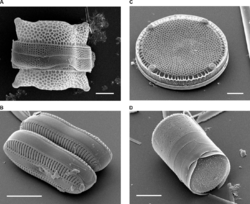
The frustule's structure is usually composed of two overlapping sections known as thecae
Theca
A theca refers to any case, covering, or sheath.In botany, the theca of an angiosperm consists a pair of microsporangia that are adjacent to each other and share a common area of dehiscence called the stomium. Any part of a microsporophyll that bears microsporangia is called an anther. Most...
(or less formally as valves). The join between the two thecae is supported by bands of silica (girdle bands) that hold them together. This overlapping allows for some internal expansion room and is essential during the reproduction process. The frustule also contains many pores and slits that provide the diatom access to the external environment for processes such as waste removal and mucilage
Mucilage
Mucilage is a thick, gluey substance produced by most plants and some microorganisms. It is a polar glycoprotein and an exopolysaccharide.It occurs in various parts of nearly all classes of plant, usually in relatively small percentages, and is frequently associated with other substances, such as...
secretion.
Thecae
A frustule is usually composed of two identically shaped but slightly differently sized thecae. The theca which is a bit smaller has an edge which fits slightly inside the corresponding edge of the larger theca. This overlapping region is reinforced with silica girdle bands, and constitutes a natural "expansion joint." The larger theca is usually thought of as "upper," and is thus termed the epitheca. The smaller theca is usually thought of as "lower," and is thus called the hypotheca. As the diatom divides, each daughter retains one theca of the original frustule and produces one new theca. Interestingly, this means that one daughter cell is the same size as the parent (epitheca and new hypotheca) while in the other daughter the old hypotheca becomes the epitheca which together with a new and slightly smaller hypotheca comprises a smaller cell.Diatoms
DiatomDiatom
Diatoms are a major group of algae, and are one of the most common types of phytoplankton. Most diatoms are unicellular, although they can exist as colonies in the shape of filaments or ribbons , fans , zigzags , or stellate colonies . Diatoms are producers within the food chain...
s have varied life strategies including floating in the water column (phytoplankton
Phytoplankton
Phytoplankton are the autotrophic component of the plankton community. The name comes from the Greek words φυτόν , meaning "plant", and πλαγκτός , meaning "wanderer" or "drifter". Most phytoplankton are too small to be individually seen with the unaided eye...
), colonising submerged surfaces and living within the surface of deposited sediments. Some cells are essentially cylindrical (centric) while other have an elongated "boat-like" shape. Since they are algae belonging to the division Bacillariophyta they require light for photosynthesis. Perhaps the most studied group of diatoms belong to the phytoplankton. Phytoplanktonic diatoms rely on ocean currents and wind to keep them in the upper oceanic levels as their cell wall is denser than water around them. They would naturally sink otherwise.
Diatom skeletons and their uses
When diatoms die and their organic material decomposes, the frustules sink to the bottom of the aquatic environment. This remnant material is diatomite, and used commercially as filters, mineral fillers, in insulation material, anti-caking agents and as a fine abrasive. There is also research underway regarding the use of diatom frustules and their properties for the field of optics, along with other cells, such as those in butterfly scales.Frustule formation
As the diatom prepares to separate it undergoes several processes in order to start the production of either a new hypotheca or new epitheca. Once each cell is completely separate they then have similar protection and the ability to continue frustule production.A brief and extremely simplified version can be explained as:
- The newly formed nucleus and the pre-existing nucleus each move to the side of the diatom where the new hypotheca will be formed.
- A vesicle known as the silica deposition vesicle forms near the plasma membrane.
- This forms the center of the pattern and silica deposition can continue outward from that point, till the frustule is produced.
External links
- Frustule on Britannica
- diatom frustule on astrographics.com
- Geometry and Pattern in Nature 1: Exploring the shapes of diatom frustules with Johan Gielis' Superformula, by Christina Brodie, UK
- http://www.nature.com/nnano/journal/v2/n6/full/nnano.2007.152.html
- Exploring Bioinorganic Pattern Formation in Diatoms. A Story of Polarized Trafficking on plantphysiol.org
Regarding the Super formula
- Exploring the miniature world on microscopy-uk.org.uk
- Superellipse And Superellipsoid, A Geometric Primitive for Computer Aided Design, by Paul Bourke, January 1990
- Supershapes (Superformula) by Paul Bourke, March 2002