
Home      Discussion      Topics      Dictionary      Almanac
Signup       Login
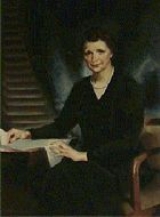
Frances Perkins

Frances Perkins

Overview
Frances Perkins born Fannie Coralie Perkins, was the U.S. Secretary of Labor
United States Secretary of Labor
The United States Secretary of Labor is the head of the Department of Labor who exercises control over the department and enforces and suggests laws involving unions, the workplace, and all other issues involving any form of business-person controversies....

 from 1933 to 1945, and the first woman appointed to the U.S. Cabinet
United States Cabinet
The Cabinet of the United States is composed of the most senior appointed officers of the executive branch of the federal government of the United States, which are generally the heads of the federal executive departments...

. As a loyal supporter of her friend, Franklin D. Roosevelt
Franklin D. Roosevelt
Franklin Delano Roosevelt , also known by his initials, FDR, was the 32nd President of the United States and a central figure in world events during the mid-20th century, leading the United States during a time of worldwide economic crisis and world war...

, she helped pull the labor movement
Labor unions in the United States
Labor unions in the United States are legally recognized as representatives of workers in many industries. The most prominent unions are among public sector employees such as teachers and police...

 into the New Deal coalition
New Deal coalition
The New Deal Coalition was the alignment of interest groups and voting blocs that supported the New Deal and voted for Democratic presidential candidates from 1932 until the late 1960s. It made the Democratic Party the majority party during that period, losing only to Dwight D. Eisenhower in 1952...

. She and Interior Secretary Harold Ickes
Harold L. Ickes
Harold LeClair Ickes was a United States administrator and politician. He served as United States Secretary of the Interior for 13 years, from 1933 to 1946, the longest tenure of anyone to hold the office, and the second longest serving Cabinet member in U.S. history next to James Wilson. Ickes...

 were the only original members of the Roosevelt cabinet who remained in offices for his entire presidency.
Discussion
Ask a question about 'Frances Perkins'
Start a new discussion about 'Frances Perkins'
Answer questions from other users
Full Discussion Forum
 
Encyclopedia
Frances Perkins born Fannie Coralie Perkins, was the U.S. Secretary of Labor
United States Secretary of Labor
The United States Secretary of Labor is the head of the Department of Labor who exercises control over the department and enforces and suggests laws involving unions, the workplace, and all other issues involving any form of business-person controversies....

 from 1933 to 1945, and the first woman appointed to the U.S. Cabinet
United States Cabinet
The Cabinet of the United States is composed of the most senior appointed officers of the executive branch of the federal government of the United States, which are generally the heads of the federal executive departments...

. As a loyal supporter of her friend, Franklin D. Roosevelt
Franklin D. Roosevelt
Franklin Delano Roosevelt , also known by his initials, FDR, was the 32nd President of the United States and a central figure in world events during the mid-20th century, leading the United States during a time of worldwide economic crisis and world war...

, she helped pull the labor movement
Labor unions in the United States
Labor unions in the United States are legally recognized as representatives of workers in many industries. The most prominent unions are among public sector employees such as teachers and police...

 into the New Deal coalition
New Deal coalition
The New Deal Coalition was the alignment of interest groups and voting blocs that supported the New Deal and voted for Democratic presidential candidates from 1932 until the late 1960s. It made the Democratic Party the majority party during that period, losing only to Dwight D. Eisenhower in 1952...

. She and Interior Secretary Harold Ickes
Harold L. Ickes
Harold LeClair Ickes was a United States administrator and politician. He served as United States Secretary of the Interior for 13 years, from 1933 to 1946, the longest tenure of anyone to hold the office, and the second longest serving Cabinet member in U.S. history next to James Wilson. Ickes...

 were the only original members of the Roosevelt cabinet who remained in offices for his entire presidency.

During her term as Secretary of Labor, Perkins championed many aspects of the New Deal
New Deal
The New Deal was a series of economic programs implemented in the United States between 1933 and 1936. They were passed by the U.S. Congress during the first term of President Franklin D. Roosevelt. The programs were Roosevelt's responses to the Great Depression, and focused on what historians call...

, including the Civilian Conservation Corps
Civilian Conservation Corps
The Civilian Conservation Corps was a public work relief program that operated from 1933 to 1942 in the United States for unemployed, unmarried men from relief families, ages 18–25. A part of the New Deal of President Franklin D...

, the Public Works Administration
Public Works Administration
The Public Works Administration , part of the New Deal of 1933, was a large-scale public works construction agency in the United States headed by Secretary of the Interior Harold L. Ickes. It was created by the National Industrial Recovery Act in June 1933 in response to the Great Depression...

 and its successor the Federal Works Agency
Federal Works Agency
The Federal Works Agency was an independent agency of the Federal government of the United States which administered a number of public construction, building maintenance, and public works relief functions and laws from 1939 to 1949...

, and the labor portion of the National Industrial Recovery Act
National Industrial Recovery Act
The National Industrial Recovery Act , officially known as the Act of June 16, 1933 The National Industrial Recovery Act (NIRA), officially known as the Act of June 16, 1933 The National Industrial Recovery Act (NIRA), officially known as the Act of June 16, 1933 (Ch. 90, 48 Stat. 195, formerly...

. With The Social Security Act she established unemployment benefits, pension
Pension
In general, a pension is an arrangement to provide people with an income when they are no longer earning a regular income from employment. Pensions should not be confused with severance pay; the former is paid in regular installments, while the latter is paid in one lump sum.The terms retirement...

s for the many uncovered elderly Americans, and welfare
Welfare
Welfare refers to a broad discourse which may hold certain implications regarding the provision of a minimal level of wellbeing and social support for all citizens without the stigma of charity. This is termed "social solidarity"...

 for the poorest Americans. She pushed to reduce workplace accidents and helped craft laws against child labor
Child labor
Child labour refers to the employment of children at regular and sustained labour. This practice is considered exploitative by many international organizations and is illegal in many countries...

. Through the Fair Labor Standards Act
Fair Labor Standards Act
The Fair Labor Standards Act of 1938 is a federal statute of the United States. The FLSA established a national minimum wage, guaranteed 'time-and-a-half' for overtime in certain jobs, and prohibited most employment of minors in "oppressive child labor," a term that is defined in the statute...

, she established the first minimum wage
Minimum wage
A minimum wage is the lowest hourly, daily or monthly remuneration that employers may legally pay to workers. Equivalently, it is the lowest wage at which workers may sell their labour. Although minimum wage laws are in effect in a great many jurisdictions, there are differences of opinion about...

 and overtime
Overtime
Overtime is the amount of time someone works beyond normal working hours. Normal hours may be determined in several ways:*by custom ,*by practices of a given trade or profession,*by legislation,...

 laws for American workers, and defined the standard 40-hour work week. She formed governmental policy for working with labor union
Trade union
A trade union, trades union or labor union is an organization of workers that have banded together to achieve common goals such as better working conditions. The trade union, through its leadership, bargains with the employer on behalf of union members and negotiates labour contracts with...

s and helped to alleviate strikes
Strike action
Strike action, also called labour strike, on strike, greve , or simply strike, is a work stoppage caused by the mass refusal of employees to work. A strike usually takes place in response to employee grievances. Strikes became important during the industrial revolution, when mass labour became...

 by way of the United States Conciliation Service
Federal Mediation and Conciliation Service (USA)
The Federal Mediation and Conciliation Service is an independent agency of the United States government, founded in 1947, which provides mediation services to industry, community and government agencies worldwide. One of its most common tasks is to help to mediate labor disputes around the country....

, Perkins resisted having American women be drafted to serve the military in World War II
World War II
World War II, or the Second World War , was a global conflict lasting from 1939 to 1945, involving most of the world's nations—including all of the great powers—eventually forming two opposing military alliances: the Allies and the Axis...

 so that they could enter the civilian workforce in greatly expanded numbers.

Early life and education


Perkins was born in Boston, Massachusetts, to Susan Bean Perkins and Frederick W. Perkins, the owner of a stationer's business (both of her parents originally were from Maine
Maine
Maine is a state in the New England region of the northeastern United States, bordered by the Atlantic Ocean to the east and south, New Hampshire to the west, and the Canadian provinces of Quebec to the northwest and New Brunswick to the northeast. Maine is both the northernmost and easternmost...

). She spent much of her childhood in Worcester
Worcester, Massachusetts
Worcester is a city and the county seat of Worcester County, Massachusetts, United States. Named after Worcester, England, as of the 2010 Census the city's population is 181,045, making it the second largest city in New England after Boston....

. She was christened Fannie Coralie Perkins, but later changed her name to Frances.

Perkins attended Worcester's Classical High School and was graduated from Mount Holyoke College
Mount Holyoke College
Mount Holyoke College is a liberal arts college for women in South Hadley, Massachusetts. It was the first member of the Seven Sisters colleges, and served as a model for some of the others...

 with a BA degree in chemistry and physics in 1902, and from Columbia University
Columbia University
Columbia University in the City of New York is a private, Ivy League university in Manhattan, New York City. Columbia is the oldest institution of higher learning in the state of New York, the fifth oldest in the United States, and one of the country's nine Colonial Colleges founded before the...

 with a master's degree in political science
Political science
Political Science is a social science discipline concerned with the study of the state, government and politics. Aristotle defined it as the study of the state. It deals extensively with the theory and practice of politics, and the analysis of political systems and political behavior...

 in 1910. In the interim, she held a variety of teaching positions including a position teaching chemistry from 1904-06 at Ferry Hall School
Ferry Hall School
The Ferry Hall School was a girls' preparatory school founded in 1869 in Lake Forest, Illinois, USA. In 1974, Ferry Hall merged into Lake Forest Academy.- History :...

, now Lake Forest Academy
Lake Forest Academy
Lake Forest Academy is a college preparatory boarding and day school for grades 9 through 12 located on the North Shore in Lake Forest, Illinois, United States. As of the 2008-2009 school year, students at Lake Forest Academy come from 20 states and 28 countries. The current Head of School is Dr....

, in Lake Forest, Illinois
Lake Forest, Illinois
Lake Forest is an affluent city located in Lake County, Illinois, United States. The city is south of Waukegan along the shore of Lake Michigan, and is a part of the Chicago metropolitan area and the North Shore. Lake Forest was founded around Lake Forest College and was laid out as a town in...

. In Chicago, she volunteered at settlement houses, including Hull House
Hull House
Hull House is a settlement house in the United States that was co-founded in 1889 by Jane Addams and Ellen Gates Starr. Located in the Near West Side of , Hull House opened its doors to the recently arrived European immigrants. By 1911, Hull House had grown to 13 buildings. In 1912 the Hull...

. In 1918 she began her years of study in economics and sociology at the University of Pennsylvania's Wharton School.

Life and Career before the Cabinet


She achieved statewide prominence as head of the New York Consumers League in 1910 and in that position she lobbied with vigor for better working hours and conditions. During this time Perkins also taught as a professor of sociology at Adelphi College. The next year, she witnessed the tragic Triangle Shirtwaist Factory fire
Triangle Shirtwaist Factory fire
The Triangle Shirtwaist Factory fire in New York City on March 25, 1911, was the deadliest industrial disaster in the history of the city of New York and resulted in the fourth highest loss of life from an industrial accident in U.S. history...

, a pivotal event in her life.

Frances Perkins married Paul Caldwell Wilson in 1913. She kept her birth name, defending her right to do so in court. The couple had a daughter, Susanna. Both father and daughter were described by biographer Kirstin Downey as having "manic-depressive symptoms." Wilson was frequently institutionalized for mental illness.

Prior to going to Washington D.C., Perkins held various positions in New York State government. In 1929 the newly-elected New York governor, Franklin D. Roosevelt
Franklin D. Roosevelt
Franklin Delano Roosevelt , also known by his initials, FDR, was the 32nd President of the United States and a central figure in world events during the mid-20th century, leading the United States during a time of worldwide economic crisis and world war...

, appointed Perkins as the state industrial commissioner. Having earned the cooperation and respect of various political factions, Perkins ably helped put New York in the forefront of progressive reform. She expanded factory investigations, reduced the workweek for women to 48 hours, and championed minimum wage
Minimum wage
A minimum wage is the lowest hourly, daily or monthly remuneration that employers may legally pay to workers. Equivalently, it is the lowest wage at which workers may sell their labour. Although minimum wage laws are in effect in a great many jurisdictions, there are differences of opinion about...

 and unemployment insurance laws.

Cabinet career


In 1933 Roosevelt appointed Perkins as Secretary of the Department of Labor
United States Department of Labor
The United States Department of Labor is a Cabinet department of the United States government responsible for occupational safety, wage and hour standards, unemployment insurance benefits, re-employment services, and some economic statistics. Many U.S. states also have such departments. The...

, a position she held for twelve years, longer than any other Secretary of Labor
United States Secretary of Labor
The United States Secretary of Labor is the head of the Department of Labor who exercises control over the department and enforces and suggests laws involving unions, the workplace, and all other issues involving any form of business-person controversies....

. She became the first woman to hold a cabinet
Cabinet (government)
A Cabinet is a body of high ranking government officials, typically representing the executive branch. It can also sometimes be referred to as the Council of Ministers, an Executive Council, or an Executive Committee.- Overview :...

 position in the United States and thus, became the first woman to enter the presidential line of succession.

With few exceptions, President Roosevelt consistently supported the goals and programs of Secretary Perkins. In an administration filled with compromise, the president's support for the agenda of Frances Perkins was unusually constant.
As Secretary of Labor, Perkins played a key role in the cabinet by writing New Deal
New Deal
The New Deal was a series of economic programs implemented in the United States between 1933 and 1936. They were passed by the U.S. Congress during the first term of President Franklin D. Roosevelt. The programs were Roosevelt's responses to the Great Depression, and focused on what historians call...

 legislation, including minimum-wage laws. Her most important contribution, however, came in 1934 as chairwoman of the President's Committee on Economic Security. In this post, she was involved in all aspects of the reports and hearings that ultimately resulted in the Social Security Act of 1935.

In 1939, she came under fire from some members of Congress for refusing to deport the Communist
Communist Party USA
The Communist Party USA is a Marxist political party in the United States, established in 1919. It has a long, complex history that is closely related to the histories of similar communist parties worldwide and the U.S. labor movement....

 head of the west coast International Longshore and Warehouse Union
International Longshore and Warehouse Union
The International Longshore and Warehouse Union is a labor union which primarily represents dock workers on the West Coast of the United States, Hawaii and Alaska, and in British Columbia, Canada. It also represents hotel workers in Hawaii, cannery workers in Alaska, warehouse workers throughout...

, Harry Bridges
Harry Bridges
Harry Bridges was an Australian-American union leader, in the International Longshore and Warehouse Union , a longshore and warehouse workers' union on the West Coast, Hawaii and Alaska which he helped form and led for over 40 years...

. Ultimately, Bridges was vindicated by the Supreme Court
Supreme Court of the United States
The Supreme Court of the United States is the highest court in the United States. It has ultimate appellate jurisdiction over all state and federal courts, and original jurisdiction over a small range of cases...

.

Al Smith
Al Smith
Alfred Emanuel Smith. , known in private and public life as Al Smith, was an American statesman who was elected the 42nd Governor of New York three times, and was the Democratic U.S. presidential candidate in 1928...

, a machine politician
Political machine
A political machine is a political organization in which an authoritative boss or small group commands the support of a corps of supporters and businesses , who receive rewards for their efforts...

 from the old school, was an early social reformer with whom Frances Perkins made common cause. At Smith's funeral in 1944 two of his former Tammany Hall
Tammany Hall
Tammany Hall, also known as the Society of St. Tammany, the Sons of St. Tammany, or the Columbian Order, was a New York political organization founded in 1786 and incorporated on May 12, 1789 as the Tammany Society...

 political cronies were overheard to speculate on why Smith had become a social crusader. One of them summed the matter up this way: "I'll tell you. Al Smith read a book. That book was a person, and her name was Frances Perkins. She told him all these things, and he believed her."

Following her tenure as Secretary of Labor, in 1945 Perkins was asked by President Harry Truman to serve on the United States Civil Service Commission
United States Civil Service Commission
The United States Civil Service Commission a three man commission was created by the Pendleton Civil Service Reform Act, which was passed into law on January 16, 1883...

, which she did until 1952, when her husband died and she resigned from federal service. During this period, she also published a memoir of her time in FDR's administration called The Roosevelt I Knew, which offered a sympathetic view of the president.


After the Cabinet


Following her government service career, Perkins remained active as a teacher and lecturer at the New York State School of Industrial and Labor Relations
Cornell University School of Industrial and Labor Relations
The New York State School of Industrial and Labor Relations is an industrial relations school at Cornell University, an Ivy League university located in Ithaca, New York, USA...

 at Cornell University
Cornell University
Cornell University is an Ivy League university located in Ithaca, New York, United States. It is a private land-grant university, receiving annual funding from the State of New York for certain educational missions...

 until her death in 1965 at age 85. She is buried in the Newcastle Cemetery in Newcastle, Maine.

Legacy


Frances Perkins, the first female member of the Presidential cabinet, had an unenviable challenge: she had to be as capable, as fearless, as tactful, as politically astute as the other Washington politicians, in order to make it possible for other women to be accepted into the halls of power after her.

Perkins would have been famous simply by being the first woman cabinet member, but her legacy stems from her accomplishments. She was largely responsible for the U.S. adoption of social security, unemployment insurance, federal laws regulating child labor, and adoption of the federal minimum wage.

Perkins had a cool personality, which held her aloof from the crowd. Although her results indicate her great love of workers and lower-class groups, her Boston upbringing held her back from mingling freely and exhibiting personal affection. She was well-suited for the high-level efforts to effect sweeping reforms, but never caught the public's eye or its affection.

The Frances Perkins Building
Frances Perkins Building
The Frances Perkins Building is the Washington, D.C. headquarters of the United States Department of Labor. It is located at 200 Constitution Avenue NW and runs alongside Interstate 395. The structure is named after Frances Perkins, the U.S. Secretary of Labor from 1933–1945 and the first female...

 that is the headquarters of the United States Department of Labor in Washington, D.C. was named in her honor in 1980.

Perkins is honored with a feast day on the liturgical calendar of the Episcopal Church (USA)
Calendar of saints (Episcopal Church in the United States of America)
The veneration of saints in the Episcopal Church is a continuation of an ancient tradition from the early Church which honors important people of the Christian faith. The usage of the term "saint" is similar to Roman Catholic and Orthodox traditions. Those in the Anglo-Catholic tradition may...

 on May 13.

Having graduated from Mount Holyoke College, Francis Perkins remains a prominent figure in the school's current existence. The Francis Perkins scholars were named after her, dedicated to educating women older than the usual college student.

Perkins is depicted in a mural displayed in the Maine Department of Labor headquarters. Maine's Republican governor, Paul LePage, has ordered the removal of the mural. A spokesperson for the governor said they received complaints about the mural from state business officials and from an anonymous fax charging that it was reminiscent of “communist North Korea where they use these murals to brainwash the masses.” Paul LePage also ordered that the names of seven conference rooms in the Department of Labor, including one named after Perkins, be changed.


External links