

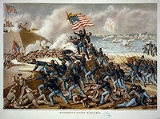
Fort Wagner

Encyclopedia
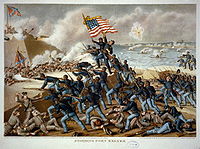
Fort Wagner was a beachhead
Beachhead
Beachhead is a military term used to describe the line created when a unit reaches a beach, and begins to defend that area of beach, while other reinforcements help out, until a unit large enough to begin advancing has arrived. It is sometimes used interchangeably with Bridgehead and Lodgement...
fortification
Fortification
Fortifications are military constructions and buildings designed for defence in warfare and military bases. Humans have constructed defensive works for many thousands of years, in a variety of increasingly complex designs...
on Morris Island
Morris Island
Morris Island is an 840 acre uninhabited island in Charleston Harbor in South Carolina, accessible only by boat. The island lies in the outer reaches of the harbor and was thus a strategic location in the American Civil War.-History:...
, South Carolina
South Carolina
South Carolina is a state in the Deep South of the United States that borders Georgia to the south, North Carolina to the north, and the Atlantic Ocean to the east. Originally part of the Province of Carolina, the Province of South Carolina was one of the 13 colonies that declared independence...
, that covered the southern approach to Charleston
Charleston, South Carolina
Charleston is the second largest city in the U.S. state of South Carolina. It was made the county seat of Charleston County in 1901 when Charleston County was founded. The city's original name was Charles Towne in 1670, and it moved to its present location from a location on the west bank of the...
harbor. It was the site of two American Civil War
American Civil War
The American Civil War was a civil war fought in the United States of America. In response to the election of Abraham Lincoln as President of the United States, 11 southern slave states declared their secession from the United States and formed the Confederate States of America ; the other 25...
battles in the campaign known as Operations Against the Defenses of Charleston in 1863, and is considered one of the toughest beachhead defenses constructed by the Confederate States Army
Confederate States Army
The Confederate States Army was the army of the Confederate States of America while the Confederacy existed during the American Civil War. On February 8, 1861, delegates from the seven Deep South states which had already declared their secession from the United States of America adopted the...
.
Construction
Named for deceased Lt. Col.Lieutenant colonel
Lieutenant colonel is a rank of commissioned officer in the armies and most marine forces and some air forces of the world, typically ranking above a major and below a colonel. The rank of lieutenant colonel is often shortened to simply "colonel" in conversation and in unofficial correspondence...
Thomas M. Wagner
Thomas M. Wagner
Thomas M. Wagner was a Lieutenant Colonel in the Confederate Army during the American Civil War. He was killed when a cannon exploded during an inspection at Fort Moultrie...
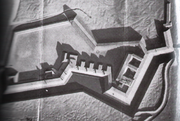
, Fort Wagner measured 250 by 100 yards (91.4 m), and spanned an area between the Atlantic on the east and an impassable swamp on the west. Its walls, composed of sand and earth, rose 30 feet (9.1 m) above the level beach and were supported by palmetto logs and sandbags. The fort's arsenal included fourteen cannons, the largest a 10 inches (254 mm) Columbiad
Columbiad
The Columbiad was a large caliber, smoothbore, muzzle loading cannon able to fire heavy projectiles at both high and low trajectories. This feature enabled the columbiad to fire solid shot or shell to long ranges, making it an excellent seacoast defense weapon for its day...
that fired a 128-pound shell. A large structure capable of sheltering nearly 1,000 of the fort's 1,700-man garrison provided substantial protection against naval shelling. The fort's land face was protected by a water-filled trench
Trench
A trench is a type of excavation or depression in the ground. Trenches are generally defined by being deeper than they are wide , and by being narrow compared to their length ....
, 10 feet (3 m) wide and 5 feet (1.5 m) deep, surrounded by buried land mines and sharpened palmetto
Sabal
Sabal is a genus of New World palms, many of the species being known as palmetto. They are fan palms , with the leaves with a bare petiole terminating in a rounded fan of numerous leaflets; in some of the species, the leaflets are joined for up to half of their length...
stakes.
History

The Second Battle of Fort Wagner, a week later, is better known. This was the Union
Union (American Civil War)
During the American Civil War, the Union was a name used to refer to the federal government of the United States, which was supported by the twenty free states and five border slave states. It was opposed by 11 southern slave states that had declared a secession to join together to form the...
attack on July 18, 1863, led by the 54th Massachusetts Volunteer Infantry
54th Massachusetts Volunteer Infantry
The 54th Regiment Massachusetts Volunteer Infantry was an infantry regiment that saw extensive service in the Union Army during the American Civil War. The regiment was one of the first official black units in the United States during the Civil War...
, one of the first major American military units made up of black soldiers. Colonel Robert Gould Shaw
Robert Gould Shaw
Robert Gould Shaw was an American officer in the Union Army during the American Civil War. As colonel, he commanded the all-black 54th Regiment, which entered the war in 1863. He was killed in the Second Battle of Fort Wagner, near Charleston, South Carolina...
led the 54th Massachusetts on foot while they charged and was killed in the assault.
Although a tactical defeat, the battle of Fort Wagner saw action for black troops in the Civil War, and it spurred additional recruitment that gave the Union Army
Union Army
The Union Army was the land force that fought for the Union during the American Civil War. It was also known as the Federal Army, the U.S. Army, the Northern Army and the National Army...
a further numerical advantage in troops over the South.
The Union besieged the fort after the unsuccessful assault. By August 25th, Union entrenchments were close enough to attempt an assault on the Advanced Rifle Pits, 240 yards in front of the Battery, this attempt was defeated. A 2nd attempt,by the 24th Mass. Inf., on August 26 was sucsessfull. After enduring almost 60 days of heavy shelling, the Confederates abandoned it on the night of September 6-7, 1863. withdrawing all operable cannons & the Garrison.
The main reason the fort was abandoned was fresh water. The bodies of the Union troops (54th Massachusetts and many white troops) were buried close to the fort and the decomposition of the bodies poisoned the fresh water well within the fort. Continuing bombardment and interception of food/water supplies by boat from Charleston made holding the fort difficult.
When the fort was abandoned in September 1863, the CSA forces left behind a large amount of gunpowder in the bomb proof. Two drunken Union soldiers were exploring the bomb proofs and set off the gunpowder, killing and injuring another 300 Union Soldiers stationed within the fort.
54th Massachusetts
The most famous regiment that fought for the Union in the battle of Fort Wagner was the 54th regiment, which was one of the first African-American regiments in the war. The 54th was controversial in the North, where many people supported the abolition of slavery, but still treated African-Americans as lesser or inferior to whites, and would do so well past World War II. Though some claimed blacks could not fight as well as whites, the actions of the 54th Massachusetts demonstrated once again the fallacy in that argument, as this was not the first time blacks ever fought in war or even for the United States. Many blacks had fought in the American RevolutionAmerican Revolution
The American Revolution was the political upheaval during the last half of the 18th century in which thirteen colonies in North America joined together to break free from the British Empire, combining to become the United States of America...
on both sides and again in the War of 1812, as well as in over 250 slave revolts in the United States alone.
William Carney
William Harvey Carney
William Harvey Carney was an African American soldier during the American Civil War who received the Medal of Honor for his actions during the Battle of Fort Wagner....
, an African-American and a sergeant with the 54th, is considered the first black recipient of the Congressional Medal of Honor for his actions at Fort Wagner in recovering and returning the unit's U.S. Flag to Union lines. After the battle, the Southern soldiers buried the regiment's commanding officer, Colonel Shaw, in a mass grave with the African-American soldiers of his regiment, viewing this as an insult to him. Instead, his family thanked the Southern soldiers for burying Shaw with his men. That site is no longer visible; the land has eroded into Charleston harbor, and the remains of Colonel Shaw and his men have been washed out to sea by Atlantic hurricanes.
