
The
54th Regiment Massachusetts Volunteer Infantry was an
infantryInfantrymen are soldiers who are specifically trained for the role of fighting on foot to engage the enemy face to face and have historically borne the brunt of the casualties of combat in wars. As the oldest branch of combat arms, they are the backbone of armies...
regimentA regiment is a major tactical military unit, composed of variable numbers of batteries, squadrons or battalions, commanded by a colonel or lieutenant colonel...
that saw extensive service in the
Union ArmyThe Union Army was the land force that fought for the Union during the American Civil War. It was also known as the Federal Army, the U.S. Army, the Northern Army and the National Army...
during the
American Civil WarThe American Civil War was a civil war fought in the United States of America. In response to the election of Abraham Lincoln as President of the United States, 11 southern slave states declared their secession from the United States and formed the Confederate States of America ; the other 25...
. The regiment was one of the first official
blackAfrican Americans are citizens or residents of the United States who have at least partial ancestry from any of the native populations of Sub-Saharan Africa and are the direct descendants of enslaved Africans within the boundaries of the present United States...
units in the United States during the Civil War. 1st South Carolina Volunteers (Union) recruited from freed slaves, was the first
Union ArmyThe Union Army was the land force that fought for the Union during the American Civil War. It was also known as the Federal Army, the U.S. Army, the Northern Army and the National Army...
regiment organized with African American soldiers in the Civil War, though many had fought in the American Revolution and the War of 1812 on both sides.
History
The regiment was authorized in March 1863 by the
Governor of Massachusetts, John A. Andrew. Commanded by
ColonelColonel , abbreviated Col or COL, is a military rank of a senior commissioned officer. It or a corresponding rank exists in most armies and in many air forces; the naval equivalent rank is generally "Captain". It is also used in some police forces and other paramilitary rank structures...
Robert Gould ShawRobert Gould Shaw was an American officer in the Union Army during the American Civil War. As colonel, he commanded the all-black 54th Regiment, which entered the war in 1863. He was killed in the Second Battle of Fort Wagner, near Charleston, South Carolina...
, it sprang to life after the passage of the
Emancipation ProclamationThe Emancipation Proclamation is an executive order issued by United States President Abraham Lincoln on January 1, 1863, during the American Civil War using his war powers. It proclaimed the freedom of 3.1 million of the nation's 4 million slaves, and immediately freed 50,000 of them, with nearly...
.
Secretary of WarThe Secretary of War was a member of the United States President's Cabinet, beginning with George Washington's administration. A similar position, called either "Secretary at War" or "Secretary of War," was appointed to serve the Congress of the Confederation under the Articles of Confederation...
Edwin M. StantonEdwin McMasters Stanton was an American lawyer and politician who served as Secretary of War under the Lincoln Administration during the American Civil War from 1862–1865...
decided white officers would be in charge of all "colored" units. Colonel Shaw was hand picked by Governor John Andrew. Governor Andrew also selected
Norwood Penrose "Pen" HallowellNorwood Penrose "Pen" Hallowell was an officer in the Union Army during the American Civil War. One of three brothers to serve with distinction during the war, he and his brother Edward Needles Hallowell both became commanders of the first all-black regiments...
as the unit's second in command, a rank of Lieutenant Colonel. Like many officers of regiments of African-American troops, both Shaw and Hallowell were promoted several grades, both being captains at the time. The rest of the officers were evaluated by Shaw and Hallowell. Many of these officers were of
abolitionistAbolitionism is a movement to end slavery.In western Europe and the Americas abolitionism was a movement to end the slave trade and set slaves free. At the behest of Dominican priest Bartolomé de las Casas who was shocked at the treatment of natives in the New World, Spain enacted the first...
families and several were chosen by Governor Andrew himself. Lt. Col. Norwood Hallowell was joined by his younger brother
Edward Needles HallowellEdward "Ned" Needles Hallowell was an officer in the Union Army during the American Civil War, commanding the 54th Massachusetts Volunteer Infantry following the death of Colonel Robert Gould Shaw at the Second Battle of Fort Wagner in 1863.-Early life:Edward grew up in a well-to-do Quaker family...
who was eventually appointed major in the regiment and would later command it after Shaw's death. 24 of the 29 officers were veterans, but only six had been previously commissioned.
The soldiers were recruited by white abolitionists (including Shaw's parents). These recruiters included Lieutenant J. Appleton, also the first man commissioned in the regiment, whose recruiting efforts included posting a notice in the
Boston Journal and holding a recruiting rally held in Joy Street Church and in which speakers Edward L. Pierce and Wendell Phillips encouraged free blacks to enlist for the regiment. This recruitment group was later known as "The Black Committee".
The 54th trained at Camp Meigs in
ReadvilleReadville, called Low Plains from 1655 until renaming in 1847 after Mr. James Read originally part of Dedham until 1867 but now a part of Boston, is considered either a part of the Hyde Park neighborhood, or a neighborhood in its own right. It is served by Readville station on the MBTA Commuter Rail...
near
BostonBoston is the capital of and largest city in Massachusetts, and is one of the oldest cities in the United States. The largest city in New England, Boston is regarded as the unofficial "Capital of New England" for its economic and cultural impact on the entire New England region. The city proper had...
. While there they received considerable moral support from abolitionists in Massachusetts including
Ralph Waldo EmersonRalph Waldo Emerson was an American essayist, lecturer, and poet, who led the Transcendentalist movement of the mid-19th century...
. Material support included warm clothing items, battle flags and $500 contributed for the equipping and training of a regimental band. As it became evident that many more recruits were coming forward than were needed the medical exam for the 54th was described as "rigid and thorough" by the Massachusetts Surgeon-General. This resulted in what he described as the most "robust, strong and healthy set of men" ever mustered into service in the United States. Despite this, as was common in the Civil War, a few men died of disease prior to the 54th's departure from Camp Meigs.
By most accounts the 54th left Boston with very high morale. This was despite the fact that
Jefferson DavisJefferson Finis Davis , also known as Jeff Davis, was an American statesman and leader of the Confederacy during the American Civil War, serving as President for its entire history. He was born in Kentucky to Samuel and Jane Davis...
' proclamation of December 23, 1862 effectively put both African-American enlisted men and white officers under a death sentence if captured. The proclamation was affirmed by the
Confederate CongressThe Congress of the Confederate States was the legislative body of the Confederate States of America, existing during the American Civil War between 1861 and 1865...
in January 1863 and turned both enlisted soldiers and their white officers over to the states from which the enlisted soldiers had been slaves. As most Southern states had enacted draconian measures for "servile insurrection" after
Nat Turner's RebellionNat Turner's Rebellion was a slave rebellion that took place in Southampton County, Virginia during August 1831. Led by Nat Turner, rebel slaves killed anywhere from 55–65 white people, the highest number of fatalities caused by slave uprisings in the South...
the likely sentence was a capital one.
Although the 54th left Boston hoping to fight for the
UnionDuring the American Civil War, the Union was a name used to refer to the federal government of the United States, which was supported by the twenty free states and five border slave states. It was opposed by 11 southern slave states that had declared a secession to join together to form the...
on May 28, 1863, it started off performing only manual labor. The regiment gained notoriety in a raid on the town of
DarienDarien is a city in McIntosh County, Georgia, United States. It lies on Georgia's coast at the mouth of the Altamaha River about 50 miles south of Savannah, and is part of the Brunswick, Georgia Metropolitan Statistical Area. The population of Darien was 1,719 at the 2000 census. The city is the...
,
GeorgiaGeorgia is a state located in the southeastern United States. It was established in 1732, the last of the original Thirteen Colonies. The state is named after King George II of Great Britain. Georgia was the fourth state to ratify the United States Constitution, on January 2, 1788...
, after being ordered to loot and burn the town by
Col. James MontgomeryJames Montgomery was a Jayhawker during the Bleeding Kansas Affair and a controversial Union colonel during the American Civil War...
. However, the 54th's participation in this raid was minimal and reluctant and Colonel Shaw initially objected to what he called a "
satanSatan , "the opposer", is the title of various entities, both human and divine, who challenge the faith of humans in the Hebrew Bible...
ic action".
The regiment's first battlefield action took place in a skirmish with Confederate troops on
James IslandJames Island is one of South Carolina's most urban Sea Islands. The island is separated from peninsular downtown Charleston by the Ashley River, from the mainland by Wappoo Creek and the Wappoo Cut, and from Johns Island by the Stono River...
,
South CarolinaSouth Carolina is a state in the Deep South of the United States that borders Georgia to the south, North Carolina to the north, and the Atlantic Ocean to the east. Originally part of the Province of Carolina, the Province of South Carolina was one of the 13 colonies that declared independence...
, on July 16. The regiment stopped a Confederate assault, losing 42 men in the process, most notably Kyree Fuller.
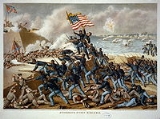
The regiment gained recognition on July 18, 1863, when it spearheaded an assault on
Fort WagnerFort Wagner was a beachhead fortification on Morris Island, South Carolina, that covered the southern approach to Charleston harbor...
near
Charleston, South CarolinaCharleston is the second largest city in the U.S. state of South Carolina. It was made the county seat of Charleston County in 1901 when Charleston County was founded. The city's original name was Charles Towne in 1670, and it moved to its present location from a location on the west bank of the...
. At this battle, Colonel Shaw was killed, along with 29 of his men. 24 more later died of wounds, 15 were captured, 52 were missing in action and never accounted for, and 149 were wounded. The total regimental casualties of 272 would be the highest total for the 54th in a single engagement during the war. Although Union forces were not able to take and hold the fort (despite taking a portion of the walls in the initial assault), the 54th was widely acclaimed for its valor during the battle, and the event helped encourage the further enlistment and mobilization of African-American troops, a key development that President
Abraham LincolnAbraham Lincoln was the 16th President of the United States, serving from March 1861 until his assassination in April 1865. He successfully led his country through a great constitutional, military and moral crisis – the American Civil War – preserving the Union, while ending slavery, and...
once noted as helping to secure the final victory. Decades later, Sergeant
William Harvey CarneyWilliam Harvey Carney was an African American soldier during the American Civil War who received the Medal of Honor for his actions during the Battle of Fort Wagner....
was awarded the
Medal of HonorThe Medal of Honor is the highest military decoration awarded by the United States government. It is bestowed by the President, in the name of Congress, upon members of the United States Armed Forces who distinguish themselves through "conspicuous gallantry and intrepidity at the risk of his or her...
for grabbing the U.S. flag as the flag bearer fell, carrying the flag to the enemy ramparts and back, and saying "Boys, the old flag never touched the ground!" While other African-Americans had since been granted the award by the time it was presented to Carney, Carney's is the earliest action for which the Medal of Honor was awarded to an African-American.
Ironically, during the week leading up to the 54th's heroic sacrifice near Charleston, simmering racial strife climaxed in the
New York Draft RiotsThe New York City draft riots were violent disturbances in New York City that were the culmination of discontent with new laws passed by Congress to draft men to fight in the ongoing American Civil War. The riots were the largest civil insurrection in American history apart from the Civil War itself...
. African-Americans on the city's waterfront and Lower East Side were beaten, tortured, and lynched by white mobs angered over conscription for the Union war effort. These mobs directed their animosity toward blacks because they felt the Civil War was caused by them. However, the bravery of the 54th would help to assuage anger of this kind.
Under the command of now-Colonel Edward Hallowell, the 54th fought a rear-guard action covering the Union retreat at the
Battle of OlusteeThe Battle of Olustee or Battle of Ocean Pond was fought in Baker County, Florida on 20 February 1864, during the American Civil War. It was the largest battle fought in Florida during the war.-Background:In February 1864, Major General Quincy A...
. As part of an all-black brigade under Col.
Alfred S. HartwellAlfred Stedman Hartwell was a lawyer and American Civil War soldier, who then had another career as cabinet minister and judge in the Kingdom of Hawaii.-Life:Alfred Stedman Hartwell was born June 11, 1836 in South Natick, Massachusetts...
, they unsuccessfully attacked entrenched Confederate
militiaThe term militia is commonly used today to refer to a military force composed of ordinary citizens to provide defense, emergency law enforcement, or paramilitary service, in times of emergency without being paid a regular salary or committed to a fixed term of service. It is a polyseme with...
at the November 1864
Battle of Honey Hill-References:** * Eicher, David J., The Longest Night: A Military History of the Civil War, Simon & Schuster, 2001, ISBN 0-684-84944-5.* The Union Army; A History of Military Affairs in the Loyal States, 1861–65 — Records of the Regiments in the Union Army — Cyclopedia of Battles...
. In mid-April 1865, they fought at the
Battle of Boykin's MillSite of the last Union officer killed in action during the American Civil War, Boykin’s Mill also hosted the final battle on South Carolina soil. Brigadier General Edward E. Potter took command of the two Northern brigades—2700 men—recently landed at Georgetown. Colonel Edward N...
, a small affair in South Carolina that proved to be one of the last engagements of the war.
Pay controversy
The enlisted men of the 54th were recruited on the promise of pay and allowances equal to their white counterparts. This was supposed to amount to subsistence and $13 a month. Instead African-American soldiers were paid $10 a month with $3 withheld for clothing, equaling $7 in the end of the month. (White troops had nothing withheld from their monthly pay for clothing.) Colonel Shaw and many others immediately began protesting the measure. Although the state of Massachusetts offered to make up the difference in pay, on principle, a regiment-wide boycott of the pay tables on paydays became the norm.
After Shaw's death at Fort Wagner, Colonel E. N. Hallowell took up the fight to get back full pay for the troops. His second in command, Lt. Col. Hooper, took command of the regiment on June 18, 1864 after Hallowell was granted permission to proceed North to press the claims of the regiment for equal pay in person. After nearly a month Colonel Hallowell returned on July 16. Finally the U.S. Congress took action and on September 28, 1864, the men of the 54th were paid from enlistment, most after 18 months of service.
The Congressional bill authorized equal and full pay to those enlisted troops who were free men as of April 1864. Of course not all the troops qualified. Colonel Hallowell, a Quaker, rationalized that because he did not believe in slavery he could therefore have all the troops swear that they were free men. Before being given their back pay the entire regiment was administered what became known as "the Quaker oath." Colonel Hallowell skillfully crafted the oath to say: “You do solemnly swear that on or before the 19th day of April 1864, no man had the right to demand unrequited labor of you so help you lord.” Hallowell wrote a typo in his hand-written transcript of the oath and actually said "1861" while administering the oath.
Refusing their reduced pay became a point of honor for the men of the 54th. In fact, at the
Battle of OlusteeThe Battle of Olustee or Battle of Ocean Pond was fought in Baker County, Florida on 20 February 1864, during the American Civil War. It was the largest battle fought in Florida during the war.-Background:In February 1864, Major General Quincy A...
, when ordered forward to protect the retreat of the Union forces, the men moved forward shouting, "Massachusetts and Seven Dollars a Month!" Unknown to them, Congress had just voted to pay
colored troopsThe United States Colored Troops were regiments of the United States Army during the American Civil War that were composed of African American soldiers. First recruited in 1863, by the end of the Civil War, the men of the 175 regiments of the USCT constituted approximately one-tenth of the Union...
the same as white troops.
Legacy
The regiment was disbanded after the Civil War, but retains a strong legacy. A monument, constructed 1884–1898 by
Augustus Saint-GaudensAugustus Saint-Gaudens was the Irish-born American sculptor of the Beaux-Arts generation who most embodied the ideals of the "American Renaissance"...
on the Boston Common, is part of the Boston
Black Heritage TrailThe Black Heritage is a path in Boston, Massachusetts, winding through the Beacon Hill neighborhood and sites important in American black history....
. A famous composition by
Charles IvesCharles Edward Ives was an American modernist composer. He is one of the first American composers of international renown, though Ives' music was largely ignored during his life, and many of his works went unperformed for many years. Over time, Ives came to be regarded as an "American Original"...
, "Col. Shaw and his Colored Regiment", the opening movement of
Three Places in New EnglandThe Three Places in New England is a composition for orchestra by Charles Ives. It was composed across a long span of time , however the bulk was written between 1911 and 1914. The piece is famous for its use of musical quotation and paraphrasing, as explained later in this article...
, is based both on the monument and the regiment.
Colonel Shaw and his men also feature prominently in
Robert LowellRobert Traill Spence Lowell IV was an American poet, considered the founder of the confessional poetry movement. He was appointed the sixth Poet Laureate Consultant in Poetry to the Library of Congress where he served from 1947 until 1948...
's Civil War Centennial poem "For the Union Dead" (1964); Lowell invokes the realism of the Saint-Gaudens monument:
- Two months after marching through Boston,
- half the regiment was dead;
- at the dedication,
- William James could almost hear the bronze Negroes breathe.
Later he unflinchingly looks at Shaw's and his men's death:
- Shaw's father wanted no monument
- except the ditch,
- where his son's body was thrown
- and lost with his "niggers."
A Union officer had asked the Confederates at Battery Wagner for the return of Shaw's body but was informed by the Confederate commander, Brigadier General
Johnson HagoodJohnson Hagood was a brigadier general in the Confederate States Army during the American Civil War and the 80th Governor of South Carolina from 1880 to 1882.-Early years:...
, "We buried him with his niggers." Shaw's father wrote in response that he was proud that Robert, a fierce fighter for equality, had been buried in that manner. "We hold that a soldier's most appropriate burial-place is on the field where he has fallen". As a recognition and honor, at the end of the Civil War, the 1st South Carolina Volunteers, and the 33rd Colored Regiment were mustered out at the Battery Wagner site of the mass burial of the 54th Massachusetts.
More recently, the story of the unit was depicted in the 1989
Academy AwardAn Academy Award, also known as an Oscar, is an accolade bestowed by the American Academy of Motion Picture Arts and Sciences to recognize excellence of professionals in the film industry, including directors, actors, and writers...
winning
filmA film, also called a movie or motion picture, is a series of still or moving images. It is produced by recording photographic images with cameras, or by creating images using animation techniques or visual effects...
Glory starring
Matthew BroderickMatthew Broderick is an American film and stage actor who, among other roles, played the title character in Ferris Bueller's Day Off, Adult Simba in The Lion King film series, and Leo Bloom in the film and Broadway productions of The Producers.He has won two Tony Awards, one in 1983 for his...
as Shaw,
Denzel WashingtonDenzel Hayes Washington Jr. is an American actor, screenwriter, director, and film producer. He first rose to prominence when he joined the cast of the medical drama, St. Elsewhere, playing Dr...
as Private Tripp,
Morgan FreemanMorgan Freeman is an American actor, film director, aviator and narrator. He is noted for his reserved demeanor and authoritative speaking voice. Freeman has received Academy Award nominations for his performances in Street Smart, Driving Miss Daisy, The Shawshank Redemption and Invictus and won...
,
Cary ElwesIvan Simon Cary Elwes , known professionally as Cary Elwes, is an English actor. The son of Dominick Elwes and Tessa Georgina Kennedy, Elwes acted in off-Broadway plays during college and moved to the United States in the early 1980s. He is known for his role as Westley in the cult classic The...
,
Jihmi KennedyJihmi Kennedy is an American actor who is best known for his roles in Glory and Gung Ho. After co-starring in several notable films during the 1980s, he quit acting and worked as a teacher in North Carolina for most of the 1990s. He returned to acting in 2001.-External links:...
and
Andre BraugherAndre Braugher is an American actor. He is perhaps best known for his roles as Thomas Searles in the film Glory, as the fiery detective Frank Pembleton on Homicide: Life on the Street from 1993 to 1998 and again in the 2000 made-for-TV film Homicide: Life on the Street, and as Owen Thoreau Jr...
. The film re-established the now-popular image of the combat role African-Americans played in the Civil War, and the unit, often represented in historical battle
reenactmentsAmerican Civil War reenactment is an effort to recreate the appearance of a particular battle or other event associated with the American Civil War by hobbyists known as Civil War reenactors or Civil War recreationists...
, now has the
nicknameA nickname is "a usually familiar or humorous but sometimes pointed or cruel name given to a person or place, as a supposedly appropriate replacement for or addition to the proper name.", or a name similar in origin and pronunciation from the original name....
The Glory Regiment.
Years after the film was made, it came to light that the word Glory was used by one of the men of the regiment. First Sergeant
Robert John SimmonsFirst Sergeant Robert John Simmons was a Bermudian who served in the 54th Massachusetts Volunteer Infantry Regiment during the American Civil War....
, of B Company, was a twenty-six year old
BermudianBermuda is a British overseas territory in the North Atlantic Ocean. Located off the east coast of the United States, its nearest landmass is Cape Hatteras, North Carolina, about to the west-northwest. It is about south of Halifax, Nova Scotia, Canada, and northeast of Miami, Florida...
clerk, probably from
St. George'sSt. George's , located on the island and within the parish of the same names, was the first permanent settlement on the islands of Bermuda, and is often described as the third successful English settlement in the Americas, after St. John's, Newfoundland, and Jamestown, Virginia. However, St...
, believed to have joined the 54th on 12 March 1863 (Many black and white Bermudians fought for the Union, mostly in the U.S. Navy.)
Simmons was introduced to Frances George Shaw, father of Col. Shaw, by
William Wells BrownWilliam Wells Brown was a prominent African-American abolitionist lecturer, novelist, playwright, and historian. Born into slavery in the Southern United States, Brown escaped to the North in 1834, where he worked for abolitionist causes and was a prolific writer...
, who described him as "a young man of more than ordinary abilities who had learned the science of war in the British Army". In his book,
The Negro in the American Rebellion, Brown said that "Frances George Shaw remarked at the time that Simmons would make a 'valuable soldier'. Colonel Shaw also had a high opinion of him." Sgt. Simmons was mentioned in an 1863 article of the
Weekly Columbus Enquirer, which described him as "a brave man and of good education. He was wounded and captured. Taken to Charleston, his bearing impressed even his captors. After suffering amputation of the arm, he died there." The newspaper also described him as saying that he fought "for glory":
One of the negroes is a remarkably sprightly fellow from Bermuda where he was educated as a soldier. His position is that of an Orderly Sergeant, but he has lost an arm, and probably one leg will go.
A third of the 'glory' for which he says he came to fight, being thus amputated, he will in the future be a wiser man. The others are a mongrel set of trash and very fair representatives of the common type of free Northern negro."
Simmons, who would be specially mentioned by Shaw's successor, Col.
HallowellEdward "Ned" Needles Hallowell was an officer in the Union Army during the American Civil War, commanding the 54th Massachusetts Volunteer Infantry following the death of Colonel Robert Gould Shaw at the Second Battle of Fort Wagner in 1863.-Early life:Edward grew up in a well-to-do Quaker family...
, and who had been awarded a private medal, died in August 1863, following the attack on Fort Wagner.
2008 reactivation
The unit was reactivated on November 21, 2008 to serve as the
Massachusetts National GuardThe Massachusetts National Guard was founded as the Massachusetts Bay Colonial Militia on December 13, 1636, and contains the oldest units in the United States Army. It is currently headquartered in Milford, Massachusetts and commanded by Major General Joseph C...
ceremonial unit to render military honors at funerals and state functions. The new unit is now known as the
54th Massachusetts Volunteer RegimentThe 54th Massachusetts Volunteer Regiment is a regiment of the Massachusetts Army National Guard. It is a descendent of the famous 54th Massachusetts Volunteer Infantry.-History:...
.
External links