


Fort Omaha

Encyclopedia
Fort Omaha, originally known as Sherman Barracks and then Omaha Barracks, is an Indian War-era United States Army
supply installation. Located at 5730 North 30th Street, with the entrance at North 30th and Fort Streets in modern-day North Omaha, Nebraska
, the facility is primarily occupied by Metropolitan Community College
. A Navy Operational Support Center and Marine Corps Reserve
unit, along with an Army Reserve unit occupy the periphery of the 82.5 acre fort. The government deeded all but four parcels of the land to the community college in 1974.
This is where Ponca Chief Standing Bear and 29 fellow Ponca were held prior to the landmark 1879 trial of Standing Bear v. Crook. Judge Elmer Dundy determined that American Indians
were persons within the meaning of the law and that the Ponca were illegally detained after leaving Indian Territory in January 1879. The Fort Omaha Historic District
is listed on the National Register of Historic Places
. The district includes the 1879 General Crook House Museum, as well as the 1879 Quartermaster's office, 1878 commissary, 1884 guardhouse, 1883 ordnance magazine and 1887 mule stables.
, Fort Omaha is primarily occupied by Metropolitan Community College
. It continues to house Navy, Marine and Army Reserve units. The Fort is located in the present-day Miller Park
neighborhood of North Omaha. The site includes the General Crook House, which is listed separately on the National Register of Historic Places
(NHRP). The entire fort is listed as an historic district
on the NRHP.
. It was located on an 82-½ acre tract four miles (6 km) north of Omaha
and 1½ miles south of Florence
. Pioneer entrepreneur Augustus Kountze
sold land for the installation to the federal government. The following year the name was changed to Omaha Barracks. General Sherman was said to have complained about such a small site being named after him.
On December 30, 1878, the post was designated Fort Omaha. During this same time period, the U. S. Army's Department of the Platte
was organized. The Fort was the Department's headquarters from 1878 to 1881. The post, however, remained home to upwards of ten companies of the 2nd Infantry until 1896 when the garrison was relocated to Fort Crook near Bellevue
.
The Spanish-American War
brought the Fort into usage as a muster
point for troops from across Nebraska. Camp Meiklejohn, Camp Augur and Camp Vincent were all subordinate troop sites around Omaha under command of the Fort.
Fort Omaha is perhaps most notable as the site where Chief Standing Bear was held prior to the 1879 trial of Standing Bear v. Crook. Standing Bear, a Ponca
chief, successfully argued in U.S. District Court that Native Americans were "persons within the meaning of the law" and had rights of citizenship. During the trial, Standing Bear was assisted by Susette LaFlesche Tibbles
, a famous Omaha woman who was the daughter of Iron Eye, the last recognized chief of the Omaha. His lawyer was Andrew Jackson Poppleton
, a pioneer Omaha attorney who held the position of general attorney for the Union Pacific Railroad
. The trial was the most important of Poppleton's career. Both the fort's significant role in US military history in relation to the Indian Wars, and this important civil rights trial, contributed to the site's being listed as a historic district on the National Register of Historic Places.
In World War II
Fort Omaha was used as a prisoner-of-war camp to house Italian Army
soldiers captured in Europe.
Shortly after the United States
entered World War I
, 800 men immediately enlisted in the Aviation Section, U. S. Signal Corps. They were sent to the Fort Omaha Balloon School for training. They later provided forward observations for the artillery. More than 16,000 airmen went through the Balloon School.
In 1917 the Army determined that weather conditions at Fort Omaha were not suitable for rapidly training balloon companies. The next year a contingent of officers and men from Fort Omaha were assigned to Camp John Wise in Texas. The Balloon School at Fort Omaha was soon ended.
, and listed the Crook House on the National Register of Historic Places
. In 1982 the Fort Omaha Guardhouse
was designated a Landmark under the City of Omaha's Landmark Heritage Preservation Ordinance.
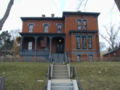
In 1879 this Italianate-style house was completed for General and Mrs. Crook for the general's continued administration of the Indian Wars
. Today it is used as the museum of the Douglas County Historical Society
. It is filled with 19th century Victorian
-style furniture, in addition to military exhibits, and offices of the Douglas County Historical Society
. Ornate Victorian-style gardens have been restored on the property. It is located in the middle of Fort Omaha, at 5730 North 30th Street. It was listed on the National Register of Historic Places
in 1969.
during the command of General George Crook
. In 1881 the headquarters moved back to Downtown Omaha
to be nearer to the railroads. Today the building serves as the community college's library.
Expanded several times, the Guardhouse, which sits at Bourke Gate, was designated an Omaha Landmark in 1982.
, in addition to the Douglas County Historical Society
at the General Crook House and Library Archives Center.
United States Army
The United States Army is the main branch of the United States Armed Forces responsible for land-based military operations. It is the largest and oldest established branch of the U.S. military, and is one of seven U.S. uniformed services...
supply installation. Located at 5730 North 30th Street, with the entrance at North 30th and Fort Streets in modern-day North Omaha, Nebraska
North Omaha, Nebraska
North Omaha is a community area in Omaha, Nebraska, USA. It is bordered by Cuming and Dodge Streets on the south, Interstate 680 on the north, North 72nd Street on the west and the Missouri River and Carter Lake, Iowa on the east, as defined by the University of Nebraska at Omaha and the Omaha...
, the facility is primarily occupied by Metropolitan Community College
Metropolitan Community College (Omaha)
Metropolitan Community College is a public community college with multiple campuses located throughout the Omaha, Nebraska metro area.- About :...
. A Navy Operational Support Center and Marine Corps Reserve
United States Marine Corps Reserve
The Marine Forces Reserve is the reserve force of the United States Marine Corps. It is the largest command in the U.S...
unit, along with an Army Reserve unit occupy the periphery of the 82.5 acre fort. The government deeded all but four parcels of the land to the community college in 1974.
This is where Ponca Chief Standing Bear and 29 fellow Ponca were held prior to the landmark 1879 trial of Standing Bear v. Crook. Judge Elmer Dundy determined that American Indians
Native Americans in the United States
Native Americans in the United States are the indigenous peoples in North America within the boundaries of the present-day continental United States, parts of Alaska, and the island state of Hawaii. They are composed of numerous, distinct tribes, states, and ethnic groups, many of which survive as...
were persons within the meaning of the law and that the Ponca were illegally detained after leaving Indian Territory in January 1879. The Fort Omaha Historic District
Historic district
A historic district or heritage district is a section of a city which contains older buildings considered valuable for historical or architectural reasons. In some countries, historic districts receive legal protection from development....
is listed on the National Register of Historic Places
National Register of Historic Places
The National Register of Historic Places is the United States government's official list of districts, sites, buildings, structures, and objects deemed worthy of preservation...
. The district includes the 1879 General Crook House Museum, as well as the 1879 Quartermaster's office, 1878 commissary, 1884 guardhouse, 1883 ordnance magazine and 1887 mule stables.
About
Opened in 1868 as a supply depot for various forts along the Platte RiverPlatte River
The Platte River is a major river in the state of Nebraska and is about long. Measured to its farthest source via its tributary the North Platte River, it flows for over . The Platte River is a tributary of the Missouri River, which in turn is a tributary of the Mississippi River which flows to...
, Fort Omaha is primarily occupied by Metropolitan Community College
Metropolitan Community College (Omaha)
Metropolitan Community College is a public community college with multiple campuses located throughout the Omaha, Nebraska metro area.- About :...
. It continues to house Navy, Marine and Army Reserve units. The Fort is located in the present-day Miller Park
Miller Park (Omaha, Nebraska)
The Miller Park neighborhood in North Omaha, Nebraska is a historically significant community housing a historic district and several notable historic places. It is located between Sorenson Parkway on the south and Redick Avenue on the north, Florence Boulevard on the east and 30th Street on the west...
neighborhood of North Omaha. The site includes the General Crook House, which is listed separately on the National Register of Historic Places
National Register of Historic Places
The National Register of Historic Places is the United States government's official list of districts, sites, buildings, structures, and objects deemed worthy of preservation...
(NHRP). The entire fort is listed as an historic district
Historic district
A historic district or heritage district is a section of a city which contains older buildings considered valuable for historical or architectural reasons. In some countries, historic districts receive legal protection from development....
on the NRHP.
History
Sherman Barracks, also known as Camp Sherman, was established in 1868 by Captain William Sinclair of the 3rd U.S. Artillery and named in honor of Lt. General William Tecumseh ShermanWilliam Tecumseh Sherman
William Tecumseh Sherman was an American soldier, businessman, educator and author. He served as a General in the Union Army during the American Civil War , for which he received recognition for his outstanding command of military strategy as well as criticism for the harshness of the "scorched...
. It was located on an 82-½ acre tract four miles (6 km) north of Omaha
Omaha, Nebraska
Omaha is the largest city in the state of Nebraska, United States, and is the county seat of Douglas County. It is located in the Midwestern United States on the Missouri River, about 20 miles north of the mouth of the Platte River...
and 1½ miles south of Florence
Florence, Nebraska
Florence is a neighborhood in Omaha, Nebraska on the city's north end and originally one of the oldest cities in Nebraska. It was incorporated by the Nebraska Territorial Legislature on March 10, 1857. The site of Winter Quarters for Mormon migrants traveling west, it has the oldest cemetery for...
. Pioneer entrepreneur Augustus Kountze
Augustus Kountze
Augustus Kountze was a pioneer banker, politician, philanthropist and railroad supporter in Omaha, Nebraska, Kountze, Texas and New York City...
sold land for the installation to the federal government. The following year the name was changed to Omaha Barracks. General Sherman was said to have complained about such a small site being named after him.
On December 30, 1878, the post was designated Fort Omaha. During this same time period, the U. S. Army's Department of the Platte
Department of the Platte
The Department of the Platte was a military administrative district established by the U.S. Army on March 5, 1866, with boundaries encompassing Iowa, Nebraska, Dakota Territory, Utah Territory and a small portion of Idaho...
was organized. The Fort was the Department's headquarters from 1878 to 1881. The post, however, remained home to upwards of ten companies of the 2nd Infantry until 1896 when the garrison was relocated to Fort Crook near Bellevue
Bellevue, Nebraska
Bellevue is a city in Sarpy County, Nebraska, United States. The population was 50,137 at the 2010 census. Eight miles south of Omaha, Bellevue is part of the Omaha-Council Bluffs metropolitan area. Originally settled in the 1830s, It was the first state capitol. Bellevue was incorporated in...
.
The Spanish-American War
Spanish-American War
The Spanish–American War was a conflict in 1898 between Spain and the United States, effectively the result of American intervention in the ongoing Cuban War of Independence...
brought the Fort into usage as a muster
Muster (military)
The term muster designates the process or event for the of accounting for members in a military unit. Within the United States Army Reserve, it is an annual event used for screening purposes.-Historical:...
point for troops from across Nebraska. Camp Meiklejohn, Camp Augur and Camp Vincent were all subordinate troop sites around Omaha under command of the Fort.
Fort Omaha is perhaps most notable as the site where Chief Standing Bear was held prior to the 1879 trial of Standing Bear v. Crook. Standing Bear, a Ponca
Ponca
The Ponca are a Native American people of the Dhegihan branch of the Siouan-language group. There are two federally recognized Ponca tribes: the Ponca Tribe of Nebraska and the Ponca Tribe of Indians of Oklahoma...
chief, successfully argued in U.S. District Court that Native Americans were "persons within the meaning of the law" and had rights of citizenship. During the trial, Standing Bear was assisted by Susette LaFlesche Tibbles
Susette LaFlesche Tibbles
Susette LaFlesche Tibbles, also called Insta Theamba , was a well-known Native American writer, lecturer, interpreter and artist of the Omaha tribe in Nebraska. Susette LaFlesche was a progressive who was a spokesperson for Native American rights. She was of Ponca, Iowa, French and Anglo-American...
, a famous Omaha woman who was the daughter of Iron Eye, the last recognized chief of the Omaha. His lawyer was Andrew Jackson Poppleton
Andrew Jackson Poppleton
Andrew Jackson Poppleton was the second mayor of Omaha, Nebraska, serving for six months from March 2, 1858-September 14, 1858 before he resigned from office. Poppleton was afterwards an influential real estate businessman and lawyer in Omaha.Poppleton worked for many years as the general attorney...
, a pioneer Omaha attorney who held the position of general attorney for the Union Pacific Railroad
Union Pacific Railroad
The Union Pacific Railroad , headquartered in Omaha, Nebraska, is the largest railroad network in the United States. James R. Young is president, CEO and Chairman....
. The trial was the most important of Poppleton's career. Both the fort's significant role in US military history in relation to the Indian Wars, and this important civil rights trial, contributed to the site's being listed as a historic district on the National Register of Historic Places.
In World War II
World War II
World War II, or the Second World War , was a global conflict lasting from 1939 to 1945, involving most of the world's nations—including all of the great powers—eventually forming two opposing military alliances: the Allies and the Axis...
Fort Omaha was used as a prisoner-of-war camp to house Italian Army
Italian Army
The Italian Army is the ground defence force of the Italian Armed Forces. It is all-volunteer force of active-duty personnel, numbering 108,355 in 2010. Its best-known combat vehicles are the Dardo infantry fighting vehicle, the Centauro tank destroyer and the Ariete tank, and among its aircraft...
soldiers captured in Europe.
Notable personnel
- Major General George CrookGeorge CrookGeorge R. Crook was a career United States Army officer, most noted for his distinguished service during the American Civil War and the Indian Wars.-Early life:...
- Major General Stuart HeintzelmanStuart HeintzelmanMajor General Stuart Heintzelman was an American soldier.He was commissioned as a Second Lieutenant of Cavalry from the United States Military Academy in 1899...
- Brigadier General Dan Christie KingmanDan Christie KingmanDan Christie Kingman was born in Dover, New Hampshire. He graduated second in the United States Military Academy class of 1875 and was commissioned in the Corps of Engineers. He served as an instructor at the Military Academy and as the engineer officer of the Army's Department of the Platte...
- Brigadier General George G. LundbergGeorge G. LundbergBrigadier-General George Godfrey Lundberg was a pilot in the United States Air Force.After graduating from the University of Pennsylvania's Economics program in 1917, Lundberg was made a Second Lieutenant the following year while stationed at Fort Omaha, Nebraska...
Fort Omaha Balloon School
In 1907 the Army built a large steel hangar at Fort Omaha for use in experiments with dirigibles, a program that was abandoned in 1909. This program and its successor were part of the American Expeditionary Forces. A balloon house was built in 1908, and in 1909 the first balloon flight took place. The military acquired additional space for training called Florence Field, at the corner of North 30th and Martin Streets in North Omaha.Shortly after the United States
United States
The United States of America is a federal constitutional republic comprising fifty states and a federal district...
entered World War I
World War I
World War I , which was predominantly called the World War or the Great War from its occurrence until 1939, and the First World War or World War I thereafter, was a major war centred in Europe that began on 28 July 1914 and lasted until 11 November 1918...
, 800 men immediately enlisted in the Aviation Section, U. S. Signal Corps. They were sent to the Fort Omaha Balloon School for training. They later provided forward observations for the artillery. More than 16,000 airmen went through the Balloon School.
In 1917 the Army determined that weather conditions at Fort Omaha were not suitable for rapidly training balloon companies. The next year a contingent of officers and men from Fort Omaha were assigned to Camp John Wise in Texas. The Balloon School at Fort Omaha was soon ended.
Notable personnel
- Major Charles DeF. ChandlerCharles deForest ChandlerColonel Charles deForest Chandler was an American military aviator, and the first head of the Aeronautical Division, U.S. Signal Corps that later became the United States Air Force.-External links:**...
- Captain Frank Purdy Lahm
- Lieutenant Thomas SelfridgeThomas SelfridgeThomas Etholen Selfridge was a First Lieutenant in the U.S. Army and the first person to die in a crash of a powered airplane. He was a passenger while Orville Wright was piloting the aircraft.-Biography:...
- Lieutenant Benjamin FouloisBenjamin FouloisBenjamin Delahauf Foulois , was a United States Army general who learned to fly the first military planes purchased from the Wright Brothers. He became the first military aviator as an airship pilot, and achieved numerous other military aviation "firsts"...
- Lieutenant Kent CurtisKent CurtisMarvin Kent Curtis was an American novelist, illustrator, and teacher. Curtis served in World War I as an aviator with the Royal Air Force, was shot down, reported dead, and held prisoner of war until the war's end. Based on his war experiences, he authored The Tired Captains, a novel centered...
Historic District
There are six extant 19th century structures in Fort Omaha, and the site overall has been judged significant in US history. Because of this, Fort Omaha has received numerous historical designations. The Department of the Interior designated Fort Omaha a historic districtHistoric district
A historic district or heritage district is a section of a city which contains older buildings considered valuable for historical or architectural reasons. In some countries, historic districts receive legal protection from development....
, and listed the Crook House on the National Register of Historic Places
National Register of Historic Places
The National Register of Historic Places is the United States government's official list of districts, sites, buildings, structures, and objects deemed worthy of preservation...
. In 1982 the Fort Omaha Guardhouse
Fort Omaha Guardhouse
The Fort Omaha Guardhouse was built in 1883 to handle Native American, civilian and military prisoners of the Department of the Platte housed at Fort Omaha. Located at 5700 North 30th Street in north Omaha, Nebraska, the Guardhouse was named an Omaha Landmark by the City of Omaha Landmarks Heritage...
was designated a Landmark under the City of Omaha's Landmark Heritage Preservation Ordinance.
General Crook House
In 1879 this Italianate-style house was completed for General and Mrs. Crook for the general's continued administration of the Indian Wars
Indian Wars
American Indian Wars is the name used in the United States to describe a series of conflicts between American settlers or the federal government and the native peoples of North America before and after the American Revolutionary War. The wars resulted from the arrival of European colonizers who...
. Today it is used as the museum of the Douglas County Historical Society
Douglas County Historical Society
The Douglas County Historical Society, or DCHS, is located at 5730 North 30th Street in the General Crook House at Fort Omaha in north Omaha, Nebraska...
. It is filled with 19th century Victorian
Victorian decorative arts
Victorian decorative arts refers to the style of decorative arts during the Victorian era. The Victorian era is known for its eclectic revival and interpretation of historic styles and the introduction of cross-cultural influences from the middle east and Asia in furniture, fittings, and Interior...
-style furniture, in addition to military exhibits, and offices of the Douglas County Historical Society
Douglas County Historical Society
The Douglas County Historical Society, or DCHS, is located at 5730 North 30th Street in the General Crook House at Fort Omaha in north Omaha, Nebraska...
. Ornate Victorian-style gardens have been restored on the property. It is located in the middle of Fort Omaha, at 5730 North 30th Street. It was listed on the National Register of Historic Places
National Register of Historic Places
The National Register of Historic Places is the United States government's official list of districts, sites, buildings, structures, and objects deemed worthy of preservation...
in 1969.
Headquarters building
Built in 1879 by the U.S. Army, the Headquarters Building at Fort Omaha first served as the home of the Department of the PlatteDepartment of the Platte
The Department of the Platte was a military administrative district established by the U.S. Army on March 5, 1866, with boundaries encompassing Iowa, Nebraska, Dakota Territory, Utah Territory and a small portion of Idaho...
during the command of General George Crook
George Crook
George R. Crook was a career United States Army officer, most noted for his distinguished service during the American Civil War and the Indian Wars.-Early life:...
. In 1881 the headquarters moved back to Downtown Omaha
Downtown Omaha
Downtown Omaha is the central business, government and social core of the Omaha-Council Bluffs metropolitan area, and is located in Omaha, Nebraska. The boundaries are 20th Street on the west to the Missouri River on the east and the centerline of Leavenworth Street on the south to the centerline...
to be nearer to the railroads. Today the building serves as the community college's library.
Guardhouse
Originally constructed in 1861, the current Guardhouse was built in 1883. Over the course of its usage, the Fort Omaha Guardhouse housed numerous notable prisoners. Its most famous was Ponca Chief Standing Bear. On March 31, 1879, General George Crook met with the imprisoned Ponca at the Fort Omaha guardhouse. It was there that he said to the General,- "I thought God intended us to live, but I was mistaken. God intends to give the country to the White people, and we are to die".
Expanded several times, the Guardhouse, which sits at Bourke Gate, was designated an Omaha Landmark in 1982.
Current usage
After World War II, Fort Omaha was placed under control of the US Navy. Today, several perimeter facilities are used as a training locations for the Marine Corps Reserve, as well as storage and repair areas for Navy vehicles. The remainder of Fort Omaha houses a campus of the Metropolitan Community CollegeMetropolitan Community College (Omaha)
Metropolitan Community College is a public community college with multiple campuses located throughout the Omaha, Nebraska metro area.- About :...
, in addition to the Douglas County Historical Society
Douglas County Historical Society
The Douglas County Historical Society, or DCHS, is located at 5730 North 30th Street in the General Crook House at Fort Omaha in north Omaha, Nebraska...
at the General Crook House and Library Archives Center.
See also
- Nebraska TerritoryNebraska TerritoryThe Territory of Nebraska was an organized incorporated territory of the United States that existed from May 30, 1854, until March 1, 1867, when the final extent of the territory was admitted to the Union as the State of Nebraska. The Nebraska Territory was created by the Kansas–Nebraska Act of 1854...
- History of military ballooningHistory of Military BallooningBalloons were the first mechanisms used in air warfare. Their role was strictly recognized for reconnaissance purposes. They provided humans with the first available method of elevating themselves well over the battlefield to obtain the proverbial "birds-eye view." They were an early instrument of...
- List of American Balloon Squadrons
Further reading
Barnes, Jeff. Forts of the Northern Plains: Guide to Historic Military Posts of the Plains Indian Wars. Mechanicsburg, PA: Stackpole Books, 2008.External links
- History of Fort Omaha Douglas County Historical Society website.
- Historic photos of Fort Omaha
- Historic photo of the Fort Omaha Balloon School
- Lantern Slides of Fort Omaha