


Ford Ranch Wagon

Encyclopedia
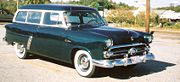
Station wagon
A station wagon is a body style variant of a sedan/saloon with its roof extended rearward over a shared passenger/cargo volume with access at the back via a third or fifth door , instead of a trunk lid...
built by Ford Motor Company
Ford Motor Company
Ford Motor Company is an American multinational automaker based in Dearborn, Michigan, a suburb of Detroit. The automaker was founded by Henry Ford and incorporated on June 16, 1903. In addition to the Ford and Lincoln brands, Ford also owns a small stake in Mazda in Japan and Aston Martin in the UK...
from 1952 to 1977. The Ranch Wagon was a full-size model, except in 1963 and 1964, when it was part of the intermediate-size Fairlane series, and represented the lowest-priced selection in its respective line.
1952-1962
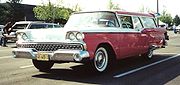
Ford Country Squire
- Third generation :Prior to 1961, all Ford wagons used a two-piece tailgate assembly that required the operator to lift the rear window up and locking it into place via a mechanical support, and then drop the tail gate down to fully access the rear compartment.For the 1961 Ford adopted a tailgate...
continued to cater to buyers who still wanted a station wagon with the look of wood (attained by applying simulated exterior wood decals, which were framed in genuine wood through 1953). But for other wagon buyers, Ford also gave them two new choices that year, the first all-steel wagons in the firm's history. These were the Country Sedan
Ford Country Sedan
The Ford Country Sedan was a full-size station wagon built by the Ford Motor Company from 1952 until 1974.It was based on the Ford full-size car line available in each year. The Country Sedan was the mid-trim station wagon in the Ford range. Unlike the Country Squire, the Country Sedan featured...
, a four-door model in the mid-range Customline
Ford Customline
Ford's mid-range trim from 1952 through 1956 was called Customline. The Customline was more expensive than the Mainline but less expensive than the Crestline or, later, the Fairlane.See also:* 1952–1954 Ford Customline* 1955–1956 Ford Customline...
series; and the Ranch Wagon, which was a two-door model in the economy Mainline
Ford Mainline
The Ford Mainline is an automobile which was produced by the Ford Motor Company in the United States in the models years 1952 to 1956. It was introduced as the base trim level of the 1952 Ford range below the Customline and Crestline models...
series. The Ranch Wagon ran with either the standard "Mileage Maker" six-cylinder engine or the long-familiar flathead V8, which was optional.
After receiving mostly cosmetic changes for 1953, a second Ranch Wagon model, a slightly fancier version in the Customline series, was added for 1954, the year Ford's new Y-block V8 replaced the flathead unit. The two models were renamed Ranch Wagon and Custom Ranch Wagon for 1955, when the entire Ford station wagon set became a series of its own. For 1957, the Del Rio Ranch Wagon was introduced (replacing both the Custom Ranch Wagon and the Parklane
Ford Parklane
The Ford Parklane was a car produced by the Ford Motor Company in the United States for one year only, 1956. Launched to compete with the Chevrolet Nomad, it was a two-door station wagon, based on the Ford Ranch Wagon, but unlike that low-end workhorse model, it was tricked out with all the...
), sporting special ranch-pattern upholstery. That same model was the basis for the new 1957 Ranchero
Ford Ranchero
The Ford Ranchero was a coupe utility produced between 1957 and 1979. Unlike a pickup truck, the Ranchero was adapted from a two-door station wagon platform that integrated the cab and cargo bed into the body. A total of 508,355 units were produced during the model's production run...
. There were three Ranch Wagons the following year, as the first four-door Ranch Wagon was added to the model range. The Del Rio was dropped for 1959, replaced by a one-year-only two-door Country Sedan. By this time, full-size two-door station wagons were fast fading in popularity, and the 1961 two-door Ranch Wagon was the last full-size two-door wagon ever built (along with the two-door Plymouth Deluxe Suburban of that same year), leaving the four-door as the sole Ranch Wagon model for 1962.
1963-1964
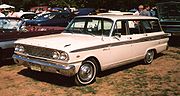
Ford Fairlane
- Automobiles :* Ford Fairlane , a car manufactured by the Ford Motor Company between 1955 and 1970* Ford Fairlane , a car manufactured by the Ford Motor Company of Australia between 1959 and 2007- See also :...
series. In both years, it was offered in the base and 500 series, the latter labeled Custom. The 1963 models ran with a 200-cid six-cylinder or any of three optional V8 engines—221, 260- or 289-cid. The 221 was dropped for 1964.
1965-1977

Ford wagons ceased to be a separate series when they were redesigned for 1969, officially becoming part of the respective series on which they were based; thus that year's base Ranch Wagon was now a member of the low-end Custom
Ford Custom
The Ford Custom is a car model name that has been used by the Ford Motor Company both in the United States and Canada from the 1930s to 1972....
series. In 1969, for the first time, all Ranch Wagons were powered by a 302 cu in V8.
The Custom series was dropped when Ford issued the next generation of full-size cars for 1973, meaning all Ranch Wagons were Custom 500s. The 1974 Ranch Wagon was the last available for sale to the general public. Subsequently, small quantities of Ranch Wagons were produced strictly for fleet buyers through 1977, after which the name was retired.