

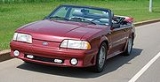
Ford Fox platform

Encyclopedia
The Ford Fox platform is a rear wheel drive, unitized-chassis, automobile architecture
used by Ford Motor Company
in North America. Introduced for the 1978 model year, it would go on to be produced until 1993 in its original version; a substantial redesign of the Ford Mustang in 1994 extended its life another 11 years. Designed to be relatively lightweight and simple, in keeping with the general downsizing of Detroit designs in the late 1970s, the Fox platform served as a replacement for many models derived from the original Ford Falcon (dating from 1960). The Ford Fairmont and Mercury Zephyr were introduced as the replacements for the Ford Maverick and Mercury Comet.
Eventually, thirteen distinct Ford models in several market segments would be built off it, with multiple bodystyles and powertrains. As downsizing
became more common in the American automotive industry in the late 1970s and early 1980s, the Fox platform was used for many nameplates that underwent downsizing. As the industry shifted to front-wheel drive, the Fox platform was used less for family cars and more for sporty cars; from 1989 to 2004, it was used exclusively by the Mustang.
However, the 1980s led to the popularization of front-wheel drive among American car manufacturers; aside from the Mustang and the Thunderbird/Cougar, the Fox platform largely disappeared after 1986.
.
Automobile platform
An automobile platform is a shared set of common design, engineering, and production efforts, as well as major components over a number of outwardly distinct models and even types of automobiles, often from different, but related marques...
used by Ford Motor Company
Ford Motor Company
Ford Motor Company is an American multinational automaker based in Dearborn, Michigan, a suburb of Detroit. The automaker was founded by Henry Ford and incorporated on June 16, 1903. In addition to the Ford and Lincoln brands, Ford also owns a small stake in Mazda in Japan and Aston Martin in the UK...
in North America. Introduced for the 1978 model year, it would go on to be produced until 1993 in its original version; a substantial redesign of the Ford Mustang in 1994 extended its life another 11 years. Designed to be relatively lightweight and simple, in keeping with the general downsizing of Detroit designs in the late 1970s, the Fox platform served as a replacement for many models derived from the original Ford Falcon (dating from 1960). The Ford Fairmont and Mercury Zephyr were introduced as the replacements for the Ford Maverick and Mercury Comet.
Eventually, thirteen distinct Ford models in several market segments would be built off it, with multiple bodystyles and powertrains. As downsizing
Downsize (automobile)
Downsizing in the automobile industry is the practice of redesigning a vehicle to retain the interior volume, and often the nameplate and styling of a larger car to a smaller, more efficient platform. General Motors was among the first to announce a downsize strategy for the whole company as a...
became more common in the American automotive industry in the late 1970s and early 1980s, the Fox platform was used for many nameplates that underwent downsizing. As the industry shifted to front-wheel drive, the Fox platform was used less for family cars and more for sporty cars; from 1989 to 2004, it was used exclusively by the Mustang.
Design history
The Fox platform, like most compact and mid-size cars of the late 1970s, was designed with a rear-wheel drive layout. Unlike the full-size Fords and Mercurys of the time (as well as current ones), the Fox platform used unibody construction. Due to the wide variety of cars using the Fox platform from its introduction, it was designed to accommodate 4-cylinder (naturally aspirated and turbocharged), I6, V6, and V8 engines.1983 changes
In 1983, the Fox platform was involved in a major shift of the Ford and Mercury product ranges. The 1980 redesign of the Ford Granada, Ford Thunderbird, and Mercury Cougar had been poorly received by buyers. As Ford had chosen not discontinue its full-size, rear-wheel drive cars in the early 1980s, the base-trim Ford LTD and Mercury Marquis nameplates were shifted to the Fox platform when the mid-size cars were updated in 1983. The Marquis replaced the Cougar sedan and wagon; the LTD replaced the Granada entirely. In addition, the Fox platform became the home of the Lincoln Continental. The Thunderbird and Cougar personal-luxury coupes were redesigned for 1983, becoming the first aerodynamic-bodied Fords. The introductory Ford Fairmont and Mercury Zephyr were discontinued at the end of the model year and replaced by the front-wheel drive 1984 Ford Tempo and Mercury Topaz.However, the 1980s led to the popularization of front-wheel drive among American car manufacturers; aside from the Mustang and the Thunderbird/Cougar, the Fox platform largely disappeared after 1986.
SN-95
The Fox-platform Ford Mustang was redesigned in 1994 under the body family program code name Fox-4. This version was wider and approximately 60% of the parts were redesigned. The SN-95 platform finally ended production with the last 2004 Mustang. This platform was replaced for the 2005 Mustang (code named S-197), with the new Ford D2C platformFord D2C platform
The Ford D2C platform is Ford's latest rear-wheel drive automobile platform. Currently, the only vehicle using this platform is the 2005-present Ford Mustang and its Shelby derivative....
.
Vehicles
| Vehicle Name | Image | Production | Predecessor | Successor | Notes |
|---|---|---|---|---|---|
| Fox-platform vehicles (Compact) | |||||
| Ford Fairmont Ford Fairmont The Ford Fairmont is a compact car produced by Ford Motor Company for the North American market. Introduced for the 1978 model year, the Fairmont was produced in several bodystyles until it was replaced by the Ford Tempo for the 1984 model year... |
1978–1983 | Ford Maverick Ford Maverick The Ford Motor Company has marketed the following models using the Ford Maverick nameplate:* The Ford Maverick , a sport-styled compact car sold in North America and Brazil during the 1970s.... |
Ford Tempo Ford Tempo The Ford Tempo is a coupe/sedan car model that was produced by Ford Motor Company for model years 1984 to 1994. It was a downsized successor to the boxy Ford Fairmont that introduced "jellybean" styling, which would later be shown on the larger 1986 Ford Taurus. and was replaced in 1994 by the... |
||
| Mercury Zephyr Mercury Zephyr The Mercury Zephyr is a compact car sold by the Lincoln-Mercury division of Ford Motor Company for the North American market. Introduced as a replacement for the Mercury Comet, it was produced from 1978 to 1983... |
1978–1983 | Mercury Comet Mercury Comet The Mercury Comet is an automobile produced by the Mercury division of the Ford Motor Company from 1960–1969 and 1971-1977 — variously as either a compact or an intermediate car.The Comet was based on the compact Ford Falcon and later the Ford Maverick... |
Mercury Topaz Mercury Topaz The Mercury Topaz is a compact car that was manufactured by the Mercury division of Ford Motor Company for model years 1984 to 1994 as a slightly upscale variant of the Ford Tempo... |
||
| Ford Durango Ford Durango The Ford Durango is a 2-passenger coupe utility that was sold by Ford Motor Company in the early 1980s. Produced out of a joint venture between Ford Motor Company and National Coach Corporation of Los Angeles, California, the Durango was sold in 1981... |
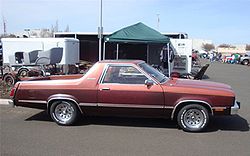 |
1981 | Ford Ranchero Ford Ranchero The Ford Ranchero was a coupe utility produced between 1957 and 1979. Unlike a pickup truck, the Ranchero was adapted from a two-door station wagon platform that integrated the cab and cargo bed into the body. A total of 508,355 units were produced during the model's production run... |
|
|
| Fox-platform vehicles (Mid-Size) | |||||
| Ford Granada Ford Granada (North America) The Ford Granada was a mid-size car built and marketed by Ford Motor Company in North America from 1975–1982, along with its sister models, the Mercury Monarch, and Lincoln Versailles. The Granada was touted by Ford as a rival to the similarly sized Mercedes-Benz 280 of the time. The Granada and... |
1980–1982 | Ford Granada (1975–1979) | Ford LTD |
|
|
| Ford LTD | 1983–1986 | Ford Granada Ford Granada (North America) The Ford Granada was a mid-size car built and marketed by Ford Motor Company in North America from 1975–1982, along with its sister models, the Mercury Monarch, and Lincoln Versailles. The Granada was touted by Ford as a rival to the similarly sized Mercedes-Benz 280 of the time. The Granada and... |
Ford Taurus Ford Taurus The Ford Taurus is an automobile manufactured by the Ford Motor Company in the United States. Originally introduced in the 1986 model year, it has remained in near-continuous production for more than two decades, making it the fourth oldest nameplate that is currently sold in the North American... |
LTD was an updated version of the 1980-1982 Ford Granada | |
| Mercury Cougar Mercury Cougar The Mercury Cougar is an automobile which was sold under the Mercury brand of the Ford Motor Company's Lincoln-Mercury Division from 1967 to 2002. The name was first used in 1967 and was carried by a diverse series of cars over the next three decades. As is common with Mercury vehicles, the Cougar... (sedan/wagon) |
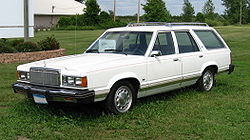 |
1980–1982 | Mercury Monarch Mercury Monarch The Mercury Monarch is a compact sedan manufactured by the Ford Motor Company; it was sold by the Lincoln-Mercury division from 1975 to 1980.... |
Mercury Marquis Mercury Marquis These were known as the "Continental Styling" years, as Mercury was trying to market itself as an affordable Lincoln, rather than a more expensive Ford... |
Cougar sedan and wagon models discontinued in 1983 |
| Mercury Marquis Mercury Marquis These were known as the "Continental Styling" years, as Mercury was trying to market itself as an affordable Lincoln, rather than a more expensive Ford... |
1983–1986 | Mercury Cougar Mercury Cougar The Mercury Cougar is an automobile which was sold under the Mercury brand of the Ford Motor Company's Lincoln-Mercury Division from 1967 to 2002. The name was first used in 1967 and was carried by a diverse series of cars over the next three decades. As is common with Mercury vehicles, the Cougar... |
Mercury Sable Mercury Sable The Sable was a very important sedan for both Mercury and the American auto industry.Ford had lagged in introducing mid-size front wheel drive cars to compete against General Motors' Chevrolet Citation and its best-selling Chevrolet Celebrity/Pontiac 6000/Oldsmobile Cutlass/Buick Century quartet as... |
||
| Lincoln Continental Lincoln Continental The Lincoln Continental is an automobile which was produced by the Lincoln division of Ford Motor Company from 1939 to 1948 and again from 1956 to 2002... (sixth generation) |
1982–1987 | Lincoln Versailles Lincoln Versailles This is about the Lincoln vehicle produced using the Versailles nameplate. For the Ford vehicles sold under the same nameplate, see Ford Versailles... |
Lincoln Continental Lincoln Continental The Lincoln Continental is an automobile which was produced by the Lincoln division of Ford Motor Company from 1939 to 1948 and again from 1956 to 2002... (D186/seventh generation) |
||
| Fox-platform vehicles (Pony Car) | |||||
| Ford Mustang Ford Mustang The Ford Mustang is an automobile manufactured by the Ford Motor Company. It was initially based on the second generation North American Ford Falcon, a compact car. Introduced early on April 17, 1964, as a "1964½" model, the 1965 Mustang was the automaker's most successful launch since the Model A... |
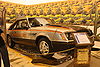 |
1979–1993 | Ford Mustang II | Ford Mustang (SN-95) | |
| Ford Mustang Ford Mustang The Ford Mustang is an automobile manufactured by the Ford Motor Company. It was initially based on the second generation North American Ford Falcon, a compact car. Introduced early on April 17, 1964, as a "1964½" model, the 1965 Mustang was the automaker's most successful launch since the Model A... (SN-95) |
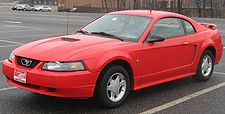 |
1994–2004 | Ford Mustang | Ford Mustang (D2C) | |
| Mercury Capri Mercury Capri -First Generation :See also Ford CapriThe Mercury Capri was built in Cologne, Germany, and was sold through Lincoln-Mercury dealers in North America. The European Capri was first sold in the US in April 1970 and carried the Mercury marque identification as Ford already had a Mustang for the same... |
1979–1986 | Mercury Capri II (1976–1978) | |||
| Fox-platform vehicles (Personal Luxury Car) | |||||
| Ford Thunderbird Ford Thunderbird The Thunderbird , is an automobile manufactured by the Ford Motor Company in the United States over eleven model generations from 1955 through 2005... (eighth and ninth generations) |
1980–1988 | Ford Thunderbird (seventh generation) | Ford Thunderbird (tenth generation/MN-12) | Produced in two generations (1980-1982 "Box Birds" and 1983-1988 "Aero Birds") | |
| Mercury Cougar Mercury Cougar The Mercury Cougar is an automobile which was sold under the Mercury brand of the Ford Motor Company's Lincoln-Mercury Division from 1967 to 2002. The name was first used in 1967 and was carried by a diverse series of cars over the next three decades. As is common with Mercury vehicles, the Cougar... (sixth generation) |
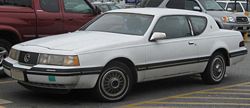 |
1983–1988 | Mercury Cougar coupe (fifth generation) | Mercury Cougar (seventh generation/MN12) | Cougar became exclusively a twin of the Ford Thunderbird after 1983 |
| Lincoln Continental Mark VII Lincoln Continental Mark VII See Lincoln Mark for a complete overview of the Lincoln Mark Series.The Continental Mark VII, later shortened to just Mark VII, was a rear wheel drive luxury coupe from Lincoln... |
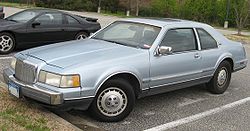 |
1984–1992 | Lincoln Continental Mark VI | Lincoln Mark VIII Lincoln Mark VIII The Lincoln Mark VIII is a large, rear-wheel drive grand touring luxury coupe built from 1993 to 1998. It was the successor of the Mark VII. The Mark VIII was built at Ford's Wixom, Michigan assembly plant and was based on the FN10 platform, a relative of the MN12 platform which underpinned the... |
The Mark VII was the first American-market car sold with composite headlamps. |
External links
- Fox Body Forum - #1 Foxbody Source on Earth!
- FoxBodyChallenge.com - A website & database dedicated to the Fox Body Mustang Platform & the 302ho
- Four Eyed Pride - A resource for all early Foxes
- foxbodyconnection.com-Great resource forum about technical help and parts that interchange between years.