


Flamingo Las Vegas

Encyclopedia
The Flamingo Las Vegas is a hotel casino located on the Las Vegas Strip
in Paradise, Nevada
and is owned and operated by Caesars Entertainment Corp.. The property offers a 77000 sq ft (7,153.5 m²) casino along with 3,626 hotel rooms. The 15 acre (6.1 ha) site's architectural theme is reminiscent of the Art Deco
and Streamline Moderne
style of Miami and South Beach
, with a garden courtyard housing a wildlife habitat featuring flamingos. It was the third resort to open on the Strip, and the oldest resort on the Strip still in operation today.
The Flamingo has a Las Vegas Monorail
station at the rear of the property.
. Billy Wilkerson was the owner of the Hollywood Reporter as well as some very popular nightclubs in the Sunset Strip: Cafe Trocadero
, Ciro's
and La Rue's.
In 1945, Wilkerson purchased 33 acres (13.4 ha) on the west side of U.S. Route 91
, about one mile (1.6 km) south of the Hotel Last Frontier in preparation for his vision. Wilkerson then hired George Vernon Russell to design a hotel that was more in the European style and something other than the "sawdust joints" on Fremont Street. He planned a hotel with luxurious rooms, a spa, health club, showroom, golf course, nightclub and an upscale restaurant. Due to high wartime materials costs, Wilkerson ran into financial problems almost at once, finding himself $400,000 short and hunting for new financing.
and his "partners" came to Las Vegas, after the fledgling resort city piqued Siegel's interest due to its legalized gambling and its off-track betting. Siegel at the time held a large interest in Trans America Wire, a racing publication.
Siegel began by purchasing The El Cortez on Fremont Street
for $600,000. His expansion plans were hampered by unfriendly city officials aware of his criminal background, so Siegel began looking for a site outside the city limits. Hearing that Wilkerson was seeking extra funding, Siegel and his partners, posing as businessmen, approached him and bought a two-thirds stake in the project.
Siegel took over the final phases of construction and convinced more of his underworld associates to invest in the project. The problem was, Siegel had no experience in construction or design, causing costs to mount from constant changes and gouging from construction firms and suppliers — including, it was reputed, workers who delivered by day, stole by night, and resold the next day. Siegel may actually have bought some of the same materials twice thanks to this kind of scheming.
Siegel lost patience with the rising costs, and his notorious outbursts unnerved his construction foreman. Reputedly, Siegel told him, "Don't worry — we only kill each other."
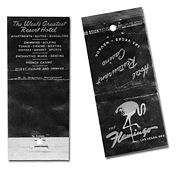 Siegel finally opened The Flamingo Hotel & Casino at a total cost of $6 million on December 26, 1946. Billed as the world's most luxurious hotel, the 105-room property and first luxury hotel on the Strip, was built seven miles (11 km) from Downtown Las Vegas
, with a large sign built in front of the construction site announcing it was a William R. Wilkerson project, with Del Webb
Construction as the prime contractor and Richard Stadelman (who later made renovations to the El Rancho Las Vegas) the architect.
Siegel named the resort after his girlfriend Virginia Hill
, who loved to gamble and whose nickname was Flamingo, a nickname Siegel gave her due to her long, skinny legs. Organized crime king Lucky Luciano
wrote in his memoir that Siegel once owned an interest in the Hialeah Park race track
and viewed the flamingos who populated nearby as an omen.
charged — at a major mob meeting in Cuba
— that either Siegel or Hill was skimming from the resort's building budget, a charge amplified when Hill was revealed to have taken $2.5 million and gone to Switzerland, where the skimmed money was believed going.
"There was no doubt in Meyer's mind," Luciano recalled in his memoir, "that Bugsy had skimmed this dough from his building budget, and he was sure that Siegel was preparing to skip as well as skim, in case the roof was gonna fall in on him." Luciano and the other mob leaders in Cuba asked Lansky what to do. Torn because of long ties to Siegel, whom he considered like a brother, Lansky nevertheless agreed that someone stealing from his friends had to go — at first. Lansky persuaded the others to wait for the Flamingo's casino opening: if it was a success, Siegel could be persuaded in other ways to repay. Luciano persuaded the others to agree.
The splashy opening — stars present included Cuban band leader Xavier Cugat
(whose band provided the music), George Jessel
, George Raft
, Rose Marie
, and Jimmy Durante
as entertainment, with guests including Clark Gable
, Lana Turner
, Cesar Romero
, Joan Crawford
, and others — was a flop. Lansky managed to persuade the mob chiefs to reprieve Siegel once more and allow the Flamingo more time. But by January 1947 Siegel had to order the resort closed until the hotel could be finished.
The Flamingo re-opened in March despite the hotel not being complete, and this time, the results proved different. By May, the resort reported a $250,000 profit, allowing Lansky to point out that Siegel was right about Las Vegas after all. But it wasn't quite enough to save Siegel. On 20 June 1947, relaxing in the Hollywood bungalow he shared with Hill, who was away at the time, Siegel was shot to death.
A memorial plaque exists on the Flamingo site near the outdoor wedding chapel.
From 1955 to 1960, the Flamingo was operated by Albert Parvin of the Parvin-Dohrmann Company. In 1960, it was sold for $10.5 million to a group including Samuel Cohen, Morris Lansburgh, and Daniel Lifter, Miami residents with reputed ties to organized crime. Lansky served as middleman for the deal, receiving $200,000.
Kirk Kerkorian
acquired the property in 1967, making it part of Kerkorian's International Leisure Company, but the Hilton Corporation
bought the resort in 1972, renaming it the Flamingo Hilton in 1974. The last of the original Flamingo Hotel structure was torn down on December 14, 1993 and the hotel's garden was built on the site.
The Flamingo's four hotel towers were built (or expanded) in 1967, 1975, 1977, 1982, 1990, and 1995. A 200-unit Hilton Grand Vacations timeshare
tower was opened in 1993.
In 1998, Hilton's gaming properties, including the Flamingo, were spun off as Park Place Entertainment (later renamed to Caesars Entertainment). The deal included a two-year license to use the Hilton name. Park Place opted not to renew that agreement when it expired in late 2000, and the property was renamed Flamingo Las Vegas.
In 2005 Harrah's Entertainment
purchased Caesars Entertainment Inc and the property became part of Harrah's Entertainment company, which changed its name to Caesars Entertainment Corp in 2010.
and Marie Osmond
. Their show premiered in September 2008, and has been extended until October 2012.
Previous headliners include Gladys Knight
and Toni Braxton
. Braxton's show ran from August 2006 to April 2008, when it closed due to Braxton's health problems.
Other shows residing at the hotel are comedian George Wallace
, comedian Vinnie Favorito, magician Nathan Burton, and X Burlesque.
The garden courtyard houses a wildlife habitat featuring flamingos and other birds. It was the home of penguin
s, but they have since been moved to the Dallas Zoo
.
Extending the hotel's tropical theme, a Jimmy Buffett's Margaritaville
restaurant and gift shop was opened in December 2003. An adjacent Margaritaville "minicasino" is scheduled to open in October 2011.
Las Vegas Strip
The Las Vegas Strip is an approximately stretch of Las Vegas Boulevard in Clark County, Nevada; adjacent to, but outside the city limits of Las Vegas proper. The Strip lies within the unincorporated townships of Paradise and Winchester...
in Paradise, Nevada
Paradise, Nevada
Paradise is an unincorporated town in the Las Vegas metropolitan area in Clark County, Nevada, United States. The population was 223,167 at the 2010 census...
and is owned and operated by Caesars Entertainment Corp.. The property offers a 77000 sq ft (7,153.5 m²) casino along with 3,626 hotel rooms. The 15 acre (6.1 ha) site's architectural theme is reminiscent of the Art Deco
Art Deco
Art deco , or deco, is an eclectic artistic and design style that began in Paris in the 1920s and flourished internationally throughout the 1930s, into the World War II era. The style influenced all areas of design, including architecture and interior design, industrial design, fashion and...
and Streamline Moderne
Streamline Moderne
Streamline Moderne, sometimes referred to by either name alone or as Art Moderne, was a late type of the Art Deco design style which emerged during the 1930s...
style of Miami and South Beach
South Beach
South Beach, also nicknamed SoBe, is a neighborhood in the city of Miami Beach, Florida, United States. It is the area south of Indian Creek and encompasses roughly the southernmost 23 blocks of the main barrier island that separates the Atlantic Ocean and Biscayne Bay.This area was the first...
, with a garden courtyard housing a wildlife habitat featuring flamingos. It was the third resort to open on the Strip, and the oldest resort on the Strip still in operation today.
The Flamingo has a Las Vegas Monorail
Las Vegas Monorail
The Las Vegas Monorail is a monorail mass transit system located on the Las Vegas Strip, in Clark County, Nevada, United States. It connects the unincorporated communities of Paradise and Winchester, and does not actually enter the City of Las Vegas. It is owned and operated by the Las Vegas...
station at the rear of the property.
A Hollywood Beginning
The Flamingo site occupies 40 acres (16.2 ha) originally owned by one of Las Vegas' first settlers, Charles "Pops" Squires. Mr. Squires paid $8.75 an acre for the land. In 1944, Margaret Folsom bought the tract for $7,500 from Squires, and she then later sold it to Billy WilkersonWilliam Wilkerson
William Richard Wilkerson was the founder of the Hollywood Reporter, Flamingo Hotel and owner of such nightclubs as Ciro's. He was also responsible for discovering actress Lana Turner across the street from Hollywood High School.-Early life:Born in Nashville, Tennessee on September 29, 1890...
. Billy Wilkerson was the owner of the Hollywood Reporter as well as some very popular nightclubs in the Sunset Strip: Cafe Trocadero
Trocadero (Los Angeles)
In West Hollywood, California, the Cafe Trocadero was the center of jitterbug in the 1930s. Today, a " new" Trocadero stands as a nightclub at 8610 Sunset Boulevard on the Sunset Strip...
, Ciro's
Ciro's
Ciro's was a nightclub in West Hollywood, California, at 8433 Sunset Boulevard, on the Sunset Strip, opened in January 1940, by entrepreneur William Wilkerson. Herman Hover took over management of Ciro's in 1942 until it closed its doors in 1957...
and La Rue's.
In 1945, Wilkerson purchased 33 acres (13.4 ha) on the west side of U.S. Route 91
U.S. Route 91
U.S. Route 91 is a north–south United States highway. The highway currently serves as a connection between the Cache Valley area of Utah and Idaho to the Salt Lake and Idaho Falls population centers. Prior the mid-1970s, U.S. 91 was an international commerce route from Long Beach, California...
, about one mile (1.6 km) south of the Hotel Last Frontier in preparation for his vision. Wilkerson then hired George Vernon Russell to design a hotel that was more in the European style and something other than the "sawdust joints" on Fremont Street. He planned a hotel with luxurious rooms, a spa, health club, showroom, golf course, nightclub and an upscale restaurant. Due to high wartime materials costs, Wilkerson ran into financial problems almost at once, finding himself $400,000 short and hunting for new financing.
Bugsy Siegel
In late 1945, mobster Bugsy SiegelBugsy Siegel
Benjamin "Bugsy" Siegel was an American gangster who was involved with the Genovese crime family...
and his "partners" came to Las Vegas, after the fledgling resort city piqued Siegel's interest due to its legalized gambling and its off-track betting. Siegel at the time held a large interest in Trans America Wire, a racing publication.
Siegel began by purchasing The El Cortez on Fremont Street
Fremont Street
Fremont Street is a street in Las Vegas, Nevada, and is the second most famous street in the Las Vegas metropolitan area after the Las Vegas Strip...
for $600,000. His expansion plans were hampered by unfriendly city officials aware of his criminal background, so Siegel began looking for a site outside the city limits. Hearing that Wilkerson was seeking extra funding, Siegel and his partners, posing as businessmen, approached him and bought a two-thirds stake in the project.
Siegel took over the final phases of construction and convinced more of his underworld associates to invest in the project. The problem was, Siegel had no experience in construction or design, causing costs to mount from constant changes and gouging from construction firms and suppliers — including, it was reputed, workers who delivered by day, stole by night, and resold the next day. Siegel may actually have bought some of the same materials twice thanks to this kind of scheming.
Siegel lost patience with the rising costs, and his notorious outbursts unnerved his construction foreman. Reputedly, Siegel told him, "Don't worry — we only kill each other."
The Flamingo Hotel & Casino
Downtown Las Vegas
Downtown Las Vegas is the central business district of Las Vegas, Nevada. It is the original gambling district of Las Vegas, prior to the Strip, and the area still incorporates downtown gaming.-Tourism:...
, with a large sign built in front of the construction site announcing it was a William R. Wilkerson project, with Del Webb
Del Webb
Delbert Eugene Webb was an American construction magnate, real estate developer and sports-team owner, who is most significant for founding and developing the retirement community of Sun City, Arizona.-Early life:...
Construction as the prime contractor and Richard Stadelman (who later made renovations to the El Rancho Las Vegas) the architect.
Siegel named the resort after his girlfriend Virginia Hill
Virginia Hill
Virginia Hill was a Chicago Outfit courier who was famous for being the girlfriend of Genovese crime family mobster Bugsy Siegel, following the breakdown of his marriage.- The Kefauver hearings :...
, who loved to gamble and whose nickname was Flamingo, a nickname Siegel gave her due to her long, skinny legs. Organized crime king Lucky Luciano
Lucky Luciano
Charlie "Lucky" Luciano was an Italian mobster born in Sicily. Luciano is considered the father of modern organized crime in the United States for splitting New York City into five different Mafia crime families and the establishment of the first commission...
wrote in his memoir that Siegel once owned an interest in the Hialeah Park race track
Hialeah Park Race Track
The Hialeah Park Race Track is a historic site in Hialeah, Florida. Its site covers 40 square blocks of central-east side Hialeah from Palm Avenue east to East 4th Avenue, and from East 22nd Street on the south to East 32nd Street on the north. On March 5, 1979, it was added to the U.S...
and viewed the flamingos who populated nearby as an omen.
The Murder of Siegel
Siegel's trouble with the Flamingo began when, a year after the official groundbreaking, the resort had produced no revenue and drained the resources of his mob investors. Then Meyer LanskyMeyer Lansky
Meyer Lansky , known as the "Mob's Accountant", was a Polish-born American organized crime figure who, along with his associate Charles "Lucky" Luciano, was instrumental in the development of the "National Crime Syndicate" in the United States...
charged — at a major mob meeting in Cuba
Cuba
The Republic of Cuba is an island nation in the Caribbean. The nation of Cuba consists of the main island of Cuba, the Isla de la Juventud, and several archipelagos. Havana is the largest city in Cuba and the country's capital. Santiago de Cuba is the second largest city...
— that either Siegel or Hill was skimming from the resort's building budget, a charge amplified when Hill was revealed to have taken $2.5 million and gone to Switzerland, where the skimmed money was believed going.
"There was no doubt in Meyer's mind," Luciano recalled in his memoir, "that Bugsy had skimmed this dough from his building budget, and he was sure that Siegel was preparing to skip as well as skim, in case the roof was gonna fall in on him." Luciano and the other mob leaders in Cuba asked Lansky what to do. Torn because of long ties to Siegel, whom he considered like a brother, Lansky nevertheless agreed that someone stealing from his friends had to go — at first. Lansky persuaded the others to wait for the Flamingo's casino opening: if it was a success, Siegel could be persuaded in other ways to repay. Luciano persuaded the others to agree.
The splashy opening — stars present included Cuban band leader Xavier Cugat
Xavier Cugat
Xavier Cugat was a Spanish-American bandleader who spent his formative years in Havana, Cuba. A trained violinist and arranger, he was a key personality in the spread of Latin music in United States popular music. He was also a cartoonist and a successful businessman...
(whose band provided the music), George Jessel
George Jessel (actor)
George Albert Jessel was an American illustrated song "model," actor, singer, songwriter, and Academy Award-winning movie producer. He was famous in his lifetime as a multitalented comedic entertainer, achieving a level of recognition that transcended his limited roles in movies...
, George Raft
George Raft
George Raft was an American film actor and dancer identified with portrayals of gangsters in crime melodramas of the 1930s and 1940s...
, Rose Marie
Rose Marie
Rose Marie is an American actress. As a child performer she had a successful singing career as Baby Rose Marie....
, and Jimmy Durante
Jimmy Durante
James Francis "Jimmy" Durante was an American singer, pianist, comedian and actor. His distinctive clipped gravelly speech, comic language butchery, jazz-influenced songs, and large nose helped make him one of America's most familiar and popular personalities of the 1920s through the 1970s...
as entertainment, with guests including Clark Gable
Clark Gable
William Clark Gable , known as Clark Gable, was an American film actor most famous for his role as Rhett Butler in the 1939 Civil War epic film Gone with the Wind, in which he starred with Vivien Leigh...
, Lana Turner
Lana Turner
Lana Turner was an American actress.Discovered and signed to a film contract by MGM at the age of sixteen, Turner first attracted attention in They Won't Forget . She played featured roles, often as the ingenue, in such films as Love Finds Andy Hardy...
, Cesar Romero
Cesar Romero
Cesar Julio Romero, Jr. was an American film and television actor who was active in film, radio, and television for almost sixty years...
, Joan Crawford
Joan Crawford
Joan Crawford , born Lucille Fay LeSueur, was an American actress in film, television and theatre....
, and others — was a flop. Lansky managed to persuade the mob chiefs to reprieve Siegel once more and allow the Flamingo more time. But by January 1947 Siegel had to order the resort closed until the hotel could be finished.
The Flamingo re-opened in March despite the hotel not being complete, and this time, the results proved different. By May, the resort reported a $250,000 profit, allowing Lansky to point out that Siegel was right about Las Vegas after all. But it wasn't quite enough to save Siegel. On 20 June 1947, relaxing in the Hollywood bungalow he shared with Hill, who was away at the time, Siegel was shot to death.
A memorial plaque exists on the Flamingo site near the outdoor wedding chapel.
After Siegel's death
Casino management changed the hotel name to The Fabulous Flamingo on March 1, 1947, and in time the Flamingo presented lavish shows and accommodations for its time, becoming well known for comfortable, air conditioned rooms, gardens, and swimming pools. Often credited for popularizing the "complete experience" as opposed to merely gambling, the Flamingo staff became known for wearing tuxedos on the job, and in 1950 the resort's Champagne Tower opened.From 1955 to 1960, the Flamingo was operated by Albert Parvin of the Parvin-Dohrmann Company. In 1960, it was sold for $10.5 million to a group including Samuel Cohen, Morris Lansburgh, and Daniel Lifter, Miami residents with reputed ties to organized crime. Lansky served as middleman for the deal, receiving $200,000.
Kirk Kerkorian
Kirk Kerkorian
Kerkor "Kirk" Kerkorian is an American businessman who is the president/CEO of Tracinda Corporation, his private holding company based in Beverly Hills, California. Kerkorian is known as one of the important figures in shaping Las Vegas and, with architect Martin Stern, Jr...
acquired the property in 1967, making it part of Kerkorian's International Leisure Company, but the Hilton Corporation
Hilton Hotels Corporation
Hilton Worldwide is a global hospitality company. It is owned by the Blackstone Group, a private equity firm. As of July 2011 Hilton brands encompass 3,750 hotels with over 600,000 rooms in 84 countries...
bought the resort in 1972, renaming it the Flamingo Hilton in 1974. The last of the original Flamingo Hotel structure was torn down on December 14, 1993 and the hotel's garden was built on the site.
The Flamingo's four hotel towers were built (or expanded) in 1967, 1975, 1977, 1982, 1990, and 1995. A 200-unit Hilton Grand Vacations timeshare
Timeshare
A timeshare is a form of ownership or right to the use of a property, or the term used to describe such properties. These properties are typically resort condominium units, in which multiple parties hold rights to use the property, and each sharer is allotted a period of time in which they may use...
tower was opened in 1993.
In 1998, Hilton's gaming properties, including the Flamingo, were spun off as Park Place Entertainment (later renamed to Caesars Entertainment). The deal included a two-year license to use the Hilton name. Park Place opted not to renew that agreement when it expired in late 2000, and the property was renamed Flamingo Las Vegas.
In 2005 Harrah's Entertainment
Harrah's Entertainment
Caesars Entertainment Corporation is a private gaming corporation that owns and operates over 50 casinos, hotels, and seven golf courses under several brands. The company, based in Paradise, Nevada, is the largest gaming company in the world, with yearly revenues $8.9 billion...
purchased Caesars Entertainment Inc and the property became part of Harrah's Entertainment company, which changed its name to Caesars Entertainment Corp in 2010.
Facilities and attractions
The headline show at the Flamingo features brother-sister musical duo DonnyDonny Osmond
Donald Clark "Donny" Osmond is an American singer, musician, actor, dancer, radio personality, and former teen idol. Osmond has also been a talk and game show host, record producer and author. In the mid 1960s, he and four of his elder brothers gained fame as the Osmond Brothers on the long...
and Marie Osmond
Marie Osmond
Olive Marie Osmond is an American singer, actress, doll designer, and a member of the show business family The Osmonds. Although she was never part of her family's singing group, she gained success as a solo country music artist in the 1970s and 1980s...
. Their show premiered in September 2008, and has been extended until October 2012.
Previous headliners include Gladys Knight
Gladys Knight
Gladys Maria Knight , known as the "Empress of Soul", is an American singer-songwriter, actress, businesswoman, humanitarian, and author...
and Toni Braxton
Toni Braxton
Toni Michelle Braxton is an American R&B singer-songwriter, record producer, and actress. Braxton has won six Grammy Awards, seven American Music Awards, and five Billboard Music Awards and has sold over 60 million records worldwide...
. Braxton's show ran from August 2006 to April 2008, when it closed due to Braxton's health problems.
Other shows residing at the hotel are comedian George Wallace
George Wallace (comedian)
George Henry Wallace is an American comedian and actor. He is number 93 on Comedy Central's list of the 100 Greatest Stand-Ups of All Time.-Early life:...
, comedian Vinnie Favorito, magician Nathan Burton, and X Burlesque.
The garden courtyard houses a wildlife habitat featuring flamingos and other birds. It was the home of penguin
Penguin
Penguins are a group of aquatic, flightless birds living almost exclusively in the southern hemisphere, especially in Antarctica. Highly adapted for life in the water, penguins have countershaded dark and white plumage, and their wings have become flippers...
s, but they have since been moved to the Dallas Zoo
Dallas Zoo
Dallas Zoo is a zoo located south of downtown Dallas, Texas in Marsalis Park. Established in 1888, it is the oldest and largest zoological park in Texas and is managed by the non-profit Dallas Zoological Society. The zoo is home to 1,800 animals representing 406 species...
.
Extending the hotel's tropical theme, a Jimmy Buffett's Margaritaville
Jimmy Buffett's Margaritaville
Jimmy Buffett's Margaritaville is the name of a United States-based casual dining American restaurant chain and a chain of stores selling Jimmy Buffett-themed merchandise...
restaurant and gift shop was opened in December 2003. An adjacent Margaritaville "minicasino" is scheduled to open in October 2011.