

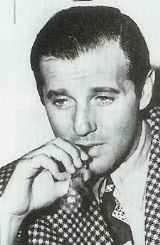
Bugsy Siegel

Encyclopedia
Benjamin "Bugsy" Siegel (born Benjamin Siegelbaum; February 28, 1906 – June 20, 1947) was an American gangster who was involved with the Genovese crime family
. Siegel was a major driving force behind large-scale development of metropolitan Las Vegas
.
, to a poor Jewish family from Letychiv
, Podolia Governorate
of the Russian Empire
, in modern Ukraine
. As a boy, Siegel joined a gang on Lafayette Street on the Lower East Side
of Manhattan and committed mainly thefts, until, with a youth named Moe Sedway
, he devised his own protection racket
: pushcart merchants were forced to pay him a dollar or he would incinerate their merchandise.
During adolescence, Siegel befriended Meyer Lansky
, who was forming a small mob whose activities expanded to gambling and car theft. Siegel reputedly also worked as the mob's hitman
, whom Lansky would hire out to other crime families
. On January 28, 1929, Siegel married Esta Krakower, his childhood sweetheart and sister of contract killer Whitey Krakower.
In 1930, Lansky and Siegel built ties to Charles "Lucky" Luciano
and Frank Costello
, future bosses of the Genovese crime family. Siegel became a bootlegger and was associated with Albert "Mad Hatter" Anastasia
. Siegel was involved in bootlegging in New York, New Jersey
and Philadelphia. Siegel and Anastasia, together with Vito Genovese
and Joe Adonis
, were the four gunmen who shot New York mob boss Joe Masseria
to death on Luciano's orders on April 15, 1931, formally ending the Castellammarese War
. On September 10 of that year, Luciano hired four trigger men from the Lansky-Siegel gang to murder Masseria's rival, Salvatore Maranzano
, cementing Luciano's rise to the top of the U.S. Mafia and marking the birth of modern American organized crime. In 1932, Siegel was arrested for gambling and bootlegging but got off with a fine. Lansky and Siegel assisted in Luciano's brief alliance with Dutch Schultz
and killed rival loan shark
s Louis "Pretty" Amberg
and Joseph Amberg in 1935.
gambling rackets with Los Angeles crime family
boss, Jack Dragna
. Once in Los Angeles, Siegel recruited gang boss Mickey Cohen
as his lieutenant. Siegel used syndicate money to set up a national wire service to help the East Coast mob quicken their returns.
Siegel moved Esta and their two daughters, Millicent and Barbara, to California. On tax returns he claimed to earn his living through legal gambling at Santa Anita Park
near Los Angeles.
On November 22, 1939, Siegel, Whitey Krakow
er, and two other gang members killed Harry "Big Greenie" Greenberg
. Greenberg had become a police informant
, and Louis "Lepke" Buchalter
, boss of Murder, Inc.
, ordered his killing. Siegel was tried for the Greenberg murder. Whitey Krakower was killed before he could face trial. Siegel was acquitted but his reputation was in ruins. During the trial, newspapers revealed Siegel's past and referred to him as "Bugsy". He hated the nickname (said to be based on the slang "bugs", meaning "crazy", and used to describe his erratic behavior), and wouldn't be called "Bugsy" to his face.
Las Vegas gave Siegel his second opportunity to reinvent himself. Siegel had traveled to Southern Nevada
in 1934 with Meyer Lansky's lieutenant Moe Sedway
, on Lansky's orders to explore expanding operations. There were opportunities in providing illicit services to the crews constructing the Hoover Dam. Lansky had turned the desert over to Siegel. But Siegel, wanting nothing to do with it, turned it over to Moe Sedway and fled for Hollywood.
Lansky pressured Siegel to represent them in Wilkerson's desert project. Someone had to watchdog their interests. Siegel, who knew Wilkerson and lived near him in Beverly Hills, was the obvious choice as a liaison, but Siegel was infuriated. He wanted no part in any operation that took him back to Nevada permanently. It meant forsaking Beverly Hills and playboy life and enduring the heat of Nevada. At Lansky's insistence, however, Siegel consented.
The problem came to a head when Siegel demanded more involvement in the project. To keep the project moving, Wilkerson agreed that Siegel would supervise the hotel while Wilkerson retained control of everything else.
In May 1946, Siegel decided the agreement had to be altered to give him control of the Flamingo. Siegel offered to buy out Wilkerson's creative participation with corporate stock – an additional 5 percent ownership in the operation (which Siegel later reneged). On June 20, 1946, Siegel formed the Nevada Project Corporation of California, naming himself president. He was also the largest principal stockholder in the operation, which defined everyone else merely as shareholders (William Wilkerson
was eventually coerced into selling all stakes in the Flamingo under threat of death, and went into hiding in Paris for a time). From this point the Flamingo became syndicate-run.
The first indication of trouble came in early November 1946. The syndicate issued an ultimatum: provide accounting or forfeit funding. But producing a balance sheet was the last thing Siegel wanted to do. After the syndicate's refusal of help, Siegel waged a campaign of private fund raising. He sold nonexistent stock. Siegel was in a hurry to finish. He doubled his work force, believing the project could be completed in half the time. But it was costs, not building, that began rising faster. Siegel paid overtime and double-time. In some cases, bonuses tied to project deadlines were offered in hope of increasing productivity. By the end of November work was nearly finished.
Under pressure to have the hotel make some money, Siegel moved the opening from Wilkerson's original date of March 1, 1947 to the day after Christmas, 1946. Although the hotel was incomplete he was hoping to generate enough from the casino to complete the project and repay investors. Siegel announced the hotel would be ready the day after Christmas. Its opening would be held that same evening, December 26, 1946. Siegel generated confusion regarding the opening date. Acting on a whim, he decided a weekend would be more likely to entice celebrities away from home. Invitations were sent out for Saturday, December 28. Siegel changed his mind again. Invitees were notified by phone that the opening had been changed back to the 26th.
, Vivian Blaine
, George Raft
, Sonny Tufts
, Brian Donlevy
and Charles Coburn
. They were welcomed by construction noise and a lobby draped with decorators' drop cloths. The desert's first air conditioning collapsed regularly. While gambling tables were operating, the luxury rooms that would have served as the lure for them to stay and gamble longer were not ready. After two weeks the Flamingo's gaming tables were $275,000 in the red and the entire operation shut down in late January 1947.
By begging the mob bosses to give his friend a second chance, Lansky got an extension for Bugsy. After being granted a second chance, Bugsy cracked down and did everything possible to turn the Flamingo into a success. However, by the time profits began improving the mob bosses above Bugsy were tired of waiting.
 On the night of June 20, 1947, as Siegel sat with his associate Allen Smiley in Virginia Hill
's Beverly Hills home reading the Los Angeles Times
, an unknown assailant fired at him through the window with a .30-caliber military M1 carbine
, hitting him many times, including twice in the head. No one was charged with the murder, and the crime remains officially unsolved.
Though descriptions held that Siegel was shot in the eye, he was actually struck twice on the right side of his head. Both death scene and postmortem photographs clearly show that one shot penetrated his right cheek and exited through the left side of his neck; the other struck the right bridge of his nose where it met the right eye socket. Overpressure created by that bullet's striking and passing through Siegel's skull blew his left eye out of its socket. Both the Los Angeles' Coroner's Report (#37448) and his death certificate (Registrar's #816192) state the cause of death was cerebral hemorrhage.
Though as noted, Siegel was actually not shot exactly through the eye (the eyeball would have been destroyed if this had been the case), the bullet-through-the-eye style of killing nevertheless became popular in Mafia lore and in movies, and was called the "Moe Greene special" after the character Moe Greene
- based on Siegel - who was killed in this manner in The Godfather
.
Siegel was hit by several other bullets including shots through his lungs. According to Florabel Muir, "Four of the nine shots fired that night destroyed a white marble statue of Bacchus
on a grand piano, and then lodged in the far wall".
The day after Siegel's death, the Los Angeles Herald-Express
carried a photograph on its front page from the morgue
of Siegel's bare right foot with a toe tag dangling from its big toe.
on Manhattan's Lower East Side, Siegel is memorialized by a Yahrtzeit
(remembrance) plaque that marks his death date so mourners can say Kaddish
for the anniversary. Siegel's plaque is below that of his father, Max Siegel, who died two months prior to his son's murder. He is interred in the Hollywood Forever Cemetery, Hollywood, CA.
Genovese crime family
The Genovese crime family , is one of the "Five Families" that dominates organized crime activities in New York City, United States, within the nationwide criminal phenomenon known as the Mafia . The Genovese crime family has been nicknamed the "Ivy League" and "Rolls Royce" of organized crime...
. Siegel was a major driving force behind large-scale development of metropolitan Las Vegas
Las Vegas metropolitan area
The Las Vegas Valley is the heart of the Las Vegas-Paradise, NV MSA also known as the Las Vegas–Paradise–Henderson MSA which includes all of Clark County, Nevada, and is a metropolitan area in the southern part of the U.S. state of Nevada. The Valley is defined by the Las Vegas Valley landform, a ...
.
Early life
Benjamin Siegelbaum was born in 1906 in Williamsburg, BrooklynWilliamsburg, Brooklyn
Williamsburg is a neighborhood in the New York City borough of Brooklyn, bordering Greenpoint to the north, Bedford-Stuyvesant to the south, Bushwick to the east and the East River to the west. The neighborhood is part of Brooklyn Community Board 1. The neighborhood is served by the NYPD's 90th ...
, to a poor Jewish family from Letychiv
Letychiv
Letychiv is a town in the eastern part of Khmelnytskyi Oblast of western Ukraine. 51 km from Khmelnytskyi and 33 km from the railway station Derazhnya. Administrative center since Tsarist times, formerly in Podolia Province. Population: 11,081 inhabitants . There are brickworks, dairy,...
, Podolia Governorate
Podolia Governorate
The Podolia Governorate or Government of Podolia, set up after the Second Partition of Poland, comprised a governorate of the Russian Empire from 1793 to 1917, of the Ukrainian People's Republic from 1917 to 1921, and of the Ukrainian SSR from 1921 to 1925.-Location:The Podolian Governorate...
of the Russian Empire
Russian Empire
The Russian Empire was a state that existed from 1721 until the Russian Revolution of 1917. It was the successor to the Tsardom of Russia and the predecessor of the Soviet Union...
, in modern Ukraine
Ukraine
Ukraine is a country in Eastern Europe. It has an area of 603,628 km², making it the second largest contiguous country on the European continent, after Russia...
. As a boy, Siegel joined a gang on Lafayette Street on the Lower East Side
Lower East Side
The Lower East Side, LES, is a neighborhood in the southeastern part of the New York City borough of Manhattan. It is roughly bounded by Allen Street, East Houston Street, Essex Street, Canal Street, Eldridge Street, East Broadway, and Grand Street....
of Manhattan and committed mainly thefts, until, with a youth named Moe Sedway
Moe Sedway
Moe Sedway was the faithful lieutenant of organized crime czar Meyer Lansky. Sedway had his own police record dating as far back as the early 1920s in New York. He began making trips to Las Vegas on Lansky's behalf in the early 1930s to franchise the syndicate's Trans-America race wire service...
, he devised his own protection racket
Protection racket
A protection racket is an extortion scheme whereby a criminal group or individual coerces a victim to pay money, supposedly for protection services against violence or property damage. Racketeers coerce reticent potential victims into buying "protection" by demonstrating what will happen if they...
: pushcart merchants were forced to pay him a dollar or he would incinerate their merchandise.
During adolescence, Siegel befriended Meyer Lansky
Meyer Lansky
Meyer Lansky , known as the "Mob's Accountant", was a Polish-born American organized crime figure who, along with his associate Charles "Lucky" Luciano, was instrumental in the development of the "National Crime Syndicate" in the United States...
, who was forming a small mob whose activities expanded to gambling and car theft. Siegel reputedly also worked as the mob's hitman
Hitman
A hitman is a person hired to kill another person.- Hitmen in organized crime :Hitmen are largely linked to the world of organized crime. Hitmen are hired people who kill people for money. Notable examples include Murder, Inc., Mafia hitmen and Richard Kuklinski.- Other cases involving hitmen...
, whom Lansky would hire out to other crime families
Crime family
A crime family is a term used to describe a unit of an organized crime syndicate, often operating within a specific geographic territory. The term is used almost exclusively to refer to units of the Mafia, both in Sicily and in the United States, although it is occasionally used to refer to other...
. On January 28, 1929, Siegel married Esta Krakower, his childhood sweetheart and sister of contract killer Whitey Krakower.
In 1930, Lansky and Siegel built ties to Charles "Lucky" Luciano
Lucky Luciano
Charlie "Lucky" Luciano was an Italian mobster born in Sicily. Luciano is considered the father of modern organized crime in the United States for splitting New York City into five different Mafia crime families and the establishment of the first commission...
and Frank Costello
Frank Costello
Frank Costello was an Italian New York City gangster who rose to the top of America's underworld, controlled a vast gambling empire across the United States and enjoyed political influence.Nicknamed the "Prime Minister of the Underworld", he became one of the most powerful and influential Mafia...
, future bosses of the Genovese crime family. Siegel became a bootlegger and was associated with Albert "Mad Hatter" Anastasia
Albert Anastasia
Albert Anastasia was boss of what is now called the Gambino crime family, one of New York City's Five Families, from 1951-1957. He also ran a gang of contract killers called Murder Inc. which enforced the decisions of the Commission, the ruling council of the American Mafia...
. Siegel was involved in bootlegging in New York, New Jersey
New Jersey
New Jersey is a state in the Northeastern and Middle Atlantic regions of the United States. , its population was 8,791,894. It is bordered on the north and east by the state of New York, on the southeast and south by the Atlantic Ocean, on the west by Pennsylvania and on the southwest by Delaware...
and Philadelphia. Siegel and Anastasia, together with Vito Genovese
Vito Genovese
Vito "Don Vito" Genovese was an Italian mafioso who rose to power in America during the Castellammarese War to later become leader of the Genovese crime family. Genovese served as mentor to future mob boss Vincent "The Chin" Gigante...
and Joe Adonis
Joe Adonis
Joe Adonis , also known as "Joey A", "Joe Adone", "Joe Arosa", "James Arosa", and "Joe DiMeo", was a New York mobster who was an important participant in the formation of the modern Cosa Nostra crime families.-Early years:Adonis was born Giuseppe Antonio Doto in the small town of Montemarano,...
, were the four gunmen who shot New York mob boss Joe Masseria
Joe Masseria
Giuseppe "Joe the Boss" Masseria was an early Mafia don in the United States. He was boss of what is now called the Genovese crime family, one of the New York Mafia's Five Families, from 1922 to 1931.-Early days:...
to death on Luciano's orders on April 15, 1931, formally ending the Castellammarese War
Castellammarese War
The Castellammarese War was a bloody power struggle for control of the Italian-American Mafia between partisans of Joe "The Boss" Masseria and those of Salvatore Maranzano. It was so called because Maranzano was based in Castellammare del Golfo, Sicily...
. On September 10 of that year, Luciano hired four trigger men from the Lansky-Siegel gang to murder Masseria's rival, Salvatore Maranzano
Salvatore Maranzano
Salvatore Maranzano was an organized crime figure from the town of Castellammare del Golfo, Sicily, and an early Cosa Nostra boss in the United States. He instigated the Castellammarese War to seize control of the American Mafia operations, and briefly became the Mafia's "Boss of Bosses"...
, cementing Luciano's rise to the top of the U.S. Mafia and marking the birth of modern American organized crime. In 1932, Siegel was arrested for gambling and bootlegging but got off with a fine. Lansky and Siegel assisted in Luciano's brief alliance with Dutch Schultz
Dutch Schultz
Dutch Schultz was a New York City-area Jewish American gangster of the 1920s and 1930s who made his fortune in organized crime-related activities such as bootlegging alcohol and the numbers racket...
and killed rival loan shark
Loan shark
A loan shark is a person or body that offers unsecured loans at illegally high interest rates to individuals, often enforcing repayment by blackmail or threats of violence....
s Louis "Pretty" Amberg
Louis Amberg
Louis "Pretty" Amberg was in a criminal organization with his brothers Joseph and Hyman Amberg competing against Jacob "Gurrah" Shapiro, Louis "Lepke" Buchalter and the Shapiro Brothers for control of Brooklyn's racketeering activities during the 1920s and early 1930s. Ambergs body was found in a...
and Joseph Amberg in 1935.
California
In 1937, the East Coast mob sent Siegel to California to develop syndicateThe Commission (mafia)
The Commission is the governing body of the American Mafia. Formed in 1931, the Commission replaced the "Boss of all Bosses" title, with a ruling committee, consisting of the New York Five Families bosses and the boss of the Chicago Outfit...
gambling rackets with Los Angeles crime family
Los Angeles crime family
The Los Angeles crime family is an Italian American criminal organization based in Los Angeles, as part of the American Mafia . Since its inception in the early 1900s, it has spread throughout Southern California. Like most Mafia families in the United States, the L.A. family gained power...
boss, Jack Dragna
Jack Dragna
Jack Ignatius Dragna was an American Mafia member and Black Hander who was active in both Italy and the United States in the 1900s. He was active in bootlegging in California during the Prohibition Era in the United States...
. Once in Los Angeles, Siegel recruited gang boss Mickey Cohen
Mickey Cohen
Meyer Harris "Mickey" Cohen was a gangster based in Los Angeles and part of the Jewish Mafia, and also had strong ties to the American Mafia from the 1930s through 1960s.-Early life:...
as his lieutenant. Siegel used syndicate money to set up a national wire service to help the East Coast mob quicken their returns.
Siegel moved Esta and their two daughters, Millicent and Barbara, to California. On tax returns he claimed to earn his living through legal gambling at Santa Anita Park
Santa Anita Park
Santa Anita Park is a thoroughbred racetrack in Arcadia, California, United States. It offers some of the prominent racing events in the United States during the winter and in spring. With its backdrop of the purple San Gabriel Mountains, it is considered by many as the world's most beautiful race...
near Los Angeles.
On November 22, 1939, Siegel, Whitey Krakow
Whitey Krakow
Whitey Krakow or Krakower was a New York mobster who, during the 1930s, served as a hitman for Murder, Inc. He was later suspected in the 1939 gangland slaying of Harry "Big Greenie" Greenberg with Frankie Carbo and brother-in-law Benjamin "Bugsy" Siegel. Implicated by fellow Murder Inc...
er, and two other gang members killed Harry "Big Greenie" Greenberg
Harry Greenberg
Harry Schachter or Harry "Big Greenie" Greenberg was an associate and childhood friend of Bugsy Siegel, and an employee of both Charlie "Lucky" Luciano and Meyer Lansky. On November 22, 1939, Greenberg was murdered by Bugsy Siegel and his brother-in-law, Whitey Krakower...
. Greenberg had become a police informant
Informant
An informant is a person who provides privileged information about a person or organization to an agency. The term is usually used within the law enforcement world, where they are officially known as confidential or criminal informants , and can often refer pejoratively to the supply of information...
, and Louis "Lepke" Buchalter
Louis Buchalter
Louis "Lepke" Buchalter was a Jewish American mobster and head of the Mafia hit squad Murder, Inc. during the 1930s. After Dutch Schultz' request of the Mafia Commission for permission to kill his enemy, U.S. Attorney Thomas Dewey, the Commission decided to kill Schultz in order to prevent the hit...
, boss of Murder, Inc.
Murder, Inc.
Murder, Inc. was the name given by the press to organized crime groups in the 1920s through the 1940s that resulted in hundreds of murders on behalf of the American Mafia and Jewish Mafia groups who together formed the early organized crime groups in New York and...
, ordered his killing. Siegel was tried for the Greenberg murder. Whitey Krakower was killed before he could face trial. Siegel was acquitted but his reputation was in ruins. During the trial, newspapers revealed Siegel's past and referred to him as "Bugsy". He hated the nickname (said to be based on the slang "bugs", meaning "crazy", and used to describe his erratic behavior), and wouldn't be called "Bugsy" to his face.
Las Vegas
Siegel desired to be legitimate. The legitimacy and respectability he craved were beyond his reach. But by spring 1946, it became stronger – in William R. Wilkerson's Flamingo.Las Vegas gave Siegel his second opportunity to reinvent himself. Siegel had traveled to Southern Nevada
Southern Nevada
Southern Nevada is the region of Nevada which includes the Las Vegas Valley. Southern Nevada also includes the areas in and around Goldfield, Hawthorne, Pahrump, and Pioche. Geographically, Southern Nevada is partly, and in some cases, fully within the Mojave Desert. The population of the...
in 1934 with Meyer Lansky's lieutenant Moe Sedway
Moe Sedway
Moe Sedway was the faithful lieutenant of organized crime czar Meyer Lansky. Sedway had his own police record dating as far back as the early 1920s in New York. He began making trips to Las Vegas on Lansky's behalf in the early 1930s to franchise the syndicate's Trans-America race wire service...
, on Lansky's orders to explore expanding operations. There were opportunities in providing illicit services to the crews constructing the Hoover Dam. Lansky had turned the desert over to Siegel. But Siegel, wanting nothing to do with it, turned it over to Moe Sedway and fled for Hollywood.
Lansky pressured Siegel to represent them in Wilkerson's desert project. Someone had to watchdog their interests. Siegel, who knew Wilkerson and lived near him in Beverly Hills, was the obvious choice as a liaison, but Siegel was infuriated. He wanted no part in any operation that took him back to Nevada permanently. It meant forsaking Beverly Hills and playboy life and enduring the heat of Nevada. At Lansky's insistence, however, Siegel consented.
Siegel accepts
Throughout the spring of 1946, Siegel proved useful. He obtained black market building materials. The postwar shortages that had dogged construction were no longer a problem. At first Siegel seemed content to do things Wilkerson's way. His desire to learn about the project took precedence over his sportsman lifestyle. It subdued his aggression. Under Wilkerson's tutelage, Siegel played the pupil, learning the mechanics of building an enterprise. The role did not come easily. Perhaps outdistanced and afraid of being upstaged by his mentor, Siegel began to feel intimidated and paranoid. He grew resentful of Wilkerson's talent and vision. As time went on, the gangster's admiration disintegrated into insane jealousy. Siegel reverted to his familiar role: the big-shot. He began making decisions without Wilkerson's authority. Informing work crews that Wilkerson had put him in charge, Siegel ordered changes which conflicted with the blueprints.The problem came to a head when Siegel demanded more involvement in the project. To keep the project moving, Wilkerson agreed that Siegel would supervise the hotel while Wilkerson retained control of everything else.
In May 1946, Siegel decided the agreement had to be altered to give him control of the Flamingo. Siegel offered to buy out Wilkerson's creative participation with corporate stock – an additional 5 percent ownership in the operation (which Siegel later reneged). On June 20, 1946, Siegel formed the Nevada Project Corporation of California, naming himself president. He was also the largest principal stockholder in the operation, which defined everyone else merely as shareholders (William Wilkerson
William Wilkerson
William Richard Wilkerson was the founder of the Hollywood Reporter, Flamingo Hotel and owner of such nightclubs as Ciro's. He was also responsible for discovering actress Lana Turner across the street from Hollywood High School.-Early life:Born in Nashville, Tennessee on September 29, 1890...
was eventually coerced into selling all stakes in the Flamingo under threat of death, and went into hiding in Paris for a time). From this point the Flamingo became syndicate-run.
Las Vegas' beginning
Siegel began a spending spree, staggering even today. He demanded the finest building that money could buy at a time of wartime shortages. Each bathroom of the 93-room hotel had its own sewer system (cost: $1,150,000); more toilets were ordered than needed (cost: $50,000); because of the plumbing alterations, the boiler room, now too small, had to be enlarged (cost: $113,000); and Siegel ordered a larger kitchen (cost: $29,000). Adding to the budgetary over-runs were problems with dishonest contractors and disgruntled unpaid builders. By day, trucks delivered black market goods. By night the same materials were pilfered and resold to Siegel a few days later. As costs soared, Siegel's checks began bouncing. By October 1946, the costs had soared above $4 million. In spring 1947, the Flamingo would clock in at over $6 million.The first indication of trouble came in early November 1946. The syndicate issued an ultimatum: provide accounting or forfeit funding. But producing a balance sheet was the last thing Siegel wanted to do. After the syndicate's refusal of help, Siegel waged a campaign of private fund raising. He sold nonexistent stock. Siegel was in a hurry to finish. He doubled his work force, believing the project could be completed in half the time. But it was costs, not building, that began rising faster. Siegel paid overtime and double-time. In some cases, bonuses tied to project deadlines were offered in hope of increasing productivity. By the end of November work was nearly finished.
Under pressure to have the hotel make some money, Siegel moved the opening from Wilkerson's original date of March 1, 1947 to the day after Christmas, 1946. Although the hotel was incomplete he was hoping to generate enough from the casino to complete the project and repay investors. Siegel announced the hotel would be ready the day after Christmas. Its opening would be held that same evening, December 26, 1946. Siegel generated confusion regarding the opening date. Acting on a whim, he decided a weekend would be more likely to entice celebrities away from home. Invitations were sent out for Saturday, December 28. Siegel changed his mind again. Invitees were notified by phone that the opening had been changed back to the 26th.
Devastation
While locals jammed the opening, few celebrities materialized. A handful did motor in from Los Angeles despite appalling weather. Some of the celebrities present were June HaverJune Haver
June Haver , was an American film actress. She is most well known as a popular star of 20th Century-Fox musicals in the late 1940s, most notably The Dolly Sisters with Betty Grable and John Payne and also for playing the 1920s Broadway actress Marilyn Miller in Look for the Silver Lining...
, Vivian Blaine
Vivian Blaine
Vivian Blaine was an American actress and singer best known for originating the role of Miss Adelaide in the musical theater production Guys and Dolls.-Life and career:...
, George Raft
George Raft
George Raft was an American film actor and dancer identified with portrayals of gangsters in crime melodramas of the 1930s and 1940s...
, Sonny Tufts
Sonny Tufts
Sonny Tufts was a United States film actor....
, Brian Donlevy
Brian Donlevy
Brian Donlevy was an Irish-born American film actor, noted for playing tough guys from the 1930s to the 1960s. He usually appeared in supporting roles. Among his best known films are Beau Geste and The Great McGinty...
and Charles Coburn
Charles Coburn
Charles Douville Coburn was an American film and theater actor.-Biography:Coburn was born in Macon, Georgia, the son of Scots-Irish Americans Emma Louise Sprigman and Moses Douville Coburn. Growing up in Savannah, he started out doing odd jobs at the local Savannah Theater, handing out programs,...
. They were welcomed by construction noise and a lobby draped with decorators' drop cloths. The desert's first air conditioning collapsed regularly. While gambling tables were operating, the luxury rooms that would have served as the lure for them to stay and gamble longer were not ready. After two weeks the Flamingo's gaming tables were $275,000 in the red and the entire operation shut down in late January 1947.
By begging the mob bosses to give his friend a second chance, Lansky got an extension for Bugsy. After being granted a second chance, Bugsy cracked down and did everything possible to turn the Flamingo into a success. However, by the time profits began improving the mob bosses above Bugsy were tired of waiting.
Death
Virginia Hill
Virginia Hill was a Chicago Outfit courier who was famous for being the girlfriend of Genovese crime family mobster Bugsy Siegel, following the breakdown of his marriage.- The Kefauver hearings :...
's Beverly Hills home reading the Los Angeles Times
Los Angeles Times
The Los Angeles Times is a daily newspaper published in Los Angeles, California, since 1881. It was the second-largest metropolitan newspaper in circulation in the United States in 2008 and the fourth most widely distributed newspaper in the country....
, an unknown assailant fired at him through the window with a .30-caliber military M1 carbine
M1 Carbine
The M1 carbine is a lightweight, easy to use semi-automatic carbine that became a standard firearm for the U.S. military during World War II, the Korean War and the Vietnam War, and was produced in several variants. It was widely used by U.S...
, hitting him many times, including twice in the head. No one was charged with the murder, and the crime remains officially unsolved.
Though descriptions held that Siegel was shot in the eye, he was actually struck twice on the right side of his head. Both death scene and postmortem photographs clearly show that one shot penetrated his right cheek and exited through the left side of his neck; the other struck the right bridge of his nose where it met the right eye socket. Overpressure created by that bullet's striking and passing through Siegel's skull blew his left eye out of its socket. Both the Los Angeles' Coroner's Report (#37448) and his death certificate (Registrar's #816192) state the cause of death was cerebral hemorrhage.
Though as noted, Siegel was actually not shot exactly through the eye (the eyeball would have been destroyed if this had been the case), the bullet-through-the-eye style of killing nevertheless became popular in Mafia lore and in movies, and was called the "Moe Greene special" after the character Moe Greene
Moe Greene
Moe Greene is a fictional character appearing in Mario Puzo's 1969 novel The Godfather and the first installment of the The Godfather trilogy of films, in which he was portrayed by actor Alex Rocco...
- based on Siegel - who was killed in this manner in The Godfather
The Godfather
The Godfather is a 1972 American epic crime film directed by Francis Ford Coppola, based on the 1969 novel by Mario Puzo. With a screenplay by Puzo, Coppola and an uncredited Robert Towne, the film stars Marlon Brando, Al Pacino, James Caan, Robert Duvall, Sterling Hayden, John Marley, Richard...
.
Siegel was hit by several other bullets including shots through his lungs. According to Florabel Muir, "Four of the nine shots fired that night destroyed a white marble statue of Bacchus
Dionysus
Dionysus was the god of the grape harvest, winemaking and wine, of ritual madness and ecstasy in Greek mythology. His name in Linear B tablets shows he was worshipped from c. 1500—1100 BC by Mycenean Greeks: other traces of Dionysian-type cult have been found in ancient Minoan Crete...
on a grand piano, and then lodged in the far wall".
The day after Siegel's death, the Los Angeles Herald-Express
Los Angeles Herald-Examiner
The Los Angeles Herald Examiner was a major Los Angeles daily newspaper, published Monday through Friday in the afternoon, and in the morning on Saturdays and Sundays. It was part of the Hearst syndicate. The afternoon Herald-Express and the morning Examiner, both of which had been publishing in...
carried a photograph on its front page from the morgue
Morgue
A morgue or mortuary is used for the storage of human corpses awaiting identification, or removal for autopsy or disposal by burial, cremation or otherwise...
of Siegel's bare right foot with a toe tag dangling from its big toe.
Memorial
In the Bialystoker SynagogueBialystoker Synagogue
The Bialystoker Synagogue at 7-11 Willett Street on the Lower East Side of Manhattan, New York City, New York State is an Orthodox Jewish synagogue...
on Manhattan's Lower East Side, Siegel is memorialized by a Yahrtzeit
Bereavement in Judaism
Bereavement in Judaism is a combination of minhag and mitzvah derived from Judaism's classical Torah and rabbinic texts...
(remembrance) plaque that marks his death date so mourners can say Kaddish
Kaddish
Kaddish is a prayer found in the Jewish prayer service. The central theme of the Kaddish is the magnification and sanctification of God's name. In the liturgy different versions of the Kaddish are used functionally as separators between sections of the service...
for the anniversary. Siegel's plaque is below that of his father, Max Siegel, who died two months prior to his son's murder. He is interred in the Hollywood Forever Cemetery, Hollywood, CA.
In pop culture
Given his larger-than-life exploits and violent death, along with a general fascination with gangsters of his era, Siegel has been portrayed many times in film, TV, and comic books.In film
- The GodfatherThe GodfatherThe Godfather is a 1972 American epic crime film directed by Francis Ford Coppola, based on the 1969 novel by Mario Puzo. With a screenplay by Puzo, Coppola and an uncredited Robert Towne, the film stars Marlon Brando, Al Pacino, James Caan, Robert Duvall, Sterling Hayden, John Marley, Richard...
(1972), as 'Moe Green', played by Alex RoccoAlex RoccoAlex Rocco is an American actor. His roles have ranged from comedy to playing gangsters in Mafia movies.-Early life:...
. - BugsyBugsyBugsy is a 1991 American crime-drama film which tells the story of mobster Bugsy Siegel. It stars Warren Beatty, Annette Bening, Harvey Keitel, Ben Kingsley, Elliott Gould, Joe Mantegna, Bebe Neuwirth, and Bill Graham....
(1991), a biography of Siegel, featured Warren BeattyWarren BeattyWarren Beatty born March 30, 1937) is an American actor, producer, screenwriter and director. He has received a total of fourteen Academy Award nominations, winning one for Best Director in 1982. He has also won four Golden Globe Awards including the Cecil B. DeMille Award.-Early life and...
as the mobster. - MobstersMobstersMobsters is a 1991 crime-drama film detailing the creation of the The Commission. Set in New York City, taking place from 1917 to 1931, it is a semi-fictitious account of the rise of Charles "Lucky" Luciano, Meyer Lansky, Frank Costello, and Benjamin "Bugsy" Siegel.-Plot:This highly dramatized...
(1991), a semi-fictitious account of the rise of Charles "Lucky" Luciano, Meyer Lansky, Frank Costello, and Benjamin "Bugsy" Siegel, featured Richard GriecoRichard GriecoRichard John Grieco, Jr. is an American actor and former fashion model.-Early life:Richard Grieco was born in Watertown, New York, the son of Carolyn and Richard Grieco. He is of Italian and Irish descent. Grieco played football for Central Connecticut State University.-Career:Grieco worked as a...
as Siegel. - LanskyLansky (film)Lansky is a 1999 American made-for-television crime drama film. Directed by John McNaughton, it stars Richard Dreyfuss as the famous gangster Meyer Lansky, Eric Roberts as Bugsy Siegel, and Ryan Merriman as the young Lansky.-Plot summary:...
, a 19991999 in filmThe year 1999 in film involved several noteworthy events and has been called "The Year That Changed Movies". Several significant feature films, including Stanley Kubrick's final film Eyes Wide Shut, Pedro Almodóvar's first Oscar-winning film All About My Mother, science fiction The Matrix, Deep...
biography of Meyer LanskyMeyer LanskyMeyer Lansky , known as the "Mob's Accountant", was a Polish-born American organized crime figure who, along with his associate Charles "Lucky" Luciano, was instrumental in the development of the "National Crime Syndicate" in the United States...
, Siegel is played by Eric RobertsEric RobertsEric Anthony Roberts is an American actor. His career began with King of the Gypsies , earning a Golden Globe nomination for best actor debut. He starred as the protagonist in the 1980 dramatisation of Willa Cather's 1905 short story, Paul's Case...
. - Boardwalk Empire (2011), Teenaged "Benny" Siegel is played by Michael Zegen.
In literature
- Siegel is a recurring villain of Greg Saunders, the first VigilanteVigilante (comics)Vigilante is the name used by several fictional characters appearing in DC Comics. The original character was one of the first DC Comics characters adapted for live-action film, beating Superman by one year.-Greg Saunders:...
.
Further reading
- Hollywood's Celebrity Gangster. The Incredible Life and Times of Mickey Cohen by Brad Lewis. (Enigma Books: New York, 2007. ISBN 978-1-929631-65-0)
- The Battle for Las Vegas: The Law Vs. the Mob by Dennis N Griffin (Huntington Press: 2006. ISBN 0929712374)
- Almog, OzOz AlmogOz Almog, an Israeli–Austrian artist was born on April 15, 1956, in Kfar Saba, Israel. He comes from a family of Russian/Ukrainian pioneers and Romanian/Russian immigrants...
, Kosher Nostra Jüdische Gangster in Amerika, 1890–1980 ; Jüdischen Museum der Stadt Wien ; 2003, Text Oz Almog, Erich Metz, ISBN 3901398333
External links
- Bugsysiegel.net, various information including a copy of Siegel's death certificate
- FBI files on Siegel (2,421 pages, heavily redacted) From the FBI Freedom of Information Act.
- Benjamin "Bugsy" Siegel Profile and NY Times Article at J-Grit: The Internet Index of Tough Jews
- PBS American Experience
- Bugsy Siegel memorial in Las Vegas