
|
|
|
|
Meyer Lansky
|
| |
|
| |
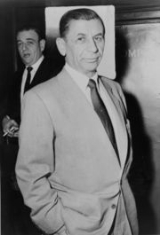
Meyer Lansky (July 4, 1902 – January 15, 1983) was a gangster who, with Charles "Lucky" Luciano, was instrumental in the development of The Commission (and possibly the "National Crime Syndicate") in the United States.
Lansky developed a gambling empire which ranged from Saratoga, Miami, Las Vegas and was officially in charge of gambling concessions in Cuba. He was appointed by Fulgencio Batista y Zaldívar. Although a member of the Jewish Mafia, Lansky undoubtedly played a central role in the Italian Mafia's organization and consolidation of the criminal underworld (although the full extent of this role has come under some debate).
r Lansky was born Majer Suchowlinski in Grodno, Russian Empire (now in Belarus) to Max Suchowlinski and his wife Yetta.

Discussion
Ask a question about 'Meyer Lansky'
Start a new discussion about 'Meyer Lansky'
Answer questions from other users
|
Recent Posts

Encyclopedia
Meyer Lansky (July 4, 1902 – January 15, 1983) was a gangster who, with Charles "Lucky" Luciano, was instrumental in the development of The Commission (and possibly the "National Crime Syndicate") in the United States.
Lansky developed a gambling empire which ranged from Saratoga, Miami, Las Vegas and was officially in charge of gambling concessions in Cuba. He was appointed by Fulgencio Batista y Zaldívar. Although a member of the Jewish Mafia, Lansky undoubtedly played a central role in the Italian Mafia's organization and consolidation of the criminal underworld (although the full extent of this role has come under some debate).
Immigration and childhood
Meyer Lansky was born Majer Suchowlinski in Grodno, Russian Empire (now in Belarus) to Max Suchowlinski and his wife Yetta. In 1911 the family emigrated to the United States and settled on the Lower East Side of Manhattan, New York. While Lansky was in school, he allegedly met young Charles "Lucky" Luciano, who tried to shake him down (extort money). When Lansky refused to pay, Luciano was impressed with the younger boy's bravery and the two became friends for life.
Lansky met Bugsy Siegel when he was a teenager. They also became lifelong friends, and together with Luciano, formed a lasting partnership. Lansky was instrumental in Luciano's rise to power by organizing the 1931 murder of Mafia powerhouse Salvatore Maranzano. As a youngster, Siegel saved Lansky's life several times, a fact which Lansky always appreciated. The two adroitly managed the Bug and Meyer Mob despite its reputation as one of the most violent Prohibition gangs.
Lansky was the brother of Jacob "Jake" Lansky, who in 1959 was the manager of the Nacional Hotel in Havana, Cuba.
Gambling operations
By 1936, Lansky had established gambling operations in Florida, New Orleans, and Cuba. In that same year, his partner Luciano was sent to prison. As Alfred McCoy records:
"During the 1930s, Meyer Lansky 'discovered' the Caribbean for Northeastern United States syndicate bosses and invested their illegal profits in an assortment of lucrative gambling ventures.... He was also reportedly responsible for organized crime's decision to declare Miami a 'free city' (i.e., not subject to the usual rules of territorial monopoly)."
Lansky later convinced the Mafia to place Bugsy Siegel in charge of Las Vegas, and became a major investor in Siegel's Flamingo Hotel.
After Al Capone's 1931 conviction for tax evasion and prostitution, Lansky saw that he too was vulnerable to a similar prosecution. To protect himself, he transferred the illegal earnings from his growing casino empire to a Swiss numbered bank account, whose anonymity was assured by the 1934 Swiss Banking Act. According to Lucy Komisar, Lansky eventually even bought an offshore bank in Switzerland, which he used to launder money through a network of shell and holding companies.
War work
In the 1930s, Meyer Lansky and his gang claims to have stepped outside their usual criminal activities to break up rallies held by Nazi sympathizers. Lansky recalled a particular rally in Yorkville, a German neighborhood in Manhattan, that he and 14 other hoods disrupted:
- The stage was decorated with a swastika and a picture of Adolf Hitler. The speakers started ranting. There were only fifteen of us, but we went into action. We threw some of them out the windows. Most of the Nazis panicked and ran out. We chased them and beat them up. We wanted to show them that Jews would not always sit back and accept insults.
However there is no evidence of these activities other than the assertions of Lansky himself, made at a time when he was attempting to rehabilitate his image.
During World War II, Lansky was also instrumental in helping the Office of Naval Intelligence's Operation Underworld, in which the US government recruited criminals to watch out for German infiltrators and submarine-borne saboteurs.
According to Lucky Luciano's authorized biography, during this time, Lansky helped arrange a deal with the US Government via a high-ranking U.S. Navy official. This deal would secure the release of Lucky Luciano from prison; in exchange the Italian mafia would provide security for the war ships that were being built along the docks in New York Harbor. German submarines were sinking allied shipping outside the west coast on daily basis and there was great fear of attack or sabotage by Nazi sympathizers.
The Flamingo
During the 1940s, Lansky associate Bugsy Siegel persuaded the crime bosses (including Lansky) to invest in a lavish new casino hotel project in Las Vegas, the Flamingo. After long delays and large cost overruns, the Flamingo Hotel was still not open for business. To discuss the Flamingo problem, the mafia investors attended a secret meeting in Havana, Cuba in 1946. While the other bosses wanted to kill Siegel, Lansky begged them to give his friend a second chance. Despite this reprieve, Siegel continued to lose mafia money on the Flamingo Hotel. A second family meeting was then called. However, by the time this meeting took place, the casino turned a small profit. Lansky again, with Luciano's support, convinced the family to give Siegel some more time.
The Flamingo was soon losing money again. At a third meeting, the family decided that Siegel was finished. He had humiliated the organized crime bosses and never had a chance. It is widely believed that Meyer Lansky himself was compelled to give the final okay on eliminating Siegel due to his long relationship with Siegel and his stature in the family.
On June 20, 1947, Bugsy Siegel was shot and killed in Beverly Hills, California. Twenty minutes after the Siegel hit, Lansky's associates, including Gus Greenbaum and Moe Sedway, walked into the Flamingo Hotel and took control of the property. According to the Federal Bureau of Investigation, Lansky was to retain a substantial financial interest in the Flamingo for the next twenty years. Lansky said in several interviews later in his life that if it had been up to him, Ben Siegel would be alive today.
This also marked a power transfer in Vegas from the New York to the Chicago crime families. Although his role was considerably more restrained than in previous years, Lansky is believed to have both advised and aided Chicago boss Tony Accardo in initially establishing his hold.
Lansky in Cuba
After World War II, Lansky associate Lucky Luciano was paroled from prison on the condition that he permanently return to Sicily. However, Luciano secretly moved to Cuba, where he worked to resume control over American mafia operations. Luciano also ran a number of casinos in Cuba with the sanction of Cuban president General Fulgencio Batista, though the American government succeeded in pressuring the Batista regime to deport Luciano. As Luciano's Cuban revenues grew and the tourism and gambling business blossomed, with Batista taking his own cut, Lansky himself started investing heavily in a Cuban hotel project called the Havana Riviera.
However, the 1959 Cuban revolution and the rise of Fidel Castro changed the climate for mob investment in Cuba. The new Cuban president, Manuel Urrutia Lleó closed the casinos and nationalized all the casino and hotel properties. This action essentially wiped out Lansky's asset base and revenue streams. Lansky left Cuba for the Bahamas and other Caribbean destinations. With the additional crackdown on casinos in Miami, Lansky was forced to depend on his Las Vegas revenues.
Later years
In his later years, Meyer Lansky lived a low-profile, routine existence in Miami Beach, making life difficult for the FBI. Lansky's associates usually met him in malls and other crowded locations. Lansky's chauffeur drove him around town to look for new pay phones almost every day. Lansky was so elusive that the FBI essentially gave up monitoring him by the mid-1970s.
During the 1970s, Lansky fled to Herzliya Pituah, Israel, to escape federal tax evasion charges. Two years later, Israel deported Lansky back to the U.S. However, the government's best shot at convicting Lansky was with the testimony of loan shark Vincent "Fat Vinnie" Teresa, an informant with little or no credibility. The jury was unreceptive, and Lansky was acquitted in 1974.
Death
Lansky's last years were spent quietly at his home in Miami Beach. On January 15, 1983, he succumbed to lung cancer, at 80 years of age, leaving behind a wife and three children. On paper, Meyer Lansky was worth almost nothing. At the time, the FBI believed he left behind over $300 million in hidden bank accounts, but they never found any money.
However, his biographer Robert Lacey describes Lansky's financially strained circumstances in the last two decades of his life and his inability to pay for health care for his relatives. For Lacey, there was no evidence "to sustain the notion of Lansky as king of all evil, the brains, the secret mover, the inspirer and controller of American organized crime." He concludes from evidence including interviews with the surviving members of the family that Lansky's wealth and influence had been grossly exaggerated, and that it would be more accurate to think of him as an accountant for gangsters rather than a gangster himself.
Popular culture
- The character Hyman Roth, portrayed by Lee Strasberg, and certain aspects of the main character Michael Corleone from the film The Godfather Part II (1974), are based on Lansky. In fact, shortly after the premiere in 1974, Lansky phoned Strasberg and congratulated him on a good performance (Strasberg was nominated for an Oscar for his role), but added "You could've made me more sympathetic". Roth's statement to Michael Corleone that "We're bigger than U.S. Steel" was actually a direct quote from Lansky, who said the same thing to his wife while watching a news story on the Cosa Nostra. Additionally, the character Moe Greene, who was a friend of Roth's, is modeled upon Bugsy Siegel.
- In the television show Gilmore Girls, one of Rory's fellow students refers to her as the Meyer Lansky behind this organization, in reference to Rory being the one to talk to about student government issues, even though she was the vice president of the student body government and therefore seemingly not the one in charge.
- The 1981 NBC mini series, The Gangster Chronicles, the character of Michael Lasker, played by Brian Benben, was based on Lansky. The reason for the name "Michael Lasker" was that Lansky was still living at the time.
- The film Bugsy (1991), a biography of Bugsy Siegel, included Lansky as a major character, played by Ben Kingsley.
- In the 1991 film Mobsters, he is played by the actor Patrick Dempsey.
- In the 1996 novel The Plan, by Stephen J. Cannell, Lansky and fellow mobster Joseph Alo are involved in putting an anti-RICO presidential candidate into office.
- A 1999 made-for-TV movie called Lansky was released starring Richard Dreyfuss as Lansky, Eric Roberts as Bugsy Siegel, and Anthony LaPaglia as Lucky Luciano.
- Meyer Lansky is portrayed by Dustin Hoffman in the 2005 film The Lost City.
- Lansky was rumored to have photographic proof that J. Edgar Hoover was a homosexual; conspiracy theorists believed this was the reason Hoover wasn't aggressive in pursuing organized crime. There is no known direct evidence that Hoover was in fact gay, but there is strong circumstantial evidence suggesting so.
- In his 2007 song "Party Life," Jay-Z raps, "So tall and Lanky / My suit, it should thank me / I make it look good to be this hood Meyer Lansky."
- Manny Wiesbord, the mob chieftain played by Joseph Wiseman on Crime Story, was based on Lansky.
- David 'Noodles' Aaronson, the gangster played by Robert De Niro in Sergio Leone's opus Once Upon A Time In America was based on Meyer Lansky.
- A member of the rap group Wu-Syndicate uses Myalansky as his stage name, referring to Meyer Lansky.
- Raekwon, a member of the Wu-tang Clan referred to himself as "rap's Meyer Lansky" in his song "Glaciers of Ice," a single on his classic 1995 release "Only Built 4 Cuban Linx..."
- In the 2009 theatrical adaption by Joseph Bologna "Lansky" is portrayed by Mike Burstyn in a one act play.
Further reading
- Cohen, Rich Tough Jews: Fathers, Sons, and Gangster Dreams. Vintage books, 1999
- Birmingham, Stephen The rest of us. Boston: Little, Brown, 1984
- Conrad, Harold Dear, Muffo: 35 Years in the Fast Lane. New York, Stein and Day, 1982
- Demaris, Ovid The Boardwalk Jungle. Bantam Books, 1986
- Eisenberg, Dennis/Dan, Uri/ Landau, Eli Meyer Lansky: Mogul of the mob. Paddington Press, 1979
- English, T.J. Havana Nocturne: How the Mob Owned Cuba and Then Lost It to the Revolution, William Morrow, 2008/The Havana Mob: Gangster, Gamblers, Showgirls and Revolutionaries in 1950s Cuba, 2007, Mainstream Publishing (UK edition)
- Fried, Albert The Rise and Fall of the Jewish Gangster in America. New York: Holt, Rinehart and Winston, 1980. ISBN 0-23109683-6
- Gosch, Martin A. / Hammer, Richard The last testament of Lucky Luciano. Dell Publishing, 1974
- Joselit, Jenna Weisman Our gang: Jewish crime and the New york Jewish community 1900-1940. Bloomington: Indiana university press, 1983
- Katcher, Leo The big bankroll, life and times of Arnold Rothstein. New york, Da Capo press,1958
- Lewis, Brad Hollywood's Celebrity Gangster. The Incredible Life and Times of Mickey Cohen. Enigma Books, 2007. ISBN 978-1-929631-65-0.
- Messick, Hank Lansky. New York: Berkley Publishing Company, 1971.
- Messick, Hank Silent syndicate New york: MacMillan, 1976
- Naylor, R.T. Hot Money. Toronto: McClelland and Stewart, 1987 (also about lansky and offshore banking and 'the loan back scam')
- Pistone, Joseph Donnie Brasco: My Life Undercover in the Mafia. Signet, 1987
- Rockaway, Robert A. But He Was Good to His Mother: The Lives and Crimes of Jewish Gangsters. Jerusalem: Gefen Publishing House, 1993.
- Summers,Anthony Official and confidential: The secret life of J.Edgar Hoover. GP Putnam's Sons, 1993 (also about Lansky and the FBI and Lansky's blackmails on Hoover)
- Stuart, Mark A. Gangster: the story of Longy Zwillman: the man who invented Organized crime. Lyle Stuart, 1985
- Ferrara, Eric. Gangsters, Murderers & Weirdos of the Lower East Side; a self-guided walking tour, 2008
External links
|
| |
|
|