

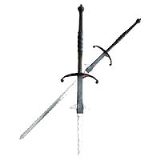
Flamberge

Encyclopedia
Blade
A blade is that portion of a tool, weapon, or machine with a cutting edge and/or a pointed tip that is designed to cut and/or puncture, stab, slash, chop, slice, thrust, or scrape animate or inanimate surfaces or materials...
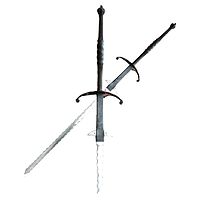
. The wave in the blade is often considered to contribute a flame-like quality to the appearance of a sword. While largely decorative, some attributes of the waved blade were useful in combat.
Flambard, flammard, and Flammenschwert
Bihänder
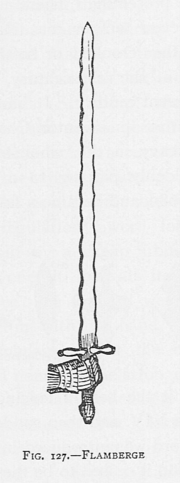
The , is a two-handed sword primarily of the Renaissance....
or Zweihänder. These weapons featured an exceptionally long grip and blade, as well as a long ricasso
Ricasso
A ricasso is a part of sword and knife blades. It is the section just above the guard or handle. It is sometimes unsharpened and unbevelled.The first unsharpened ricassos were found on Middle Bronze Age swords...
protected by a set of "Parierhaken" or parrying hooks also known as flukes. This upper guard protected the wielder's hand when gripping the ricasso. Used during the 16th century by the Landsknecht
Landsknecht
Landsknechte were European, predominantly German mercenary pikemen and supporting foot soldiers from the late 15th to the late 16th century, and achieved the reputation for being the universal mercenary of Early modern Europe.-Etymology:The term is from German, Land "land, country" + Knecht...
s, the Zweihänder found its place most commonly among pike square
Pike square
The pike square was a military tactic developed by the Swiss Confederacy during the 15th century for use by its infantry.- History :The pike square was used to devastating effect at the Battle of Nancy against Charles the Bold of Burgundy in 1477, when the Swiss defeated a smaller but more...
s. Here, the Zweihänder was used in defence of important leaders by well-trained and experienced swordsmen, called Doppelsöldner (double mercenary) because they received double pay. It may have been the case that the wave-shaped edges were more useful for attacking the wooden shaft of an opponent's pike, cutting off the tip and thus rendering the pike relatively harmless. It is not known if the undulating blades on these weapons imparts a significantly greater or lesser ability to cut, slice, or thrust against a human target. Similarly, they do not appear to especially weaken or strengthen the weapon. However, a sword with a flamed or scalloped blade has a serrated blade
Serrated blade
A serrated blade is a type of blade used on saws and on some knives or scissors. It is also known as a dentated, sawtooth, or toothed blade.A serrated blade has a cutting edge that has many small points of contact with the material being cut...
with an increased cutting surface and a reduced overall mass. It is likely that there was some practical reason for this blade shape which was difficult to forge, and many functional true two-handed swords were forged with at least part of the blade made in this undulating style.
When parrying with such a sword, unpleasant vibrations may be transmitted into the attacker’s blade. These vibrations caused the blades to slow contact with each other, as additional friction was encountered with each wave.
Its fashionable and eye-catching appearance, however, did lead to its use on larger, heavier ceremonial Paradeschwerter, or "parade swords".
Flamberge
Rapier
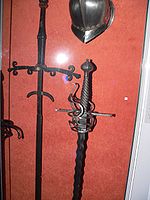
A rapier is a slender, sharply pointed sword, ideally used for thrusting attacks, used mainly in Early Modern Europe during the 16th and 17th centuries.-Description:...
s. When parrying
Parry (fencing)
A parry is a fencing bladework manoeuvre intended to deflect or block an incoming attack.-Execution:To execute a parry, fencers strike the opponent's foible, or the area near the tip of the blade, with their forte, or the part of the blade near the handle of the sword...
with such a sword, unpleasant vibrations may be transmitted into the attacker's blade. These vibrations caused the blades to slow contact with each other, as additional friction was encountered with each wave.
The term flamberge was misapplied by collectors and museums to blades that are historically named flambards and flammards. This misuse continues despite recognition of the error.
In literature
Flamberge was also the name of a sword borne by the fictional character Renaud de MontaubanRenaud de Montauban
Renaud de Montauban, was a fictional hero who was introduced to literature in a 12th century Old French chanson de geste also known as Les Quatre Fils Aymon . His exploits form part of the Doon de Mayence cycle of chansons...
. It was forged by the smith Galas
Galas
In Greek mythology, the name Galas was attributed to individuals. Galas, in mythological accounts, was regarded as the eponymous founder of the Gauls.*Galas was the son of Polyphemos and Galatea and the brother of Illyrius and Keltos....
, and was one of nine blades shattered by Olivier's sword, Hauteclere
Hauteclere
Hauteclere is the sword of Olivier, a character in the French epic "The Song of Roland". It is described as being of burnished steel, with a crystal embedded in a golden hilt....
. It is also vaguely mentioned by Brom in the book Eragon
Eragon
Eragon is the first book in the Inheritance Cycle by Christopher Paolini, who began writing at the age of 15. After writing the first draft for a year, he spent a second year rewriting it and fleshing out the story and characters. Paolini's parents saw the final manuscript and decided to...
.