

Fire-resistance rating

Encyclopedia
A fire-resistance rating typically means the duration for which a passive fire protection
system
can withstand a standard fire resistance test
. This can be quantified simply as a measure of time, or it may entail a host of other criteria, involving other evidence of functionality or fitness for purpose.
, a fire door
may have a "T90" designation, which means that the door
has documented evidence of its ability to withstand that country's fire door test regime for a duration of 90 minutes.
There are many international variations for nearly countless types of products and systems, some with multiple test requirements.
Canada
's Institute for Research in Construction (a part of the National Research Council and publisher of Canada's model building code - NBC) requires a special test regime for firestops for plastic
pipe
penetrant
s. Fire endurance tests for this application must be run under 50Pa positive furnace pressure in order to adequately simulate the effect of potential temperature differences between indoor and outdoor temperatures in Canada's winters. Special hoods are applied here to provide suction on the top side of a test assembly in order to reach the 50Pa pressure differential. Afterwards, a 30PSI hose-stream test may be applied.
Some fire doors in the North American Free Trade Agreement
(NAFTA) area may even open up somewhat during a fire endurance test, although not too far, while a wall or floor assembly proper may not even be allowed an average temperature rise above 140°C or single point increases over 180°C.
Outdoor spray fireproofing
methods that must be qualified to the hydrocarbon
curve may be required to pass a host of environmental tests before any burn takes place, to minimize the likelihood that ordinary operational environments cannot render a vital system component useless before it ever encounters a fire
.
If critical environmental conditions are not satisfied, an assembly may not be eligible for a fire-resistance rating.
Regardless of the complexity of any given test regime that may lead to a rating, the premise is generally product certification
and, most importantly listing and approval use and compliance. Testing without certification and installations that cannot be matched with an appropriate certification listing
, are not usually recognised by any Authority Having Jurisdiction (AHJ) unless it is in a realm where product certification
is optional.
. The building elements curve is characterized jointly by, including, but not limited to, DIN4102, BS476, ASTM E119, ULC-S101, etc. For exterior systems used in the petrochemical industry, the hydrocarbon curve is used. The only exposure beyond this, apart from the more recent tunnel curves shown above, would be the British "jetfire" exposure, which is not commonly used.
Big differences between different countries in terms of the use of the curves include the use of pipes, which shield the furnace thermocouples inside of NAFTA testing laboratories. This slows down the response time and results in a somewhat more conservative test regime in North America
. On the other hand, the ISO based Europe
an curves run somewhat hotter for most of the test. North America also selectively uses a hose-stream test between 30 and 45PSI, to simulate real-world impacts and damages that may not be simulated in a laboratory. The US Navy even insists on a 90PSI hose-stream test for some of its assemblies, which may simulate the pressure available to firefighters in fighting a fire, but which has little to do with countermeasures against damaging effects of manual fire suppression. The hose-stream is simply intended to add a level of toughness to matters because without this, some fairly flimsy systems can pass a test, thus receive a rating and thus be permissible by a building code
but be so weak that ordinary building use may damage a thus qualified system before it encounters a fire. See firestop.org treatise on the hose stream test.
Germany's DIN4102 also includes a significant impact test for a potential firewall
, which is, however, applied from the wrong side: the cold side. Applying the impact from the cold side is more practical to do in a lab setting, however, potential impacts should come from the exposed side, not the unexposed side. Still, for the person designing, building and paying for the test, the fire resistance itself may be rather uneventful unless major problems appear. The burn itself is the long duration, up to 4 hours, but the hose stream test only lasts a few minutes, with large damage potential due to the sudden thermal and kinetic impacts, as the fire was upwards of 1,100°C (see curves above), whereas the sudden hose-stream test is as cold as the domestic water fed to the fire hose used in the test, which might be 10-20°C. This combined impact explains the debris that can be seen coming from test specimens during the hose stream test, as seen herein.
Because of the large differences in test regimes all over the world, even for identical products and systems, organizations that intend to market their products internationally are often required to run many tests in many countries. Even where test regimes are identical, countries are often reluctant to accept the test results and particularly the certification methods of other countries.
During a fire in a tunnel
, as well as in the petrochemical industry, temperatures exceed those of ordinary building (cellulosic) fires. This is because the fuel for the fire is hydrocarbon
s, which burn hotter (compare hydrocarbon curve above to ASTM E119 curve), faster and typically run out of fuel faster as well, compared against timber. The added complication with tunnels is that the environment inside a "tube" is best described as a "microclimate". The heat cannot escape as well as it can in a burning refinery, which is in the open. Instead, the fire is confined to a narrow tube, where pressure and heat build up and spread rapidly, with little room for escape and little chance of compartmentalization
. This scenario was amply tested and quantified, particularly during the "Eureka Project", run by Technische Universität Braunschweig
's iBMB, Dr. Ekkehard Richter, which has profoundly affected tunnel regulations in the Nations that took part in the project. The Netherlands, through Rijkswaterstaat
in particular, mandated an extremely tough standard, the curve of which is shown in the gallery above.
floor, with typical mechanical and electrical utility components (pipes and cables) penetrating
the floor assembly.A firestop mortar
is applied around the penetrations.
The completed test sample is inserted into a furnace such that one side is exposed to a fire. The test is terminated when the fire stops successfully meet the test criteria in minimizing the amount of heat and smoke allowed to pass through the assembly, when the fire penetrates the fire stops. This determines the fire stop F-Rating. The length of time required for a penetrant or sample on average to exceed a specified average heat rise above ambient at any single location determines the duration for the FT Rating (Fire and Temperature). If a hose-stream test is passed afterwards, the rating can then be expressed as an FTH Rating (Fire, Temperature and Hose-stream). The lowest of the three determines the overall rating.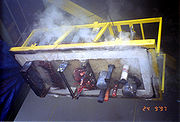
Passive fire protection
Passive fire protection is an integral component of the three components of structural fire protection and fire safety in a building. PFP attempts to contain fires or slow the spread, through use of fire-resistant walls, floors, and doors...
system
System
System is a set of interacting or interdependent components forming an integrated whole....
can withstand a standard fire resistance test
Fire test
A fire test is a means of determining whether or not fire protection products meet minimum performance criteria as set out in a building code or other applicable legislation. Successful tests in laboratories holding national accreditation for testing and certification result in the issuance of a...
. This can be quantified simply as a measure of time, or it may entail a host of other criteria, involving other evidence of functionality or fitness for purpose.
Common rating systems
The following depict the most commonly used international time/temperature curves:International fire-resistance ratings
For instance, in GermanyGermany
Germany , officially the Federal Republic of Germany , is a federal parliamentary republic in Europe. The country consists of 16 states while the capital and largest city is Berlin. Germany covers an area of 357,021 km2 and has a largely temperate seasonal climate...
, a fire door
Fire door
A fire door is a door with a fire-resistance rating used as part of a passive fire protection system to reduce the spread of fire or smoke between compartments and to enable safe egress from a building or structure or ship...
may have a "T90" designation, which means that the door
Door
A door is a movable structure used to open and close off an entrance, typically consisting of a panel that swings on hinges or that slides or rotates inside of a space....
has documented evidence of its ability to withstand that country's fire door test regime for a duration of 90 minutes.
There are many international variations for nearly countless types of products and systems, some with multiple test requirements.
Canada
Canada
Canada is a North American country consisting of ten provinces and three territories. Located in the northern part of the continent, it extends from the Atlantic Ocean in the east to the Pacific Ocean in the west, and northward into the Arctic Ocean...
's Institute for Research in Construction (a part of the National Research Council and publisher of Canada's model building code - NBC) requires a special test regime for firestops for plastic
Plastic
A plastic material is any of a wide range of synthetic or semi-synthetic organic solids used in the manufacture of industrial products. Plastics are typically polymers of high molecular mass, and may contain other substances to improve performance and/or reduce production costs...
pipe
Pipe (material)
A pipe is a tubular section or hollow cylinder, usually but not necessarily of circular cross-section, used mainly to convey substances which can flow — liquids and gases , slurries, powders, masses of small solids...
penetrant
Penetrant
Penetrants, or penetrating items, are the mechanical, electrical or structural items that pass through an opening in a wall or floor, such as pipes, electrical conduits, ducting, cables and cable trays, or structural steel beams and columns...
s. Fire endurance tests for this application must be run under 50Pa positive furnace pressure in order to adequately simulate the effect of potential temperature differences between indoor and outdoor temperatures in Canada's winters. Special hoods are applied here to provide suction on the top side of a test assembly in order to reach the 50Pa pressure differential. Afterwards, a 30PSI hose-stream test may be applied.
Some fire doors in the North American Free Trade Agreement
North American Free Trade Agreement
The North American Free Trade Agreement or NAFTA is an agreement signed by the governments of Canada, Mexico, and the United States, creating a trilateral trade bloc in North America. The agreement came into force on January 1, 1994. It superseded the Canada – United States Free Trade Agreement...
(NAFTA) area may even open up somewhat during a fire endurance test, although not too far, while a wall or floor assembly proper may not even be allowed an average temperature rise above 140°C or single point increases over 180°C.
Outdoor spray fireproofing
Fireproofing
Fireproofing, a passive fire protection measure, refers to the act of making materials or structures more resistant to fire, or to those materials themselves, or the act of applying such materials. Applying a certification listed fireproofing system to certain structures allows these to have a...
methods that must be qualified to the hydrocarbon
Hydrocarbon
In organic chemistry, a hydrocarbon is an organic compound consisting entirely of hydrogen and carbon. Hydrocarbons from which one hydrogen atom has been removed are functional groups, called hydrocarbyls....
curve may be required to pass a host of environmental tests before any burn takes place, to minimize the likelihood that ordinary operational environments cannot render a vital system component useless before it ever encounters a fire
Fire
Fire is the rapid oxidation of a material in the chemical process of combustion, releasing heat, light, and various reaction products. Slower oxidative processes like rusting or digestion are not included by this definition....
.
If critical environmental conditions are not satisfied, an assembly may not be eligible for a fire-resistance rating.
Regardless of the complexity of any given test regime that may lead to a rating, the premise is generally product certification
Product certification
Product certification or product qualification is the process of verifying that a certain product has passed performance tests and quality assurance tests or qualification requirements stipulated in contracts, regulations, or specifications...
and, most importantly listing and approval use and compliance. Testing without certification and installations that cannot be matched with an appropriate certification listing
Certification listing
A certification listing is a document used to guide installations of certified products against which a field installation is compared to make sure that it complies with a regulation, such as a building code...
, are not usually recognised by any Authority Having Jurisdiction (AHJ) unless it is in a realm where product certification
Product certification
Product certification or product qualification is the process of verifying that a certain product has passed performance tests and quality assurance tests or qualification requirements stipulated in contracts, regulations, or specifications...
is optional.
Tests for fire resistance of record protection equipment
The following classifications may be attained when testing in accordance with UL 72.Class 125 Rating
This rating is the requirement in data safes and vault structures for protecting digital information on magnetic media or hard drives. Temperatures inside the protected chamber must be held below 125 °F (51.7 °C) for the time period specified, such as Class 125-2 Hour, with temperatures up to 2000 °F (1,093.3 °C) outside the vault. The temperature reading is taken on the inside surfaces of the protective structure. Maintaining the temperature below 125°F. is critical because data is lost above that temperature threshold, even if the media or hard drives appear to be intact.Class 150 Rating
This is the rating required to protect microfilm, microfiche, and other film-based information storage media. Above 150°F (65.5°C) film is distorted by the heat and information is lost. A Class 150-2 Hour vault must keep the temperature below 150°F. for at least two hours, with temperatures up to 2,000°F. (1,093.3°C) outside the vault.Class 350 Rating
This rating is the requirement for protecting paper documents. Above 350°F (176.7°C) paper is distorted by the heat and information is lost. A Class 350-4 Hour vault must keep the temperature below 350°F. for at least four hours, with temperatures up to 2,000°F. (1,093.3°C) outside the vault.Different time/temperature curves
Typically, most countries use the building elements curve, which is nearly identical in most countries as that is what results by burning woodWood
Wood is a hard, fibrous tissue found in many trees. It has been used for hundreds of thousands of years for both fuel and as a construction material. It is an organic material, a natural composite of cellulose fibers embedded in a matrix of lignin which resists compression...
. The building elements curve is characterized jointly by, including, but not limited to, DIN4102, BS476, ASTM E119, ULC-S101, etc. For exterior systems used in the petrochemical industry, the hydrocarbon curve is used. The only exposure beyond this, apart from the more recent tunnel curves shown above, would be the British "jetfire" exposure, which is not commonly used.
Big differences between different countries in terms of the use of the curves include the use of pipes, which shield the furnace thermocouples inside of NAFTA testing laboratories. This slows down the response time and results in a somewhat more conservative test regime in North America
North America
North America is a continent wholly within the Northern Hemisphere and almost wholly within the Western Hemisphere. It is also considered a northern subcontinent of the Americas...
. On the other hand, the ISO based Europe
Europe
Europe is, by convention, one of the world's seven continents. Comprising the westernmost peninsula of Eurasia, Europe is generally 'divided' from Asia to its east by the watershed divides of the Ural and Caucasus Mountains, the Ural River, the Caspian and Black Seas, and the waterways connecting...
an curves run somewhat hotter for most of the test. North America also selectively uses a hose-stream test between 30 and 45PSI, to simulate real-world impacts and damages that may not be simulated in a laboratory. The US Navy even insists on a 90PSI hose-stream test for some of its assemblies, which may simulate the pressure available to firefighters in fighting a fire, but which has little to do with countermeasures against damaging effects of manual fire suppression. The hose-stream is simply intended to add a level of toughness to matters because without this, some fairly flimsy systems can pass a test, thus receive a rating and thus be permissible by a building code
Building code
A building code, or building control, is a set of rules that specify the minimum acceptable level of safety for constructed objects such as buildings and nonbuilding structures. The main purpose of building codes are to protect public health, safety and general welfare as they relate to the...
but be so weak that ordinary building use may damage a thus qualified system before it encounters a fire. See firestop.org treatise on the hose stream test.
Germany's DIN4102 also includes a significant impact test for a potential firewall
Firewall (construction)
A firewall is a fireproof barrier used to prevent the spread of fire between or through buildings, structures, electrical substation transformers, or within an aircraft or vehicle.- Applications :...
, which is, however, applied from the wrong side: the cold side. Applying the impact from the cold side is more practical to do in a lab setting, however, potential impacts should come from the exposed side, not the unexposed side. Still, for the person designing, building and paying for the test, the fire resistance itself may be rather uneventful unless major problems appear. The burn itself is the long duration, up to 4 hours, but the hose stream test only lasts a few minutes, with large damage potential due to the sudden thermal and kinetic impacts, as the fire was upwards of 1,100°C (see curves above), whereas the sudden hose-stream test is as cold as the domestic water fed to the fire hose used in the test, which might be 10-20°C. This combined impact explains the debris that can be seen coming from test specimens during the hose stream test, as seen herein.
Because of the large differences in test regimes all over the world, even for identical products and systems, organizations that intend to market their products internationally are often required to run many tests in many countries. Even where test regimes are identical, countries are often reluctant to accept the test results and particularly the certification methods of other countries.
During a fire in a tunnel
Tunnel
A tunnel is an underground passageway, completely enclosed except for openings for egress, commonly at each end.A tunnel may be for foot or vehicular road traffic, for rail traffic, or for a canal. Some tunnels are aqueducts to supply water for consumption or for hydroelectric stations or are sewers...
, as well as in the petrochemical industry, temperatures exceed those of ordinary building (cellulosic) fires. This is because the fuel for the fire is hydrocarbon
Hydrocarbon
In organic chemistry, a hydrocarbon is an organic compound consisting entirely of hydrogen and carbon. Hydrocarbons from which one hydrogen atom has been removed are functional groups, called hydrocarbyls....
s, which burn hotter (compare hydrocarbon curve above to ASTM E119 curve), faster and typically run out of fuel faster as well, compared against timber. The added complication with tunnels is that the environment inside a "tube" is best described as a "microclimate". The heat cannot escape as well as it can in a burning refinery, which is in the open. Instead, the fire is confined to a narrow tube, where pressure and heat build up and spread rapidly, with little room for escape and little chance of compartmentalization
Compartmentalization
Compartmentalization or compartmentalisation may refer to:* Compartmentalization * Compartmentalization * Compartmentalization * Compartmentalization...
. This scenario was amply tested and quantified, particularly during the "Eureka Project", run by Technische Universität Braunschweig
Technische Universität Braunschweig
The TU Braunschweig is the oldest University of Technology in Germany. It was founded in 1745 as Collegium Carolinum and is a member of TU9, an incorporated society of the most renowned and largest German Institutes of Technology. Today it has about 13,000 students, making it the third largest...
's iBMB, Dr. Ekkehard Richter, which has profoundly affected tunnel regulations in the Nations that took part in the project. The Netherlands, through Rijkswaterstaat
Rijkswaterstaat
Rijkswaterstaat, founded in 1798 as the Bureau voor den Waterstaat, is part of the Dutch Ministry of Infrastructure and the Environment, the former Ministry of Transport, Public Works and Water Management...
in particular, mandated an extremely tough standard, the curve of which is shown in the gallery above.
Example of a fire stop fire-resistance rating test
Construction of a test sample consists of a mock-up of a section of concreteConcrete
Concrete is a composite construction material, composed of cement and other cementitious materials such as fly ash and slag cement, aggregate , water and chemical admixtures.The word concrete comes from the Latin word...
floor, with typical mechanical and electrical utility components (pipes and cables) penetrating
Penetrant
Penetrants, or penetrating items, are the mechanical, electrical or structural items that pass through an opening in a wall or floor, such as pipes, electrical conduits, ducting, cables and cable trays, or structural steel beams and columns...
the floor assembly.A firestop mortar
Mortar (firestop)
Firestop mortars are mortars most typically used to firestop large openings in walls and floors required to have a fire-resistance rating. They are passive fire protection items...
is applied around the penetrations.
The completed test sample is inserted into a furnace such that one side is exposed to a fire. The test is terminated when the fire stops successfully meet the test criteria in minimizing the amount of heat and smoke allowed to pass through the assembly, when the fire penetrates the fire stops. This determines the fire stop F-Rating. The length of time required for a penetrant or sample on average to exceed a specified average heat rise above ambient at any single location determines the duration for the FT Rating (Fire and Temperature). If a hose-stream test is passed afterwards, the rating can then be expressed as an FTH Rating (Fire, Temperature and Hose-stream). The lowest of the three determines the overall rating.
External links
- Efectis
- BAM Berlin
- Underwriters LaboratoriesUnderwriters LaboratoriesUnderwriters Laboratories Inc. is an independent product safety certification organization. Established in 1894, the company has its headquarters in Northbrook, Illinois. UL develops standards and test procedures for products, materials, components, assemblies, tools and equipment, chiefly dealing...
- Underwriters' Laboratories of Canada
- Institute for Research in Construction/NRC
- Technische Universität BraunschweigTechnische Universität BraunschweigThe TU Braunschweig is the oldest University of Technology in Germany. It was founded in 1745 as Collegium Carolinum and is a member of TU9, an incorporated society of the most renowned and largest German Institutes of Technology. Today it has about 13,000 students, making it the third largest...
(iBMB TU Braunschweig) - Gütegemeinschaft Brandschutz im Ausbau