
Encyclopedia
Fawlty Towers was a British sitcom made by the BBC and first broadcast on
BBC2 in 1975. Only twelve episodes were produced, but the series has had a lasting and powerful influence on later shows.
The show is set in a
fictional hotel named Fawlty Towers in the
Devon town of
Torquay on "
The English Riviera". The series was written by
John Cleese and
Connie Booth, both of whom played main characters, and was broadcast in two series: The first, in 1975, was produced and directed by John Howard Davies, and the second, in 1979, was produced by Douglas Argent and directed by Bob Spiers.
In a list of the 100 Greatest British Television Programmes drawn up by the
British Film Institute in 2000, voted for by industry professionals,
Fawlty Towers was placed first. It was also voted fifth in the
BBC's "Britain's Best Sitcom" poll in 2004.
Origins
Fawlty Towers was inspired by the
Monty Python team's stay in the Gleneagles Hotel in
Torquay.
Cleese and
Booth stayed on at the hotel after filming for the Python show had finished. The owner, Mr. Donald Sinclair, was very rude, throwing a bus timetable at a guest who asked when the next bus to town would arrive and placing
Eric Idle's suitcase behind a wall in the garden on the suspicion that it contained a bomb . He also criticised the American-born
Terry Gilliam's table manners for being too American , possibly inspiring Basil's treatment of an American visitor in the episode "
Waldorf Salad".
For more information see Donald Sinclair.Even before this programme existed, English seaside boarding houses and their proprietors had something of a reputation for firmness and intransigence. Cleese had also parodied the contrast between organisational dogma and sensitive customer service in many personnel training videotapes issued with a serious purpose by his company, Video Arts.
Bill Cotton, the BBC's Head of Light Entertainment in the mid-1970s, said after the first series was produced that the show was a prime example of the BBC's relaxed attitude to trying out new entertainment formats and encouraging new ideas. He said that when he read the first scripts he could see nothing funny in them, but trusting that Cleese knew what he was doing, he gave the go-ahead for the series. He said that the commercial channels, with their emphasis on audience ratings, would never have let the show get to the production stage on the basis of the scripts.
Plot
The episodes typically revolve around Basil Fawlty's efforts to succeed, and his frustration at mistakes, both his own and those of others, which prevent him from doing so. Much of the humour comes from Basil's insulting and sometimes aggressive manner, engaging in angry but witty arguments with guests, staff and--in particular--his wife, whom he addresses with insults such as "that golfing
puff adder". Despite this, he frequently feels intimidated as she is able to insult him with equal venom. At the end of some episodes, Basil succeeds in annoying the guests and sometimes gets it thrown back in his face.
The plots are intricate and farcical, involving coincidences, misunderstandings, cross-purposes, accidental meetings and missed meetings. The sex of the bedroom farce is sometimes present, often to the disgust of conservative Basil, but it is Basil Fawlty's eccentricity, not his lust, that drives the plots.
The guests at the hotel are typically comic foils to Basil's anger and outbursts, with requests both reasonable and impossible testing Basil Fawlty's temper. The show also uses mild black humour at times, notably when Basil is forced to hide a dead body, and some of the comments made by Basil both about Sybil and about the guests border on the psychopathic.
Basil behaves violently towards Manuel for innocent mistakes, exacting on some occasions physical violence, including beating Manuel with a frying pan and hitting him over the head, despite Manuel's piteous pleading. In this, and in other exaggerated physical mannerisms of Basil, Fawlty Towers employs Physical comedy.
Basil displays blatant elitism, expressing disdain for the "riff-raff" that he believes currently stay at the hotel, in order to climb the social ladder. His desperation is apparent, as he makes increasingly hopeless manoeuvres and painful faux pas in trying to gain favour with the wealthy, yet finds himself forced to serve and help people he sees as beneath him. As such, Basil's efforts tend to be counter-productive, with guests leaving the hotel in disgust and his marriage stretching further and further towards breaking point.
Characters
Basil Fawlty
Basil Fawlty, played by
John Cleese, is a snobbish,
miserly, xenophobic and sexually repressed paranoiac who is desperate to belong to a higher social class. He sees the successful running of the hotel as a means of achieving this , yet his job forces him to be pleasant to people he despises or aspires to be above socially.
While he is terrified of his wife's sharp tongue, he wishes to stand up to her and his plans often conflict with her wishes. She is often verbally abusive towards him and though he is much taller than Sybil, he often finds himself on the receiving end of Sybil's temper, expressed verbally or physically. Basil usually turns to Manuel or Polly to help him with whatever scheme he has planned, while trying his best to prevent Sybil from finding out.
Basil served in the Catering Corps of the
British Army, possibly as part of his National Service, but makes it seem as if he was a soldier. He claims: "I fought in the Korean War, you know, I killed four men" to which his wife jokingly replies to the threat, "he was in the Catering Corps; he used to poison them". He is often seen wearing a military tie and a military-type moustache. He also claims to have sustained an injury to his leg in the
Korean War caused by
shrapnel, although this tends to flare up at surprisingly convenient times.
Cleese himself described Basil as thinking that "he could run a first-rate hotel if he didn't have all the guests getting in the way."
Sybil Fawlty
Sybil Fawlty, played by
Prunella Scales, is Basil's wife. She is often seen to be a more effective manager of the hotel, making sure Basil either gets certain jobs done or stays out of the way when she is handling difficult customers. Despite this, she rarely participates directly in the running of the hotel; during busy check-in sessions or meal-times, whilst everyone else is busy working she is frequently found talking on the phone to one of her friends with her memorable "Oohhh I knoooooooow", or chatting to customers. She has a distinctive conversational tone and braying laugh, which her husband compares to "someone machine-gunning a seal". Being his wife, she is the only one who refers to him by his first name, although Basil also refers to her by a number of epithets, occasionally to her face: these include "the dragon", "toxic midget", "my little nest of vipers", "my little piranha fish", "my little commandant", "that golfing puff adder!" and "a rancorous, coiffured old sow".
Polly Sherman
Polly Sherman, played by
Connie Booth, is employed as a
waitress, although she is often stuck doing many other jobs in the hotel. She is also a voice of sanity as she loyally attempts to aid Mr Fawlty when he is trying to cover for a mistake he's made.
Polly is, in theory, only employed part-time, and is supposedly an art student: in one episode, she is seen to draw a sketch of Basil, which everyone but Basil immediately recognises . She does find time to sketch, and has managed to sell some occasionally to supplement her meagre waitressing income, even to the hotel guests.
Like Manuel she has a room of her own at the hotel, so perhaps this explains her part time status and doing more than just waitressing
Manuel
Manuel, a
waiter played by
Andrew Sachs, is a well-meaning but disorganised and constantly confused
Spaniard from
Barcelona with a poor grasp of the
English language and customs. He is constantly verbally and physically abused by his boss. He is afraid of Mr Fawlty's quick temper and violent assaults, yet often expresses his appreciation for being given the position. When told by either Basil, Sybil or Polly what to do, he answers, "Qué?", which means 'What?', and "Sí", which means 'Yes'.
His less than flattering portrayal of a Spaniard resulted in the character's nationality being switched to
Mexican for the
Spanish dub of the show broadcast to most of Spain and for the Catalan version broadcast to Catalonia, including Barcelona. He became Manolo the Italian for the version broadcast to the Basque region.
Other regular characters
Terry the Chef, played by Brian Hall, is the chef at Fawlty Towers. Terry's cooking style is quite relaxed and Basil occasionally gets frustrated with his "It's all right" attitude. Terry arrives in the second season as relief for Kurt . He used to work in
Dorchester .
Major Gowen, played by Ballard Berkeley, is a slightly senile old soldier who holds a permanent residence in the hotel. He enjoys talking about the world outside and is always on the lookout for the paper. He seems to have trouble forgiving the Germans due to the World Wars.
Miss Tibbs & Miss Gatsby, played by Gilly Flower and Renee Roberts respectively, are the other two permanent residents, who are slightly scatty spinsters. They seem to take a fancy to Basil, though he switches from being overly kind to utterly rude during various talks with the two.
Audrey, an unseen character, had one onscreen appearance in
The Anniversary. Audrey is Sybil's lifelong best friend, and mostly appears in the form of gossiping, trivial telephone calls to Sybil. Audrey is used as a source of refuge for Sybil from the hotel and from Basil's ludicrous situations. When times get tough for Audrey , Sybil will offer solutions and guidance, often resulting in the infamous catchphrase
ooh, I know... - when Mrs. Fawlty tries to understand her problems.
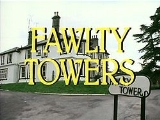
The paperboy, though not seen very often, is responsible for changing the "Fawlty Towers" sign to read various phrases, such as "Fatty Owls", "Flay Otters", "Farty Towels", "Watery Fowls" and "Flowery Twats". The last is the only anagram that can be made using all of the letters. The shot of the sign with the hotel appears at the beginning of every episode but one, The Germans, when a shot of a hospital is used, as Sybil is having an operation on her ingrown toenail.
Episode guide
Fawlty Towers was first broadcast on
BBC 2 from September 19th 1975 to October 25th 1979. The first series was directed by John Howard Davies, the second by Bob Spiers.
Production of the last two episodes was disrupted by a
strike of BBC technical staff, which resulted in the recasting of the actor who had originally been cast as Reg in 'The Anniversary', and delayed the episode's transmission date by one week. The episode 'Basil the Rat' was also delayed, and was not screened until the end of a repeat showing six months later, due to the tape going missing.
Not the Nine O'Clock News was a comedy [i] television [i] programme shown on the BBC [i] ...
was originally scheduled to debut after an episode of
Fawlty Towers and Cleese was to have introduced
Not the Nine O'Clock News in a sketch referring to the technicians' strike, explaining that there was no show ready that week, so a "tatty revue" would be broadcast instead. However, the
1979 general election intervened, and
Not the Nine O'Clock News was pulled as being too political. Later that year, Cleese's sketch was broadcast, when by a stroke of luck the final episode of
Fawlty Towers went out before the first series of
Not the Nine O'Clock News, though the original significance of the sketch was lost.
When originally transmitted, the individual episodes had no on-screen titles. The ones in common currency were first used for the VHS release of the series in the 1980s. There were working titles, such as "USA" for "Waldorf Salad", "Death" for "The Kipper and the Corpse" and "Rats" for "Basil the Rat" which have been printed in some programme guides. In addition, some of the early BBC audio releases of episodes on vinyl and cassette included other variations, such as "Mrs Richards" and "The Rat", for "Communication Problems" and "Basil the Rat" respectively.
Memorable Moments
A number of scenes from
Fawlty Towers have have become iconic in their own right and entered the British national consciousness. In particular, this is due to their frequent exposure to illustrate the series in clip programmes.
- In "Gourmet Night", Basil yells at his broken-down Austin 1100 and gives it a "damn good thrashing" with a branch in the middle of the road. This scene has been immortalised in the form of a miniature model car and Basil figure clutching a branch by the Corgi toy company.
- In "The Hotel Inspectors", Basil and Manuel throw pies at a troublesome guest, Mr Hutchinson, and fill his briefcase with milk. Basil realises afterwards that hotel inspectors witnessed the event.
- In "Communication Problems", Basil shows the deaf Mrs Richards round her room where she complains about everything. Basil wonders aloud why Mrs Richards doesn't switch on her hearing aid to which she explains, "Because it runs down the battery".
- In "The Germans", Basil Fawlty, having suffered a severe concussion, tries to serve lunch to four Germans. Despite his advice to Polly to not mention the war, he does so repeatedly himself. It ends with him goosestepping out of the dining hall in an impression of Hitler.
One of the funniest lines of the series comes from this episode. Basil constant talking of World War II leaves one of the German ladies crying. Basil inquires why, and the German man with her tells her it's because he is mentioning the war. Basil cannot believe he mentioned the war due to his injury on the head and denies it. Basil then says "You started it." the German replies "we did not start it!" Basil says "yes you did, you invaded Poland."
Awards
Three
BAFTAs were awarded to people for their involvement with the series.
Each of the two series were awarded the BAFTA in the category for "Best Situation Comedy", the first won by John Howard Davies in 1976, and the second by Douglas Argent and Bob Spiers in 1980. John Cleese won the BAFTA for "Best Light Entertainment Performance" in 1976.
More recently, in a list of the 100 Greatest British Television Programmes drawn up by the
British Film Institute in 2000, voted for by industry professionals,
Fawlty Towers was placed first. It was also voted fifth in the
BBC's "Britain's Best Sitcom" poll in 2004 and second only to
Frasier is a critically acclaimed American TV [i] sitcom [i] ...
in The Ultimate Sitcom poll of comedy writers in January 2006.
Basil Fawlty came top of the
Britain’s Funniest Comedy Character poll, held by Five on 14 May 2006.
Remakes and inspiration
Three remakes of
Fawlty Towers have been produced for the American market. The first,
Chateau Snavely, was produced by ABC for a pilot in 1978, but the transfer from coastal hotel to highway motel proved too much and the series was never produced. The second, also by ABC, was
Amanda's, notable for switching the genders of Basil and Sybil. It also failed to pick up a major audience and was dropped. A third remake called
Payne was also produced, but was cancelled shortly after. Another American sitcom which was loosely based on
Fawlty Towers was
Newhart was a television [i] situation comedy [i] starring comedian [i] Bob Newhart [i] that aired o ...
, starring
Bob Newhart, set in a hotel in
Vermont. There also was a
German sitcom based on
Fawlty Towers and
Guest House on
Pakistani television also resembles the series.
The popular sitcom
Cheers was a long-running American [i] situation comedy [i] produced ...
has cited
Fawlty Towers as an inspiration, especially the dysfunctional "family" in a workplace and Arthur Mathews and Graham Linehan have cited
Fawlty Towers as a major influence on their sitcom
Father Ted is a popular 1990s [i] television [i] situation comedy [i] set around the lives of three ...
.
Trivia
- Although the series is set in Torquay, none of it was shot there. For the exterior filming, instead of an actual hotel, the Wooburn Grange Country Club in Buckinghamshire was used. It later served as a nightclub named "Basil's" for a short time after the series ended until it was destroyed by fire in March 1991. The remnants of the building were demolished and the site was bought by developers. Other location filming was done mostly around the Harrow area of north London. In the episode "Gourmet Night", the exterior of Andre's restaurant was filmed on Preston Road in the Harrow area. The launderette next door to the restaurant still exists today and Andre's is now a Chinese restaurant called 'Wings'.
- Cleese and Booth were married at the time of the first series . By the second series , Cleese and Booth had divorced after ten years of marriage .
- During the making of this series, Andrew Sachs
...
twice suffered serious injury while playing Manuel. Once
John Cleese mistakenly picked up a real metal pan, rather than a fake rubber one, to knock him unconscious in "The Wedding Party". And, when his clothes were treated in order to make them give off smoke after he had been let out of the burning kitchen in "The Germans", the corrosive chemicals used went through them and gave Sachs severe burns.
...
is English, although Spanish accent when in character is an integral part of the show. Sachs' native language is actually German and when the series was dubbed for broadcast in Germany, he voiced the German translation of Manuel, with a Spanish accent. When the show is broadcast in Basque, the Manuel character is changed to an Italian.
- Basil and Sybil's wedding anniversary is on 17 April.
- Gilly Flower and Renee Roberts, who played Miss Tibbs and Miss Gatsby in the series, reprised the roles in a 1983 episode of Only Fools and Horses was a long-running British [i] television [i] sit-com [i], crea ...
. - In 2006, Cleese played Basil Fawlty for the first time in 27 years, for the FIFA World cup Germany song "Don't Mention the War", named after the phrase Basil used in "The Germans".
- On September 18, 2006, the Gleneagles Hotel staged a gala reopening, embracing its notoriety from the television series. "We decided Hotel Gleneagles is always going to be famous for inspiring 'Fawlty Towers' so, rather than be embarrassed about what has happened, we have chosen to capitalize on it," said Brian Shone, co-owner of the hotel in Torquay. "You cannot get rid of the spirit of Basil, so you have got to embrace him." Donald Sinclair's widow, Beatrice, has called the reputation completely unfair, blaming the Pythons for the trouble. "They didn't fit into a family hotel...they kept annoying my husband and were quite insulting," she said. John Cleese did not attend the reopening, but Prunella Scales was the guest of honor, arriving in a replica of the bright red Austin 1100 that Basil thrashed with a tree branch in "Gourmet Night".
Real Fawlty Towers?
Several hotels and guesthouses have called themselves "Fawlty Towers", including:
- A youth hostel in Darwin, Australia, visited in an episode of the travel documentary Full Circle with Michael Palin.
- A motel in Eilat, Israel.
- A motel in Bunbury, Western Australia
- A hotel in Sidmouth which was painted like a Union Flag
- A hotel in the tourist town of Yangshuo in southern China
- A hotel in Rome, near Termini Station
- A hostel in Livingstone, Zambia
- A youth hostel in Fingal, Tasmania, now a campus of Scotch Oakburn College
- A hotel in Cocoa Beach, Florida, located a block from the beach, which displays British flags and a large sign displaying a picture of the hotel from the show. The typeface used on this sign is nearly identical to the one used in the opening title of the show.
The title has also been altered as a pun for other establishments:
...
,
Cornwall, there is a bed and breakfast establishment called "Salty Towers".
References
- 'Fawlty Towers' Reopens, Rejoicing in Its Notoriety, Associated Press report, Washington Post, Sunday 24 September 2006, page D-3
Further reading
- Fawlty Towers: A Worshipper's Companion, Leo Publishing, ISBN 91-973661-8-8
External links
Television databasesFansitesArticles