


British Film Institute

Encyclopedia
Royal Charter
A royal charter is a formal document issued by a monarch as letters patent, granting a right or power to an individual or a body corporate. They were, and are still, used to establish significant organizations such as cities or universities. Charters should be distinguished from warrants and...
to:
- Encourage the development of the arts of film, television and the moving image throughout the United Kingdom, to promote their use as a record of contemporary life and manners, to promote education about film, television and the moving image generally, and their impact on society, to promote access to and appreciation of the widest possible range of British and world cinemaWorld cinemaWorld cinema is a term used primarily in English language speaking countries to refer to the films and film industries of non-English speaking countries. It is therefore often used interchangeably with the term foreign film...
and to establish, care for and develop collections reflecting the moving image history and heritage of the United Kingdom.
Cinemas
BFI Southbank
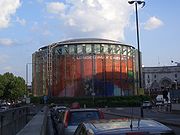
BFI Southbank is the leading repertory cinema in the UK specialising in seasons of classic, independent and non-English language films and is operated by the British Film Institute.-History:...
(formerly the National Film Theatre (NFT)) and IMAX
London IMAX
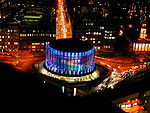
The London IMAX is an IMAX cinema in the South Bank district of London, England, just north of Waterloo Station. It is operated by the British Film Institute.The cinema is located in the centre of a roundabout on Waterloo Road...
theatre, both located on the south bank of the River Thames
River Thames
The River Thames flows through southern England. It is the longest river entirely in England and the second longest in the United Kingdom. While it is best known because its lower reaches flow through central London, the river flows alongside several other towns and cities, including Oxford,...
in London
London
London is the capital city of :England and the :United Kingdom, the largest metropolitan area in the United Kingdom, and the largest urban zone in the European Union by most measures. Located on the River Thames, London has been a major settlement for two millennia, its history going back to its...
. The IMAX has the largest cinema screen in the UK, and shows popular recent releases and short films showcasing its technology, which includes 3D screenings and 12,000 watts of digital surround sound. BFI Southbank (the National Film Theatre screens and the Studio) shows films from all over the world particularly critically acclaimed historical & specialised films that may not otherwise get a cinema showing. The BFI also distributes archival and cultural cinema to other venues - each year to more than 800 venues all across the UK, as well as to a substantial number of overseas venues.
Festivals
The BFI runs the annual London Film FestivalLondon Film Festival
The BFI London Film Festival is the UK's largest public film event, screening more than 300 features, documentaries and shorts from almost 50 countries. The festival, , currently in its 54th year, is run every year in the second half of October under the umbrella of the British Film Institute...
along with the London Lesbian and Gay Film Festival and Future Film Festival in partnership with BBC Blast.
Education
The BFI offers a range of education initiatives, in particular to support the teaching of film and media studies in schools.Archive
The BFI maintains the world's largest film archive, the BFI National ArchiveBFI National Archive
The BFI National Archive is a department of the British Film Institute, and one of the largest film archives in the world. It was originally set up as the National Film Library in 1935; its first curator was Ernest Lindgren. In 1955 its name became the National Film Archive, and in 1992, the...
, previously called National Film Library (1935-1955), National Film Archive (1955-1992) and National Film and Television Archive (1993-2006). The archive contains more than 50,000 fiction films, over 100,000 non-fiction titles and around 625,000 television programmes. The majority of the collection is British material but it also features internationally significant holdings from around the world. The Archive also collects films which feature key British actors and the work of British directors.
Other activities
The BFI publishes the monthly Sight and Sound magazine as well as films on Blu-ray, DVDDVD
A DVD is an optical disc storage media format, invented and developed by Philips, Sony, Toshiba, and Panasonic in 1995. DVDs offer higher storage capacity than Compact Discs while having the same dimensions....
and books. It runs the BFI National Library, a reference library, and maintains the SIFT (Summary of Information on Film and Television) database, which contains credits, synopses and other data on global film and TV. It also has a substantial collection of around 7 million film and TV stills.
The BFI has co-produced a number of television series featuring footage from the BFI National Archive, in partnership with the BBC
BBC
The British Broadcasting Corporation is a British public service broadcaster. Its headquarters is at Broadcasting House in the City of Westminster, London. It is the largest broadcaster in the world, with about 23,000 staff...
:
- The Lost World of Mitchell & KenyonThe Lost World of Mitchell & KenyonThe Lost World of Mitchell & Kenyon is a BBC documentary series produced in conjunction with the British Film Institute. Three one-hour episodes were broadcast on BBC One in January 2005 and released on Region 2 DVD soon after....
- The Lost World of Friese-GreeneThe Lost World of Friese-GreeneThe Lost World of Friese-Greene is a BBC documentary series produced in conjunction with the British Film Institute. Three one-hour episodes were broadcast on BBC Two in spring 2006....
- The Lost World of TibetThe Lost World of TibetThe Lost World of Tibet is a BBC documentary film produced in conjunction with the British Film Institute. The 90-minute film was broadcast on BBC Two in November 2006....
History
The institute was founded in 1933. Despite its foundation resulting from a recommendation in a report on Film and National Life, at that time the institute was a private company, though it has received public money throughout its history - from the Privy Council and Treasury until 1965 and the various culture departments since then.
British Academy of Film and Television Arts
The British Academy of Film and Television Arts is a charity in the United Kingdom that hosts annual awards shows for excellence in film, television, television craft, video games and forms of animation.-Introduction:...
assumed control for promoting production.
The institute received a Royal Charter in 1983. This was updated in 2000, and in the same year the newly-established UK Film Council took responsibility for providing the BFI's annual grant-in-aid (government subsidy). As an independent registered charity, the BFI is regulated by the Charity Commission and the Privy Council.
In 1988, the BFI opened the London Museum of the Moving Image (MOMI) on the South Bank
South Bank
South Bank is an area of London, England located immediately adjacent to the south side of the River Thames. It forms a long and narrow section of riverside development that is within the London Borough of Lambeth to the border with the London Borough of Southwark and was formerly simply known as...
. MOMI was acclaimed internationally and set new standards for education through entertainment, but subsequently it did not receive the high levels of continuing investment that might have enabled it to keep pace with technological developments and ever-rising audience expectations. The Museum was "temporarily" closed in 1999 when the BFI stated that it would be re-sited. This did not happen, and MOMI's closure became permanent in 2002 when it was decided to redevelop the South Bank site. This redevelopment was itself then further delayed.
Today
The BFI is currently managed on a day-to-day basis by its director, Amanda Nevill. Supreme decision-making authority rests with a chair and a board of up to 14 governors. The current chair is Greg DykeGreg Dyke
Gregory "Greg" Dyke is a British media executive, journalist and broadcaster. Since the 1960s, Dyke has a long career in the UK in print and then broadcast journalism. He is credited with introducing 'tabloid' television to British broadcasting, and reviving the ratings of TV-am...
, who took office on 1 March 2008. He succeeded the late film director Anthony Minghella
Anthony Minghella
Anthony Minghella, CBE was an English film director, playwright and screenwriter. He was Chairman of the Board of Governors at the British Film Institute between 2003 and 2007....
, who was chair from 2003 until 31 December 2007. The chair of the board is appointed by the BFI's own Board of Governors but requires the consent of the Secretary of State for Culture, Media and Sport
Secretary of State for Culture, Media and Sport
The Secretary of State for Culture, Olympics, Media and Sport is a United Kingdom cabinet position with responsibility for the Department for Culture, Media and Sport. The role was created in 1992 by John Major as Secretary of State for National Heritage...
. Other Governors are co-opted by existing board members when required (but if one of these is appointed Deputy Chair, that appointment is subject to ratification by the Secretary of State).
The BFI operates with three sources of income. The largest is public money allocated by the Department for Culture, Media and Sport
Department for Culture, Media and Sport
The Department for Culture, Media and Sport is a department of the United Kingdom government, with responsibility for culture and sport in England, and some aspects of the media throughout the whole UK, such as broadcasting and internet....
. In 2011-12, this funding will amount to approximately £20m. The second largest source is commercial activity such as receipts from ticket sales at BFI Southbank or the BFI London Imax (2007, £5m), sales of DVDs, etc. Thirdly, grants and sponsorship of around £5m are obtained from various sources, including National Lottery
National Lottery (United Kingdom)
The National Lottery is the state-franchised national lottery in the United Kingdom and the Isle of Man.It is operated by Camelot Group, to whom the licence was granted in 1994, 2001 and again in 2007. The lottery is regulated by the National Lottery Commission, and was established by the then...
funding grants, private sponsors and through donations (J. Paul Getty, Jr.
Paul Getty
Sir John Paul Getty KBE , born Eugene Paul Getty, was a wealthy American-born British philanthropist and book collector. He was the elder son of Jean Paul Getty, Sr...
donated around £1m in his will following his death in 2003). The BFI is also the distributor for all Lottery funds for film (in 2011-12 this will amount to c.£25m).
As well as its work on film, the BFI also devotes a large amount of its time to the preservation and study of British television
Television
Television is a telecommunication medium for transmitting and receiving moving images that can be monochrome or colored, with accompanying sound...
programming and its history. In 2000, it published a high-profile list of the 100 Greatest British Television Programmes
100 Greatest British Television Programmes
The BFI TV 100 is a list compiled in 2000 by the British Film Institute , chosen by a poll of industry professionals, to determine what were the greatest British television programmes of any genre ever to have been screened....
, as voted for by a range of industry figures.
The delayed redevelopment of the National Film Theatre finally took place in 2007, creating in the rebranded "BFI Southbank" new education spaces, a gallery, and a pioneering mediatheque which for the first time enabled the public to gain access, free of charge, to some of the otherwise inaccessible treasures in the National Film & Television Archive. The mediatheque has proved to be the most successful element of this redevelopment, and there are plans to roll out a network of them across the UK.
An announcement of a £25 million capital investment in the National Archive Strategy was made by Secretary of State for Culture Media and Sport at the opening night of the 2007 London Film Festival. The bulk of this money will pay for long overdue development of the BFI National Archive facilities in Hertfordshire and Warwickshire.
After a period in 2009-10 when the then-government wished the UK Film Council to takeover the BFI, the BFI took over most of the UKFC's functions and funding from 1 April 2011. It had been announced that the UKFC was being abolished. The BFI is therefore responsible for all Lottery funding for film -- currently in excess of £25m p.a., and shortly to exceed £40m p.a.
Chairmen of the BFI's Board of Governors
- George Sutherland-Leveson-Gower, 5th Duke of SutherlandGeorge Sutherland-Leveson-Gower, 5th Duke of SutherlandGeorge Granville Sutherland-Leveson-Gower, 5th Duke of Sutherland PC, KT , styled Earl Gower until 1892 and Marquess of Stafford between 1892 and 1913, was a British courtier, patron of the film industry and Conservative politician...
(1933-1936) - Sir Charles Cleland (1936-1937)
- Sir George Clerk (1938-1939)
- William Brass, 1st Baron ChattishamWilliam Brass, 1st Baron ChattishamWilliam Brass, 1st Baron Chattisham , known as Sir William Brass between 1929 and 1945, was a British Conservative Party politician.-Early life:...
(1939-1945) - Patrick Gordon WalkerPatrick Gordon WalkerPatrick Chrestien Gordon Walker, Baron Gordon-Walker CH, PC was a British Labour Party politician. He was a Member of Parliament for nearly thirty years, and served twice as a Cabinet minister...
(1946-1948) - Cecil Harmsworth KingCecil Harmsworth KingCecil Harmsworth King was owner of Mirror Group Newspapers, and later a director at the Bank of England .He came on his father's side from a Protestant Irish family, and was brought up in Ireland...
(1948-1952) - S. C. RobertsSydney Castle RobertsSir Sydney Castle Roberts was a well-known and popular figure around Cambridge throughout his life, and was recognised as a publisher of skill and distinction....
(1952-1956) - Sylvester Gates (1956-1964)
- Sir William ColdstreamWilliam ColdstreamSir William Menzies Coldstream was a British realist painter and a long standing art teacher.-Biography:...
(1964-1971) - Sir Denis FormanDenis FormanSir Denis Forman is a former executive in the British film and television industry.-Career:Forman was born in 1917 at Cragielands in Dumfries and educated at Pembroke College, Cambridge. Forman had a distinguished military career during the Second World War and was wounded at Monte Cassino. After...
(1971-1973) - Lord Lloyd of Hampstead (1973-1976)
- John Freeman (1976-1977)
- Enid Wistrich (Acting) (1977-1978)
- Sir Basil EngholmBasil EngholmSir Basil Charles Engholm KCB was a senior British Civil Servant at the Ministry of Agriculture. On retirement he was heavily involved in raising money for the arts and was Chairman of the British Film Institute....
(1978-1981) - Lord AttenboroughRichard AttenboroughRichard Samuel Attenborough, Baron Attenborough , CBE is a British actor, director, producer and entrepreneur. As director and producer he won two Academy Awards for the 1982 film Gandhi...
(1982-1992) - Jeremy ThomasJeremy ThomasJeremy Jack Thomas, CBE is a British film producer, founder of the Recorded Picture Company. He was the producer of Bernardo Bertolucci's The Last Emperor, which won the 1988 Academy Award for Best Picture. In 2006 he received a European Film Award for Outstanding European Achievement in World...
(1993-1997) - Sir Alan ParkerAlan ParkerSir Alan William Parker, CBE is an English film director, producer, writer and actor. He has been active in both the British cinema and American cinema and was a founding member of the Directors Guild of Great Britain.-Life and career:...
(1998-1999) - Joan Bakewell (1999-2002)
- Anthony MinghellaAnthony MinghellaAnthony Minghella, CBE was an English film director, playwright and screenwriter. He was Chairman of the Board of Governors at the British Film Institute between 2003 and 2007....
(2003-2007) - Roger Laughton (Acting) (2008)
- Greg DykeGreg DykeGregory "Greg" Dyke is a British media executive, journalist and broadcaster. Since the 1960s, Dyke has a long career in the UK in print and then broadcast journalism. He is credited with introducing 'tabloid' television to British broadcasting, and reviving the ratings of TV-am...
(2008- )
BFI directors
- J. W. Brown (1933-1936)
- Oliver Bell (1936-1949)
- Denis FormanDenis FormanSir Denis Forman is a former executive in the British film and television industry.-Career:Forman was born in 1917 at Cragielands in Dumfries and educated at Pembroke College, Cambridge. Forman had a distinguished military career during the Second World War and was wounded at Monte Cassino. After...
(1949-1955) - James QuinnJames Quinn (BFI Director)James Quinn was a film administrator, producer and exhibitor.He was best known as one of the longest-serving Directors of the British Film Institute...
(1955-1964) - Stanley Reed (1964-1972)
- Keith Lucas (1972-1978)
- Anthony SmithAnthony Smith (producer)Professor Anthony Smith, CBE, is a British broadcaster, author and academic, who was President of Magdalen College, Oxford University between 1988 and 2005.-Life:...
(1979-1987) - Wilf Stevenson (1988-1997)
- John Woodward (1997-1998)
- Jon Teckman (1998-2002)
- Adrian Wootton (acting, 2002-2003)
- Amanda NevillAmanda NevillAmanda Nevill is an English arts administrator and is the current Director of the British Film Institute.She was educated in Yorkshire and Paris. She set up the first British contemporary art fair at Bath in 1980 and subsequently led a major touring exhibition for Kodak.She joined the Royal...
(2003- )
See also
- BFI Top 100 British filmsBFI Top 100 British filmsIn 1999 the British Film Institute surveyed 1000 people from the world of British film and television to produce the BFI 100 list of the greatest British films of the 20th century. Voters were asked to choose up to 100 films that were 'culturally British'...
- BFI TV 100 - a list of the best British television programmes
- British Film Institute list of the 50 films you should see by the age of 14British Film Institute list of the 50 films you should see by the age of 14The 50 films you should see by the age of 14 is a list created by the British Film Institute in 2005 in order to inspire parents and educators to take movies as seriously as books and other kinds of art...
- BFI 75 Most WantedBFI 75 Most WantedThe BFI 75 Most Wanted is a list compiled by the British Film Institute of their most sought-after British feature films not currently held in the BFI National Archive, and classified as "missing, believed lost". The films chosen range from quota quickies and B-movies to lavish prestige...
- the most sought-after films currently missing from the BFI archive - Fellows of the British Film InstituteBritish Film Institute FellowshipThe British Film Institute is a charitable organisation established in 1933, based in the United Kingdom. It has awarded its Fellowship title to individuals in "recognition of their outstanding contribution to film or television culture" and is considered the highest accolade presented by the...
- Independent Cinema in the United KingdomIndependent Cinema in the United KingdomThe United Kingdom has a well-established history of independent cinema exhibition dating back to the 1930s and the Film Society Movement, which still exists as the British Federation of Film Societies. Since the 1980s independent exhibition has thrived in a series of regional film theatres set up...
- List of film institutes
- ScreenonlineScreenonlineScreenonline is a Web site devoted to the history of British film and television, and to social history as revealed by film and television. The project has been developed by the British Film Institute and funded by a £1.2 million grant from the National Lottery New Opportunities Fund.Reviews...
, a history website run by the BFI external link below.
External links
- BFI homepage
- Official BFI Print Store
- Bfi's Screenonline Film History Website
- Bfi's National Library Online Book Database
- Bfi's Film & TV Database with details of their Archive holdings
- Research Project on the history of the BFI
- BFIwatch: Independent blog about events affecting the BFI
- BFI YouTube channel
- BFI Twitter feed