

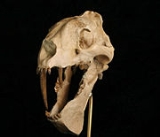
Eusmilus

Encyclopedia
Eusmilus is a prehistoric genus
of the family
Nimravidae
, subfamily Nimravinae endemic to North America
, Europe
,and Asia
during the Late Eocene-Early Oligocene epochs (37.2—28.4 mya), existing for approximately .

. It had developed long saber teeth and looked like a saber-toothed cat
, but was actually a so-called 'false saber-tooth
'. Most were leopard-sized and rather long-bodied and short-legged compared to modern leopards. Some reached 2.5 metres (8 ft) long. Eusmilus had lost many other teeth, possessing only 26 instead of the 44 usually seen in carnivore mammals. Its mouth could open to an angle of 90 degrees, allowing the creature to properly use its saber teeth. Bony flanges projected from Eusmilus ' lower jaw to protect the sabers (this is also seen in the unrelated marsupial
Thylacosmilus
and felid Megantereon
). There is fossil evidence of conflict between Eusmilus and Nimravus
, another genus of nimravid.
A single specimen was examined by Legendre and Roth for body mass and was estimated to have a weight of 70 kg (154.3 lb).
Genus
In biology, a genus is a low-level taxonomic rank used in the biological classification of living and fossil organisms, which is an example of definition by genus and differentia...
of the family
Family (biology)
In biological classification, family is* a taxonomic rank. Other well-known ranks are life, domain, kingdom, phylum, class, order, genus, and species, with family fitting between order and genus. As for the other well-known ranks, there is the option of an immediately lower rank, indicated by the...
Nimravidae
Nimravidae
The Nimravidae, sometimes known as false saber-toothed cats, are an extinct family of mammalian carnivores belonging to the suborder Feliformia and endemic to North America, Europe, and Asia living from the Eocene through the Miocene epochs , existing for approximately .-Morphology:Although some...
, subfamily Nimravinae endemic to North America
North America
North America is a continent wholly within the Northern Hemisphere and almost wholly within the Western Hemisphere. It is also considered a northern subcontinent of the Americas...
, Europe
Europe
Europe is, by convention, one of the world's seven continents. Comprising the westernmost peninsula of Eurasia, Europe is generally 'divided' from Asia to its east by the watershed divides of the Ural and Caucasus Mountains, the Ural River, the Caspian and Black Seas, and the waterways connecting...
,and Asia
Asia
Asia is the world's largest and most populous continent, located primarily in the eastern and northern hemispheres. It covers 8.7% of the Earth's total surface area and with approximately 3.879 billion people, it hosts 60% of the world's current human population...
during the Late Eocene-Early Oligocene epochs (37.2—28.4 mya), existing for approximately .
Taxonomy
Ekgmoiteptecela was named by Macdonald (1963). Its type is Ekgmoiteptecela olsontau. It was synonymized subjectively with Eusmilus by Martin (1980), Bryant (1984) and Bryant (1996).Morphology
Eusmilus had a long body and was about as tall as a leopardLeopard
The leopard , Panthera pardus, is a member of the Felidae family and the smallest of the four "big cats" in the genus Panthera, the other three being the tiger, lion, and jaguar. The leopard was once distributed across eastern and southern Asia and Africa, from Siberia to South Africa, but its...
. It had developed long saber teeth and looked like a saber-toothed cat
Saber-toothed cat
Saber-toothed cat or Sabre-toothed cat refers to the extinct subfamilies of Machairodontinae , Barbourofelidae , and Nimravidae as well as two families related to marsupials that were found worldwide from the Eocene Epoch to the end of the Pleistocene Epoch ,...
, but was actually a so-called 'false saber-tooth
Nimravidae
The Nimravidae, sometimes known as false saber-toothed cats, are an extinct family of mammalian carnivores belonging to the suborder Feliformia and endemic to North America, Europe, and Asia living from the Eocene through the Miocene epochs , existing for approximately .-Morphology:Although some...
'. Most were leopard-sized and rather long-bodied and short-legged compared to modern leopards. Some reached 2.5 metres (8 ft) long. Eusmilus had lost many other teeth, possessing only 26 instead of the 44 usually seen in carnivore mammals. Its mouth could open to an angle of 90 degrees, allowing the creature to properly use its saber teeth. Bony flanges projected from Eusmilus ' lower jaw to protect the sabers (this is also seen in the unrelated marsupial
Marsupial
Marsupials are an infraclass of mammals, characterized by giving birth to relatively undeveloped young. Close to 70% of the 334 extant species occur in Australia, New Guinea, and nearby islands, with the remaining 100 found in the Americas, primarily in South America, but with thirteen in Central...
Thylacosmilus
Thylacosmilus
Thylacosmilus was a genus of sabre-toothed metatherian predators that first appeared during the Miocene. Remains of the animal have been found in parts of South America, primarily Argentina...
and felid Megantereon
Megantereon
Megantereon was an ancient machairodontine saber-toothed cat that lived in North America, Eurasia, and Africa. It may be the ancestor of Smilodon.- Fossil range :...
). There is fossil evidence of conflict between Eusmilus and Nimravus
Nimravus
Nimravus is an extinct genus of the family Nimravidae, subfamily Nimravinae endemic to North America during the Oligocene epoch , existing for approximately .-Taxonomy:...
, another genus of nimravid.
A single specimen was examined by Legendre and Roth for body mass and was estimated to have a weight of 70 kg (154.3 lb).