

Ephippiorhynchus

Encyclopedia
Ephippiorhynchus is a small genus
of stork
s. It contains two living species
only, very large bird
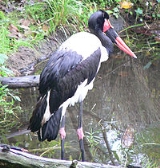
s more than 140 cm tall with a 230–270 cm wingspan. Both are mainly black and white, with huge colourful, mainly red and black bills. The sexes of these species are similarly plumaged, but differ in eye colour. The members of this genus are sometimes called "jabiru
s", but this properly refers to a close relative from Latin America
.
The species are:
A prehistoric relative, Ephippiorhynchus pakistanensis, has been described from Late Miocene
fossils found in Pakistan
. At about the same time, another now-extinct species occurred in eastern to central Africa.
These large wading birds breed in marshes and other wetlands, building a large, deep stick nest in a tree. Like most storks, they fly with the neck outstretched, not retracted like a heron
; in flight, they present a strange shape, with the head and large bill somewhat drooping down. They are silent except for bill-clattering at the nest.
Ephippiorhynchus storks, like most of their relatives, feeds mainly on fish
, frog
s and crab
s, but also on young bird
s, and other land vertebrate
s. They move in a deliberate and stately manner as they hunt, in a similar way to the larger heron
.
These birds are not infrequently kept in captivity by zoos or aviculturalists
. Individuals occasionally escape, and these have been proposed to be responsible for sightings of "Big Bird" cryptid
s; the Saddle-billed Stork is the most likely basis for the Kongamato
.
The genus name Ephippiorhynchus is derived from Ancient Greek
ephippos, a saddle (literally "something which is placed on a horse"), and rhynchus, "bill", and refers to the frontal shield which saddles the bill of one species.
Genus
In biology, a genus is a low-level taxonomic rank used in the biological classification of living and fossil organisms, which is an example of definition by genus and differentia...
of stork
Stork
Storks are large, long-legged, long-necked wading birds with long, stout bills. They belong to the family Ciconiidae. They are the only family in the biological order Ciconiiformes, which was once much larger and held a number of families....
s. It contains two living species
Species
In biology, a species is one of the basic units of biological classification and a taxonomic rank. A species is often defined as a group of organisms capable of interbreeding and producing fertile offspring. While in many cases this definition is adequate, more precise or differing measures are...
only, very large bird
Bird
Birds are feathered, winged, bipedal, endothermic , egg-laying, vertebrate animals. Around 10,000 living species and 188 families makes them the most speciose class of tetrapod vertebrates. They inhabit ecosystems across the globe, from the Arctic to the Antarctic. Extant birds range in size from...
s more than 140 cm tall with a 230–270 cm wingspan. Both are mainly black and white, with huge colourful, mainly red and black bills. The sexes of these species are similarly plumaged, but differ in eye colour. The members of this genus are sometimes called "jabiru
Jabiru
The Jabiru is a large stork found in the Americas from Mexico to Argentina, except west of the Andes. It is most common in the Pantanal region of Brazil and the Eastern Chaco region of Paraguay. It is the only member of the genus Jabiru...
s", but this properly refers to a close relative from Latin America
Latin America
Latin America is a region of the Americas where Romance languages – particularly Spanish and Portuguese, and variably French – are primarily spoken. Latin America has an area of approximately 21,069,500 km² , almost 3.9% of the Earth's surface or 14.1% of its land surface area...
.
The species are:
- Saddle-billed StorkSaddle-billed StorkThe Saddle-billed Stork is a large wading bird in the stork family, Ciconiidae. It is a widespread species which is a resident breeder in sub-Saharan Africa from Sudan, Ethiopia and Kenya south to South Africa, and in The Gambia, Senegal, Côte d'Ivoire and Chad in west Africa.This is a close...
, Ephippiorhynchus senegalensis of sub-Saharan AfricaAfricaAfrica is the world's second largest and second most populous continent, after Asia. At about 30.2 million km² including adjacent islands, it covers 6% of the Earth's total surface area and 20.4% of the total land area... - Black-necked StorkBlack-necked StorkThe Black-necked Stork is a tall long-necked wading bird in the stork family. It is a resident species across South and Southeast Asia with a disjunct population in Australia. It lives in wetland habitats to forage for a wide range of animal prey...
, Ephippiorhynchus asiaticus of tropical AsiaAsiaAsia is the world's largest and most populous continent, located primarily in the eastern and northern hemispheres. It covers 8.7% of the Earth's total surface area and with approximately 3.879 billion people, it hosts 60% of the world's current human population...
A prehistoric relative, Ephippiorhynchus pakistanensis, has been described from Late Miocene
Miocene
The Miocene is a geological epoch of the Neogene Period and extends from about . The Miocene was named by Sir Charles Lyell. Its name comes from the Greek words and and means "less recent" because it has 18% fewer modern sea invertebrates than the Pliocene. The Miocene follows the Oligocene...
fossils found in Pakistan
Pakistan
Pakistan , officially the Islamic Republic of Pakistan is a sovereign state in South Asia. It has a coastline along the Arabian Sea and the Gulf of Oman in the south and is bordered by Afghanistan and Iran in the west, India in the east and China in the far northeast. In the north, Tajikistan...
. At about the same time, another now-extinct species occurred in eastern to central Africa.
These large wading birds breed in marshes and other wetlands, building a large, deep stick nest in a tree. Like most storks, they fly with the neck outstretched, not retracted like a heron
Heron
The herons are long-legged freshwater and coastal birds in the family Ardeidae. There are 64 recognised species in this family. Some are called "egrets" or "bitterns" instead of "heron"....
; in flight, they present a strange shape, with the head and large bill somewhat drooping down. They are silent except for bill-clattering at the nest.
Ephippiorhynchus storks, like most of their relatives, feeds mainly on fish
Fish
Fish are a paraphyletic group of organisms that consist of all gill-bearing aquatic vertebrate animals that lack limbs with digits. Included in this definition are the living hagfish, lampreys, and cartilaginous and bony fish, as well as various extinct related groups...
, frog
Frog
Frogs are amphibians in the order Anura , formerly referred to as Salientia . Most frogs are characterized by a short body, webbed digits , protruding eyes and the absence of a tail...
s and crab
Crab
True crabs are decapod crustaceans of the infraorder Brachyura, which typically have a very short projecting "tail" , or where the reduced abdomen is entirely hidden under the thorax...
s, but also on young bird
Bird
Birds are feathered, winged, bipedal, endothermic , egg-laying, vertebrate animals. Around 10,000 living species and 188 families makes them the most speciose class of tetrapod vertebrates. They inhabit ecosystems across the globe, from the Arctic to the Antarctic. Extant birds range in size from...
s, and other land vertebrate
Vertebrate
Vertebrates are animals that are members of the subphylum Vertebrata . Vertebrates are the largest group of chordates, with currently about 58,000 species described. Vertebrates include the jawless fishes, bony fishes, sharks and rays, amphibians, reptiles, mammals, and birds...
s. They move in a deliberate and stately manner as they hunt, in a similar way to the larger heron
Heron
The herons are long-legged freshwater and coastal birds in the family Ardeidae. There are 64 recognised species in this family. Some are called "egrets" or "bitterns" instead of "heron"....
.
These birds are not infrequently kept in captivity by zoos or aviculturalists
Aviculture
Aviculture is the practice of keeping and breeding birds and the culture that forms around it. Aviculture is generally focused on not only the raising and breeding of birds, but also on preserving avian habitat, and public awareness campaigns....
. Individuals occasionally escape, and these have been proposed to be responsible for sightings of "Big Bird" cryptid
Cryptid
In cryptozoology and sometimes in cryptobotany, a cryptid is a creature or plant whose existence has been suggested but is unrecognized by scientific consensus and often regarded as highly unlikely. Famous examples include the Yeti in the Himalayas and the Loch Ness Monster in...
s; the Saddle-billed Stork is the most likely basis for the Kongamato
Kongamato
The Kongamato is a reported pterosaur-like creature said to have been seen by natives and explorers in the Mwinilunga district's Jiundu swamps of Western Zambia, Angola and Congo...
.
The genus name Ephippiorhynchus is derived from Ancient Greek
Ancient Greek
Ancient Greek is the stage of the Greek language in the periods spanning the times c. 9th–6th centuries BC, , c. 5th–4th centuries BC , and the c. 3rd century BC – 6th century AD of ancient Greece and the ancient world; being predated in the 2nd millennium BC by Mycenaean Greek...
ephippos, a saddle (literally "something which is placed on a horse"), and rhynchus, "bill", and refers to the frontal shield which saddles the bill of one species.