

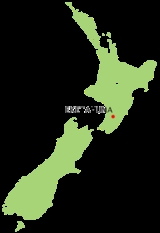
Eketahuna

Encyclopedia
Eketahuna is a small rural
service town, the most southerly in the Tararua District in the Manawatu-Wanganui
region of the North Island
of New Zealand
, but is considered to be in northern Wairarapa
. It was called Mellenskov, but was renamed soon after its founding.
The town is located at the foot of the Tararua Ranges which lie to the west. It is 35 kilometres north of Masterton
and a similar distance south of Palmerston North
. It is situated on State Highway 2
and the eastern bank of the Makakahi River
.
Eketahuna is considered by some to be the stereotypical rural New Zealand town, and is occasionally used in conversation to represent "the real New Zealand". The 2001 census recorded Eketahuna's population at 579.
New Zealanders colloquially refer to the town of Eketahuna the way other English speakers refer to Timbuktu
, i.e., the middle of nowhere, "the sticks", the end of the world. Likewise, Eketahuna is a booming metropolis compared to the mythical town of Waikikamukau
.
The Mount Bruce bird sanctuary is located to the south of the town.
The name of the town, when spoken, sounds like a sentence in Afrikaans
which translates to "I have a chicken". This is a source of amusement to immigrant Afrikaans-speaking South Africans in New Zealand.
Rural
Rural areas or the country or countryside are areas that are not urbanized, though when large areas are described, country towns and smaller cities will be included. They have a low population density, and typically much of the land is devoted to agriculture...
service town, the most southerly in the Tararua District in the Manawatu-Wanganui
Manawatu-Wanganui
Manawatu-Wanganui is a region in the lower half of the North Island of New Zealand, around the cities of Palmerston North and Whanganui. It is administered by the Horizons Regional Council.-Administration:...
region of the North Island
North Island
The North Island is one of the two main islands of New Zealand, separated from the much less populous South Island by Cook Strait. The island is in area, making it the world's 14th-largest island...
of New Zealand
New Zealand
New Zealand is an island country in the south-western Pacific Ocean comprising two main landmasses and numerous smaller islands. The country is situated some east of Australia across the Tasman Sea, and roughly south of the Pacific island nations of New Caledonia, Fiji, and Tonga...
, but is considered to be in northern Wairarapa
Wairarapa
Wairarapa is a geographical region of New Zealand. It occupies the south-eastern corner of the North Island, east of metropolitan Wellington and south-west of the Hawke's Bay region. It is lightly populated, having several rural service towns, with Masterton being the largest...
. It was called Mellenskov, but was renamed soon after its founding.
The town is located at the foot of the Tararua Ranges which lie to the west. It is 35 kilometres north of Masterton
Masterton
Masterton is a large town and local government district in the Wellington Region of New Zealand. It is the largest town in the Wairarapa, a region separated from Wellington by the Rimutaka ranges...
and a similar distance south of Palmerston North
Palmerston North
Palmerston North is the main city of the Manawatu-Wanganui region of the North Island of New Zealand. It is an inland city with a population of and is the country's seventh largest city and eighth largest urban area. Palmerston North is located in the eastern Manawatu Plains near the north bank...
. It is situated on State Highway 2
New Zealand State Highway network
The New Zealand State Highway network is the major national highway network in New Zealand. Just under 100 roads in both the North and South Islands are State Highways...
and the eastern bank of the Makakahi River
Makakahi River
The Makakahi River is in the Manawatu-Wanganui region of the North Island of New Zealand.Its headwaters are to the south of Eketahuna. From there, it flows northwest alongside State Highway 2 for 40 kilometres, before feeding into the Manawatu River between Pahiatua and Woodville....
.
Eketahuna is considered by some to be the stereotypical rural New Zealand town, and is occasionally used in conversation to represent "the real New Zealand". The 2001 census recorded Eketahuna's population at 579.
New Zealanders colloquially refer to the town of Eketahuna the way other English speakers refer to Timbuktu
Timbuktu
Timbuktu , formerly also spelled Timbuctoo, is a town in the West African nation of Mali situated north of the River Niger on the southern edge of the Sahara Desert. The town is the capital of the Timbuktu Region, one of the eight administrative regions of Mali...
, i.e., the middle of nowhere, "the sticks", the end of the world. Likewise, Eketahuna is a booming metropolis compared to the mythical town of Waikikamukau
Waikikamukau
Waikikamukau, Why-key-car-moo-koh, , is any small rural town or locality in New Zealand. New Zealanders use the name as a placeholder name for "any town" or to denote a particularly remote rural town. It has a similar connotation as the term wop-wops, or for other English speakers Timbuktu, or BFE...
.
The Mount Bruce bird sanctuary is located to the south of the town.
The name of the town, when spoken, sounds like a sentence in Afrikaans
Afrikaans
Afrikaans is a West Germanic language, spoken natively in South Africa and Namibia. It is a daughter language of Dutch, originating in its 17th century dialects, collectively referred to as Cape Dutch .Afrikaans is a daughter language of Dutch; see , , , , , .Afrikaans was historically called Cape...
which translates to "I have a chicken". This is a source of amusement to immigrant Afrikaans-speaking South Africans in New Zealand.