

Manawatu-Wanganui

Encyclopedia
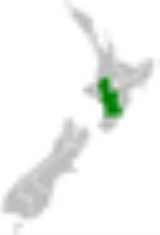
Manawatu-Wanganui is a region in the lower half of the North Island
of New Zealand
, around the cities of Palmerston North
and Whanganui
. It is administered by the Horizons Regional Council.
. Parts of five of these are covered by five other regions of New Zealand
, the most of any region. In descending order of land area the Districts are Ruapehu
, Tararua
(part), Rangitikei
(part), Manawatu, Wanganui
, Horowhenua, Stratford
(part), Palmerston North
, Waitomo (part) and Taupo
(part).
and the Manawatu
. The Whanganui River, in the region's northwest, is the longest navigable river in New Zealand. The river was extremely important to early Māori as it was the southern link in a chain of waterways that spanned almost two-thirds of the North Island. It was one of the chief areas of Māori settlement with its easily fortified cliffs and ample food supplies. Legends emphasise the importance of the river and it remains sacred to Wanganui iwi
. Māori along the coast and lowland plains grew kumara
and other crops. The Manawatu River runs across the centre of the region, from rolling hill country in the east to the fertile Manawatu Plains
in the west. the main city of Palmerston North
is located on these plains, and is an important service city for the southern North Island as a whole. This river is unusual, in that it passes from hill country to plains through a gorge cut into much higher country, an indication that the hills have risen since the river formed.
To the southeast, a further, more sparsely populated area lies between the sources of the Manawatu River and the Pacific coast. This area, often historically connected with both the Hawke's Bay Region to the north and the Wairarapa
to the south, was historically simply known as Bush, a name which still survives in some businesses and oprganisations, most notably in the mname of the Wairarapa-Bush Rugby Football Union.
The two river catchments have very different natures. While the open Manawatu Plains
became more densely settled by Europeans, inland Ruapehu
, Rangitikei and Wanganui remained more Māori-dominated, remote and independent, and is still heavily forested. As late as the 1950s the Whanganui River remained a river of mystery. Since then exploitation of the river's commercial potential has opened up the area, often causing friction with local Māori, who have long-standing grievances. The Manawatu-Wanganui Region as a whole is one of the most important pastoral areas in New Zealand, its status recognised when the government opened the Massey Agricultural College
in the 1920s.
Much of the Manawatu-Wanganui Region was fertile and bush
-covered when Europeans arrived and developed the area as a source of timber
. Saw milling and flax
milling dominated the 19th century, followed by an influx of sheep farmers who exploited the newly-cleared ground. Deforestation
, burn-offs of timber and scrub and large scale drainage combined with overgrazing
, resulted in considerable environmental degradation. In the early 1900s authorities realised that careful management was needed to maintain this important agricultural
area.
to Owhanga. It borders the Waikato, Taranaki, Hawke's Bay and Wellington Regions and includes river catchment areas that run from the volcanic plateau
to the sea. The Pacific Ocean
is the eastern boundary and the Ruahine Ranges form a natural boundary between the region and Hawke's Bay.
The area includes a variety of landscape formations. Districts close to the Volcanic Plateau
are higher and more rugged, often subject to harsh temperatures in winter. The Manawatu District has a much gentler topography, consisting mainly of the flat, tree-studded Manawatu Plains
that run between the ranges and the sea. The land was under the sea till about 500,000 years ago and still has a very thick layer of marine sediment, which is about five or six million years old. A block faulting system underneath the thick sediment has raised a series of domes and gentle depressions. These structures can provide natural storage areas for oil and some of the Manawatu domes have been drilled. The domes have shaped the course of the Manawatu River, giving it a meandering path which, uniquely among New Zealand rivers, begins close to the east coast and exits on the west coast. The Manawatu River begins just inside the Hawke's Bay Region, then flows through a deep gorge to the Manawatu Plains
before exiting in the Tasman Sea
. The river is also unique in New Zealand (and rare worldwide) in that this gorge (the Manawatu Gorge
) is a water gap
through recently uplifted rock, causing the river to flow from relatively low lying land along an eroded course through higher terrain. The Wanganui District is more rugged, with canyon
-like valleys and gorges carved out of the soft rock by rivers and ocean waves.
The region includes a series of mountain ranges, notably the Tararua and the Ruahine Ranges and the three major active volcano
es of the North Island. Mount Ruapehu
at 2,797 m is the tallest mountain in the North Island, Ngauruhoe
2,291 m and Tongariro
1,968 m. During the last 100 years Ruapehu has experienced six significant eruptions, and last erupted in 1995 and 1996.
Three major rivers divide the region: the Whanganui (290 km), Manawatu (182 km) and Rangitikei
(241 km). The Whanganui is the second-longest river and has the second-largest catchment in the North Island, draining most of the inland region west of Lake Taupo
. There are few roads in this area, which contains some of the largest surviving areas of native bush in the North Island.
-covered terraces and river flats inland. These river flats and swamp areas contain fertile alluvial and organic soils. On the drier terraces inland yellow-grey earths predominate. The flatter more fertile soils suit intensive sheep farming and cropping while the hill country of Rangitikei favours semi-intensive sheep and beef
farming. Areas close to the volcanic plateau consist largely of pumice
soils which lack some essential trace elements but within the region much of this land is occupied by national parks.
The region has a comparatively mild climate with greater climatic extremes inland. Chateau Tongariro
experienced the lowest temperature recorded in the North Island, falling to -13.6 °C on 7 July 1937. In summer the region is warm, with a maximum mid-summer daily average of between 20.1 and 22.9 °C. Sunshine hours approximate the national average for much of the region (1,800-2,000 hours per annum) but Palmerston North is defined as cloudy with an average of 1,725 sunshine hours. In the winter the minimum mid-winter daily average for coastal areas is 4.0 to 7.9 °C, while inland areas are considerably colder. Waiouru
has a minimum mid-winter daily average of 0.1 °C.
Rainfall on the plains is slightly below average, with Palmerston North receiving 960 mm, while the rest of the region receives the New Zealand average rainfall of 1,000-2,000 mm.
is the largest park in the region (795.98 km2) and is the oldest national park in the country, established in 1887. The volcanoes Tongariro, Ruapehu and Ngauruhoe are sacred to Māori and were gifted to the nation by Te Heuheu Tukino IV
, paramount chief of Ngati Tuwharetoa
. They form the nucleus of the park, which is designated a world heritage area.
Whanganui National Park
is slightly smaller (742.31 km2) and was established 99 years later when a series of reserves were incorporated into one area and given national park status. There are two state forest parks in the rugged, bush-clad Ruahine and Tararua Ranges. The four parks offer skiing
, tramping, jetboat
ing and white-water rafting
and the opportunity to appreciate the environment.
The regional council, responsible for managing natural and physical resources, provides flood protection and monitors environmental problems such as pest infestation and pollution. Invasive plant pests such as African feathergrass, goats rue
and nodding thistle
pose a threat to pastureland in this heavily agricultural-dependent region, and the regional council has instituted control campaigns. The regional council has also instituted animal pest control programmes. Possum
s are perceived as the major animal pest since they damage native forests and endanger cattle production through the spread of bovine tuberculosis
. Eradication programmes also concentrate on rabbit
s, rook
s and feral goat
s, while other exotic species such as Parma Wallaby (Macropus parma) wallaby
, wasp
s, ferret
s, stoat
s and weasel
s are a source of concern.
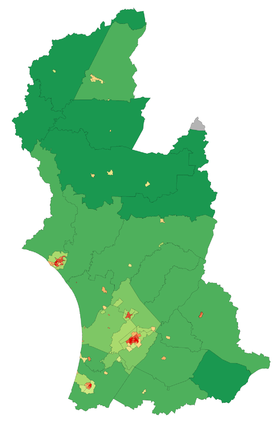 The region had a usually resident population of 222,423 people at the 2006 Census, the fifth-largest population in New Zealand. The region has a lower than average population density, 10.3 people per square kilometre, compared with 13.1 for New Zealand. Between the 2001 and 2006 censuses the population rose by 1.6%, or 3,477 people.
There are two major urban areas in the region. Palmerston North
, with an estimated resident population of , expanded as an educational centre and a supply centre for the surrounding rural hinterland. It became a city in 1930. The other major urban area is Whanganui
, with an estimated resident population of Other urban centres include Levin
, Feilding, Dannevirke
, Taumarunui
, Foxton
, and Marton
.
City life does not dominate the region, as half the population live outside a large urban area, over a third in small towns or rural areas. While manufacturing
has become an important part of the region's economy, most businesses are agriculturally based and agriculture remains the regional linchpin. The dominance of agriculture, combined with the relatively small scale of most urban areas, gives a rural quality to the region, quite distinct from neighbouring Wellington
. The region's rugged interior has also become one of the main training areas for New Zealand's defence force, which maintain three bases in the region.
, forestry
and fishing
industries, 6.3% compared with 4.4% nationally. Businesses engaged in retail trade were dominant numerically. In 1997 there were 2,300 businesses in the region, employing a total of 10,380 full-time
equivalents (FTEs). The percentage of businesses engaged in manufacturing was slightly higher than the national average and manufacturing employed the greatest number of people (12,830 FTEs).
s, with 194 installed turbines and more planned.
and the Manawatu. Research by members of the college into animal genetics in the 1930s led to the development of new breeds of sheep, the Drysdale and the Perendale
, which became commercially significant after World War II.
Agriculture dominates land use in the region although there are areas of forestry and horticulture
. Soils and climate favour pastoral farming. There were 6,344 farm holdings in the region on 30 June 1996, which was almost a tenth of all farm holdings in New Zealand. Farming occupied 72.5% of land in the region, which was much higher than the national average of 60.1%. Approximately 80% of this land was used for agricultural purposes (grazing, arable, fodder and fallow land). In the Manawatu, Rangitikei and Tararua Districts this percentage rose to over 90% of total land.
The region is one of the most important areas of pastoral farming in New Zealand. The region had 7,216,177 sheep (at 30 June 1996), the largest number of sheep in the North Island and the fourth-highest figure in the country behind Canterbury, Southland and Otago
. The region also produces a significant proportion of vegetables in the North Island and is particularly noted for its abundant potato
crop. Barley
, which is used for the manufacture of stock feed and for malting, is grown in the region. The region produces the largest quantities of barley in the North Island, providing 10% of the national refined crop of 302,804 tonnes in 1995.
, the main state highway, and the North Island Main Trunk Railway, the main railway line, which link Auckland
and Wellington
. The Palmerston North - Gisborne Line
and State Highway 3
follow the Manawatu Gorge
, linking the region with Hawke's Bay. The Marton - New Plymouth Line provides a railway link with Taranaki, and from this line a short branch line runs to Wanganui. Road and rail transport give the region's exporters easy access to ports.
The region has approximately 16% of the North Island's road length. There are 8,732 km of road, of which two-thirds are sealed. Approximately 12% of roads in the region are classified as urban and three-quarters as rural, with almost half of the rural roads being unsealed. With 945.9 km the region has the second-highest length of State Highways in the North Island, after Waikato.
North Island
The North Island is one of the two main islands of New Zealand, separated from the much less populous South Island by Cook Strait. The island is in area, making it the world's 14th-largest island...
of New Zealand
New Zealand
New Zealand is an island country in the south-western Pacific Ocean comprising two main landmasses and numerous smaller islands. The country is situated some east of Australia across the Tasman Sea, and roughly south of the Pacific island nations of New Caledonia, Fiji, and Tonga...
, around the cities of Palmerston North
Palmerston North
Palmerston North is the main city of the Manawatu-Wanganui region of the North Island of New Zealand. It is an inland city with a population of and is the country's seventh largest city and eighth largest urban area. Palmerston North is located in the eastern Manawatu Plains near the north bank...
and Whanganui
Whanganui
Various places in New Zealand are called Whanganui:*Whanganui, a city at the mouth of the Whanganui River, also often spelled "Wanganui", Manawatu-Wanganui Region*Whanganui District, Manawatu-Wanganui Region*Whanganui Island, Waikato Region...
. It is administered by the Horizons Regional Council.
Administration
The region covers all or part of ten DistrictsTerritorial authorities of New Zealand
Territorial authorities are the second tier of local government in New Zealand, below regional councils. There are 67 territorial authorities: 13 city councils, 53 district councils, and the Chatham Islands Council...
. Parts of five of these are covered by five other regions of New Zealand
Regions of New Zealand
The region is the top tier of local government in New Zealand. There are 16 regions of New Zealand. Eleven are governed by an elected regional council, while five are governed by territorial authorities which also perform the functions of a regional council and thus are known as unitary authorities...
, the most of any region. In descending order of land area the Districts are Ruapehu
Ruapehu District
Ruapehu District is a territorial authority near the centre of New Zealand's North Island.It has an area of 6,730.185 square kilometers and a population of 13,569 at the 2006 census .-Features:...
, Tararua
Tararua District
The Tararua District lies near the south-east corner of New Zealand's North Island. Created in 1989, it was named after the Tararua Range, which forms much of its western boundary. It has a population of and an area of 4,360.56 km²....
(part), Rangitikei
Rangitikei
Rangitikei is an area in New Zealand that follows the course of State Highway 1, from just south of Waiouru with the QEII Army Memorial Museum, through Taihape, Mangaweka, Hunterville, Marton and Bulls, and then winds down a minor road to the coast at Turakina & Scott’s Ferry...
(part), Manawatu, Wanganui
Wanganui
Whanganui , also spelled Wanganui, is an urban area and district on the west coast of the North Island of New Zealand. It is part of the Manawatu-Wanganui region....
, Horowhenua, Stratford
Stratford, New Zealand
Stratford is the only town in the central Taranaki district of Stratford District, New Zealand. It lies beneath the eastern slopes of Mount Taranaki/Egmont, approximately half-way between New Plymouth and Hawera, near the geographic centre of the Taranaki region. The town has a population of...
(part), Palmerston North
Palmerston North
Palmerston North is the main city of the Manawatu-Wanganui region of the North Island of New Zealand. It is an inland city with a population of and is the country's seventh largest city and eighth largest urban area. Palmerston North is located in the eastern Manawatu Plains near the north bank...
, Waitomo (part) and Taupo
Taupo District Council
The Taupo District Council is a local council located in the Central North Island of New Zealand.-Area:The district stretches from the small town of Mangakino in the northwest to the Tongariro National Park in the south, and east into the Kaingaroa Forest, covering 6,970 km2...
(part).
General
The region is dominated and defined by two significant river catchments, the WhanganuiWhanganui River
The Whanganui River is a major river in the North Island of New Zealand.Known for many years as the Wanganui River, the river's name reverted to Whanganui in 1991, according with the wishes of local iwi. Part of the reason was also to avoid confusion with the Wanganui River in the South Island...
and the Manawatu
Manawatu River
The Manawatu River is a major river of the southern North Island of New Zealand.The river has its headwaters to the northwest of Norsewood in the Ruahine Ranges of southern Hawke's Bay. It flows initially eastward before turning south-west near Ormondville, flowing 40 km before turning...
. The Whanganui River, in the region's northwest, is the longest navigable river in New Zealand. The river was extremely important to early Māori as it was the southern link in a chain of waterways that spanned almost two-thirds of the North Island. It was one of the chief areas of Māori settlement with its easily fortified cliffs and ample food supplies. Legends emphasise the importance of the river and it remains sacred to Wanganui iwi
Iwi
In New Zealand society, iwi form the largest everyday social units in Māori culture. The word iwi means "'peoples' or 'nations'. In "the work of European writers which treat iwi and hapū as parts of a hierarchical structure", it has been used to mean "tribe" , or confederation of tribes,...
. Māori along the coast and lowland plains grew kumara
Sweet potato
The sweet potato is a dicotyledonous plant that belongs to the family Convolvulaceae. Its large, starchy, sweet-tasting, tuberous roots are an important root vegetable. The young leaves and shoots are sometimes eaten as greens. Of the approximately 50 genera and more than 1,000 species of...
and other crops. The Manawatu River runs across the centre of the region, from rolling hill country in the east to the fertile Manawatu Plains
Manawatu Plains
Some of the most fertile land in the southwestern North Island of New Zealand is located on the floodplains of the Manawatu and Rangitikei Rivers, in an area known as the Manawatu Plains....
in the west. the main city of Palmerston North
Palmerston North
Palmerston North is the main city of the Manawatu-Wanganui region of the North Island of New Zealand. It is an inland city with a population of and is the country's seventh largest city and eighth largest urban area. Palmerston North is located in the eastern Manawatu Plains near the north bank...
is located on these plains, and is an important service city for the southern North Island as a whole. This river is unusual, in that it passes from hill country to plains through a gorge cut into much higher country, an indication that the hills have risen since the river formed.
To the southeast, a further, more sparsely populated area lies between the sources of the Manawatu River and the Pacific coast. This area, often historically connected with both the Hawke's Bay Region to the north and the Wairarapa
Wairarapa
Wairarapa is a geographical region of New Zealand. It occupies the south-eastern corner of the North Island, east of metropolitan Wellington and south-west of the Hawke's Bay region. It is lightly populated, having several rural service towns, with Masterton being the largest...
to the south, was historically simply known as Bush, a name which still survives in some businesses and oprganisations, most notably in the mname of the Wairarapa-Bush Rugby Football Union.
The two river catchments have very different natures. While the open Manawatu Plains
Manawatu Plains
Some of the most fertile land in the southwestern North Island of New Zealand is located on the floodplains of the Manawatu and Rangitikei Rivers, in an area known as the Manawatu Plains....
became more densely settled by Europeans, inland Ruapehu
Ruapehu District
Ruapehu District is a territorial authority near the centre of New Zealand's North Island.It has an area of 6,730.185 square kilometers and a population of 13,569 at the 2006 census .-Features:...
, Rangitikei and Wanganui remained more Māori-dominated, remote and independent, and is still heavily forested. As late as the 1950s the Whanganui River remained a river of mystery. Since then exploitation of the river's commercial potential has opened up the area, often causing friction with local Māori, who have long-standing grievances. The Manawatu-Wanganui Region as a whole is one of the most important pastoral areas in New Zealand, its status recognised when the government opened the Massey Agricultural College
Massey University
Massey University is one of New Zealand's largest universities with approximately 36,000 students, 20,000 of whom are extramural students.The University has campuses in Palmerston North , Wellington and Auckland . Massey offers most of its degrees extramurally within New Zealand and internationally...
in the 1920s.
Much of the Manawatu-Wanganui Region was fertile and bush
Forest
A forest, also referred to as a wood or the woods, is an area with a high density of trees. As with cities, depending where you are in the world, what is considered a forest may vary significantly in size and have various classification according to how and what of the forest is composed...
-covered when Europeans arrived and developed the area as a source of timber
Timber
Timber may refer to:* Timber, a term common in the United Kingdom and Australia for wood materials * Timber, Oregon, an unincorporated community in the U.S...
. Saw milling and flax
Flax
Flax is a member of the genus Linum in the family Linaceae. It is native to the region extending from the eastern Mediterranean to India and was probably first domesticated in the Fertile Crescent...
milling dominated the 19th century, followed by an influx of sheep farmers who exploited the newly-cleared ground. Deforestation
Deforestation
Deforestation is the removal of a forest or stand of trees where the land is thereafter converted to a nonforest use. Examples of deforestation include conversion of forestland to farms, ranches, or urban use....
, burn-offs of timber and scrub and large scale drainage combined with overgrazing
Overgrazing
Overgrazing occurs when plants are exposed to intensive grazing for extended periods of time, or without sufficient recovery periods. It can be caused by either livestock in poorly managed agricultural applications, or by overpopulations of native or non-native wild animals.Overgrazing reduces the...
, resulted in considerable environmental degradation. In the early 1900s authorities realised that careful management was needed to maintain this important agricultural
Agriculture
Agriculture is the cultivation of animals, plants, fungi and other life forms for food, fiber, and other products used to sustain life. Agriculture was the key implement in the rise of sedentary human civilization, whereby farming of domesticated species created food surpluses that nurtured the...
area.
Topography
The Manawatu-Wanganui Region takes up a large proportion of the lower half of the North Island. It is the second-largest region in the North Island and the sixth-largest in New Zealand, totalling 22,215 km2 (8.1% of New Zealand's land area). The region stretches from north of Taumarunui to south of Levin on the west coast, and across to the east coast from Cape TurnagainCape Turnagain
Cape Turnagain is a prominent headland on the east coast of New Zealand's North Island, part way between Hawke Bay and Cook Strait, between the mouths of the Porangahau and Akitio Rivers.The cape was named by Captain James Cook in 1769...
to Owhanga. It borders the Waikato, Taranaki, Hawke's Bay and Wellington Regions and includes river catchment areas that run from the volcanic plateau
Volcanic plateau
A volcanic plateau is a plateau produced by volcanic activity. There are two main types: lava plateaus and pyroclastic plateaus.-Lava plateau:...
to the sea. The Pacific Ocean
Pacific Ocean
The Pacific Ocean is the largest of the Earth's oceanic divisions. It extends from the Arctic in the north to the Southern Ocean in the south, bounded by Asia and Australia in the west, and the Americas in the east.At 165.2 million square kilometres in area, this largest division of the World...
is the eastern boundary and the Ruahine Ranges form a natural boundary between the region and Hawke's Bay.
The area includes a variety of landscape formations. Districts close to the Volcanic Plateau
North Island Volcanic Plateau
The North Island Volcanic Plateau is a volcanic plateau covering much of central North Island of New Zealand with volcanoes, lava plateaus, and crater lakes....
are higher and more rugged, often subject to harsh temperatures in winter. The Manawatu District has a much gentler topography, consisting mainly of the flat, tree-studded Manawatu Plains
Manawatu Plains
Some of the most fertile land in the southwestern North Island of New Zealand is located on the floodplains of the Manawatu and Rangitikei Rivers, in an area known as the Manawatu Plains....
that run between the ranges and the sea. The land was under the sea till about 500,000 years ago and still has a very thick layer of marine sediment, which is about five or six million years old. A block faulting system underneath the thick sediment has raised a series of domes and gentle depressions. These structures can provide natural storage areas for oil and some of the Manawatu domes have been drilled. The domes have shaped the course of the Manawatu River, giving it a meandering path which, uniquely among New Zealand rivers, begins close to the east coast and exits on the west coast. The Manawatu River begins just inside the Hawke's Bay Region, then flows through a deep gorge to the Manawatu Plains
Manawatu Plains
Some of the most fertile land in the southwestern North Island of New Zealand is located on the floodplains of the Manawatu and Rangitikei Rivers, in an area known as the Manawatu Plains....
before exiting in the Tasman Sea
Tasman Sea
The Tasman Sea is the large body of water between Australia and New Zealand, approximately across. It extends 2,800 km from north to south. It is a south-western segment of the South Pacific Ocean. The sea was named after the Dutch explorer Abel Janszoon Tasman, the first recorded European...
. The river is also unique in New Zealand (and rare worldwide) in that this gorge (the Manawatu Gorge
Manawatu Gorge
The Manawatu Gorge runs between the Ruahine and Tararua Ranges of the North Island of New Zealand, linking the Manawatu and Hawke's Bay regions...
) is a water gap
Water gap
A water gap is an opening or notch which flowing water has carved through a mountain range. Water gaps often offer a practical route for road and rail transport to cross mountain ridges.- Geology :...
through recently uplifted rock, causing the river to flow from relatively low lying land along an eroded course through higher terrain. The Wanganui District is more rugged, with canyon
Canyon
A canyon or gorge is a deep ravine between cliffs often carved from the landscape by a river. Rivers have a natural tendency to reach a baseline elevation, which is the same elevation as the body of water it will eventually drain into. This forms a canyon. Most canyons were formed by a process of...
-like valleys and gorges carved out of the soft rock by rivers and ocean waves.
The region includes a series of mountain ranges, notably the Tararua and the Ruahine Ranges and the three major active volcano
Volcano
2. Bedrock3. Conduit 4. Base5. Sill6. Dike7. Layers of ash emitted by the volcano8. Flank| 9. Layers of lava emitted by the volcano10. Throat11. Parasitic cone12. Lava flow13. Vent14. Crater15...
es of the North Island. Mount Ruapehu
Mount Ruapehu
Mount Ruapehu, or just Ruapehu, is an active stratovolcano at the southern end of the Taupo Volcanic Zone in New Zealand. It is 23 kilometres northeast of Ohakune and 40 kilometres southwest of the southern shore of Lake Taupo, within Tongariro National Park...
at 2,797 m is the tallest mountain in the North Island, Ngauruhoe
Mount Ngauruhoe
Mount Ngauruhoe is an active stratovolcano or composite cone in New Zealand, made from layers of lava and tephra. It is the youngest vent in the Tongariro volcanic complex on the Central Plateau of the North Island, and first erupted about 2,500 years ago...
2,291 m and Tongariro
Mount Tongariro
Mount Tongariro is a volcanic complex in the North Island of New Zealand. It is located 20 kilometres to the southwest of Lake Taupo, and is the northernmost of the three active volcanoes that dominate the landscape of the central North Island....
1,968 m. During the last 100 years Ruapehu has experienced six significant eruptions, and last erupted in 1995 and 1996.
Three major rivers divide the region: the Whanganui (290 km), Manawatu (182 km) and Rangitikei
Rangitikei River
The Rangitikei River is one of New Zealand's longest rivers, 185 kilometers long.Its headwaters are to the southeast of Lake Taupo in the Kaimanawa Ranges. It flows from the Central Plateau south past Taihape, Mangaweka, Hunterville, Marton, and Bulls, to the South Taranaki Bight at Tangimoana, 40...
(241 km). The Whanganui is the second-longest river and has the second-largest catchment in the North Island, draining most of the inland region west of Lake Taupo
Lake Taupo
Lake Taupo is a lake situated in the North Island of New Zealand. With a surface area of , it is the largest lake by surface area in New Zealand, and the second largest freshwater lake by surface area in geopolitical Oceania after Lake Murray ....
. There are few roads in this area, which contains some of the largest surviving areas of native bush in the North Island.
Soil and climate
Soils in the region are productive with the addition of fertiliser. In the Manawatu and Horowhenua Districts there are sandy soils and swampy hollows around the coast with loessLoess
Loess is an aeolian sediment formed by the accumulation of wind-blown silt, typically in the 20–50 micrometre size range, twenty percent or less clay and the balance equal parts sand and silt that are loosely cemented by calcium carbonate...
-covered terraces and river flats inland. These river flats and swamp areas contain fertile alluvial and organic soils. On the drier terraces inland yellow-grey earths predominate. The flatter more fertile soils suit intensive sheep farming and cropping while the hill country of Rangitikei favours semi-intensive sheep and beef
Beef
Beef is the culinary name for meat from bovines, especially domestic cattle. Beef can be harvested from cows, bulls, heifers or steers. It is one of the principal meats used in the cuisine of the Middle East , Australia, Argentina, Brazil, Europe and the United States, and is also important in...
farming. Areas close to the volcanic plateau consist largely of pumice
Pumice
Pumice is a textural term for a volcanic rock that is a solidified frothy lava typically created when super-heated, highly pressurized rock is violently ejected from a volcano. It can be formed when lava and water are mixed. This unusual formation is due to the simultaneous actions of rapid...
soils which lack some essential trace elements but within the region much of this land is occupied by national parks.
The region has a comparatively mild climate with greater climatic extremes inland. Chateau Tongariro
Chateau Tongariro
Chateau Tongariro is a New Zealand hotel and resort complex.It is located close to Whakapapa skifield on the slopes of Mount Ruapehu, and is close to the volcanic peaks of Mount Tongariro and Mount Ngauruhoe, within the boundaries of Tongariro National Park, New Zealand's oldest.Now officially...
experienced the lowest temperature recorded in the North Island, falling to -13.6 °C on 7 July 1937. In summer the region is warm, with a maximum mid-summer daily average of between 20.1 and 22.9 °C. Sunshine hours approximate the national average for much of the region (1,800-2,000 hours per annum) but Palmerston North is defined as cloudy with an average of 1,725 sunshine hours. In the winter the minimum mid-winter daily average for coastal areas is 4.0 to 7.9 °C, while inland areas are considerably colder. Waiouru
Waiouru
Waiouru is a small town in the centre of the North Island of New Zealand. It is on the North Island Volcanic Plateau, 25 kilometres south-east of Mount Ruapehu, and in the Ruapehu District....
has a minimum mid-winter daily average of 0.1 °C.
Rainfall on the plains is slightly below average, with Palmerston North receiving 960 mm, while the rest of the region receives the New Zealand average rainfall of 1,000-2,000 mm.
Conservation and parks
The region contains areas of great ecological significance, reflected in the designation of approximately a seventh of its land area as part of the nation's conservation estate. Tongariro National ParkTongariro National Park
Tongariro National Park is the oldest national park in New Zealand, located in the central North Island. It has been acknowledged by UNESCO as one of the 28 mixed cultural and natural World Heritage Sites....
is the largest park in the region (795.98 km2) and is the oldest national park in the country, established in 1887. The volcanoes Tongariro, Ruapehu and Ngauruhoe are sacred to Māori and were gifted to the nation by Te Heuheu Tukino IV
Te Heuheu Tukino IV
Te Heuheu Tukino IV was paramount chief of the Ngāti Tuwharetoa, a Māori tribe of the central North Island of New Zealand. His birth name was Pataatai but he assumed the name Horonuku - meaning landslide - after the death of his parents in a landslide in 1846...
, paramount chief of Ngati Tuwharetoa
Ngati Tuwharetoa
Ngāti Tūwharetoa is an iwi descended from Ngātoro-i-rangi, the priest who navigated the Arawa canoe to New Zealand. The Tūwharetoa region extends from Te Awa o te Atua at Matata across the central plateau of the North Island to the lands around Mount Tongariro and Lake Taupo.The iwi is identified...
. They form the nucleus of the park, which is designated a world heritage area.
Whanganui National Park
Whanganui National Park
The Whanganui National Park is a national park located in the North Island of New Zealand. Established in 1986, it covers an area of 742 km² bordering the Whanganui River. It incorporates areas of Crown land, former state forest and a number of former reserves. The river itself is not part of the...
is slightly smaller (742.31 km2) and was established 99 years later when a series of reserves were incorporated into one area and given national park status. There are two state forest parks in the rugged, bush-clad Ruahine and Tararua Ranges. The four parks offer skiing
Skiing
Skiing is a recreational activity using skis as equipment for traveling over snow. Skis are used in conjunction with boots that connect to the ski with use of a binding....
, tramping, jetboat
Jetboat
A jetboat is a boat propelled by a jet of water ejected from the back of the craft. Unlike a powerboat or motorboat that uses a propeller in the water below or behind the boat, a jetboat draws the water from under the boat into a pump inside the boat, then expels it through a nozzle at the...
ing and white-water rafting
Rafting
Rafting or white water rafting is a challenging recreational outdoor activity using an inflatable raft to navigate a river or other bodies of water. This is usually done on white water or different degrees of rough water, in order to thrill and excite the raft passengers. The development of this...
and the opportunity to appreciate the environment.
The regional council, responsible for managing natural and physical resources, provides flood protection and monitors environmental problems such as pest infestation and pollution. Invasive plant pests such as African feathergrass, goats rue
Galega officinalis
Galega officinalis, commonly known as goat's rue, French lilac, Italian fitch or professor-weed, is an herbaceous plant in the Faboideae subfamily. It is native to the Middle East, but it has been naturalised in Europe, western Asia, and western Pakistan...
and nodding thistle
Thistle
Thistle is the common name of a group of flowering plants characterised by leaves with sharp prickles on the margins, mostly in the family Asteraceae. Prickles often occur all over the plant – on surfaces such as those of the stem and flat parts of leaves. These are an adaptation that protects the...
pose a threat to pastureland in this heavily agricultural-dependent region, and the regional council has instituted control campaigns. The regional council has also instituted animal pest control programmes. Possum
Possum
A possum is any of about 70 small to medium-sized arboreal marsupial species native to Australia, New Guinea, and Sulawesi .Possums are quadrupedal diprotodont marsupials with long tails...
s are perceived as the major animal pest since they damage native forests and endanger cattle production through the spread of bovine tuberculosis
Tuberculosis
Tuberculosis, MTB, or TB is a common, and in many cases lethal, infectious disease caused by various strains of mycobacteria, usually Mycobacterium tuberculosis. Tuberculosis usually attacks the lungs but can also affect other parts of the body...
. Eradication programmes also concentrate on rabbit
Rabbit
Rabbits are small mammals in the family Leporidae of the order Lagomorpha, found in several parts of the world...
s, rook
Rook (bird)
The Rook is a member of the Corvidae family in the passerine order of birds. Named by Carl Linnaeus in 1758, the species name frugilegus is Latin for "food-gathering"....
s and feral goat
Goat
The domestic goat is a subspecies of goat domesticated from the wild goat of southwest Asia and Eastern Europe. The goat is a member of the Bovidae family and is closely related to the sheep as both are in the goat-antelope subfamily Caprinae. There are over three hundred distinct breeds of...
s, while other exotic species such as Parma Wallaby (Macropus parma) wallaby
Wallaby
A wallaby is any of about thirty species of macropod . It is an informal designation generally used for any macropod that is smaller than a kangaroo or wallaroo that has not been given some other name.-Overview:...
, wasp
Wasp
The term wasp is typically defined as any insect of the order Hymenoptera and suborder Apocrita that is neither a bee nor an ant. Almost every pest insect species has at least one wasp species that preys upon it or parasitizes it, making wasps critically important in natural control of their...
s, ferret
Ferret
The ferret is a domesticated mammal of the type Mustela putorius furo. Ferrets are sexually dimorphic predators with males being substantially larger than females. They typically have brown, black, white, or mixed fur...
s, stoat
Stoat
The stoat , also known as the ermine or short-tailed weasel, is a species of Mustelid native to Eurasia and North America, distinguished from the least weasel by its larger size and longer tail with a prominent black tip...
s and weasel
Weasel
Weasels are mammals forming the genus Mustela of the Mustelidae family. They are small, active predators, long and slender with short legs....
s are a source of concern.
People
There are two major urban areas in the region. Palmerston North
Palmerston North
Palmerston North is the main city of the Manawatu-Wanganui region of the North Island of New Zealand. It is an inland city with a population of and is the country's seventh largest city and eighth largest urban area. Palmerston North is located in the eastern Manawatu Plains near the north bank...
, with an estimated resident population of , expanded as an educational centre and a supply centre for the surrounding rural hinterland. It became a city in 1930. The other major urban area is Whanganui
Whanganui
Various places in New Zealand are called Whanganui:*Whanganui, a city at the mouth of the Whanganui River, also often spelled "Wanganui", Manawatu-Wanganui Region*Whanganui District, Manawatu-Wanganui Region*Whanganui Island, Waikato Region...
, with an estimated resident population of Other urban centres include Levin
Levin, New Zealand
Levin is a town in the Manawatu-Wanganui region of New Zealand, and is the largest town in the Horowhenua district. It is 90 kilometres north of Wellington, 50 kilometres south of Palmerston North, and two kilometres to the east of Lake Horowhenua....
, Feilding, Dannevirke
Dannevirke
Dannevirke , is a rural service town in the Manawatu-Wanganui Region of the North Island, New Zealand. It is the major town of the administrative Tararua District, the easternmost of the districts in which the Regional Council has responsibilities...
, Taumarunui
Taumarunui
Taumarunui is a town in the King Country of the central North Island of New Zealand. It is on State Highway 4 and the North Island Main Trunk Railway....
, Foxton
Foxton, New Zealand
Foxton is a town in the Manawatu-Wanganui region of New Zealand. The 2006 census population was 2715.It is located on the lower west coast of the North Island, in the Horowhenua district, 30 kilometres southwest of Palmerston North and 15 kilometres north of Levin. The town is located close to the...
, and Marton
Marton, New Zealand
Marton is the hub of the Rangitikei district of the Manawatu-Wanganui region of New Zealand's North Island. It is situated 35 kilometres southeast of Wanganui and 40 kilometres northwest of Palmerston North. The population was 4752 .-History:...
.
City life does not dominate the region, as half the population live outside a large urban area, over a third in small towns or rural areas. While manufacturing
Manufacturing
Manufacturing is the use of machines, tools and labor to produce goods for use or sale. The term may refer to a range of human activity, from handicraft to high tech, but is most commonly applied to industrial production, in which raw materials are transformed into finished goods on a large scale...
has become an important part of the region's economy, most businesses are agriculturally based and agriculture remains the regional linchpin. The dominance of agriculture, combined with the relatively small scale of most urban areas, gives a rural quality to the region, quite distinct from neighbouring Wellington
Wellington
Wellington is the capital city and third most populous urban area of New Zealand, although it is likely to have surpassed Christchurch due to the exodus following the Canterbury Earthquake. It is at the southwestern tip of the North Island, between Cook Strait and the Rimutaka Range...
. The region's rugged interior has also become one of the main training areas for New Zealand's defence force, which maintain three bases in the region.
History
- Pre-1769 Approximately 3% of Māori lived in the Wanganui Basin and 8% on the Taranaki coast. Coastal Māori garden and gather food but life for Māori further inland is more difficult, relying on hunting and gathering.
- 1820-1840 Ngati ToaNgati ToaNgāti Toa , an iwi , traces its descent from the eponymous ancestor Toarangatira. The Ngāti Toa region extends from Miria-te-kakara at Rangitikei to Wellington, and across Cook Strait to Wairau and Nelson....
and Te Atiawa iwiIwiIn New Zealand society, iwi form the largest everyday social units in Māori culture. The word iwi means "'peoples' or 'nations'. In "the work of European writers which treat iwi and hapū as parts of a hierarchical structure", it has been used to mean "tribe" , or confederation of tribes,...
displace local iwi from their lands. - 1830 Te RauparahaTe RauparahaTe Rauparaha was a Māori rangatira and war leader of the Ngāti Toa tribe who took a leading part in the Musket Wars. He was influential in the original sale of conquered Rangitane land to the New Zealand Company and was a participant in the Wairau Incident in Marlborough...
(Ngati Toa) lay siege to Putiki PāPa (Maori)The word pā can refer to any Māori village or settlement, but in traditional use it referred to hillforts fortified with palisades and defensive terraces and also to fortified villages. They first came into being about 1450. They are located mainly in the North Island north of lake Taupo...
in retaliation for an attack on Kapiti IslandKapiti Island-External links:* , Department of Conservation* * , Nature Coast Enterprise *...
, sacking the pā and killing its inhabitants. - 1831 European traders arrive in Wanganui, led by Joe Rowe, supposedly a dealer in preserved heads (moko mokai). A dispute with local Māori leads to the death of three of his party and his own head is cut off and preserved.
- 1840 Edward Jerningham WakefieldEdward Jerningham WakefieldEdward Jerningham Wakefield was the only son of Edward Gibbon Wakefield. He was born in London, and educated in England and France....
(Edward Gibbon WakefieldEdward Gibbon WakefieldEdward Gibbon Wakefield was a British politician, the driving force behind much of the early colonisation of South Australia, and later New Zealand....
's son) purchases 40000 acres (161.9 km²) of land under dubious circumstances, for the New Zealand CompanyNew Zealand CompanyThe New Zealand Company originated in London in 1837 as the New Zealand Association with the aim of promoting the "systematic" colonisation of New Zealand. The association, and later the company, intended to follow the colonising principles of Edward Gibbon Wakefield, who envisaged the creation of...
, including the Wanganui town site. The first European settlers start arriving in Wanganui. - 1842 The first organised European settlers in Horowhenua arrive at Paiaka.
- 1847 In July the "Battle of St John's Wood" occurs when 400 Māori clash with an equal force of British Regulars.
- 1848 The Crown purchases Wanganui, 80000 acres (323.7 km²), 8000 acres (32.4 km²) of which are supposed to be set aside as a reserve.
- 1855 Paiaka settlers move closer to the coast at "FoxtonFoxton, New ZealandFoxton is a town in the Manawatu-Wanganui region of New Zealand. The 2006 census population was 2715.It is located on the lower west coast of the North Island, in the Horowhenua district, 30 kilometres southwest of Palmerston North and 15 kilometres north of Levin. The town is located close to the...
", which becomes a port handling flax, timber and agricultural produce. - 1856 The Wanganui ChronicleWanganui ChronicleThe Wanganui Chronicle is New Zealand's oldest newspaper. Based in Wanganui, it celebrated 150 years of publishing in September 2006.Local resident Henry Stokes first proposed the paper for Petre, as the town was then called, but initial publication was held back by lack of equipment...
is first published. - 1860s Scandinavians settle in the Tararua District, later founding EketahunaEketahunaEketahuna is a small rural service town, the most southerly in the Tararua District in the Manawatu-Wanganui region of the North Island of New Zealand, but is considered to be in northern Wairarapa. It was called Mellenskov, but was renamed soon after its founding.The town is located at the foot of...
, DannevirkeDannevirkeDannevirke , is a rural service town in the Manawatu-Wanganui Region of the North Island, New Zealand. It is the major town of the administrative Tararua District, the easternmost of the districts in which the Regional Council has responsibilities...
, and NorsewoodNorsewoodNorsewood is a small rural town in the Manawatu - Wanganui region of New Zealand's North Island. It is situated in the Tararua District. Its population is 330....
. - 1865 A battle ensues between the Hau HauPai MarireThe Pai Mārire movement was a syncretic Māori religion that flourished in New Zealand from about 1863 to 1874. Founded in Taranaki by the prophet Te Ua Haumene, it incorporated Biblical and Māori spiritual elements and promised its followers deliverance from Pākehā domination, providing a...
adherents (who were largely upper Whanganui Māori), who want to expel the PākehāPakehaPākehā is a Māori language word for New Zealanders who are "of European descent". They are mostly descended from British and to a lesser extent Irish settlers of the nineteenth and twentieth centuries, although some Pākehā have Dutch, Scandinavian, German, Yugoslav or other ancestry...
at Wanganui, and the Māori of the lower river. - 1866 Palmerston NorthPalmerston NorthPalmerston North is the main city of the Manawatu-Wanganui region of the North Island of New Zealand. It is an inland city with a population of and is the country's seventh largest city and eighth largest urban area. Palmerston North is located in the eastern Manawatu Plains near the north bank...
(Te Papai-oea) is founded. It is surrounded by forests with the Manawatu River serving as its only link with the port of Foxton and the outside world. - 1870s The bush is gradually felled and the Manawatu opened up for European farms and settlement. Former DanishDenmarkDenmark is a Scandinavian country in Northern Europe. The countries of Denmark and Greenland, as well as the Faroe Islands, constitute the Kingdom of Denmark . It is the southernmost of the Nordic countries, southwest of Sweden and south of Norway, and bordered to the south by Germany. Denmark...
Prime Minister, Bishop Ditlev Gothard MonradDitlev Gothard MonradDitlev Gothard Monrad was a Danish politician and bishop of Lolland-Falster.Monrad was one of the pioneers of the making of a constitutional Denmark after 1848...
, organises a settlement of Danes near Awapuni. - 1871 The first sawmill is established at Palmerston North.
- 1872 Wanganui becomes a borough.
- 1875 The Manawatu Times is published for the first time at Palmerston North.
- 1876 A railway opens between Foxton and Palmerston North via Longburn, later named the Foxton BranchFoxton BranchThe Foxton Branch was a railway line in New Zealand. It began life as a tramway, evolved into a railway by 1876, and operated until 1959. At Himatangi there was a junction with the Sanson Tramway, a line operated by the Manawatu County Council that was never upgraded to the status of a...
. Wellington ProvinceWellington ProvinceThe Wellington Province was a province of New Zealand until the abolition of provincial government in 1876.-Area:...
abolished. - 1877 Palmerston North becomes a borough.
- 1878 A railway line opens between Palmerston North and Wanganui. The first portion later became part of the North Island Main Trunk Railway, between Aramoho and Wanganui the Wanganui Branch, and the rest part of the Marton - New Plymouth Line.
- 1884 The Sanson Tramway, built and operated by the Manawatu County Council, opens to Sanson, New ZealandSanson, New ZealandSanson is a small town in the Manawatu region of New Zealand. It is located just south of Bulls and the Rangitikei River, and west of the city of Palmerston North. The 2001 census revealed that Sanson's population was 495, a 4.6% decrease from the previous census in 1996...
from the Foxton Branch at HimatangiHimatangiHimatangi, formerly Carnarvon, is a small settlement in the Manawatu-Wanganui region of New Zealand's North Island. It is located at the junction of State Highways 1 and 56, 25 kilometres west of Palmerston North, and seven kilometres east of the coastal settlement of Himatangi Beach...
. - 1885 Mother Mary Joseph Aubert starts her community of the Daughters of Our Lady of Compassion at JerusalemJerusalem, New ZealandJerusalem was once an important kainga on the Whanganui River in New Zealand where a Roman Catholic mission was first established in 1854....
, founding a home for Māori orphans, the elderly and infirm. The private Castleciff Railway opens between Wanganui and Castlecliff. - 1886 The Wellington and Manawatu Railway opens between Wellington and Longburn railway (later the North Island Main Trunk), superseding the Foxton link and ensuring Palmerston North's growth.
- 1889 LevinLevin, New ZealandLevin is a town in the Manawatu-Wanganui region of New Zealand, and is the largest town in the Horowhenua district. It is 90 kilometres north of Wellington, 50 kilometres south of Palmerston North, and two kilometres to the east of Lake Horowhenua....
is founded because of the construction of Wellington & Manawatu Railway - 1908 The North Island Main Trunk reaches TaumarunuiTaumarunuiTaumarunui is a town in the King Country of the central North Island of New Zealand. It is on State Highway 4 and the North Island Main Trunk Railway....
and thence AucklandAucklandThe Auckland metropolitan area , in the North Island of New Zealand, is the largest and most populous urban area in the country with residents, percent of the country's population. Auckland also has the largest Polynesian population of any city in the world...
, opening up the inland districts for development. - 1906 Levin becomes a borough.
- 1930 Palmerston North becomes a city.
- 1939 Ohakea Air ForceRoyal New Zealand Air ForceThe Royal New Zealand Air Force is the air arm of the New Zealand Defence Force...
Station commences operations. - 1945 The Sanson Tramway closes.
- 1953 New Zealand's worst rail disaster occurs at TangiwaiTangiwai disasterThe Tangiwai disaster on 24 December 1953 was the worst rail accident in New Zealand history. An 11-carriage overnight express from Wellington to Auckland fell into the Whangaehu River at Tangiwai, ten kilometres west of Waiouru. The bridge carrying the North Island Main Trunk Railway over the...
on the North Island Main Trunk, as the railway bridge collapses because of a laharLaharA lahar is a type of mudflow or debris flow composed of a slurry of pyroclastic material, rocky debris, and water. The material flows down from a volcano, typically along a river valley. The term is a shortened version of "berlahar" which originated in the Javanese language of...
flow from the crater lake on Mount RuapehuMount RuapehuMount Ruapehu, or just Ruapehu, is an active stratovolcano at the southern end of the Taupo Volcanic Zone in New Zealand. It is 23 kilometres northeast of Ohakune and 40 kilometres southwest of the southern shore of Lake Taupo, within Tongariro National Park...
. A train with Christmas holiday-makers plunges into the flood, killing 151 people. - 1956 The private railway between Wanganui and Castlecliff is purchased by the government and incorporated into the national railway networkRail transport in New ZealandRail transport in New Zealand consists of a network of gauge railway lines in both the North and South Islands. Rail services are focused primarily on freight, particularly bulk freight, with limited passenger services on some lines...
as the Castlecliff Branch. - 1959 The Foxton Branch railway closes.
- 1960s Famous New Zealand poet James K. BaxterJames K. BaxterJames Keir Baxter was a poet, and is a celebrated figure in New Zealand society.-Biography:Baxter was born in Dunedin to Archibald Baxter and Millicent Brown and grew up near Brighton. He was named after James Keir Hardie, a founder of the British Labour Party. His father had been a conscientious...
sets up a commune at Jerusalem. - 1963 Massey UniversityMassey UniversityMassey University is one of New Zealand's largest universities with approximately 36,000 students, 20,000 of whom are extramural students.The University has campuses in Palmerston North , Wellington and Auckland . Massey offers most of its degrees extramurally within New Zealand and internationally...
is formed by a merger of a branch of Victoria UniversityVictoria University of WellingtonVictoria University of Wellington was established in 1897 by Act of Parliament, and was a former constituent college of the University of New Zealand. It is particularly well known for its programmes in law, the humanities, and some scientific disciplines, but offers a broad range of other courses...
(at Palmerston North) with Massey Agricultural College. - 1991 In formal recognition of its original name the government renames the Wanganui River the Whanganui River.
- 1995 Occupation of Moutoa Gardens (Wanganui) in protest at the slowness of the Waitangi TribunalWaitangi TribunalThe Waitangi Tribunal is a New Zealand permanent commission of inquiry established under the Treaty of Waitangi Act 1975...
claim settlement process and loss of control of the Whanganui River. - 1995-1996 A series of small eruptions occurs on Mt Ruapehu, throwing ash over a wide area.
- 2004 Sustained heavy rain in February caused the region's worst flooding in over 100 years.
Economy
The sub-national GDP of the Manawatu-Wanganui region was estimated at US$5.594 billion in 2003, 4% of New Zealand's national GDP.Business
Agriculture dominates the economy in the region. A higher than average proportion of businesses were engaged in the agricultureAgriculture
Agriculture is the cultivation of animals, plants, fungi and other life forms for food, fiber, and other products used to sustain life. Agriculture was the key implement in the rise of sedentary human civilization, whereby farming of domesticated species created food surpluses that nurtured the...
, forestry
Forestry
Forestry is the interdisciplinary profession embracing the science, art, and craft of creating, managing, using, and conserving forests and associated resources in a sustainable manner to meet desired goals, needs, and values for human benefit. Forestry is practiced in plantations and natural stands...
and fishing
Fishing
Fishing is the activity of trying to catch wild fish. Fish are normally caught in the wild. Techniques for catching fish include hand gathering, spearing, netting, angling and trapping....
industries, 6.3% compared with 4.4% nationally. Businesses engaged in retail trade were dominant numerically. In 1997 there were 2,300 businesses in the region, employing a total of 10,380 full-time
equivalents (FTEs). The percentage of businesses engaged in manufacturing was slightly higher than the national average and manufacturing employed the greatest number of people (12,830 FTEs).
Energy
Unlike its neighbour Taranaki, Manawatu-Wanganui has not been a major producer of energy or minerals. There are some new power schemes operating within the region including the southern hemisphere's largest collection of wind farmWind farm
A wind farm is a group of wind turbines in the same location used to produce electric power. A large wind farm may consist of several hundred individual wind turbines, and cover an extended area of hundreds of square miles, but the land between the turbines may be used for agricultural or other...
s, with 194 installed turbines and more planned.
Agriculture
The region is known for its strong agricultural base, which prompted the establishment of an agricultural college there in the 1920s. The government wanted to promote scientific farming and established colleges in two of the most important farming areas, CanterburyCanterbury, New Zealand
The New Zealand region of Canterbury is mainly composed of the Canterbury Plains and the surrounding mountains. Its main city, Christchurch, hosts the main office of the Christchurch City Council, the Canterbury Regional Council - called Environment Canterbury - and the University of Canterbury.-...
and the Manawatu. Research by members of the college into animal genetics in the 1930s led to the development of new breeds of sheep, the Drysdale and the Perendale
Perendale
The Perendale is a breed of sheep developed in New Zealand by Massey Agricultural College for use in steep hill situations. The breed is named after Sir Geoffrey Peren and it achieves its aims by being the offspring of Romney ewes and Cheviot rams with sturdy legs...
, which became commercially significant after World War II.
Agriculture dominates land use in the region although there are areas of forestry and horticulture
Horticulture
Horticulture is the industry and science of plant cultivation including the process of preparing soil for the planting of seeds, tubers, or cuttings. Horticulturists work and conduct research in the disciplines of plant propagation and cultivation, crop production, plant breeding and genetic...
. Soils and climate favour pastoral farming. There were 6,344 farm holdings in the region on 30 June 1996, which was almost a tenth of all farm holdings in New Zealand. Farming occupied 72.5% of land in the region, which was much higher than the national average of 60.1%. Approximately 80% of this land was used for agricultural purposes (grazing, arable, fodder and fallow land). In the Manawatu, Rangitikei and Tararua Districts this percentage rose to over 90% of total land.
The region is one of the most important areas of pastoral farming in New Zealand. The region had 7,216,177 sheep (at 30 June 1996), the largest number of sheep in the North Island and the fourth-highest figure in the country behind Canterbury, Southland and Otago
Otago
Otago is a region of New Zealand in the south of the South Island. The region covers an area of approximately making it the country's second largest region. The population of Otago is...
. The region also produces a significant proportion of vegetables in the North Island and is particularly noted for its abundant potato
Potato
The potato is a starchy, tuberous crop from the perennial Solanum tuberosum of the Solanaceae family . The word potato may refer to the plant itself as well as the edible tuber. In the region of the Andes, there are some other closely related cultivated potato species...
crop. Barley
Barley
Barley is a major cereal grain, a member of the grass family. It serves as a major animal fodder, as a base malt for beer and certain distilled beverages, and as a component of various health foods...
, which is used for the manufacture of stock feed and for malting, is grown in the region. The region produces the largest quantities of barley in the North Island, providing 10% of the national refined crop of 302,804 tonnes in 1995.
Forestry
The region is one of the most significant forestry areas in the southern North Island. The predominant soil type in the region, yellow-brown earths, when enhanced by the use of fertilisers, is very suitable for forestry. Forestry has a long history in the Manawatu since Palmerston North developed as a saw-milling town and the region's initial prosperity depended on heavy exploitation of native timbers. But land use practices inhibited the long term viability of this indigenous forestry industry. Severe burn-offs destroyed large areas of native forest and subsequent overgrazing affected the region's soils. Forestry largely disappeared until the early twentieth century. In an attempt to combat erosion problems in sandy soils the government planted forests in the Foxton/Levin area in the early twentieth century. Inland forests were planted later. Some private native forest in the region has been set aside for sustainable logging but most forestry in the region depends on exotic plantings.Tourism
For the eight quarters between September 1996 and June 1998 the region averaged 4.1% of total guest nights in New Zealand. This was close behind Wellington at 6.7% and greater than Hawke's Bay, which averaged 3.1%. Occupancy rates, at 20.1%, were the fourth-lowest in the country for the June 1998 quarter. Rates for the city of Palmerston North were significantly higher than the national average (39.5% compared with 25.8%) whereas districts such as Ruapehu are far more seasonal with fairly low occupancy rates except in the peak ski season.Transport
The region includes State Highway 1State Highway 1 (New Zealand)
State Highway 1 is the longest and most significant road in the New Zealand roading network, running the length of both main islands. It appears on road maps as SH 1 and on road signs as a white number 1 on a red shield, but it has the official designations SH 1N in the North Island, SH 1S in the...
, the main state highway, and the North Island Main Trunk Railway, the main railway line, which link Auckland
Auckland
The Auckland metropolitan area , in the North Island of New Zealand, is the largest and most populous urban area in the country with residents, percent of the country's population. Auckland also has the largest Polynesian population of any city in the world...
and Wellington
Wellington
Wellington is the capital city and third most populous urban area of New Zealand, although it is likely to have surpassed Christchurch due to the exodus following the Canterbury Earthquake. It is at the southwestern tip of the North Island, between Cook Strait and the Rimutaka Range...
. The Palmerston North - Gisborne Line
Palmerston North - Gisborne Line
The Palmerston North – Gisborne Line is a secondary main line railway in the North Island of New Zealand. It branches from the North Island Main Trunk Railway in Palmerston North and runs east through the Manawatu Gorge to Woodville, where it meets the Wairarapa Line, and then proceeds to...
and State Highway 3
New Zealand State Highway 3
State Highway 3 is one of New Zealand's eight national highways. It serves the west coast of the country's North Island and forms a link between State Highway 1 and State Highway 2...
follow the Manawatu Gorge
Manawatu Gorge
The Manawatu Gorge runs between the Ruahine and Tararua Ranges of the North Island of New Zealand, linking the Manawatu and Hawke's Bay regions...
, linking the region with Hawke's Bay. The Marton - New Plymouth Line provides a railway link with Taranaki, and from this line a short branch line runs to Wanganui. Road and rail transport give the region's exporters easy access to ports.
The region has approximately 16% of the North Island's road length. There are 8,732 km of road, of which two-thirds are sealed. Approximately 12% of roads in the region are classified as urban and three-quarters as rural, with almost half of the rural roads being unsealed. With 945.9 km the region has the second-highest length of State Highways in the North Island, after Waikato.