
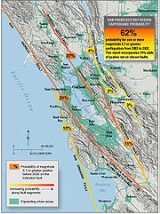
An
earthquake prediction is a
predictionA prediction or forecast is a statement about the way things will happen in the future, often but not always based on experience or knowledge...
that an
earthquakeAn earthquake is the result of a sudden release of energy in the Earth's crust that creates seismic waves. The seismicity, seismism or seismic activity of an area refers to the frequency, type and size of earthquakes experienced over a period of time...
of a specific
magnitudeThe moment magnitude scale is used by seismologists to measure the size of earthquakes in terms of the energy released. The magnitude is based on the seismic moment of the earthquake, which is equal to the rigidity of the Earth multiplied by the average amount of slip on the fault and the size of...
will occur in a particular place at a particular time (or ranges thereof). Despite considerable research efforts by seismologists, scientifically reproducible predictions cannot yet be made to a specific day or month. However, for well-understood faults the probability that a segment may rupture during the next few decades can be estimated.
Scientists still do not know many of the details of the physical processes involved in earthquakes and how to predict them. The theory of
plate tectonicsPlate tectonics is a scientific theory that describes the large scale motions of Earth's lithosphere...
was born in the mid 1960s and confirmed in the early 1970s. Many phenomena are considered to be possible precursors of earthquakes, and among those under investigation are seismicity, changes in the
ionosphereThe ionosphere is a part of the upper atmosphere, comprising portions of the mesosphere, thermosphere and exosphere, distinguished because it is ionized by solar radiation. It plays an important part in atmospheric electricity and forms the inner edge of the magnetosphere...
, various types of
electromagneticElectromagnetic may refer to:* Electromagnetism* Electromagnetic field* Electromagnetic force* Electromagnetic radiation* Electromagnetic induction* Electromagnetic spectrum...
indicators including
infraredInfrared light is electromagnetic radiation with a wavelength longer than that of visible light, measured from the nominal edge of visible red light at 0.74 micrometres , and extending conventionally to 300 µm...
and
radio wavesRadio waves are a type of electromagnetic radiation with wavelengths in the electromagnetic spectrum longer than infrared light. Radio waves have frequencies from 300 GHz to as low as 3 kHz, and corresponding wavelengths from 1 millimeter to 100 kilometers. Like all other electromagnetic waves,...
,
radonRadon is a chemical element with symbol Rn and atomic number 86. It is a radioactive, colorless, odorless, tasteless noble gas, occurring naturally as the decay product of uranium or thorium. Its most stable isotope, 222Rn, has a half-life of 3.8 days...
emissions, and even unusual animal behavior.
According to the Seismological Society of America, for a statement to be accepted as a valid earthquake prediction, it has to contain the expected magnitude with error limits, the well defined area of the epicenter, the range of dates, and the probability of this to come true. The data from which the prediction was derived must be verifiable and the analysis of these data must be reproducible. Long term predictions (years to decades) are more likely to be achieved than medium term predictions (months to years), and short term predictions (hours to days) are in general unlikely to be possible, at present. If a plausible mechanism linking the observations with the predicted earthquake is not offered, the credibility of the prediction is diminished, but it may not necessarily be rejected. Evaluations of apparent successes must include a statistical estimate of the probability that the prediction came true by chance, which is often the case with predictions by amateurs. Whether a prediction is scientific or amateurish is not based on who makes the prediction, but based on how the prediction is made and tested. Predictions can be formulated either by defining the limits of the parameters probabilistically or by firm values.
The problem of earthquake prediction
In efforts to predict earthquakes, seismologists have investigated the association of an impending earthquake with such varied phenomena as seismicity patterns, crustal movements, ground water level in wells,
radonRadon is a chemical element with symbol Rn and atomic number 86. It is a radioactive, colorless, odorless, tasteless noble gas, occurring naturally as the decay product of uranium or thorium. Its most stable isotope, 222Rn, has a half-life of 3.8 days...
or
hydrogenHydrogen is the chemical element with atomic number 1. It is represented by the symbol H. With an average atomic weight of , hydrogen is the lightest and most abundant chemical element, constituting roughly 75% of the Universe's chemical elemental mass. Stars in the main sequence are mainly...
gas emissions from the Earth, changes of seismic wave velocities,
electromagnetic fieldAn electromagnetic field is a physical field produced by moving electrically charged objects. It affects the behavior of charged objects in the vicinity of the field. The electromagnetic field extends indefinitely throughout space and describes the electromagnetic interaction...
s (
seismo-electromagneticsSeismo-electromagnetics is the study of electromagnetic phenomena associated with seismic activity such as earthquakes and volcanos, and also the use of electromagnetic methods in seismology such as magnetotellurics. Links between the electromagnetic fields in the lithosphere and those in the...
), large-scale changes in soil temperature, and changes in ion concentration in the ionosphere. "Earthquake prediction: An overview" is a 2003 review by Hiroo Kanamori and the August 2010 issue of
Pure and Applied Geophysics contains a collection of articles on the subject.
The mystery of earthquake occurrence frequently sparks people without scientific training into claiming that they have found the solution to the earthquake prediction problem. Discredited, fantastic theories of predicting earthquakes include weather conditions and
unusual cloudsEarthquake clouds are clouds claimed to be signs of imminent earthquakes. They have been described in antiquity: In chapter 32 of his work Brihat Samhita, Indian scholar Varahamihira discussed a number of signs warning of earthquakes, including extraordinary clouds occurring a week before the...
, and the phases of the moon. These pseudoscientific theories and predictions ignore the requirement of rigorously formulating the hypothesis and to test it statistically.
http://www.corssa.org/
Self-appointed prediction experts often resort to the technique of making vague statements, which they claim were correct predictions, after an earthquake has happened somewhere.
Rudolf FalbRudolf Falb Rudolf Falb Rudolf Falb (born April 14, 1838 in Obdach (Styria, Austrian Empire; died September 29, 1903 in Schöneberg, German Empire) was an Austrian popularizer of natural history who concerned himself with earthquakes, meteorology, astronomy and also with evolutionary linguistics...
's "lunisolar flood theory" is a typical example from the late 19th century.
History of research programs
In the United States an earthquake prediction program was formulated in the mid 1960s and began to hold, jointly with Japan, earthquake prediction conferences, but there existed no serious research effort in the USA until 1977, when the National Earthquake Hazards Reduction Program was initiated. Part of its original mandate was the development of earthquake prediction techniques and early-warning systems. However, the emphasis was shifted away from earthquake prediction in 1990, and toward mitigation of the damage, due to legislation co-sponsored by Senator
Al GoreAlbert Arnold "Al" Gore, Jr. served as the 45th Vice President of the United States , under President Bill Clinton. He was the Democratic Party's nominee for President in the 2000 U.S. presidential election....
. In 1984, the Parkfield Prediction Experiment was launched. It failed to correctly predict the characteristic Parkfield earthquake on the San Andreas fault. In 1995, the National Academy of Sciences sponsored a colloquium, "Earthquake Prediction: The Scientific Challenge," which did not bring much new information about prediction.
In
Japan, an earthquake prediction program was started in 1964 and a subsequent five-year plan was formulated by Rikitake. This program became focused in 1978 on predicting a magnitude 8 earthquake in the Tokai district, near Tokyo, which may become a major disaster for Japan, and the world economy, once it happens. Japan is now the best instrumented country in the world for recording seismic waves, crustal deformation, properties of ground water, and electro-magnetic transients, all as part of a massive effort to try to understand the earthquake generation process.
In China, it is the job of governmental seismological agencies to coordinate the research and its application to earthquake prediction. In 1956, China included earthquake prediction research as an important task in the 12-year national long-term plan for science and technology development (1956–1967). The State Seismological Bureau (SSB), now named the China Earthquake Administration (CEA), was established in 1970. The CEA is a governmental body responsible to the State Council, and required by the ‘‘Law of the People’s Republic of China on Protecting Against and Mitigating Earthquake Disasters’ to conduct Annual Consultation Meetings on Earthquake Prediction Research and Applications every January. In 1975, people were evacuated before the magnitude 7.3 Haicheng earthquake. This was claimed as a successful prediction, but was in fact a precautionary action initiated by leaders of the local government, reacting to hundreds of
foreshockA foreshock is an earthquake that occurs before a larger seismic event and is related to it in both time and space. The designation of an earthquake as foreshock, mainshock or aftershock is only possible after the event....
s, some of which damaged some buildings. Since then, several disastrous earthquakes which have not been predicted have ravaged China.
In Russia, the new program of development of earthquake prediction in Russia was designed by order of the President of the Russian Federation in 2004. It is targeted at increasing the reliability of long-, medium, and short-term forecasting of the earthquake potential, including tsunami prediction.
The program comprises:
- building 11 integrated geophysical test sites;
- deploying satellite telecommunication systems;
- enlarging the database of prognostic information by including data received from aerospace Earth’s remote sensing devices, GPS observations and other geological and geophysical monitoring sources;
- building and equipping a Seismological Information Center under the auspices of Geophysical Service RAS in Obninsk for collection and prompt transmission of monitoring and prognostic data on seismic events;
- building and equipping a Coordination Center for Earthquake Prediction under the auspices of the Institute of Physics of the Earth RAS in Moscow;
- creating 5 regional branches of Coordination Center for Earthquake Prediction;
- developing high-performance algorithms and programs for seismic situation forecasting based on integrated seismological, geophysical, and aerospace data.
Seven test sites will be positioned in seismically active areas:
- Petropavlovsk-Kamchatsky,
- Klyuchevskoy,
- Sakhalin,
- South Baikal,
- Gorny Altai,
- Caucasian Mineral Waters,
- Sochi – Krasnaya Polyana.
Four test sites will be positioned in areas with abnormal high-level technogenic burden:
- Dagestan (on the base of Chirkey hydro power plant),
- Verkhnekamsk (on the base of Verkhnekamsk potassium salts deposit),
- Moscow (Russia’s largest, rapidly growing urban and industrial conglomerate),
- Kemerovo (Russia’s largest coal basin located in a seismic zone).
The eleven new and modernized test sites will perform:
- seismic observations using local networks and micro groups,
- GPS-surveillance of current Earth’s crust motions,
- seismic probing and surveys using vibratory energy sources,
- high-frequency seismic noise measurements,
- dipole electrical sounding with high-energy artificial sources,
- electrotelluric potential measurements,
- measurements of the Earth’s electro-magnetic field variations,
- tectonomagnetic and absolute magnetic measurements,
- laser deformation and pitch and roll measurements,
- hydro-geodynamic borehole monitoring,
- hydro-geochemical monitoring,
- continuous video monitoring of active volcanoes (Klyuchevskoy, Shiveluch, Bezymianny, and Avachinsky volcanoes in Kamchatka),
- integrated aerospace monitoring.
The main targets of the Coordination Center for Earthquake Prediction are:
- analysis of the seismic potential in the Russian Federation and neighboring countries in a mode close to real time using prognostic algorithms;
- expert assessment of current data and preparation of material for prognostic conclusions;
- coordination of scientific research in the field of seismicity and seismic prediction, medium- and short-term in particular;
- inter-regional and international exchange of data from seismological, geophysical, geodynamical and other prognostic observations;
- performing expert assessments on seismic risk and its reduction on the instructions of scientific and technical committees for providing seismic safety under the jurisdiction of the Ministry of Regional Development of the Russian Federation;
- submitting prognostic conclusions on the seismic potential in Russia to the National Emergency Action Center of the Ministry of the Russian Federation for Civil Defense, Emergency Management and Natural Disasters Response.
Earthquake predictions and methods are reviewed by the Earthquake Forecast Advisory Council (FAC) of the Russian Academy of Sciences (RAN) and the Ministry of Emergency Situations of Russia (EMERCOM).
Russia has an earthquake prediction program that has yielded some of the best tested hypotheses, but also some claims that are viewed with suspicion, internationally. Peter Bormann has presented a review of individual achievements and claims by Russian seismologists.
The Collaboratory of the Study of Earthquake Predictability (
CSEP) is an international multi-institution effort, underway since 2005, to develop a peer-reviewed scientific testing platform and expert community to assess earthquake prediction and predictability.
Precursory seismicity patterns
In 1969 Japanese seismologist
Kiyoo MogiDr is a prominent seismologist. He is regarded as Japan's foremost authority on earthquake prediction and is a former chair of the Japanese Coordinating Committee for Earthquake Prediction . Mogi is also a former Director of the University of Tokyo's Earthquake Research Institute, was a professor...
proposed that there exists a
precursorIn chemistry, a precursor is a compound that participates in the chemical reaction that produces another compound. In biochemistry, the term "precursor" is used more specifically to refer to a chemical compound preceding another in a metabolic pathway....
y seismicity pattern before large earthquakes that has become known as the 'Mogi doughnut hypothesis'. He showed maps that suggested that major earthquakes tend to occur in seismically unusually calm areas surrounded by a ring of unusually high seismic activity. However, he did not back up his claim by statistical analyses that would have shown whether or not these patterns constituted a significant departure from normal.
Subsequently, several groups have separately tested with statistical methods the inside and the outside patterns. The idea that there sometimes exists a 'calm before the storm' is called the
quiescence hypothesis, the idea of precursory increased activity in the ring outside is called the
accelerated seismic moment release hypothesis.
The research regarding the use of these patterns for earthquake prediction is discussed in the following in separate sections because it is extensive and complex.
Radon
Emission of
radonRadon is a chemical element with symbol Rn and atomic number 86. It is a radioactive, colorless, odorless, tasteless noble gas, occurring naturally as the decay product of uranium or thorium. Its most stable isotope, 222Rn, has a half-life of 3.8 days...
as a quake precursor was studied in the 1970s and 80s with no reliable results and continued to be dismissed by most seismologists until recently.
Electromagnetic precursors
VAN is a controversial method of earthquake prediction proposed by Professors
VarotsosPanayotis Varotsos is a Greek physicist , full professor in the Department of Physics of the University of Athens since 1986, notable for his VAN method to predict earthquakes. His group claims the ability to identify electromagnetic signals that are precursors to earthquakes...
, Alexopoulos and Nomicos in the 1980s; it was named after the researchers' initials. The method is based on the detection of "seismic electric signals" (SES) via a telemetric network of conductive metal rods inserted in the ground; it stems from theoretical predictions by P. Varotsos, a solid-state physicist at the National and Capodistrian University of Athens. First, VAN have claimed to be able to predict earthquakes of magnitude larger than 2.8 within all of Greece with a precursor time of 7 hours. Later the claim changed to being able to predict earthquake larger than magnitude 5, within 100 km of epicentral location, within 0.7 units of magnitude, and in a 2-hour to 11-day time window, but this is disputed.
Errors have been discovered in the list of earthquakes correlated according to Van with SES signals. VAN has claimed to have observed at a recording station in Athens a perfect record of a one-to-one correlation between SESs and all earthquakes of magnitude ≥ 2.9 which occurred 7 hours later in Greece. However, it was later shown that the list of earthquake used for the correlation was false. Although VAN stated in their article that the list of earthquakes was that of the Bulletin of the National Observatory of Athens
http://www.noa.gr/indexen.html it was found that 37% of the earthquakes actually listed in the bulletin, including the largest one, were not in the list used by VAN for issuing their claim. In addition, 40% of the earthquakes which VAN claimed had occurred were not in the NOA bulletin.
Objections have been raised that the physics of the claimed process is not possible. None of the earthquakes which Van claimed were preceded by SESs generated an SES themselves, which would have to be expected because the main shock disturbance in the Earth is much larger than any precursory disturbance. An analysis of the
wave propagationWave propagation is any of the ways in which waves travel.With respect to the direction of the oscillation relative to the propagation direction, we can distinguish between longitudinal wave and transverse waves....
properties of SESs in the Earth’s crust showed that it is impossible that signals with the
amplitudeAmplitude is the magnitude of change in the oscillating variable with each oscillation within an oscillating system. For example, sound waves in air are oscillations in atmospheric pressure and their amplitudes are proportional to the change in pressure during one oscillation...
reported by VAN could have been generated by small earthquakes and transmitted over the several hundred kilometers distances from the
epicenterThe epicenter or epicentre is the point on the Earth's surface that is directly above the hypocenter or focus, the point where an earthquake or underground explosion originates...
to the receiving station.
Several authors have pointed out that VAN’s publications are characterized by a lack of addressing the problem of eliminating the many and strong sources of change in the magneto-electric field measured by them, such as currents generated near their recording station in suburban Athens, and especially by a lack of statistical testing of the validity of their hypothesis. In particular, it was discovered that of the 22 claims of successful prediction by VAN 74% were false, 9% correlated at random and for 14% the correlation was uncertain.
Foreshocks
ForeshockA foreshock is an earthquake that occurs before a larger seismic event and is related to it in both time and space. The designation of an earthquake as foreshock, mainshock or aftershock is only possible after the event....
s are medium-sized earthquakes that precede major quakes.
An increase in foreshock activity (combined with purported indications like ground water levels and strange animal behavior) enabled the successful evacuation of a million people one day before the February 4, 1975 M7.3
Haicheng earthquakeThe 1975 Haicheng earthquake measuring 7.3 on the Richter Scale occurred at 19:36 CST on February 4, 1975 in Haicheng, Liaoning, China, a city that at the time had approximately 1 million residents....
by the China State Seismological Bureau.
The Xiuyan M5.3 earthquake (29 November 1999) is another example where a successful prediction was issued, based on a correct interpretation of an earthquake swarm as foreshocks.
While 50% of major earthquakes are preceded by foreshocks, only about 5-10% of small earthquakes turn out to be foreshocks, leading to false warnings.
Earth tides as triggers
There are two flavors of tidal stressing that have been claimed to generate enhanced rates of earthquakes—diurnal and biweekly
Earth tideEarth tide is the sub-meter motion of the Earth of about 12 hours or longer caused by Moon and Sun gravitation, also called body tide which is the largest contribution globally. The largest body tide contribution is from the semidiurnal constituents, but there are also significant diurnal...
s. The diurnal correlations would cause more earthquakes only during the hours when the tidal stress is pushing in an encouraging direction. In contrast, biweekly effects would be earthquakes occurring during the days when the sinusoidal stressing oscillations are largest. The former, as most easily observed in the twice-daily rise and fall of the ocean
tideTides are the rise and fall of sea levels caused by the combined effects of the gravitational forces exerted by the moon and the sun and the rotation of the Earth....
s, have occasionally been shown to influence earthquakes (e.g., Cochran, Vidale and Tanaka (2004) shows there may be some weak tidal triggering of shallow, oceanic thrust-faulting earthquakes). The latter, which arises from the periodic alignment of the Sun and Moon, has often been claimed in the popular press to incubate earthquakes (sometimes termed the "
syzygyIn astronomy, a syzygy is a straight line configuration of three celestial bodies in a gravitational system. The word is usually used in reference to the Sun, the Earth and either the Moon or a planet, where the latter is in conjunction or opposition. Solar and lunar eclipses occur at times of...
" effect) and occasionally for small datasets in the scientific literature (e.g., Glaser (2003)), but generally such effects do not appear in careful studies of large datasets.
A paper written by researchers from Beijing Normal University and the Chinese Academy of Sciences found a significant relationship between tidal forces and earthquakes in China and Taiwan. The paper considered the relationship between 21 major earthquakes (Ms ≥ 7.0) in land and the offshore area of Taiwan island in the 20th century and the variance ratio of the lunar–solar tidal force. The result indicated that the time of these earthquakes is closely related to the variance ratio of the lunar–solar tidal force, and therefore that the tidal force possibly plays an important role in triggering earthquakes.
The conclusion is this method may be used to help forecast earthquakes by studying the lunar
perigeePerigee is the point at which an object makes its closest approach to the Earth.. Often the term is used in a broader sense to define the point in an orbit where the orbiting body is closest to the body it orbits. The opposite is the apogee, the farthest or highest point.The Greek prefix "peri"...
.
Syzygy, which is not given much credence in the scientific community, is motivated by the observation that, historically, there have been some great earthquakes whose timing coincides with tidal forces near their maximum. For maximum tidal force, three factors must coincide: first, when the moon (in its elliptical orbit) is closest to the earth; second, when it is within a day or two of a new moon (so that the tidal forces of the moon and sun are acting in concert); and third, when the earth (in its elliptical orbit) is at or near its closest distance to the sun.
Shallow earthquakes near mid-ocean ridges, volcanic earthquakes, and episodic tremor and slip have also been observed to sometimes correlate with the diurnal tides, with enhanced activity correlating with times that faults are unclamped.
Early warning
An
earthquake warning systemAn earthquake warning system is a system of accelerometers, communication, computers, and alarms that is devised for regional notification of a substantial earthquake while it is in progress...
is a system of accelerometers, communication, computers, and alarms that is devised for regional notification of a substantial earthquake while it is in progress. Japan, Taiwan and Mexico all have earthquake early-warning systems.
In a paper in the journal
NatureNature, first published on 4 November 1869, is ranked the world's most cited interdisciplinary scientific journal by the Science Edition of the 2010 Journal Citation Reports...
, Richard Allen of the University of California claims that the distinction between small and large earthquakes can be made from the very first seconds of seismic energy recorded by seismometers, though other scientists are not convinced. If correct this may make earthquake early warning (as distinct from prediction) more powerful. Earthquake early warning provides an alarm that strong shaking is due soon to arrive, and the more quickly that the magnitude of an earthquake can be estimated, the more useful is the early warning. However, earthquake early warning can still be effective without the ability to infer the magnitude of an earthquake in its initial second or two.
National prediction evaluation councils
Official earthquake prediction evaluation councils have been established in California (the California Earthquake Prediction Evaluation Council) and the federal government in the United States (the National Earthquake Prediction Evaluation Council), but have yet to endorse any method of predicting quakes as reliable.
Unless the following parameters are specified, a statement does not qualify as an earthquake prediction:
- A specific location or area
- A specific span of time
- A specific magnitude range
- A specific probability of occurrence
International evaluation of claims and methods
The sub-commission for earthquake prediction of
IASPEI (International Association of Seismology and Physics of the Earth’s Interior) has reviewed claims of successful predictions and of proposed methods to predict during the 1990s. Their procedure was similar to reviews of proposals for research grants. Authors submitted their detailed research on the prediction problem. Anonymous reviewers commented, and members of the sub-commission discussed the merits of the proposal and of the reviewer’s comments.
A decision to place the claim into one of three categories (preliminary list of significant precursors, no decision, rejected) was then transmitted to the authors, who could write a reply, if they so wished. The entire exchange was then published, unless the authors did not agree to publication. Most of the nominated successful predictions and methods to predict were rejected. At that time, three methods seemed most promising: Seismicity patterns, ground water properties, and crustal deformations.
Attribution to a plausible physical mechanism lends credibility, and suggests a means for future improvement.
ReproducibilityReproducibility is the ability of an experiment or study to be accurately reproduced, or replicated, by someone else working independently...
and statistical analysis are used to distinguish predictions which come true due to random chance (of which a certain number are expected) versus those that have more useful predictive capability, and to validate models of long-term probability. Such models are difficult to test or validate because large earthquakes are so rare, and because earthquake activity is naturally clustered in space and time. "Predictions" which are made only after the fact are common but generally discounted.
Animal behavior
Animal behavior reports are often ambiguous and not consistently observed. In folklore, some animals, especially dogs, cats, chickens, horses, toads and other smaller animals, have been identified as being more able to predict earthquakes than others.
It has been postulated that the reported animal behavior before an earthquake is simply their response to an increase in low-frequency
electromagneticElectromagnetic radiation is a form of energy that exhibits wave-like behavior as it travels through space...
signals.
In Italy, findings from 2009 suggest that toads are able to detect pre-seismic cues. In the 2011 Virginia earthquake, animals at the
Smithsonian National Zoological ParkThe Smithsonian National Zoological Park, commonly known as the National Zoo, is one of the oldest zoos in the United States, and as part of the Smithsonian Institution, does not charge admission. Founded in 1889, its mission is to provide leadership in animal care, science, education,...
were reported to have sensed the Earthquake coming.
Earthquake prediction in the form of animal behavior can be dated as far back as 373 BC. It was believed that rats, weasels, snakes, and centipedes would flee their homes as early as a few days before a large earthquake. It is easy for us to explain how animals can predict earthquakes mere seconds before they occur, however their ability to predict earthquakes days before the occurrence is still debatable. Animals with more keen senses possess the ability to detect P waves that occur before the S waves, while humans simply cannot. We do understand that animals possess an instinctive response to stimuli in order to escape predators, and certain vertebrates have a sort of "early warning" behavior. It is possible that these instinctive responses and "early warning" behaviors could have evolved into something more: a system for evading seismic activity.
American seismologists are very skeptical on this topic. Although documented cases of odd animal behavior directly before an earthquake, the United States Geological Survey states that there can be no reproducible connection between seismic activity and animal behavior. Andy Michael, a geophysicist at USGS says, "Animals react to so many things—being hungry, defending their territories, mating, predators—so it's hard to have a controlled study to get that advanced warning signal." In the 1970's, the USGS conducted experiments on animal behavior in relation to earthquake prediction, however "nothing concrete came out of it." said Michael. The USGS has done no further experiments on this topic. Geologists dismiss this theory for the reason of the "Psychological focusing effect", which essentially states that people will only remember these strange behaviors due to the earthquake, or any other major occurrence. If not for the earthquake, these odd behaviors in animals would not be noted.
The largest earthquake to ever hit China occurred in Haiyuan County, Ninghsia Province, in 1920, with a magnitude of 8.5. Before the earthquake, eyewitnesses reported observing wolves running around in packs, sparrows flying wildly, as well as dogs barking in an unusual manner. In addition, prior to the 6.8 magnitude earthquake in Hsingtai County, Hopei Province of 1966, dogs in a village at the epicenter of the quake managed to escape their kennels and thus surviving the catastrophe. In 1969, a warning was issued at the Tientsin People's Park Zoo, just two hours before the earthquake struck. This warning was based upon odd behaviors in various animals in the zoo, including, but not limited to; giant pandas, deer, sharks, tigers, and yaks. Another report states that in 1976, a local stock breeder was tending to his animals, but instead of eating, the horses and mules were jumping and kicking furiously until they were able to break free and ran outside. Moments later, a 7.3 magnitude earthquake struck the area.
Fractoluminescence
One possible method for predicting earthquakes is fractoluminescence. Studies at the Chugoku National Industrial Research Institute by Yoshizo Kawaguchi have shown that upon fracturing, silica releases red and blue light for a period of about 100 milliseconds. Kawaguchi attributed this to the relaxation of the free bonds and unstable oxygen atoms that are left when the silicon oxygen bonds have broken due to the stresses within the rock.
It has not been applied yet only because of various limitations of current technology. First, blue light does not travel well through the ground, which makes it necessary to place either
transducersA photodiode is a type of photodetector capable of converting light into either current or voltage, depending upon the mode of operation.The common, traditional solar cell used to generateelectric solar power is a large area photodiode....
that turn a light signal into an electrical signal or
fiber optic interfacesAn optical fiber connector terminates the end of an optical fiber, and enables quicker connection and disconnection than splicing. The connectors mechanically couple and align the cores of fibers so that light can pass...
allowing a direct pick up of blue light into an optical medium in direct contact with the rock that is about to fracture, and to lay the corresponding
optical or electrical transmission linesIn communications and electronic engineering, a transmission line is a specialized cable designed to carry alternating current of radio frequency, that is, currents with a frequency high enough that its wave nature must be taken into account...
required for bringing the signal to the surface. Secondly, since the exact position where rocks are going to fracture is known only with a degree of approximation, a very large volume of rock where fracture is reasonably expected to happen needs to be covered with transducers or optical interfaces. Thirdly, considering that most earthquakes are due to fractures taking place at
depthsIn seismology, the depth of focus refers to the depth at which an earthquake occurs. Earthquakes occurring at a depth of less than 60 km are classified as 'shallow-focus' earthquakes, while those with a focal-depth between 60 and 300 km are commonly termed 'mid-focus' or...
of several kilometers, building the whole required infrastructure is still beyond the reach of current
drillingScientific drilling is a way to probe down into the Earth, allowing scientists and students to obtain samples of sediments, crust, and upper mantle. In addition to rock samples, drilling technology allows humans to obtain samples of connate fluids and of the subsurface biosphere, mostly microbial...
technology.
Demeter microsatellite
The "Detection of Electro-Magnetic Emissions Transmitted from Earthquake Regions" satellite, constructed by
CNESThe is the French government space agency . Established under President Charles de Gaulle in 1961, its headquarters are located in central Paris and it is under the supervision of the French Ministries of Defence and Research...
, has made observations which show strong correlations between certain types of low frequency electromagnetic activity and the most seismically active zones on the Earth, and have shown a sharp signal in the
ionosphericThe ionosphere is a part of the upper atmosphere, comprising portions of the mesosphere, thermosphere and exosphere, distinguished because it is ionized by solar radiation. It plays an important part in atmospheric electricity and forms the inner edge of the magnetosphere...
electronThe electron is a subatomic particle with a negative elementary electric charge. It has no known components or substructure; in other words, it is generally thought to be an elementary particle. An electron has a mass that is approximately 1/1836 that of the proton...
densityThe mass density or density of a material is defined as its mass per unit volume. The symbol most often used for density is ρ . In some cases , density is also defined as its weight per unit volume; although, this quantity is more properly called specific weight...
and
temperatureTemperature is a physical property of matter that quantitatively expresses the common notions of hot and cold. Objects of low temperature are cold, while various degrees of higher temperatures are referred to as warm or hot...
near southern Japan seven days before a 7.1 magnitude occurred there (on August 29 and September 5, 2004, respectively).
QuakeSat nanosatellite
QuakesatQuakesat is an earth observation nanosatellite based on 3 CubeSats. It was designed to be a proof-of-concept for space-based detection of ELF signals, thought by some to be earthquake precursor signals. The science behind the concept is disputed....
is an earth observation nanosatellite based on 3
CubeSatA CubeSat is a type of miniaturized satellite for space research that usually has a volume of exactly one liter , has a mass of no more than 1.33 kilograms, and typically uses commercial off-the-shelf electronics components...
s. It was designed to be a proof-of-concept for collecting
extremely low frequencyExtremely low frequency is a term used to describe radiation frequencies from 3 to 300 Hz. In atmosphere science, an alternative definition is usually given, from 3 Hz to 3 kHz...
earthquake precursor signals from space. The primary instrument is a
magnetometerA magnetometer is a measuring instrument used to measure the strength or direction of a magnetic field either produced in the laboratory or existing in nature...
housed in a 2 foot (0.6 m) telescoping boom.
The ESPERIA Project
ESPERIA is an equatorial space mission mainly concerned with detecting any tectonic and preseismic related signals. More in general, it has been proposed for defining the near-Earth electromagnetic, plasma, and particle environment, and for studying perturbations and instabilities in the ionosphere-
magnetosphereA magnetosphere is formed when a stream of charged particles, such as the solar wind, interacts with and is deflected by the intrinsic magnetic field of a planet or similar body. Earth is surrounded by a magnetosphere, as are the other planets with intrinsic magnetic fields: Mercury, Jupiter,...
transition region. To study earthquake preparation processes and anthropogenic impacts in the Earth's surface, a phase A study has been realized for the
Italian Space AgencyThe Italian Space Agency is a government agency established in 1988 to fund, regulate and coordinate space exploration activities in Italy...
.
DESDynI radar satellite
The Deformation, Ecosystem Structure and Dynamics of Ice (DESDynI) radar satellite, which was canceled in the White House's 2012 budget proposal, would have the capacity to identify elastic strain in tectonic plates, combining L-band interferometric synthetic aperture radar and a multi-beam infrared
lidarLIDAR is an optical remote sensing technology that can measure the distance to, or other properties of a target by illuminating the target with light, often using pulses from a laser...
to detect strains in the Earth’s surface that could lead to serious earthquakes.
TwinSat
Russia and the United Kingdom have agreed to jointly deploy two satellites in 2015 that will measure electromagnetic signals that are released from the earth's crust prior to earthquakes. The project is said to be able to "help predict earthquakes and potentially save thousands of lives."
The Haicheng evacuation
After a series of foreshocks, some of which damaged buildings, local government leaders evacuated much of the populace before the devastating magnitude 7.3
1975 Haicheng earthquakeThe 1975 Haicheng earthquake measuring 7.3 on the Richter Scale occurred at 19:36 CST on February 4, 1975 in Haicheng, Liaoning, China, a city that at the time had approximately 1 million residents....
. Although much discussion about the possibility of future earthquakes in NE China had taken place during the years preceding this earthquake, there was no prediction formulated that would have fit this event.
However, the Chinese government failed to predict the July 28, 1976 M7.8 Tangshan earthquake, which put Chinese earthquake prediction research in doubt for several years.
In the late 1990s, there were over thirty false alarms unofficially announced in China.
The Xiuyan prediction
On November 29, 1999 an earthquake of magnitude 5.3
http://earthquake.usgs.gov/earthquakes/eqarchives/epic/ occurred at latitude 40.46 and longitude 122.89, near Xiuyan. On November 28, 1999, the Seismological Bureau of Liaoning Province (a branch of the China Seismological Bureau) issued a prediction with the following parameters.
- Location: Within a square of 1 degree by 1 degree, centered at latitude 40.5 degrees and longitude 123 degrees.
- Occurrence time: between 29 November and 8 December 1999.
- Magnitudes: Between 5.0 and 5.9.
This means that the event was located only 10 km from the center of the specified area, occurred within the time window, and the magnitude range given. Thus, this was a correct prediction.
The research activities, which lead to this prediction started on November 9 because two magnitude 4 earthquakes occurred. Another two magnitude 4 earthquakes occurred on November 25, and on November 26 a magnitude 4.4 earthquake triggered the report by seismologists to the local government, stating "if the earthquake swarm keeps increasing, then a 5.5-6.0 earthquake is imminent; otherwise there would be a M6 earthquake expected to occur, but location cannot be sure (based on present data and knowledge)". The local government's decision was to deploy imminent works to enhance the preparedness, without issuing a prediction publicly. Because of this special deployment, there were no injuries and deaths during the earthquake, nor social panic before and after the earthquake.
Japan
The Japanese government established the Imperial Earthquake Investigation Committee in 1892 in response to the
Nobi (Mino-Owari) earthquakeThe was a large earthquake that struck the former provinces of Mino and Owari in the Nōbi Plain area during the Meiji period in Japan. It is also referred to as the Nōbi Earthquake or the Great Nōbi Earthquake . It is the largest known inland earthquake in Japan.-History:The earthquake struck on...
(1891) which caused significant damage in Japan.
In the 1970s and 1980s, the Japanese government embarked on a major earthquake preparedness campaign, which some criticized as emphasizing prediction too much over mitigation. It failed to result in a prediction of the
Great Hanshin earthquakeThe Great Hanshin earthquake, or Kobe earthquake, was an earthquake that occurred on Tuesday, January 17, 1995, at 05:46 JST in the southern part of Hyōgo Prefecture, Japan. It measured 6.8 on the moment magnitude scale , and Mj7.3 on JMA magnitude scale. The tremors lasted for approximately 20...
which devastated the city of
Kobe, pronounced , is the fifth-largest city in Japan and is the capital city of Hyōgo Prefecture on the southern side of the main island of Honshū, approximately west of Osaka...
in 1995. See also
2011 Tōhoku earthquake and tsunamiThe 2011 earthquake off the Pacific coast of Tohoku, also known as the 2011 Tohoku earthquake, or the Great East Japan Earthquake, was a magnitude 9.0 undersea megathrust earthquake off the coast of Japan that occurred at 14:46 JST on Friday, 11 March 2011, with the epicenter approximately east...
.
Failed Lima prediction
An earthquake predicted by a scientist at the U.S. Bureau of Mines to occur on June 28, 1981, in
LimaLima is the capital and the largest city of Peru. It is located in the valleys of the Chillón, Rímac and Lurín rivers, in the central part of the country, on a desert coast overlooking the Pacific Ocean. Together with the seaport of Callao, it forms a contiguous urban area known as the Lima...
, Peru, failed to materialize. Despite being dismissed by the U.S. National Earthquake Prediction Evaluation Council, the prediction caused popular fear and many left the city.
Failed Parkfield earthquake prediction
Based on a history of regularly spaced earthquakes in the early 20th century, the USGS in 1985 began an experiment based on the predictions and published papers of Allan Lindh and W.H. Bakun of the USGS and T.V. McEvilly of the University of California at Berkeley. The goal was to predict a 6.0 magnitude earthquake near
Parkfield, CaliforniaParkfield is an unincorporated community in Monterey County, California. It is located on Little Cholame Creek east of Bradley, at an elevation of 1529 feet...
.
"Bakun and Lindh summarized the state of the art in the Parkfield Prediction Experiment, and predicted that a moderate-size earthquake would occur at Parkfield between 1985 and 1993. Their prediction was unusual both in its precision (as to location, time and magnitude) and high degree of confidence (95% within the 9-year window). Bakun and Lindh (1985) also suggested that the predicted earthquake could produce extended rupture of the San Andreas faultThe San Andreas Fault is a continental strike-slip fault that runs a length of roughly through California in the United States. The fault's motion is right-lateral strike-slip...
to the southeast, possibly growing to magnitude 6.5 to 7.0."
Media attention focused on the prediction and the experiment. 122,000 pamphlets were mailed to residents of the Parkfield area, entitled "The Parkfield Earthquake Prediction."
Despite the prediction, such an earthquake did not occur until after the end of the prediction window, in 2004.
Loma Prieta prediction
From 1968 to 1988 scientists in California mapped seismic activity on a cross section of the fault lines. They identified a "
seismic gapA seismic gap is a segment of an active fault that has not slipped in an unusually long time when compared with other segments along the same structure. Seismic gap hypothesis/theory states that, over long periods of time, the displacement on any segment must be equal to that experienced by all...
" in the Loma Prieta area from various features of the regional seismicity. They therefore concluded that Loma Prieta was due for an earthquake. Smaller quakes several months beforehand were treated as possible
foreshockA foreshock is an earthquake that occurs before a larger seismic event and is related to it in both time and space. The designation of an earthquake as foreshock, mainshock or aftershock is only possible after the event....
s, but the warnings had expired by the date of the moment magnitude 6.9 quake, on 17 October 1989.
Jim Berkland
Jim BerklandJim Berkland is an American geologist studying earthquake prediction. He claims to have developed a method for predicting earthquakes, and offers his predictions through media appearances and publications. Before his retirement, Berkland was the County Geologist for Santa Clara County for...
claims to have predicted the Loma Prieta quake, but the mainstream scientific community does not endorse his techniques as repeatable, attributing his success with this quake partly to random chance.
Failed New Madrid prediction by Iben Browning
In 1989
Iben BrowningIben Browning was an American climatologist and author. Browning was a scientific generalist, who made a career of suggesting new and sometimes unusual ideas....
predicted a major earthquake in the New Madrid fault zone of southern
MissouriMissouri is a US state located in the Midwestern United States, bordered by Iowa, Illinois, Kentucky, Tennessee, Arkansas, Oklahoma, Kansas and Nebraska. With a 2010 population of 5,988,927, Missouri is the 18th most populous state in the nation and the fifth most populous in the Midwest. It...
and specified December 2 or 3, 1990, as the most likely days. This prediction was reported on extensively in the media and led to great community concern. No earthquake occurred on those days or thereafter.
Failed SoCal prediction
In early 2004, a group of scientists at the
University of California, Los AngelesThe University of California, Los Angeles is a public research university located in the Westwood neighborhood of Los Angeles, California, USA. It was founded in 1919 as the "Southern Branch" of the University of California and is the second oldest of the ten campuses...
, led by Dr.
Vladimir Keilis-BorokVladimir Keilis-Borok was born in Moscow, Russia on July 31, 1921. He is a mathematical geophysicist.- Biography :In 1948, he received a Ph.D. in mathematical geophysics from the Academy of Sciences in Moscow. He was the founder, and is the Director Emeritus, of the International Institute of...
, predicted that a quake similar in strength to the
San Simeon earthquakeThe 2003 San Simeon Earthquake was a magnitude 6.5 earthquake on the Central Coast of California, about northeast of San Simeon. It occurred at 11:15 PST on December 22, 2003. The earthquake probably occurred on the Oceanic fault zone in the Santa Lucia Mountains. It was caused by reverse...
of 2003 would occur in a 12,000 square mile (31,100 km) area of
Southern CaliforniaSouthern California is a megaregion, or megapolitan area, in the southern area of the U.S. state of California. Large urban areas include Greater Los Angeles and Greater San Diego. The urban area stretches along the coast from Ventura through the Southland and Inland Empire to San Diego...
by September of that year. The odds were given as 50/50.
In April 2004, the California Earthquake Prediction Evaluation Council (CEPEC) evaluated Keilis-Borok's prediction and reported to the California State Office of Emergency Services. CEPEC concluded that the "uncertainty along with the large geographic area included in the prediction (about 12,400 square miles) leads (us) to conclude that the results do not at this time warrant any special policy actions in California.” The predicted time window came and went with no significant earthquake.
L'Aquila controversy
Italian technician Giampaolo Giuliani claims to have predicted the
2009 L'Aquila earthquakeThe 2009 L'Aquila earthquake occurred in the region of Abruzzo, in central Italy. The main shock occurred at 3:32 local time on 6 April 2009, and was rated 5.8 on the Richter scale and 6.3 on the moment magnitude scale; its epicentre was near L'Aquila, the capital of Abruzzo, which together...
. He had previously been reported to Italian police for "causing fear" but he was acquitted. Emission of radon as an earthquake precursor has been studied since the seventies, but the research has not resulted in successful prediction methods. The claim by Giuliani that he predicted the M6.3 L'Aquila earthquake of 6 April 2009 was investigated by the International Commission on Earthquake Forecasting established by the Italian government, but was not substantiated in their report. Mr. Giuliani has never published any reports in peer reviewed scientific journals on his measurement methods, his analysis of the data, elimination of noise sources, and statistical correlation with earthquakes, something that would be required for taking prediction claims seriously. Mr. Giuliani presented his observations at the fall meeting of the American Geophysical Union (AGU)
http://www.agu.org/ in 2009, where no work is reviewed or rejected . Contrary to some reports, Mr. Giuliani was not invited by anyone representing the
American Geophysical UnionThe American Geophysical Union is a nonprofit organization of geophysicists, consisting of over 50,000 members from over 135 countries. AGU's activities are focused on the organization and dissemination of scientific information in the interdisciplinary and international field of geophysics...
to participate in any research project, according to P. Shearer, president of the Seismology Section of the AGU.
See also
- Forecasting
Forecasting is the process of making statements about events whose actual outcomes have not yet been observed. A commonplace example might be estimation for some variable of interest at some specified future date. Prediction is a similar, but more general term...
- Earthquake engineering
Earthquake engineering is the scientific field concerned with protecting society, the natural and the man-made environment from earthquakes by limiting the seismic risk to socio-economically acceptable levels...
- Earthquake storm
An earthquake storm is a recently proposed theory about earthquakes, where one triggers a series of other large earthquakes—along the same plate boundary—as the stress transfers along the fault system. This is similar to the idea of aftershocks, with the exception that they take place...
- Earthquake weather
Earthquake weather is a type of weather popularly believed to precede earthquakes.-History:From the ancient histories of Herodotus to the modern writings of David Lance Goines, the notion that weather can somehow foreshadow coming seismic activity has been the topic of much discussion and debate...
- Geoforecasting
Geoforecasting is the science of predicting the movement of tectonic plates and the future climate, shape, and other geological elements of the planet.-External links:* http://www.cbc.ca/quirks/archives/06-07/jan20.html CBC podcast on geoforecasting...
- Plate tectonics
Plate tectonics is a scientific theory that describes the large scale motions of Earth's lithosphere...
- Convergent boundary
In plate tectonics, a convergent boundary, also known as a destructive plate boundary , is an actively deforming region where two tectonic plates or fragments of lithosphere move toward one another and collide...
- Pacific Ring of Fire
The Pacific Ring of Fire is an area where large numbers of earthquakes and volcanic eruptions occur in the basin of the Pacific Ocean. In a horseshoe shape, it is associated with a nearly continuous series of oceanic trenches, volcanic arcs, and volcanic belts and/or plate movements...
- Alpide belt
The Alpide belt is a mountain range which extends along the southern margin of Eurasia. Stretching from Java to Sumatra through the Himalayas, the Mediterranean, and out into the Atlantic, it includes the Alps, the Carpathians, the mountains of Asia Minor and Iran, the Hindu Kush, the Himalayas,...
- Supermoon
A "supermoon" is the coincidence of a full moon with the closest approach the Moon makes to the Earth on its elliptical orbit, or perigee, leading to the technical name for a supermoon of the perigee-syzygy of the Earth-Moon-Sun system...
- Coordinating Committee for Earthquake Prediction, Japan
The Coordinating Committee for Earthquake Prediction in Japan was founded in April 1969, as part of the Geodesy Council's Second Earthquake Prediction Plan, in order to carry out a comprehensive evaluation of earthquake data in Japan. The committee consists of 30 members and meets four times each...
External links