

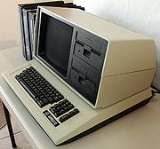
Eagle Computer

Encyclopedia
Eagle Computer of Los Gatos, California
was an early microcomputer manufacturing company. Spun off from Audio-Visual Laboratories (AVL), it first sold a line of popular CP/M
computers which were highly praised in the computer magazines of the day. After the IBM PC
was launched, Eagle produced the Eagle 1600 series, which ran MS-DOS but were not true clones. When it became evident that the buying public wanted actual clones of the IBM PC, even if a non-clone had better features, Eagle responded with a line of clones, including a portable. The Eagle PCs were always rated highly in computer magazines.
On June 8, 1983, the day of Eagle's initial public offering
, its president, Dennis Barnhart, was killed in a crash of his new Ferrari
. (He had just taken a yacht salesman to lunch.) There was a succession plan in place which resulted in the assumption of the CEO position by Ronald Mickwee. New York Times article As news of Barnhart's death spread, the underwriters reversed the IPO, refunding the money that investors had paid for the stock, and held another IPO a few months later, which was unprecedented in the PC industry. This dramatic timing has led people to suppose that this event caused the end of Eagle. In fact, the company continued to lead PC sales until IBM
launched a multi-party lawsuit against every company that made PC clones, claiming copyright infringement of the BIOS
in its machines. Unable to match IBM's resources, all the companies named settled out of court. This led to the founding of third-party companies that sold BIOSes to computer manufacturers.
Eagle rewrote its BIOS, but it never regained its lost sales. In what was a pioneering effort at the time, an initiative was launched to create a new market selling Eagles to China. This effort eventually fell through and the company, like many others impacted by the BIOS copyright restrictions, was ultimately unable to recover and was out of business by 1986.
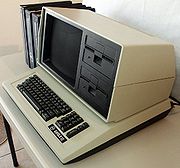 The AVL Eagle I and II had audio-visual connectors on the back. As a separate company, Eagle sold the Eagle I, II, III, IV, and V computer models, and external SCSI/SASI
hard-disk boxes called the File 10 and the File 40.
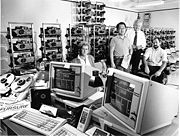 The first Eagle computers were produced by Audio Visual Labs (AVL
), a company founded by Chuck Kappenman in New Jersey in the early 1970s to produce proprietary large-format multi-image equipment. Kappenman introduced the world's first microprocessor-controlled multi-image programming computers, the ShowPro III and V, which were dedicated controllers. In 1980, AVL introduced the first non-dedicated controller, the Eagle. This very first Eagle computer utilized a 16 kHz processor and had a 5 1/4-inch disk drive for online storage.
The Eagle ran PROCALL (PROgrammable Computer Audio-visual Language Library) software for writing cues to control up to 30 Ektagraphic projectors
, five 16 mm film
projectors and 20 auxiliary control points. Digital control data was sourced via an RCA
or XLR-type audio connector at the rear of the unit. AVL's proprietary "ClockTrak" (a biphase digital timecode similar to, but incompatible with SMPTE timecode) was sourced from the control channel of a multitrack
analog audio tape deck. The timed list of events in the Eagle was synchronized to the ClockTrak. Later versions of PROCALL included the option of using SMPTE timecode.
Most programmers abandoned ClockTrak for SMPTE, as more multi-image programs began to incorporate video
.
Two separate digital data streams were output from the Eagle, also via RCA or XLR-type audio connectors. These telemetry streams, called "PosiTrak", each controlled up to five external slide projector control devices also manufactured by AVL, known as "Doves". The Dove units received biphase data from the Eagle via audio cables, and interpreted the Eagle's data streams to control as many as three Kodak Ektagraphic projectors (for large screens, compatible Xenon
-lamped projectors) and two dry-closure contacts per Dove unit. AVL also made the Raven, a device similar to the Dove, for comprehensive control of a single 16 mm film projector, as well as numerous other external control devices for lighting, sound, video projectors and sources, etc.
AVL Eagles and associated products, when properly setup and powered, were extremely reliable. During the 1970s through the early 1990s, when the products of its competitors were not as reliable nor readily available, AVL became the industry standard for multi-image control equipment. However, the development of large-screen electronic media and HDTV ushered out the era of film-based multi-image productions.
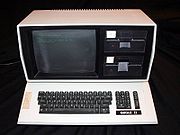 All CP/M Eagles had the same basic design, except for the storage devices. The exception to this was a portable model, in which the keyboard formed a removable lid that could be snapped to the main unit for traveling. An attractive off-white case held the entire computer. The top section held a green monochrome monitor on the left, and one or two full-height storage devices, stacked one above the other, on the right. An anti-glare screen was held in place against the front of the monitor, and the front of the top section shut, by a black plastic bezel. This bezel snapped into place. The back of this section held a fan right behind the drive enclosure, and a silver label behind the monitor with the company logo and address, the model number, serial number, voltage, frequency, and current.
The bottom section projected forward and had the keyboard in its top, and the system logo. Inside this "clamshell" was the main circuit board, connected to the monitor, drives, keyboard and ports by cables. Underneath the main board and connected to it by cables was a Xebec
hard-disk controller card. On the back of the clamshell was the reset button, two RS-232
serial ports labeled "Serial A" and "Serial B", a Centronics
parallel port labeled "Parallel A", a SASI port labeled "Parallel B", the brightness knob for the monitor, and the on/off switch.
The keyboard was well-designed. The keys were black with white lettering. Besides a full typewriter keyboard, there was a complete ten-key number pad on the right, uncommon at that time. Labels on the front of the number keys of the typewriter keyboard, and all the keys of the number pad, denoted what function those keys performed in the command mode of the bundled Spellbinder software.
The CPU of the whole line was a 4-MHz Zilog
Z-80A, the standard microprocessor of the day. Memory was 64K, which was all the RAM
that the standard CP/M 2.2 operating system could address with an 8-bit chip.
Also available were external hard-disk units called the File 10 and File 40. These were metal Corvus
boxes with a fan and power switch on the back. Inside a File 10 was the same hard disk as an Eagle IV had, the same Eagle SASI card, and a power supply. The File 40 had the same 32 MB
hard disk as an Eagle V.
To upgrade an Eagle III, for instance, the user could buy a File 40, connect it to the "Parallel B" port on the back of the Eagle with the ribbon cable that came with it, turn on the File 40, and turn on the Eagle. If a File 10 or File 40 was attached and turned on when an Eagle I, II, or III was turned on, the computer booted from the hard disk in the external box, even if a bootable floppy disk was in a floppy-disk drive.
An Eagle III with a File 10 attached had the same hard-disk storage as an Eagle IV, but two floppy-disk drives instead of one. Similarly, with a File 40 attached, it was functionally the same as an Eagle V with an extra floppy-disk drive.
When half-height floppy-disk drives and hard disks became available, Eagle drives that had worn out could be replaced with ones that took up less space and drew less power. The Eagle BIOS supported up to two double-sided
floppy-disk drives and up to four 8 MB hard-disk partitions. Systems could be built with two half-height floppies and a 10, 20, or 32 MB hard disk. (A system with two floppies and a 10 MB hard disk was jokingly called a "IV plus", while one with a 20 MB hard disk was called a "4 and a half" however many floppies it had.)
Just to see whether it would work, Eagle Computer Users Group members mounted two half-height 10-MB hard disks in an Eagle, each attached to its own SASI card, both cards connected to the same Xebec
controller. This "IV by two" worked perfectly, but it was a waste of resources; the Eagle SASI card was the rarest and hardest-to-find part in the computer, since only Eagle made them and not all Eagles had them to begin with.
in various ways even after Digital Research
was no longer in business. A computer was said to be running the Z-System, rather than CP/M, if the CP/M CCP
had been replaced by ZCPR or a similar command processor, the BDOS had been replaced by ZRDOS or Z3DOS, or both. This could be done manually, if the source code for the BIOS
were available, or automatically with various packages.
One long-term concern with Eagles was how loud the hard disks were, and how they seemed to hunt over and over whenever reading or writing data. NZ-COM from Alpha Systems Corporation allowed the hard disk of the Eagle IV to run more quickly and quietly. This observation was confirmed whenever an Eagle had the Z-System installed.
If you bought an Eagle IV, Eagle V, File 10, or File 40, all of the software was already installed.
consisted of three parts, two of which never changed and were copyrighted by Digital Research
. The third part, the BIOS, was the interface between the operating system and the hardware, and varied between the systems of different computer manufacturers, and sometimes between different models from the same company. The BIOS was written by the manufacturer and copyrighted by that company. There were three Eagle BIOSes:
Disk formats: The format for floppy disks and hard disks is defined in the BIOS, and every manufacturer of a CP/M computer had its own. Eagle kept it simple.
There was a single-sided floppy-disk format, and a double-sided one. Furthermore, they were identical on one side. The double-sided format filled up the whole first side just like the single-sided format, then continued on the second side. This wasn't as efficient as first writing one track to one side of the disk, and then one track to the other, before moving the drive head to the next track, but it was done deliberately to make the two formats as alike as possible. A customer who upgraded from a I or II to a III, IV, or V didn't need to copy his old disks to the format of his new machine.
There was only one hard-disk format. The format program required a hard disk with the right number of heads, platters, and cylinders. There were numerous makes and models of 10, 20, and 32 MB hard disks that met that requirement. The program formatted the hard disk 8 megabytes at a time (CP/M's limit for a logical disk drive) until it had successfully finished four partitions and quit, or suddenly ran out of hard disk. Thus a 10 MB hard disk had an 8 MB partition and a 2 MB partition; a 20 MB hard disk had two 8 MB partitions and one 4 MB partition; and a 32 MB hard disk had four 8 MB partitions. (The "IV by 2" mentioned above had four partitions, 8 MB, 2 MB, 8 MB, and 2 MB.)
Drive letters: In CP/M
, the drive booted from is drive A, whether it's a floppy disk or a hard disk. In addition, double-sided Eagles addressed single-sided floppies as drive I or J. Which drive letter applied to which device did not change on a given system, but modifying systems could be confusing:
If an Eagle booted from a File 10, File 40, or "File 20" (a File 10 or File 40 box with a 20-Mb hard disk inside), the drive-letter assignments of the hard-disk BIOS
prevailed. The external hard disk's partitions would be A and B for a File 10; A, B, and C for a "File 20", and A, B, C, and D for a File 40. The top floppy would be E and I and the bottom one F and J, unless they were single-sided floppies, which could only be I and J.
Since the hard-disk BIOS
only addressed four hard-disk partitions, an Eagle IV with a File 10 attached would address the two partitions of the File 10 as A and B, and the two in the Eagle as C and D. With a "File 20" attached, the external partitions would be A, B, and C, the 8 MB internal partition would be D, and the other internal partition couldn't be used at all. Similarly, with a File 40 attached, no partitions of a hard disk in the Eagle could be read from or written to, because all available hard-disk partitions were assigned to the File 40.
Utilities: All the standard CP/M utilities were included: PIP to copy files, etc. DRI's sophisticated compiled BASIC
programming language, CBASIC
, was also included.
distributions add their own installer, etc. to the standard kernel and libraries. On Eagles, they were:
The combination of Spellbinder software, the Eagle keyboard, and the large storage capacity of Eagle floppies, made a word-processing machine so powerful for its day that many Eagle owners never realized how much more their computers were capable of.
floppy disks to hold it all, and required constant disk swapping on an Eagle without a hard disk.
Constant protests, questions, and requests for customer support led Eagle to stop bundling Accounting Plus with its computers. Most users simply didn't need all that. Ultracalc, a spreadsheet program from Sorcim
, was substituted in later machines.
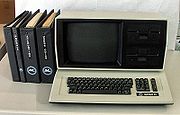
ProCall was an early modem program for dialing up bulletin boards or exchanging files with other computers remotely.
Later Eagles had a single white binder with the Eagle logo across the top of the spine and "Eagle Software Manual" down along it. This was a manual written by Eagle which told how to use the computer, including Spellbinder and Ultracalc, without distinguishing Eagle's software from Lexisoft's or Sorcim's. Mentors at Eagle Computer User Group meetings would often have to explain, in fact, that there were separate programs on the computer, written by separate companies; between the manual and the menu system, it looked like one big program to the new computer user.
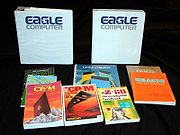
The only other thing in the documentation binder was a thin spiral-bound book called "CP/M Primer," which gave a very superficial idea of what an operating system was, why you had to format disks before using them, and so forth. Vendors would often throw in the Digital Research
"CP/M 2.2 User Guide," the "CBASIC User Guide", or a good book on CP/M such as "Mastering CP/M" or "The CP/M Handbook with MP/M." But they weren't part of the standard Eagle documentation.
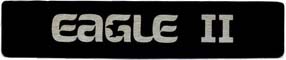
However, Eagle consolidated the entire line as the "Eagle IIE" series, which resulted in the labels indicating no differentiation between the five 8-bit models:
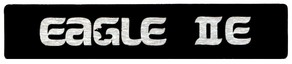
The silver label on the back of each machine then specified the individual model as IIE-1, IIE-2, IIE-3, IIE-4, or IIE-5, corresponding to the previously-named Eagle I, II, III, IV, and V.
Some causes of failure may be expected in any computer built the same way. If chips are attached to the boards in sockets, rather than soldered on, they may be loose because they expanded from heat whenever the computer was on for a long time, then contracted whenever the computer was turned off. A computer that was used a great deal, and for a long time, may require a new owner to open it up and gently press the chips down before it will run.
Another problem sometimes found in old Eagles with hard disks is stiction
. Hard disk read/write heads from that era rested on the platter when turned off, and may adhere to where they've been sitting with greater force than the drive motor can exert on starting. An experienced technician may be able to coax the head free without destroying the hard disk or losing data.
The most common problem peculiar to CP/M Eagles involves the character generator chip on the main board. It tends to fail with age, so that a line of text will have the dots of its letters scattered unreadably all over the screen. When this problem became apparent, the chip was no longer made, but they were still available in parts warehouses. Now they may be unavailable.
but were not clones. They were the first PCs to be based on the fully 16-bit Intel 8086
processor, rather than the Intel 8088
, which used 16 bits internally, but only had an 8-bit external interface. Eagle attempted to create a niche for itself in the brand-new "16-bit" market by building machines that were as easy to use as their CP/M models, but had an Intel CPU and 640 kB of RAM (which was more memory than almost any other PC at that time had to offer).
These computers came with MS-DOS, the PC version of Spellbinder, a PC spreadsheet program, and documentation. They would run many PC programs, but at that time most PC programs were recent ports from CP/M and there was little agreement about standards. The fact that the 1600's were not IBM clones meant that games that expected exactly the same video hardware as an IBM PC, or that called PC hardware or the PC ROM BIOS directly for the sake of speed, wouldn't run or ran very poorly.
The 1600 line were also the first computers with MS-DOS to have hard disks. Eagle achieved this by using the same hard-disk subsystem (Xebec
hard-disk controller card, Eagle SASI card, and hard disk) as in the CP/M models. Subdirectories were not yet supported in the MS-DOS version that the Eagles used, just as in CP/M. MS-DOS didn't offer CP/M's 16 numbered "user zones" either, which somewhat limited the usefulness of the hard disks.
of the IBM PC
. The Eagle PC was introduced in 1982. It had enhanced 752 x 352 graphics compared to the IBM PC's 640 x 200 resolution, and it was quieter because it did not need a cooling fan. The PC 2 followed, but the screen resolution was downgraded to match that of the IBM PC. Later the Eagle Spirit portable came out, and the Eagle Turbo.
Spellbinder was renamed Eaglewriter on the Eagle PCs, and the spreadsheet program was called Eaglecalc. No actual changes were made to either program.
Another user group was called The Screaming Eagles and the two groups sent each other their newsletters every month.
Los Gatos, California
The Town of Los Gatos is an incorporated town in Santa Clara County, California, United States. The population was 29,413 at the 2010 census. It is located in the San Francisco Bay Area at the southwest corner of San Jose in the foothills of the Santa Cruz Mountains...
was an early microcomputer manufacturing company. Spun off from Audio-Visual Laboratories (AVL), it first sold a line of popular CP/M
CP/M
CP/M was a mass-market operating system created for Intel 8080/85 based microcomputers by Gary Kildall of Digital Research, Inc...
computers which were highly praised in the computer magazines of the day. After the IBM PC
IBM PC
The IBM Personal Computer, commonly known as the IBM PC, is the original version and progenitor of the IBM PC compatible hardware platform. It is IBM model number 5150, and was introduced on August 12, 1981...
was launched, Eagle produced the Eagle 1600 series, which ran MS-DOS but were not true clones. When it became evident that the buying public wanted actual clones of the IBM PC, even if a non-clone had better features, Eagle responded with a line of clones, including a portable. The Eagle PCs were always rated highly in computer magazines.
On June 8, 1983, the day of Eagle's initial public offering
Initial public offering
An initial public offering or stock market launch, is the first sale of stock by a private company to the public. It can be used by either small or large companies to raise expansion capital and become publicly traded enterprises...
, its president, Dennis Barnhart, was killed in a crash of his new Ferrari
Ferrari
Ferrari S.p.A. is an Italian sports car manufacturer based in Maranello, Italy. Founded by Enzo Ferrari in 1929, as Scuderia Ferrari, the company sponsored drivers and manufactured race cars before moving into production of street-legal vehicles as Ferrari S.p.A. in 1947...
. (He had just taken a yacht salesman to lunch.) There was a succession plan in place which resulted in the assumption of the CEO position by Ronald Mickwee. New York Times article As news of Barnhart's death spread, the underwriters reversed the IPO, refunding the money that investors had paid for the stock, and held another IPO a few months later, which was unprecedented in the PC industry. This dramatic timing has led people to suppose that this event caused the end of Eagle. In fact, the company continued to lead PC sales until IBM
IBM
International Business Machines Corporation or IBM is an American multinational technology and consulting corporation headquartered in Armonk, New York, United States. IBM manufactures and sells computer hardware and software, and it offers infrastructure, hosting and consulting services in areas...
launched a multi-party lawsuit against every company that made PC clones, claiming copyright infringement of the BIOS
BIOS
In IBM PC compatible computers, the basic input/output system , also known as the System BIOS or ROM BIOS , is a de facto standard defining a firmware interface....
in its machines. Unable to match IBM's resources, all the companies named settled out of court. This led to the founding of third-party companies that sold BIOSes to computer manufacturers.
Eagle rewrote its BIOS, but it never regained its lost sales. In what was a pioneering effort at the time, an initiative was launched to create a new market selling Eagles to China. This effort eventually fell through and the company, like many others impacted by the BIOS copyright restrictions, was ultimately unable to recover and was out of business by 1986.
Multi-image models
SCSI
Small Computer System Interface is a set of standards for physically connecting and transferring data between computers and peripheral devices. The SCSI standards define commands, protocols, and electrical and optical interfaces. SCSI is most commonly used for hard disks and tape drives, but it...
hard-disk boxes called the File 10 and the File 40.
AVL
AVL may refer to:*Acadèmia Valenciana de la Llengua *Approved Vendor List*The United Nations Audiovisual Library of International Law*Aroostook Valley Railroad...
), a company founded by Chuck Kappenman in New Jersey in the early 1970s to produce proprietary large-format multi-image equipment. Kappenman introduced the world's first microprocessor-controlled multi-image programming computers, the ShowPro III and V, which were dedicated controllers. In 1980, AVL introduced the first non-dedicated controller, the Eagle. This very first Eagle computer utilized a 16 kHz processor and had a 5 1/4-inch disk drive for online storage.
The Eagle ran PROCALL (PROgrammable Computer Audio-visual Language Library) software for writing cues to control up to 30 Ektagraphic projectors
Carousel slide projector
A carousel slide projector is a common form of slide projector, used to project slide photographs and to create slideshows. The first carousel slide projector was invented by Louis Misuraca, who immigrated to the United States from Naples, Italy when he was a child. Louis was paid a one-time fee...
, five 16 mm film
16 mm film
16 mm film refers to a popular, economical gauge of film used for motion pictures and non-theatrical film making. 16 mm refers to the width of the film...
projectors and 20 auxiliary control points. Digital control data was sourced via an RCA
RCA
RCA Corporation, founded as the Radio Corporation of America, was an American electronics company in existence from 1919 to 1986. The RCA trademark is currently owned by the French conglomerate Technicolor SA through RCA Trademark Management S.A., a company owned by Technicolor...
or XLR-type audio connector at the rear of the unit. AVL's proprietary "ClockTrak" (a biphase digital timecode similar to, but incompatible with SMPTE timecode) was sourced from the control channel of a multitrack
Multitrack recording
Multitrack recording is a method of sound recording that allows for the separate recording of multiple sound sources to create a cohesive whole...
analog audio tape deck. The timed list of events in the Eagle was synchronized to the ClockTrak. Later versions of PROCALL included the option of using SMPTE timecode.
Most programmers abandoned ClockTrak for SMPTE, as more multi-image programs began to incorporate video
Video
Video is the technology of electronically capturing, recording, processing, storing, transmitting, and reconstructing a sequence of still images representing scenes in motion.- History :...
.
Two separate digital data streams were output from the Eagle, also via RCA or XLR-type audio connectors. These telemetry streams, called "PosiTrak", each controlled up to five external slide projector control devices also manufactured by AVL, known as "Doves". The Dove units received biphase data from the Eagle via audio cables, and interpreted the Eagle's data streams to control as many as three Kodak Ektagraphic projectors (for large screens, compatible Xenon
Xenon arc lamp
A xenon arc lamp is a specialized type of gas discharge lamp, an electric light that produces light by passing electricity through ionized xenon gas at high pressure to produce a bright white light that closely mimics natural sunlight...
-lamped projectors) and two dry-closure contacts per Dove unit. AVL also made the Raven, a device similar to the Dove, for comprehensive control of a single 16 mm film projector, as well as numerous other external control devices for lighting, sound, video projectors and sources, etc.
AVL Eagles and associated products, when properly setup and powered, were extremely reliable. During the 1970s through the early 1990s, when the products of its competitors were not as reliable nor readily available, AVL became the industry standard for multi-image control equipment. However, the development of large-screen electronic media and HDTV ushered out the era of film-based multi-image productions.
Basic design
The bottom section projected forward and had the keyboard in its top, and the system logo. Inside this "clamshell" was the main circuit board, connected to the monitor, drives, keyboard and ports by cables. Underneath the main board and connected to it by cables was a Xebec
Xebec
A xebec , also spelled zebec, was a Mediterranean sailing ship that was used mostly for trading. It would have a long overhanging bowsprit and protruding mizzen mast...
hard-disk controller card. On the back of the clamshell was the reset button, two RS-232
RS-232
In telecommunications, RS-232 is the traditional name for a series of standards for serial binary single-ended data and control signals connecting between a DTE and a DCE . It is commonly used in computer serial ports...
serial ports labeled "Serial A" and "Serial B", a Centronics
Centronics
Centronics Data Computer Corporation was a pioneering American manufacturer of computer printers, now remembered primarily for the parallel interface that bears its name.-The beginning:Centronics began as a division of Wang Laboratories...
parallel port labeled "Parallel A", a SASI port labeled "Parallel B", the brightness knob for the monitor, and the on/off switch.
The keyboard was well-designed. The keys were black with white lettering. Besides a full typewriter keyboard, there was a complete ten-key number pad on the right, uncommon at that time. Labels on the front of the number keys of the typewriter keyboard, and all the keys of the number pad, denoted what function those keys performed in the command mode of the bundled Spellbinder software.
The CPU of the whole line was a 4-MHz Zilog
Zilog
Zilog, Inc., previously known as ZiLOG , is a manufacturer of 8-bit and 24-bit microcontrollers, and is most famous for its Intel 8080-compatible Z80 series.-History:...
Z-80A, the standard microprocessor of the day. Memory was 64K, which was all the RAM
Ram
-Animals:*Ram, an uncastrated male sheep*Ram cichlid, a species of freshwater fish endemic to Colombia and Venezuela-Military:*Battering ram*Ramming, a military tactic in which one vehicle runs into another...
that the standard CP/M 2.2 operating system could address with an 8-bit chip.
Storage options
| Model | 5.25" Floppy-disk drives | Hard disk | Additional | Price in 1982 |
| I | 1 SSQD 382K | None | None | $1000 |
| II | 2 SSQD 382K | None | None | $1200 |
| III | 2 DSQD 784K | None | None | $1600 |
| IV | 1 DSQD 784K | 10 MB Megabyte The megabyte is a multiple of the unit byte for digital information storage or transmission with two different values depending on context: bytes generally for computer memory; and one million bytes generally for computer storage. The IEEE Standards Board has decided that "Mega will mean 1 000... |
SASI board, second power supply | $2600 |
| V | 1 DSQD 784K | 32 MB | SASI board, second power supply | $3000 |
Also available were external hard-disk units called the File 10 and File 40. These were metal Corvus
Corvus (company)
Corvus Systems was a technology company founded by Michael D'Addio and Mark Hahn in 1979 and located in San Jose, Silicon Valley, in the U.S. Corvus was a pioneer of the early days of personal computers, producing the first hard disk drives, data backup, and networking devices, commonly for the...
boxes with a fan and power switch on the back. Inside a File 10 was the same hard disk as an Eagle IV had, the same Eagle SASI card, and a power supply. The File 40 had the same 32 MB
Megabyte
The megabyte is a multiple of the unit byte for digital information storage or transmission with two different values depending on context: bytes generally for computer memory; and one million bytes generally for computer storage. The IEEE Standards Board has decided that "Mega will mean 1 000...
hard disk as an Eagle V.
To upgrade an Eagle III, for instance, the user could buy a File 40, connect it to the "Parallel B" port on the back of the Eagle with the ribbon cable that came with it, turn on the File 40, and turn on the Eagle. If a File 10 or File 40 was attached and turned on when an Eagle I, II, or III was turned on, the computer booted from the hard disk in the external box, even if a bootable floppy disk was in a floppy-disk drive.
An Eagle III with a File 10 attached had the same hard-disk storage as an Eagle IV, but two floppy-disk drives instead of one. Similarly, with a File 40 attached, it was functionally the same as an Eagle V with an extra floppy-disk drive.
Hardware changes
Eagles were easy to open and easy to upgrade. The only difference between an Eagle I and an Eagle II, for instance, was the number of floppy-disk drives. By adding the right drives, and a hard disk, SASI card, and extra power supply, a I could be upgraded to a II, III, IV, or V; a III could become a IV or V; a IV could become a V.When half-height floppy-disk drives and hard disks became available, Eagle drives that had worn out could be replaced with ones that took up less space and drew less power. The Eagle BIOS supported up to two double-sided
Double-sided disk
In computer science, a double-sided disk is a disk of which both sides are used to store data.Early floppy disks only used one surface for recording. The term "single sided disk" was not common until the introduction of double-sided disks, which offered double the capacity in the same physical size...
floppy-disk drives and up to four 8 MB hard-disk partitions. Systems could be built with two half-height floppies and a 10, 20, or 32 MB hard disk. (A system with two floppies and a 10 MB hard disk was jokingly called a "IV plus", while one with a 20 MB hard disk was called a "4 and a half" however many floppies it had.)
Just to see whether it would work, Eagle Computer Users Group members mounted two half-height 10-MB hard disks in an Eagle, each attached to its own SASI card, both cards connected to the same Xebec
Xebec
A xebec , also spelled zebec, was a Mediterranean sailing ship that was used mostly for trading. It would have a long overhanging bowsprit and protruding mizzen mast...
controller. This "IV by two" worked perfectly, but it was a waste of resources; the Eagle SASI card was the rarest and hardest-to-find part in the computer, since only Eagle made them and not all Eagles had them to begin with.
Software changes
Computer hobbyists continued to improve CP/MCP/M
CP/M was a mass-market operating system created for Intel 8080/85 based microcomputers by Gary Kildall of Digital Research, Inc...
in various ways even after Digital Research
Digital Research
Digital Research, Inc. was the company created by Dr. Gary Kildall to market and develop his CP/M operating system and related products. It was the first large software company in the microcomputer world...
was no longer in business. A computer was said to be running the Z-System, rather than CP/M, if the CP/M CCP
CCP
- Politics :* Canadian Conservative Party, majority government* Chinese Communist Party, the ruling political party in the People's Republic of China* Confederación Campesina del Perú, a peasant organization in Peru- Other :...
had been replaced by ZCPR or a similar command processor, the BDOS had been replaced by ZRDOS or Z3DOS, or both. This could be done manually, if the source code for the BIOS
BIOS
In IBM PC compatible computers, the basic input/output system , also known as the System BIOS or ROM BIOS , is a de facto standard defining a firmware interface....
were available, or automatically with various packages.
One long-term concern with Eagles was how loud the hard disks were, and how they seemed to hunt over and over whenever reading or writing data. NZ-COM from Alpha Systems Corporation allowed the hard disk of the Eagle IV to run more quickly and quietly. This observation was confirmed whenever an Eagle had the Z-System installed.
Software
The software for the CP/M Eagles came on 5.25" floppy disks:| Disk label | Contents | On booting, displays |
| System | CP/M, Eagle utilities, CBASIC CBASIC CBASIC is a compiled version of the BASIC programming language written for the CP/M operating system by Gordon Eubanks in 1976–77. It is an enhanced version of BASIC-E, his master's thesis project.-History:... |
A:> prompt |
| Spellbinder | wordprocessor | Menu |
| Ultracalc | spreadsheet | Menu |
If you bought an Eagle IV, Eagle V, File 10, or File 40, all of the software was already installed.
CP/M operating system
BIOS: CP/MCP/M
CP/M was a mass-market operating system created for Intel 8080/85 based microcomputers by Gary Kildall of Digital Research, Inc...
consisted of three parts, two of which never changed and were copyrighted by Digital Research
Digital Research
Digital Research, Inc. was the company created by Dr. Gary Kildall to market and develop his CP/M operating system and related products. It was the first large software company in the microcomputer world...
. The third part, the BIOS, was the interface between the operating system and the hardware, and varied between the systems of different computer manufacturers, and sometimes between different models from the same company. The BIOS was written by the manufacturer and copyrighted by that company. There were three Eagle BIOSes:
- The Eagle II BIOS supported 2 single-sided floppy-disk drives. It was used by the Eagle I and II.
- The Eagle III BIOS supported 2 double-sided floppy-disk drives. It was used by the Eagle III.
- The Eagle V BIOS supported 2 double-sided floppy-disk drives and 4 hard-disk partitions. It was used by the Eagle IV and V.
Disk formats: The format for floppy disks and hard disks is defined in the BIOS, and every manufacturer of a CP/M computer had its own. Eagle kept it simple.
There was a single-sided floppy-disk format, and a double-sided one. Furthermore, they were identical on one side. The double-sided format filled up the whole first side just like the single-sided format, then continued on the second side. This wasn't as efficient as first writing one track to one side of the disk, and then one track to the other, before moving the drive head to the next track, but it was done deliberately to make the two formats as alike as possible. A customer who upgraded from a I or II to a III, IV, or V didn't need to copy his old disks to the format of his new machine.
There was only one hard-disk format. The format program required a hard disk with the right number of heads, platters, and cylinders. There were numerous makes and models of 10, 20, and 32 MB hard disks that met that requirement. The program formatted the hard disk 8 megabytes at a time (CP/M's limit for a logical disk drive) until it had successfully finished four partitions and quit, or suddenly ran out of hard disk. Thus a 10 MB hard disk had an 8 MB partition and a 2 MB partition; a 20 MB hard disk had two 8 MB partitions and one 4 MB partition; and a 32 MB hard disk had four 8 MB partitions. (The "IV by 2" mentioned above had four partitions, 8 MB, 2 MB, 8 MB, and 2 MB.)
Drive letters: In CP/M
CP/M
CP/M was a mass-market operating system created for Intel 8080/85 based microcomputers by Gary Kildall of Digital Research, Inc...
, the drive booted from is drive A, whether it's a floppy disk or a hard disk. In addition, double-sided Eagles addressed single-sided floppies as drive I or J. Which drive letter applied to which device did not change on a given system, but modifying systems could be confusing:
| Model | Floppy-disk drives | Hard-disk partitions |
| I | Top: A (single-sided) | None |
| II | Top: A (single-sided) Bottom: B (single-sided) |
None |
| III | Top: A (double-sided), I (single-sided) Bottom: B (double-sided), J (single-sided) |
None |
| IV | Top: E (double-sided), I (single-sided) Bottom: F (double-sided), J (single-sided) |
A (8 MB), B (2 MB) |
| V | Top: E (double-sided), I (single-sided) Bottom: F (double-sided), J (single-sided) |
A, B, C, and D (8 MB each) |
If an Eagle booted from a File 10, File 40, or "File 20" (a File 10 or File 40 box with a 20-Mb hard disk inside), the drive-letter assignments of the hard-disk BIOS
BIOS
In IBM PC compatible computers, the basic input/output system , also known as the System BIOS or ROM BIOS , is a de facto standard defining a firmware interface....
prevailed. The external hard disk's partitions would be A and B for a File 10; A, B, and C for a "File 20", and A, B, C, and D for a File 40. The top floppy would be E and I and the bottom one F and J, unless they were single-sided floppies, which could only be I and J.
Since the hard-disk BIOS
BIOS
In IBM PC compatible computers, the basic input/output system , also known as the System BIOS or ROM BIOS , is a de facto standard defining a firmware interface....
only addressed four hard-disk partitions, an Eagle IV with a File 10 attached would address the two partitions of the File 10 as A and B, and the two in the Eagle as C and D. With a "File 20" attached, the external partitions would be A, B, and C, the 8 MB internal partition would be D, and the other internal partition couldn't be used at all. Similarly, with a File 40 attached, no partitions of a hard disk in the Eagle could be read from or written to, because all available hard-disk partitions were assigned to the File 40.
Utilities: All the standard CP/M utilities were included: PIP to copy files, etc. DRI's sophisticated compiled BASIC
BASIC
BASIC is a family of general-purpose, high-level programming languages whose design philosophy emphasizes ease of use - the name is an acronym from Beginner's All-purpose Symbolic Instruction Code....
programming language, CBASIC
CBASIC
CBASIC is a compiled version of the BASIC programming language written for the CP/M operating system by Gordon Eubanks in 1976–77. It is an enhanced version of BASIC-E, his master's thesis project.-History:...
, was also included.
Eagle utilities
Every CP/M computer manufacturer supplied additional software utilities, in much the same way that LinuxLinux
Linux is a Unix-like computer operating system assembled under the model of free and open source software development and distribution. The defining component of any Linux system is the Linux kernel, an operating system kernel first released October 5, 1991 by Linus Torvalds...
distributions add their own installer, etc. to the standard kernel and libraries. On Eagles, they were:
- HELLO: In CP/M there is a memory address which holds 8 bytes, normally blank. If this location is patched with a word like "HELLO ", then the operating system, after booting will look for a HELLO.COM or HELLO.BAT, and if it finds one, will run it. All the Eagle software disks except the system disk, and all Eagle hard-disk systems, ran a menu program on booting. The bundled software appears on this menu, so the user doesn't have to type the names of the programs at all, just type a number from the menu. A utilities sub-menu even includes things like "Copy from the top floppy to the bottom floppy" and "Turn off the computer safely" so that the customer doesn't have to learn PIP or remember to park the hard disk. More experienced users could exit from the menu program, rename HELLO.COM to something else to prevent it running, or even patch CP/M to remove the "HELLO " entry.
- FORMAT and HDFORMAT: These are the floppy-disk and hard-disk formatting programs, described above under the CP/M BIOSBIOSIn IBM PC compatible computers, the basic input/output system , also known as the System BIOS or ROM BIOS , is a de facto standard defining a firmware interface....
. - BACKUP: This program let the user specify what files he wanted to back up from a hard disk and save on floppies; and he could save the specification list in a file. With a floppy-disk format of about 3/4 of a megabyte, it only took 12 or 13 floppies to back up an Eagle IV, even if the hard disk was completely full. When the user ran BACKUP, it asked for a name for the set and a comment to identify it; this information was stored on each floppy disk of the set. It didn't matter what size the files were because of BACKUP's intelligent design. If it ran out of disk space in the middle of a file, BACKUP asked its owner to insert the next disk, and continued backing up the file onto the next disk.
- RESTORE: Like BACKUP, RESTORE allowed an Eagle user to specify the file(s) to work on, in a specification file. If a file to be restored had been divided across two or more disks, RESTORE would ask for disks as it needed them, and tell its user if he put in the wrong disk. Of course, if a file weren't divided, and the user knew what disk it was on, he could also restore it with PIP or some regular copy program.
- PWRDWN: When Eagles were made, hard-disk read/write heads would come down on the platter when turned off, and data could be lost unless they were first moved to a special location. The PWRDWN command parked the head so an Eagle with a hard disk could be turned off safely.
Spellbinder word processor
Spellbinder, from Lexisoft, was a powerful word processor which was highly configurable and even had a built-in programming language for automating tasks. Eagle computers came with a version of Spellbinder already configured, with many functions already assigned to keys (the keys had labels on their fronts to show their Spellbinder functions). The only configuration needed, then, was to set it up for a given printer; and for most printers, that just meant choosing the printer off a list.The combination of Spellbinder software, the Eagle keyboard, and the large storage capacity of Eagle floppies, made a word-processing machine so powerful for its day that many Eagle owners never realized how much more their computers were capable of.
Accounting Plus or Ultracalc
Eagles were marketed as business machines, so financial software had to be part of the package. Originally this was Accounting Plus, a professional bookkeeping system so large that it took six Eagle double-sided 784 kBKilobyte
The kilobyte is a multiple of the unit byte for digital information. Although the prefix kilo- means 1000, the term kilobyte and symbol KB have historically been used to refer to either 1024 bytes or 1000 bytes, dependent upon context, in the fields of computer science and information...
floppy disks to hold it all, and required constant disk swapping on an Eagle without a hard disk.
Constant protests, questions, and requests for customer support led Eagle to stop bundling Accounting Plus with its computers. Most users simply didn't need all that. Ultracalc, a spreadsheet program from Sorcim
Sorcim
Sorcim was an early start-up company in Silicon Valley, founded in June 1980 by Richard Frank, Paul McQuesten, Martin Herbach, Anil Lakhwara , and Steve Jasik - all former Control Data Corporation employees working in the Language Group in Sunnyvale, CA...
, was substituted in later machines.
Manuals
Eagles early enough to come with Accounting Plus, whether made by AVL or Eagle, had two black binders of documentation. One, labeled "Accounting", was the Accounting Plus manual. The binder labeled "Users Guide" contained everything else.ProCall was an early modem program for dialing up bulletin boards or exchanging files with other computers remotely.
Later Eagles had a single white binder with the Eagle logo across the top of the spine and "Eagle Software Manual" down along it. This was a manual written by Eagle which told how to use the computer, including Spellbinder and Ultracalc, without distinguishing Eagle's software from Lexisoft's or Sorcim's. Mentors at Eagle Computer User Group meetings would often have to explain, in fact, that there were separate programs on the computer, written by separate companies; between the manual and the menu system, it looked like one big program to the new computer user.
The only other thing in the documentation binder was a thin spiral-bound book called "CP/M Primer," which gave a very superficial idea of what an operating system was, why you had to format disks before using them, and so forth. Vendors would often throw in the Digital Research
Digital Research
Digital Research, Inc. was the company created by Dr. Gary Kildall to market and develop his CP/M operating system and related products. It was the first large software company in the microcomputer world...
"CP/M 2.2 User Guide," the "CBASIC User Guide", or a good book on CP/M such as "Mastering CP/M" or "The CP/M Handbook with MP/M." But they weren't part of the standard Eagle documentation.
IIE or not IIE
In a confusing marketing move, Eagle renamed its 8-bit CP/M line at about the same time that it introduced its first 16-bit computers. Prior to the change, the logo on the keyboard announced the computer's model as Eagle I, II, III, IV, or V.However, Eagle consolidated the entire line as the "Eagle IIE" series, which resulted in the labels indicating no differentiation between the five 8-bit models:
The silver label on the back of each machine then specified the individual model as IIE-1, IIE-2, IIE-3, IIE-4, or IIE-5, corresponding to the previously-named Eagle I, II, III, IV, and V.
Old Eagles Today
A computer collector or hobbyist who finds a computer in storage since the 1980s should not get his hopes up until he sees whether the computer runs when it's turned on, whether the software is also present, and whether the monitor works.Some causes of failure may be expected in any computer built the same way. If chips are attached to the boards in sockets, rather than soldered on, they may be loose because they expanded from heat whenever the computer was on for a long time, then contracted whenever the computer was turned off. A computer that was used a great deal, and for a long time, may require a new owner to open it up and gently press the chips down before it will run.
Another problem sometimes found in old Eagles with hard disks is stiction
Stiction
Stiction is the static friction that needs to be overcome to enable relative motion of stationary objects in contact. The term is a portmanteau of the term "static friction", perhaps also influenced by the verb "stick"....
. Hard disk read/write heads from that era rested on the platter when turned off, and may adhere to where they've been sitting with greater force than the drive motor can exert on starting. An experienced technician may be able to coax the head free without destroying the hard disk or losing data.
The most common problem peculiar to CP/M Eagles involves the character generator chip on the main board. It tends to fail with age, so that a line of text will have the dots of its letters scattered unreadably all over the screen. When this problem became apparent, the chip was no longer made, but they were still available in parts warehouses. Now they may be unavailable.
1600 series
The Eagle 1600 series of computers ran MS-DOSMS-DOS
MS-DOS is an operating system for x86-based personal computers. It was the most commonly used member of the DOS family of operating systems, and was the main operating system for IBM PC compatible personal computers during the 1980s to the mid 1990s, until it was gradually superseded by operating...
but were not clones. They were the first PCs to be based on the fully 16-bit Intel 8086
Intel 8086
The 8086 is a 16-bit microprocessor chip designed by Intel between early 1976 and mid-1978, when it was released. The 8086 gave rise to the x86 architecture of Intel's future processors...
processor, rather than the Intel 8088
Intel 8088
The Intel 8088 microprocessor was a variant of the Intel 8086 and was introduced on July 1, 1979. It had an 8-bit external data bus instead of the 16-bit bus of the 8086. The 16-bit registers and the one megabyte address range were unchanged, however...
, which used 16 bits internally, but only had an 8-bit external interface. Eagle attempted to create a niche for itself in the brand-new "16-bit" market by building machines that were as easy to use as their CP/M models, but had an Intel CPU and 640 kB of RAM (which was more memory than almost any other PC at that time had to offer).
These computers came with MS-DOS, the PC version of Spellbinder, a PC spreadsheet program, and documentation. They would run many PC programs, but at that time most PC programs were recent ports from CP/M and there was little agreement about standards. The fact that the 1600's were not IBM clones meant that games that expected exactly the same video hardware as an IBM PC, or that called PC hardware or the PC ROM BIOS directly for the sake of speed, wouldn't run or ran very poorly.
The 1600 line were also the first computers with MS-DOS to have hard disks. Eagle achieved this by using the same hard-disk subsystem (Xebec
Xebec
A xebec , also spelled zebec, was a Mediterranean sailing ship that was used mostly for trading. It would have a long overhanging bowsprit and protruding mizzen mast...
hard-disk controller card, Eagle SASI card, and hard disk) as in the CP/M models. Subdirectories were not yet supported in the MS-DOS version that the Eagles used, just as in CP/M. MS-DOS didn't offer CP/M's 16 numbered "user zones" either, which somewhat limited the usefulness of the hard disks.
Eagle PCs
Eagle was also one of the first manufacturers of clonesIBM PC compatible
IBM PC compatible computers are those generally similar to the original IBM PC, XT, and AT. Such computers used to be referred to as PC clones, or IBM clones since they almost exactly duplicated all the significant features of the PC architecture, facilitated by various manufacturers' ability to...
of the IBM PC
IBM PC
The IBM Personal Computer, commonly known as the IBM PC, is the original version and progenitor of the IBM PC compatible hardware platform. It is IBM model number 5150, and was introduced on August 12, 1981...
. The Eagle PC was introduced in 1982. It had enhanced 752 x 352 graphics compared to the IBM PC's 640 x 200 resolution, and it was quieter because it did not need a cooling fan. The PC 2 followed, but the screen resolution was downgraded to match that of the IBM PC. Later the Eagle Spirit portable came out, and the Eagle Turbo.
Spellbinder was renamed Eaglewriter on the Eagle PCs, and the spreadsheet program was called Eaglecalc. No actual changes were made to either program.
User groups
The Eagle Computer User Group in San Jose, California, was the primary Eagle user group. It drew attendees from all over the San Francisco Bay Area for its monthly meetings, and Eagle users all over the United States paid dues and got its newsletter. Meetings generally consisted of more experienced Eagle owners showing others how to use the advanced features of the bundled software, or configuring printers. Actual presentations were rare but welcome.Another user group was called The Screaming Eagles and the two groups sent each other their newsletters every month.