

Duwamish River

Encyclopedia
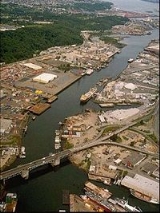
The Duwamish River is the name of the lower 12 miles (19.3 km) of Washington state's Green River
. Its industrialized estuary is known as the Duwamish Waterway.
and Green Rivers
combined at Auburn
, and joined the Black River
at Tukwila
to form the Duwamish. In 1906, however, the White River changed course following a major flood and emptied into the Puyallup River as it does today. The lower portion of the historic White River—from the historic confluence of the White and Green Rivers to the conjunction with the Black River—is now considered part of the Green River. Later, in 1911 the Cedar River
was diverted to empty into Lake Washington
instead of into the Black River; at that time, the lake itself still emptied into the Black River. Then, with the opening of the Lake Washington Ship Canal
in 1916, the lake's level dropped nearly nine feet and the Black River dried up. From that time forward, the point of the name change from Green to Duwamish is no longer the confluence of the Green and Black Rivers, though it has not changed location.
The native Lushootseed
name of the Duwamish River (and of the Cedar River) was Dxwdəw. The Lushootseed name of the Duwamish tribe was Dxw'Dəw?Abš or Dkhw'Duw'Absh. Both of these have been anglicized as Duwamish.
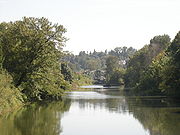
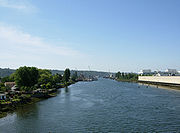 The Duwamish Waterway empties into Elliott Bay
in Seattle
, divided by the man-made Harbor Island into two channels, the East and West Waterways.
Due to 20th century industrial contamination
, the lower 5 miles (8 km) of the Duwamish was declared a Superfund
site by the United States Environmental Protection Agency
. The contaminants include PCB
s, PAH
s, mercury
, and phthalates. The cleanup of the river has been controversial: the original plan was to dredge the river and dump the resulting sludge
in Tacoma's
Commencement Bay
, 26 miles (41.8 km) to the southwest. Local opposition to this plan forced the sludge to be shipped to Klickitat County in south central Washington.
Along with the contaminants already mentioned above the Duwamish River faces other types of pollution as well. One other major form of pollution is fecal coliform caused by sewage overflow. Even if these overflows were to be cleaned up the overall quality of the water would not improve much. Contamination would still occur from farms, surface runoff, wildlife, or failing septic tanks. Also, the Duwamish River's most common pollutant is petroleum. This is because it is used in many different ways by many different groups of people.
chum and steelhead, not to mention the more rare pink, sockeye, sea-run cutthroat trout and bull trout.
Many of the animal species found in or around the river contain an unhealthy amount of contaminants. For example, other than salmon, any type of fish or shellfish found in the river is unfit for human consumption. It was found that PCB levels in fish and crab that live in the waterway most of their lives are 35 to 110 times higher than in Puget Sound salmon. The Ecological Risk Assessment also found that river otters from the Lower Duwamish River might be exposed to such high levels of PCBs that the growth or survival of their offspring may be reduced.
the character Jordan Collier
annexes a square mile of Seattle property and declares it an autonomous city called Promise City
. The characters in the show claim that this is a portion of the "Duwamish River delta" and refer to it as one of the most polluted locations in the country. However, the map that many characters use for this location does not correspond to the Duwamish river at all (much less the delta), and in fact all scenes featuring Promise City were shot in Vancouver (presumably at a location within the Burrard Inlet).
Green River (Washington)
The Green River is a long river in the state of Washington in the United States, arising on the western slopes of the Cascade Mountains south of I-90....
. Its industrialized estuary is known as the Duwamish Waterway.
History
Until 1906, the WhiteWhite River (Washington)
The White River is a white, glacial river in the U.S. state of Washington. It flows about 75 miles from its source, the Emmons Glacier on Mount Rainier, to join the Puyallup River at Sumner...
and Green Rivers
Green River (Washington)
The Green River is a long river in the state of Washington in the United States, arising on the western slopes of the Cascade Mountains south of I-90....
combined at Auburn
Auburn, Washington
-Parks:Auburn has an extensive system of parks, open space and urban trails comprising 29 developed parks, 5 undeveloped sites under planning, 2 skate parks, 2 water roatary parks, and over of trails , and almost of open space for passive and active recreation.-Environmental Park:The Auburn...
, and joined the Black River
Black River (Duwamish River)
The Black River, also known as the Duwamish River, was a river in King County in the U.S. state of Washington. It drained Lake Washington until 1916 when the opening of the Lake Washington Ship Canal lowered the lake, causing the Black River to dry up...
at Tukwila
Tukwila, Washington
Tukwila is a city in King County, Washington, United States. The northern edge of Tukwila borders the city of Seattle. The population was 19,107 at the 2010 census.-History:...
to form the Duwamish. In 1906, however, the White River changed course following a major flood and emptied into the Puyallup River as it does today. The lower portion of the historic White River—from the historic confluence of the White and Green Rivers to the conjunction with the Black River—is now considered part of the Green River. Later, in 1911 the Cedar River
Cedar River (Washington)
The Cedar River is a river in the U.S. state of Washington. About long, it originates in the Cascade Range and flows generally west and northwest, emptying into the southern end of Lake Washington...
was diverted to empty into Lake Washington
Lake Washington
Lake Washington is a large freshwater lake adjacent to the city of Seattle. It is the largest lake in King County and the second largest in the state of Washington, after Lake Chelan. It is bordered by the cities of Seattle on the west, Bellevue and Kirkland on the east, Renton on the south and...
instead of into the Black River; at that time, the lake itself still emptied into the Black River. Then, with the opening of the Lake Washington Ship Canal
Lake Washington Ship Canal
The Lake Washington Ship Canal, which runs through the City of Seattle, Washington, connects the fresh water body of Lake Washington with the salt water inland sea of Puget Sound. The Ship Canal includes a series of locks, modeled after the Panama Canal, to accommodate the different water levels...
in 1916, the lake's level dropped nearly nine feet and the Black River dried up. From that time forward, the point of the name change from Green to Duwamish is no longer the confluence of the Green and Black Rivers, though it has not changed location.
The native Lushootseed
Lushootseed
Lushootseed is the language or dialect continuum of several SalishNative American groups of modern-day Washington state...
name of the Duwamish River (and of the Cedar River) was Dxwdəw. The Lushootseed name of the Duwamish tribe was Dxw'Dəw?Abš or Dkhw'Duw'Absh. Both of these have been anglicized as Duwamish.
Modern use
Elliott Bay
Elliott Bay is the body of water on which Seattle, Washington, is located. A line drawn from Alki Point in the south to West Point in the north serves to mark the generally accepted division between the bay and the open sound...
in Seattle
Seattle, Washington
Seattle is the county seat of King County, Washington. With 608,660 residents as of the 2010 Census, Seattle is the largest city in the Northwestern United States. The Seattle metropolitan area of about 3.4 million inhabitants is the 15th largest metropolitan area in the country...
, divided by the man-made Harbor Island into two channels, the East and West Waterways.
Due to 20th century industrial contamination
Pollution
Pollution is the introduction of contaminants into a natural environment that causes instability, disorder, harm or discomfort to the ecosystem i.e. physical systems or living organisms. Pollution can take the form of chemical substances or energy, such as noise, heat or light...
, the lower 5 miles (8 km) of the Duwamish was declared a Superfund
Superfund
Superfund is the common name for the Comprehensive Environmental Response, Compensation, and Liability Act of 1980 , a United States federal law designed to clean up sites contaminated with hazardous substances...
site by the United States Environmental Protection Agency
United States Environmental Protection Agency
The U.S. Environmental Protection Agency is an agency of the federal government of the United States charged with protecting human health and the environment, by writing and enforcing regulations based on laws passed by Congress...
. The contaminants include PCB
Polychlorinated biphenyl
Polychlorinated biphenyls are a class of organic compounds with 2 to 10 chlorine atoms attached to biphenyl, which is a molecule composed of two benzene rings. The chemical formula for PCBs is C12H10-xClx...
s, PAH
Polycyclic aromatic hydrocarbon
Polycyclic aromatic hydrocarbons , also known as poly-aromatic hydrocarbons or polynuclear aromatic hydrocarbons, are potent atmospheric pollutants that consist of fused aromatic rings and do not contain heteroatoms or carry substituents. Naphthalene is the simplest example of a PAH...
s, mercury
Mercury (element)
Mercury is a chemical element with the symbol Hg and atomic number 80. It is also known as quicksilver or hydrargyrum...
, and phthalates. The cleanup of the river has been controversial: the original plan was to dredge the river and dump the resulting sludge
Sludge
Sludge refers to the residual, semi-solid material left from industrial wastewater, or sewage treatment processes. It can also refer to the settled suspension obtained from conventional drinking water treatment, and numerous other industrial processes...
in Tacoma's
Tacoma, Washington
Tacoma is a mid-sized urban port city and the county seat of Pierce County, Washington, United States. The city is on Washington's Puget Sound, southwest of Seattle, northeast of the state capital, Olympia, and northwest of Mount Rainier National Park. The population was 198,397, according to...
Commencement Bay
Commencement Bay
Commencement Bay is a bay of Puget Sound in the U.S. state of Washington. The city of Tacoma is located on the bay, with the Port of Tacoma occupying the southeastern end. A line drawn from Point Defiance in the southwest to Browns Point in the northeast serves to mark the generally accepted...
, 26 miles (41.8 km) to the southwest. Local opposition to this plan forced the sludge to be shipped to Klickitat County in south central Washington.
Along with the contaminants already mentioned above the Duwamish River faces other types of pollution as well. One other major form of pollution is fecal coliform caused by sewage overflow. Even if these overflows were to be cleaned up the overall quality of the water would not improve much. Contamination would still occur from farms, surface runoff, wildlife, or failing septic tanks. Also, the Duwamish River's most common pollutant is petroleum. This is because it is used in many different ways by many different groups of people.
Wildlife
Despite the industrialization of the Duwamish river, it remains an important habitat for the thousands of salmon and trout that visit the marshes and estuaries each year to spawn. The Duwamish supports chinook, coho,chum and steelhead, not to mention the more rare pink, sockeye, sea-run cutthroat trout and bull trout.
Many of the animal species found in or around the river contain an unhealthy amount of contaminants. For example, other than salmon, any type of fish or shellfish found in the river is unfit for human consumption. It was found that PCB levels in fish and crab that live in the waterway most of their lives are 35 to 110 times higher than in Puget Sound salmon. The Ecological Risk Assessment also found that river otters from the Lower Duwamish River might be exposed to such high levels of PCBs that the growth or survival of their offspring may be reduced.
In popular media
In the television series The 4400The 4400
The 4400 is a science fiction TV series produced by CBS Paramount Network Television in association with Sky Television, Renegade 83, and American Zoetrope for USA Network. The show was created and written by Scott Peters and René Echevarria, and it stars Joel Gretsch and Jacqueline McKenzie...
the character Jordan Collier
Jordan Collier
Jordan Collier is a fictional character on the USA Network science fiction television series The 4400. He is portrayed by American actor Billy Campbell.-Character Profile:...
annexes a square mile of Seattle property and declares it an autonomous city called Promise City
Promise City (The 4400)
Promise City is a fictional location in the science fiction television series The 4400.- History :Promise City was founded by Jordan Collier with the guidance of Kyle Baldwin. It is created as a safe haven for people who are promicin-positive , and also serves as the base of Collier's movement to...
. The characters in the show claim that this is a portion of the "Duwamish River delta" and refer to it as one of the most polluted locations in the country. However, the map that many characters use for this location does not correspond to the Duwamish river at all (much less the delta), and in fact all scenes featuring Promise City were shot in Vancouver (presumably at a location within the Burrard Inlet).