
Home      Discussion      Topics      Dictionary      Almanac
Signup       Login
Dormouse

Dormouse

Overview
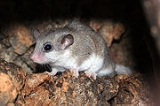
Dormice are rodent
Rodent
Rodentia is an order of mammals also known as rodents, characterised by two continuously growing incisors in the upper and lower jaws which must be kept short by gnawing....

s of the family
Family (biology)
In biological classification, family is* a taxonomic rank. Other well-known ranks are life, domain, kingdom, phylum, class, order, genus, and species, with family fitting between order and genus. As for the other well-known ranks, there is the option of an immediately lower rank, indicated by the...

 Gliridae. (This family is also variously called Myoxidae or Muscardinidae by different taxonomists.) Dormice are mostly found in Europe
Europe
Europe is, by convention, one of the world's seven continents. Comprising the westernmost peninsula of Eurasia, Europe is generally 'divided' from Asia to its east by the watershed divides of the Ural and Caucasus Mountains, the Ural River, the Caspian and Black Seas, and the waterways connecting...

, although some live in Africa
Africa
Africa is the world's second largest and second most populous continent, after Asia. At about 30.2 million km² including adjacent islands, it covers 6% of the Earth's total surface area and 20.4% of the total land area...

 and Asia
Asia
Asia is the world's largest and most populous continent, located primarily in the eastern and northern hemispheres. It covers 8.7% of the Earth's total surface area and with approximately 3.879 billion people, it hosts 60% of the world's current human population...

. They are particularly known for their long periods of hibernation
Hibernation
Hibernation is a state of inactivity and metabolic depression in animals, characterized by lower body temperature, slower breathing, and lower metabolic rate. Hibernating animals conserve food, especially during winter when food supplies are limited, tapping energy reserves, body fat, at a slow rate...

. Because only one species of dormouse is native to the British Isles
British Isles
The British Isles are a group of islands off the northwest coast of continental Europe that include the islands of Great Britain and Ireland and over six thousand smaller isles. There are two sovereign states located on the islands: the United Kingdom of Great Britain and Northern Ireland and...

, in everyday English usage dormouse usually refers to one species (the Hazel Dormouse
Hazel Dormouse
The Hazel Dormouse or Common Dormouse is a small mammal and the only living species in the genus Muscardinus....

) as well as to the family as a whole.
Discussion
Ask a question about 'Dormouse'
Start a new discussion about 'Dormouse'
Answer questions from other users
Full Discussion Forum
 
Unanswered Questions
Recent Discussions
Encyclopedia
Dormice are rodent
Rodent
Rodentia is an order of mammals also known as rodents, characterised by two continuously growing incisors in the upper and lower jaws which must be kept short by gnawing....

s of the family
Family (biology)
In biological classification, family is* a taxonomic rank. Other well-known ranks are life, domain, kingdom, phylum, class, order, genus, and species, with family fitting between order and genus. As for the other well-known ranks, there is the option of an immediately lower rank, indicated by the...

 Gliridae. (This family is also variously called Myoxidae or Muscardinidae by different taxonomists.) Dormice are mostly found in Europe
Europe
Europe is, by convention, one of the world's seven continents. Comprising the westernmost peninsula of Eurasia, Europe is generally 'divided' from Asia to its east by the watershed divides of the Ural and Caucasus Mountains, the Ural River, the Caspian and Black Seas, and the waterways connecting...

, although some live in Africa
Africa
Africa is the world's second largest and second most populous continent, after Asia. At about 30.2 million km² including adjacent islands, it covers 6% of the Earth's total surface area and 20.4% of the total land area...

 and Asia
Asia
Asia is the world's largest and most populous continent, located primarily in the eastern and northern hemispheres. It covers 8.7% of the Earth's total surface area and with approximately 3.879 billion people, it hosts 60% of the world's current human population...

. They are particularly known for their long periods of hibernation
Hibernation
Hibernation is a state of inactivity and metabolic depression in animals, characterized by lower body temperature, slower breathing, and lower metabolic rate. Hibernating animals conserve food, especially during winter when food supplies are limited, tapping energy reserves, body fat, at a slow rate...

. Because only one species of dormouse is native to the British Isles
British Isles
The British Isles are a group of islands off the northwest coast of continental Europe that include the islands of Great Britain and Ireland and over six thousand smaller isles. There are two sovereign states located on the islands: the United Kingdom of Great Britain and Northern Ireland and...

, in everyday English usage dormouse usually refers to one species (the Hazel Dormouse
Hazel Dormouse
The Hazel Dormouse or Common Dormouse is a small mammal and the only living species in the genus Muscardinus....

) as well as to the family as a whole.

Characteristics


Dormice are small for rodents, with a body length of between 6 centimetre, and weighing between 15 gram. They are generally mouse
Mouse
A mouse is a small mammal belonging to the order of rodents. The best known mouse species is the common house mouse . It is also a popular pet. In some places, certain kinds of field mice are also common. This rodent is eaten by large birds such as hawks and eagles...

-like in appearance, but with fur
Fur
Fur is a synonym for hair, used more in reference to non-human animals, usually mammals; particularly those with extensives body hair coverage. The term is sometimes used to refer to the body hair of an animal as a complete coat, also known as the "pelage". Fur is also used to refer to animal...

red, rather than scaly tail
Tail
The tail is the section at the rear end of an animal's body; in general, the term refers to a distinct, flexible appendage to the torso. It is the part of the body that corresponds roughly to the sacrum and coccyx in mammals, reptiles, and birds...

s. They are largely but not exclusively arboreal animals, and are agile and well adapted to climbing. Most species are nocturnal. Dormice have an excellent sense of hearing
Hearing (sense)
Hearing is the ability to perceive sound by detecting vibrations through an organ such as the ear. It is one of the traditional five senses...

, and signal each other with a variety of vocalisations.

Dormice are omnivorous
Omnivore
Omnivores are species that eat both plants and animals as their primary food source...

, typically feeding on fruits, berries, flowers, nuts and insects. Dormice are unique among rodents in that they lack a cecum
Cecum
The cecum or caecum is a pouch, connecting the ileum with the ascending colon of the large intestine. It is separated from the ileum by the ileocecal valve or Bauhin's valve, and is considered to be the beginning of the large intestine. It is also separated from the colon by the cecocolic...

, a part of the gut used in other species to ferment vegetable matter. Their dental formula
Dentition
Dentition pertains to the development of teeth and their arrangement in the mouth. In particular, the characteristic arrangement, kind, and number of teeth in a given species at a given age...

 is similar to that of squirrel
Squirrel
Squirrels belong to a large family of small or medium-sized rodents called the Sciuridae. The family includes tree squirrels, ground squirrels, chipmunks, marmots , flying squirrels, and prairie dogs. Squirrels are indigenous to the Americas, Eurasia, and Africa and have been introduced to Australia...

s, although they often lack premolar
Premolar
The premolar teeth or bicuspids are transitional teeth located between the canine and molar teeth. In humans, there are two premolars per quadrant, making eight premolars total in the mouth. They have at least two cusps. Premolars can be considered as a 'transitional tooth' during chewing, or...

s:

Dormice breed once or maybe twice a year, producing litters with an average of four young after a gestation
Gestation
Gestation is the carrying of an embryo or fetus inside a female viviparous animal. Mammals during pregnancy can have one or more gestations at the same time ....

 period of 21-32 days. They can live for as long as five years. The young are born hairless, and helpless, and their eyes do not open until about eighteen days after birth. They typically become sexually mature after the end of their first hibernation. Dormice live in small family groups, with home ranges that vary widely between species, and depending on the availability of food.

Hibernation


One of the most notable characteristics of those dormice that live in temperate
Temperate
In geography, temperate or tepid latitudes of the globe lie between the tropics and the polar circles. The changes in these regions between summer and winter are generally relatively moderate, rather than extreme hot or cold...

 zones is hibernation
Hibernation
Hibernation is a state of inactivity and metabolic depression in animals, characterized by lower body temperature, slower breathing, and lower metabolic rate. Hibernating animals conserve food, especially during winter when food supplies are limited, tapping energy reserves, body fat, at a slow rate...

. Dormice can hibernate six months out of the year, or even longer if the weather remains sufficiently cool, sometimes waking for brief periods to eat food they had previously stored nearby. During the summer, they accumulate fat
Fat
Fats consist of a wide group of compounds that are generally soluble in organic solvents and generally insoluble in water. Chemically, fats are triglycerides, triesters of glycerol and any of several fatty acids. Fats may be either solid or liquid at room temperature, depending on their structure...

 in their bodies, to nourish them through the hibernation period.

It is from this trait that they got their name, which comes from Anglo-Norman
Anglo-Norman language
Anglo-Norman is the name traditionally given to the kind of Old Norman used in England and to some extent elsewhere in the British Isles during the Anglo-Norman period....

 dormeus, which means "sleepy (one)"; the word was later altered by folk etymology to resemble the word "mouse". The sleepy behaviour of the Dormouse character in Lewis Carroll
Lewis Carroll
Charles Lutwidge Dodgson , better known by the pseudonym Lewis Carroll , was an English author, mathematician, logician, Anglican deacon and photographer. His most famous writings are Alice's Adventures in Wonderland and its sequel Through the Looking-Glass, as well as the poems "The Hunting of the...

's Alice's Adventures in Wonderland
Alice's Adventures in Wonderland
Alice's Adventures in Wonderland is an 1865 novel written by English author Charles Lutwidge Dodgson under the pseudonym Lewis Carroll. It tells of a girl named Alice who falls down a rabbit hole into a fantasy world populated by peculiar, anthropomorphic creatures...

 also attests to this trait.

Relationship with humans


The edible dormouse
Edible dormouse
The edible dormouse or fat dormouse is a large dormouse and the only living species in the genus Glis.-Description:...

 was considered a delicacy in ancient Rome, either as a savoury appetizer or as a dessert (dipped in honey and poppy seeds). The Romans had a special kind of enclosure known as glirarium used to rear dormice for the table. Dormice to this day are eaten in Slovenia. Dormouse fat was used by the Elizabethans to induce sleep.

Evolution


Gliridae are one of the oldest extant rodent families with a fossil record dating back to the early Eocene
Eocene
The Eocene Epoch, lasting from about 56 to 34 million years ago , is a major division of the geologic timescale and the second epoch of the Paleogene Period in the Cenozoic Era. The Eocene spans the time from the end of the Palaeocene Epoch to the beginning of the Oligocene Epoch. The start of the...

. As currently understood, they descended in Europe
Europe
Europe is, by convention, one of the world's seven continents. Comprising the westernmost peninsula of Eurasia, Europe is generally 'divided' from Asia to its east by the watershed divides of the Ural and Caucasus Mountains, the Ural River, the Caspian and Black Seas, and the waterways connecting...

 from early Paleogene
Paleogene
The Paleogene is a geologic period and system that began 65.5 ± 0.3 and ended 23.03 ± 0.05 million years ago and comprises the first part of the Cenozoic Era...

 ischyromyids such as Microparamys (Sparnacomys) chandoni. The early and middle Eocene genus Eogliravus represents the earliest and most primitive glirid taxon; the oldest species, Eogliravus wildi, is known from isolated teeth from the early Eocene[ of France and a complete specimen of the early middle Eocene of the Messel pit
Messel pit
The Messel Pit is a disused quarry near the village of Messel, about southeast of Frankfurt am Main, Germany. Bituminous shale was mined there. Because of its abundance of fossils, it has significant geological and scientific importance...

 in Germany. They appear in Africa
Africa
Africa is the world's second largest and second most populous continent, after Asia. At about 30.2 million km² including adjacent islands, it covers 6% of the Earth's total surface area and 20.4% of the total land area...

 in the upper Miocene
Miocene
The Miocene is a geological epoch of the Neogene Period and extends from about . The Miocene was named by Sir Charles Lyell. Its name comes from the Greek words and and means "less recent" because it has 18% fewer modern sea invertebrates than the Pliocene. The Miocene follows the Oligocene...

 and only relatively recently in Asia
Asia
Asia is the world's largest and most populous continent, located primarily in the eastern and northern hemispheres. It covers 8.7% of the Earth's total surface area and with approximately 3.879 billion people, it hosts 60% of the world's current human population...

. Many types of extinct dormouse species have been identified. During the Pleistocene
Pleistocene
The Pleistocene is the epoch from 2,588,000 to 11,700 years BP that spans the world's recent period of repeated glaciations. The name pleistocene is derived from the Greek and ....

, giant dormice the size of large rats, such as Leithia melitensis, lived on the islands of Malta
Malta
Malta , officially known as the Republic of Malta , is a Southern European country consisting of an archipelago situated in the centre of the Mediterranean, south of Sicily, east of Tunisia and north of Libya, with Gibraltar to the west and Alexandria to the east.Malta covers just over in...

 and Sicily
Sicily
Sicily is a region of Italy, and is the largest island in the Mediterranean Sea. Along with the surrounding minor islands, it constitutes an autonomous region of Italy, the Regione Autonoma Siciliana Sicily has a rich and unique culture, especially with regard to the arts, music, literature,...

.

Classification


The family consists of 29 living species, in three subfamilies and (arguably) 9 genera:

FAMILY GLIRIDAE - Dormice
  • Subfamily Graphiurinae
    • Genus Graphiurus
      Graphiurus
      The African dormice, Graphiurus, are a genus of dormouse that live throughout sub-Saharan Africa in a variety of habitats. They are very agile climbers and have bushy tails...

      , African dormice
      • Angolan African Dormouse, Graphiurus angolensis
      • Christy's Dormouse
        Christy's Dormouse
        Christy's Dormouse is a species of rodent in the Gliridae family. It is found in Cameroon and Democratic Republic of the Congo. Its natural habitat is subtropical or tropical moist lowland forests.-References:...

        , Graphiurus christyi
      • Jentink's Dormouse
        Jentink's Dormouse
        Jentink's Dormouse is a species of rodent in the Gliridae family. It is found in Cameroon, Ivory Coast, Ghana, Liberia, Nigeria, Togo, possibly Benin, possibly Equatorial Guinea, and possibly Sierra Leone. Its natural habitat is subtropical or tropical moist lowland forests.-References:* Grubb, P....

        , Graphiurus crassicaudatus
      • Jouhnston's African Dormouse, Graphiurus johnstoni
      • Kellen's Dormouse
        Kellen's Dormouse
        Kellen's Dormouse is a species of rodent in the Gliridae family. It is found in Angola, Burkina Faso, Cameroon, Central African Republic, Democratic Republic of the Congo, Gambia, Kenya, Mali, Nigeria, Niger, Senegal, Tanzania, and Uganda.Its natural habitats are subtropical or tropical dry...

        , Graphiurus kelleni
      • Lorrain Dormouse
        Lorrain Dormouse
        The Lorrain Dormouse is a species of rodent in the Gliridae family. It is found in Cameroon, Democratic Republic of the Congo, Ghana, Guinea-Bissau, Liberia, Nigeria, Sierra Leone, Tanzania, and Uganda. Its natural habitats are subtropical or tropical moist lowland forests, moist savanna, and...

        , Graphiurus lorraineus
      • Small-eared Dormouse
        Small-eared Dormouse
        The Small-eared Dormouse is a species of rodent in the Gliridae family. It is found in Angola, Botswana, Eritrea, Ethiopia, Kenya, Lesotho, Malawi, Mozambique, Namibia, South Africa, Sudan, Swaziland, Tanzania, Zambia, and Zimbabwe.-References:*Holden, M. E.. 2005. Family Gliridae. Pp...

        , Graphiurus microtis
      • Monard's Dormouse
        Monard's Dormouse
        Monard's Dormouse is a species of rodent in the Gliridae family. It is found in Angola, Democratic Republic of the Congo, and possibly Zambia. Its natural habitat is moist savanna.-References:...

        , Graphiurus monardi
      • Woodland Dormouse
        Woodland Dormouse
        The Woodland Dormouse is a species of rodent in the Gliridae family. It is endemic to South Africa. It is also known as African Dwarf Dormouse, African Pygmy Dormouse, Woodland Dormouse, or colloquially as Micro Squirrel...

        , Graphiurus murinus
      • Nagtglas's African Dormouse, Graphiurus nagtglasii
      • Spectacled Dormouse, Graphiurus ocularis
      • Rock Dormouse
        Rock Dormouse
        The Rock Dormouse is a species of rodent in the Gliridae family. It is found in Angola, Botswana, Mozambique, South Africa, Swaziland, Zambia, and Zimbabwe.-References:* Grubb, P. 2004. . Downloaded on 29 July 2007....

        , Graphiurus platyops
      • Stone Dormouse
        Stone Dormouse
        The Stone Dormouse is a species of rodent in the Gliridae family. It is found in Namibia, South Africa, and possibly Angola. Its natural habitat is rocky areas.-References:...

        , Graphiurus rupicola
      • Silent Dormouse
        Silent Dormouse
        The Silent Dormouse is a species of rodent in the Gliridae family. It is found in Cameroon, Democratic Republic of the Congo, Equatorial Guinea, and Gabon. Its natural habitat is subtropical or tropical moist lowland forests....

        , Graphiurus surdus
      • Graphiurus walterverheyeni
  • Subfamily Leithiinae
    Leithiinae
    Leithiinae is a subfamily of dormice.-Classification:Subfamily Leithiinae*Genus Chaetocauda**Chinese Dormouse, Chaetocauda sichuanensis*Genus Dryomys**Woolly Dormouse, Dryomys laniger...

    • Genus Chaetocauda
      • Chinese Dormouse
        Chinese Dormouse
        The Chinese Dormouse or Sichuan Dormouse is a species of dormouse that lives in sub-alpine mixed forests in northern Sichuan, China...

        , Chaetocauda sichuanensis
    • Genus Dryomys
      • Woolly Dormouse
        Woolly Dormouse
        The Woolly Dormouse is a species of rodent in the Gliridae family.It is endemic to Turkey.-References:* Baillie, J. 1996. . Downloaded on 29 July 2007....

        , Dryomys laniger
      • Balochistan Forest Dormouse
        Balochistan Forest Dormouse
        The Balochistan Forest Dormouse is a species of rodent in the Gliridae family.It is endemic to Pakistan.-References:* Gippoliti, S. 2002. . Downloaded on 29 July 2007....

        , Dryomys niethammeri
      • Forest Dormouse
        Forest Dormouse
        The Forest Dormouse is a species of rodent in the Gliridae family found in eastern Europe, the Balkans and parts of western Central Asia...

        , Dryomys nitedula
    • Genus Eliomys
      Eliomys
      Eliomys is a genus of rodent in the Gliridae family.It contains the following species:* Asian Garden Dormouse, Eliomys melanurus* Maghreb Garden Dormouse, Eliomys munbyanus* Garden Dormouse, Eliomys quercinus-References:...

      , Garden Dormice
      • Asian Garden Dormouse
        Asian Garden Dormouse
        The Asian Garden Dormouse is a species of rodent in the Gliridae family.It is found in Algeria, Egypt, Iraq, Israel, Jordan, Lebanon, Libya, Morocco, Saudi Arabia, Syria, Tunisia, and Turkey....

        , Eliomys melanurus
      • Maghreb Garden Dormouse
        Maghreb Garden Dormouse
        The Maghreb Garden Dormouse is a nocturnal species of rodent in the Gliridae family. It is found in Algeria, Libyan Arab Jamahiriya, Morocco, Tunisia and Western Sahara. Its natural habitats vary from humid forests to semi-deserts.-Further reading:**...

        , Eliomys munbyanus
      • Garden Dormouse
        Garden dormouse
        The garden dormouse is a rodent in the dormouse family.- Features :Garden dormice are typically in length, with the tail adding an additional . They weigh . The coat is gray or brown, with a white underside...

        , Eliomys quercinus
    • Genus Hypnomys† (Balearic dormouse)
      • Hypnomys morphaeus†
      • Hypnomys mahonensis†
    • Genus Muscardinus
      • Hazel Dormouse
        Hazel Dormouse
        The Hazel Dormouse or Common Dormouse is a small mammal and the only living species in the genus Muscardinus....

        , Muscardinus avellanarius
    • Genus Myomimus
      Myomimus
      Myomimus is a genus of rodent in the Gliridae family.It contains the following species:* Masked Mouse-tailed Dormouse * Roach's Mouse-tailed Dormouse * Setzer's Mouse-tailed Dormouse...

      , Mouse-tailed dormice
      • Masked Mouse-tailed Dormouse
        Masked Mouse-tailed Dormouse
        The masked mouse-tailed dormouse is a species of rodent in the Gliridae family. It is found in Iran and Turkmenistan.-Source:* Tchabovsky, A. 1996. . Downloaded on 30 July 2007....

        , Myomimus personatus
      • Roach's Mouse-tailed Dormouse, Myomimus roachi
      • Setzer's Mouse-tailed Dormouse
        Setzer's Mouse-tailed Dormouse
        The Setzer's mouse-tailed dormouse is a species of rodent in the Gliridae family. It is endemic to Iran.-Source:* Baillie, J. 1996. . Downloaded on 30 July 2007.-External links:...

        , Myomimus setzeri
    • Genus Selevinia
      • Desert Dormouse
        Desert Dormouse
        The Desert Dormouse is a species of rodent in the dormouse family Gliridae.This species was formerly placed in its own family, Seleviniidae, but it is now considered to be a dormouse, monotypic within the genus Selevinia.It is endemic to Kazakhstan.-References:*Holden, M. E. 2005. Family Gliridae....

        , Selevinia betpakdalaensis
  • Subfamily Glirinae
    Glirinae
    Glirinae is a subfamily of dormice .It contains two extant genera, each one having one species:Subfamily Glirinae*Genus Glirulus**Japanese Dormouse, Glirulus japonicus*Genus Glis**Edible Dormouse, Glis glis...

    • Genus Glirulus
      • Japanese Dormouse
        Japanese Dormouse
        The Japanese Dormouse is a species of rodent in the Gliridae family. It is monotypic within the genus Glirulus. It is endemic to Japan....

        , Glirulus japonicus
    • Genus Glis
      • Edible Dormouse
        Edible dormouse
        The edible dormouse or fat dormouse is a large dormouse and the only living species in the genus Glis.-Description:...

        , Glis glis

Fossil species

  • Subfamily Bransatoglirinae
    • Genus Oligodyromys
    • Genus Bransatoglis
      • Bransatoglis adroveri Majorca, Early Oligocene
      • Bransatoglis planus Eurasia, Early Oligocene

External links