


Dirce

Encyclopedia
Dirce was the wife of Lycus
in Greek mythology
, and aunt
to Antiope
whom Zeus
impregnated. Antiope fled in shame to King Epopeus
of Sicyon
, but was brought back by Lycus through force, giving birth to the twins Amphion and Zethus
on the way. Dirce hated Antiope, and treated her cruelly after Lycus gave Antiope to her; until Antiope, in time, escaped.
In Euripides
' play Antiope, Antiope flees back to the cave where Amphion and Zethus were born, now living there as young men. They disbelieve her claim to be their mother and refuse her pleas for sanctuary, but when Dirce comes to find Antiope and orders her to be killed, the twins are convinced by the shepherd who raised them that Antiope is their mother. They kill Dirce by tying her to the horns of a bull.
Dirce was devoted to the god Dionysus
. He caused a spring to flow where she died, either at Mount Cithaeron or at Thebes
, and it was a local tradition for the outgoing Theban hipparch to swear in his successor at her tomb.
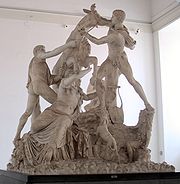 The death of Dirce is depicted in a marble statue, 1st Century AD Roman Copy of a 2nd century BC Hellenistic Greek original, known as the Farnese Bull
, now in the collections of the National Archaeological Museum in Naples. The colossal piece was first excavated in the 16th century in the Baths of Caracalla. Some scholars identify it with the Dirce bull mentioned in Pliny's Natural History, but this is disputed.
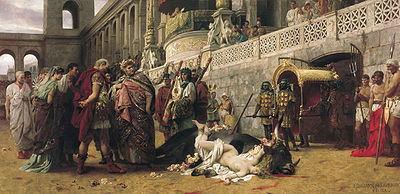 This scene was apparently recreated in spectacles in the Roman arena. Clement
, in his First Letter to the Corinthians, recounts how Christian women were martyr
ed.
Lycus (brother of Nycteus)
In Greek Mythology, Lycus was a ruler of the ancient city of Ancient Thebes . His rule was preceded by the regency of Nycteus, and he was succeeded by the twins Amphion and Zethus.-Genealogy:...
in Greek mythology
Greek mythology
Greek mythology is the body of myths and legends belonging to the ancient Greeks, concerning their gods and heroes, the nature of the world, and the origins and significance of their own cult and ritual practices. They were a part of religion in ancient Greece...
, and aunt
Aunt
An aunt is a person who is the sister or sister-in-law of a parent. A man with an equivalent relationship is an uncle, and the reciprocal relationship is that of a nephew or niece....
to Antiope
Antiope (mother of Amphion)
In Greek mythology, Antiope was the name of the daughter of the Boeotian river god Asopus, according to Homer; in later sources she is called the daughter of the "nocturnal" king Nycteus of Thebes or, in the Cypria, of Lycurgus, but for Homer her site is purely Boeotian. Her beauty attracted Zeus,...
whom Zeus
Zeus
In the ancient Greek religion, Zeus was the "Father of Gods and men" who ruled the Olympians of Mount Olympus as a father ruled the family. He was the god of sky and thunder in Greek mythology. His Roman counterpart is Jupiter and his Etruscan counterpart is Tinia.Zeus was the child of Cronus...
impregnated. Antiope fled in shame to King Epopeus
Epopeus
Epopeus was a mythical Greek king of Sicyon, with an archaic bird-name that linked him to epops , the hoopoe, the "watcher"...
of Sicyon
Sicyon
Sikyon was an ancient Greek city situated in the northern Peloponnesus between Corinth and Achaea on the territory of the present-day prefecture of Corinthia...
, but was brought back by Lycus through force, giving birth to the twins Amphion and Zethus
Amphion and Zethus
Amphion and Zethus , in ancient Greek mythology, were the twin sons of Zeus by Antiope. They are important characters in one of the two founding myths of the city of Thebes, because they constructed the city's walls....
on the way. Dirce hated Antiope, and treated her cruelly after Lycus gave Antiope to her; until Antiope, in time, escaped.
In Euripides
Euripides
Euripides was one of the three great tragedians of classical Athens, the other two being Aeschylus and Sophocles. Some ancient scholars attributed ninety-five plays to him but according to the Suda it was ninety-two at most...
' play Antiope, Antiope flees back to the cave where Amphion and Zethus were born, now living there as young men. They disbelieve her claim to be their mother and refuse her pleas for sanctuary, but when Dirce comes to find Antiope and orders her to be killed, the twins are convinced by the shepherd who raised them that Antiope is their mother. They kill Dirce by tying her to the horns of a bull.
Dirce was devoted to the god Dionysus
Dionysus
Dionysus was the god of the grape harvest, winemaking and wine, of ritual madness and ecstasy in Greek mythology. His name in Linear B tablets shows he was worshipped from c. 1500—1100 BC by Mycenean Greeks: other traces of Dionysian-type cult have been found in ancient Minoan Crete...
. He caused a spring to flow where she died, either at Mount Cithaeron or at Thebes
Thebes, Greece
Thebes is a city in Greece, situated to the north of the Cithaeron range, which divides Boeotia from Attica, and on the southern edge of the Boeotian plain. It played an important role in Greek myth, as the site of the stories of Cadmus, Oedipus, Dionysus and others...
, and it was a local tradition for the outgoing Theban hipparch to swear in his successor at her tomb.
Dirce in Roman culture
Farnese Bull
The Farnese Bull, formerly in the Farnese collection, Rome, is a massive Hellenistic sculpture attributed to the Rhodian artists Apollonius of Tralles and his brother Tauriscus. We know this thanks to the writings of Pliny the Elder. He tells us it was commissioned at the end of the 2nd century BC...
, now in the collections of the National Archaeological Museum in Naples. The colossal piece was first excavated in the 16th century in the Baths of Caracalla. Some scholars identify it with the Dirce bull mentioned in Pliny's Natural History, but this is disputed.
Pope Clement I
Starting in the 3rd and 4th century, tradition has identified him as the Clement that Paul mentioned in Philippians as a fellow laborer in Christ.While in the mid-19th century it was customary to identify him as a freedman of Titus Flavius Clemens, who was consul with his cousin, the Emperor...
, in his First Letter to the Corinthians, recounts how Christian women were martyr
Martyr
A martyr is somebody who suffers persecution and death for refusing to renounce, or accept, a belief or cause, usually religious.-Meaning:...
ed.
Sources
- Tripp, Edward. Crowell's Handbook of Classical Mythology. New York: Thomas Crowell Press, 1970.