

All Topics  
Dimer


   Email Print
   Bookmark   Link


Dimer


s are often found in vapour phase.]] A dimer is a chemical or biological
Biological

The word biological may refer to:*Adjectival form of "biology", the study of life*Biological , a biological preparation that is synthesized from living organisms or their products and used medically as a diagnostic, preventive, or therapeutic agent....
 entity consisting of two identical subunits called monomer
Monomer

A monomer is a small molecule that may become Chemistry chemical bonding to other monomers to form a polymer....
s, which are held together by either intramolecular
Intramolecular

Intramolecular in chemistry describes a process or characteristic limited within the structure of a single molecule; a property or phenomenon limited to the extent of a single molecule....
 forces (covalent bonds) or weaker intermolecular forces.

hough this might not be readily apparent on initial inspection]] An example of a molecular dimer (i.e. held together by intramolecular
Intramolecular

Intramolecular in chemistry describes a process or characteristic limited within the structure of a single molecule; a property or phenomenon limited to the extent of a single molecule....
 forces) is dicyclopentadiene
Dicyclopentadiene

Dicyclopentadiene, abbreviated DCPD, is the chemical compound with the formula C10H12. At room temperature, it is a white crystalline solid with a camphor-like odor....
, wherein two cyclopentadiene
Cyclopentadiene

Cyclopentadiene is a chemical compound with the Chemical formula C5H6. This colorless liquid organic chemistry chemical compound has a strong and unpleasant odor....
 molecules have reacted to give the product.

Molecular dimers are often formed by the reaction of two identical compounds e.g.: 2A ? A-A.

In this example, monomer
Monomer

A monomer is a small molecule that may become Chemistry chemical bonding to other monomers to form a polymer....
 "A" is said to dimerise to give the dimer "A-A".


Discussion
Ask a question about 'Dimer'
Start a new discussion about 'Dimer'
Answer questions from other users
Full Discussion Forum


Encyclopedia


s are often found in vapour phase.]] A dimer is a chemical or biological
Biological

The word biological may refer to:*Adjectival form of "biology", the study of life*Biological , a biological preparation that is synthesized from living organisms or their products and used medically as a diagnostic, preventive, or therapeutic agent....
 entity consisting of two identical subunits called monomer
Monomer

A monomer is a small molecule that may become Chemistry chemical bonding to other monomers to form a polymer....
s, which are held together by either intramolecular
Intramolecular

Intramolecular in chemistry describes a process or characteristic limited within the structure of a single molecule; a property or phenomenon limited to the extent of a single molecule....
 forces (covalent bonds) or weaker intermolecular forces.

Chemistry

although this might not be readily apparent on initial inspection]] An example of a molecular dimer (i.e. held together by intramolecular
Intramolecular

Intramolecular in chemistry describes a process or characteristic limited within the structure of a single molecule; a property or phenomenon limited to the extent of a single molecule....
 forces) is dicyclopentadiene
Dicyclopentadiene

Dicyclopentadiene, abbreviated DCPD, is the chemical compound with the formula C10H12. At room temperature, it is a white crystalline solid with a camphor-like odor....
, wherein two cyclopentadiene
Cyclopentadiene

Cyclopentadiene is a chemical compound with the Chemical formula C5H6. This colorless liquid organic chemistry chemical compound has a strong and unpleasant odor....
 molecules have reacted to give the product.

Molecular dimers are often formed by the reaction of two identical compounds e.g.: 2A ? A-A.

In this example, monomer
Monomer

A monomer is a small molecule that may become Chemistry chemical bonding to other monomers to form a polymer....
 "A" is said to dimerise to give the dimer "A-A". Diaminocarbenes are another example which dimerise, to give tetraaminoethylene
Tetraaminoethylene

Tetraaminoethylene organic compounds of the generla chemical formula: 2C=C2....
s.

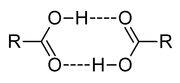
An example of an intermolecular or physical dimer is acetic acid
Acetic acid

Acetic acid, CH3COOH, also known as ethanoic acid, is an organic acid which gives vinegar its sour taste and pungent smell. Pure, water-free acetic acid is a colourless liquid that absorbs water from the environment , and freezes at 16.7 Celsius to a colourless crystalline solid....
 wherein hydrogen bond
Hydrogen bond

A hydrogen bond is the attractive force between one electronegative atom and a hydrogen covalently bonded to another electronegative atom. It results from a dipole-dipole force with a hydrogen atom bonded to nitrogen, oxygen or fluorine ....
s hold the two molecules together. The water dimer
Water dimer

The water dimer consists of two water molecules loosely bound by a hydrogen bond. It is the smallest water cluster. Because it is the simplest model system for studying hydrogen bonding in water, it has been the target of so many theoretical studies that it has been called "a theoretical Guinea pig" ....
 is another such dimer.

The term homodimer is used when the two molecules are identical (e.g. A-A) and heterodimer when they are not (e.g. A-B).

The reverse of dimerisation is often called dissociation
Dissociation (chemistry)

Dissociation in chemistry and biochemistry is a general process in which ionic compounds separate or split into smaller molecules, ions, or Radical , usually in a reversible manner....
.

Biochemistry

In biochemistry
Biochemistry

Biochemistry is the study of the chemistry processes in living organisms. It deals with the structure and function of cellular components such as proteins, carbohydrates, lipids, nucleic acids and other biomolecules....
 and molecular biology
Molecular biology

Molecular biology is the study of biology at a molecule level. The field overlaps with other areas of biology and chemistry, particularly genetics and biochemistry....
, dimers of macromolecule
Macromolecule

The term macromolecule by definition implies "large molecule". In the context of biochemistry, the term may be applied to the four conventional biopolymers , as well as non-polymeric molecules with large molecular mass such as macrocycles....
s like protein
Protein

Proteins are organic compounds made of amino acids arranged in a linear chain and joined together by peptide bonds between the carboxyl and amino groups of adjacent amino acid Residue ....
s and nucleic acid
Nucleic acid

A nucleic acid is a macromolecule composed of chains of monomeric nucleotides. In biochemistry these molecules carry genetic information or form structures within Cell ....
s are often observed. The dimerization of identical subunits is called homodimerization; the dimerization of different subunits or unrelated monomer
Monomer

A monomer is a small molecule that may become Chemistry chemical bonding to other monomers to form a polymer....
s is called heterodimerization. Most dimers in biochemistry are not connected by covalent bond
Covalent bond

A covalent bond is a form of chemical bonding that is characterized by the sharing of pairs of electrons between atoms, or between atoms and other covalent bonds....
s with the exception of disulfide bridges. An example of this would be the enzyme reverse transcriptase
Reverse transcriptase

In biochemistry, a reverse transcriptase, also known as RNA-dependent DNA polymerase, is a DNA polymerase enzyme that transcription single-stranded RNA into double-stranded DNA....
, which is made of two different amino acid
Amino acid

In chemistry, an amino acid is a molecule containing both amine and carboxyl functional groups. These molecules are particularly important in biochemistry, where this term refers to alpha-amino acids with the general formula H2NCHRCOOH, where R is an organic substituent....
 chains.

Examples

  • Nucleic acid
    Nucleic acid

    A nucleic acid is a macromolecule composed of chains of monomeric nucleotides. In biochemistry these molecules carry genetic information or form structures within Cell ....
    s:
    • DNA
      DNA

      Deoxyribonucleic acid is a nucleic acid that contains the genetics instructions used in the development and functioning of all known living organisms and some viruses....
  • DNA Polymerase
    DNA polymerase

    A DNA polymerase is an enzyme that catalyze the polymerization of deoxyribonucleotides into a DNA strand. DNA polymerases are best-known for their role in DNA replication, in which the polymerase "reads" an intact DNA strand as a template and uses it to synthesize the new strand....
  • Protein
    Protein

    Proteins are organic compounds made of amino acids arranged in a linear chain and joined together by peptide bonds between the carboxyl and amino groups of adjacent amino acid Residue ....
    s:
    • Antibodies
      Antibody

      Antibodies are gamma globulin proteins that are found in blood or other bodily fluids of vertebrates, and are used by the immune system to identify and neutralize foreign objects, such as bacterium and viruses....
    • Protein kinase
      Protein kinase

      A protein kinase is a kinase enzyme that modifies other proteins by chemically adding phosphate groups to them . Phosphorylation usually results in a functional change of the target protein by changing enzyme catalysis, cellular location, or association with other proteins....
      s:
      • Receptor tyrosine kinase
        Receptor tyrosine kinase

        Receptor tyrosine kinases s are the high dissociation constant#Protein-Ligand binding cell surface receptors for many polypeptide growth factors, cytokines and hormones....
        s
    • Transcription factor
      Transcription factor

      In the field of molecular biology, a transcription factor is a protein that binds to specific DNA sequence and thereby controls the transfer of genetic information from DNA to RNA....
      s
      • Leucine zipper
        Leucine zipper

        A leucine zipper, aka leucine scissors, is a super secondary structural motif found in proteins that creates adhesion forces in parallel alpha helices....
         motif proteins
      • Nuclear receptor
        Nuclear receptor

        In the field of molecular biology, nuclear receptors are a class of proteins found within the interior of cells that are responsible for sensing the presence of hormone and certain other molecules....
        s
    • 14-3-3 protein
      14-3-3 protein

      14-3-3 proteins are a family of conserved regulatory molecules expressed in all eukaryote cells. 14-3-3 proteins have the ability to bind a multitude of functionally diverse signal transduction, including kinases, phosphatases, and transmembrane receptors....
      s
    • G protein-coupled receptor
      G protein-coupled receptor

      G protein-coupled receptors , also known as seven transmembrane domain receptors, 7TM receptors, heptahelical receptors, serpentine receptor, and G protein-linked receptors , comprise a large protein family of transmembrane receptors that sense molecules outside the Cell and activate inside signal transductio...
      s
    • G protein
      G protein

      G proteins, short for guanine nucleotide-binding proteins, are a family of proteins involved in second messenger cascades.G proteins are so called because they function as "molecular switches," alternating between an inactive guanosine diphosphate and active guanosine triphosphate bound state, ultimately going on to regulate down...
       ß?-subunit dimer
    • Kinesin
      Kinesin

      Kinesins are a class of motor proteins found in eukaryotic cells. Kinesins move along microtubule cables powered by the dephosphorylation of Adenosine triphosphate ....
    • Triosephosphateisomerase
      Triosephosphateisomerase

      Triose-phosphate isomerase , is an enzyme that catalyst the reversible interconversion of the triose phosphate isomers dihydroxyacetone phosphate and D-glyceraldehyde 3-phosphate....
       (TIM)
    • Alcohol dehydrogenase
      Alcohol dehydrogenase

      Alcohol dehydrogenase is an enzyme discovered in the mid-1960s in Drosophila melanogaster. Since then, there has been extensive research on the enzyme....
    • Factor XI
      Factor XI

      Factor XI or plasma thromboplastin antecedent is the zymogen form of factor XIa, one of the enzymes of the coagulation. Like many other coagulation factors, it is a serine protease....
    • Factor XIII
      Factor XIII

      Factor XIII or fibrin stabilizing factor is an enzyme of the coagulation that crosslinks fibrin. When thrombin has converted fibrinogen to fibrin, the latter forms a proteinaceous network in which every E-unit is crosslinked to only one D-unit....
    • Toll-like receptor
      Toll-like receptor

      Toll-like receptors are a class of proteins that play a key role in the innate immune system. They are single membrane-spanning non-catalytic Receptor that recognize structurally conserved molecules derived from microbes....
    • Fibrin
      Fibrin

      Fibrin is a fibrous protein involved in the clotting of blood, and is non globular. It is a fibrillar protein that is Polymerization to form a "mesh" that forms a hemostasis plug or clot over a wound site....
      ogen


See also

  • Monomer
    Monomer

    A monomer is a small molecule that may become Chemistry chemical bonding to other monomers to form a polymer....
  • Trimer
    Trimer

    Trimer might refer to:* trimer , a reaction product composed of three identical molecules* trimer , a compound of three macromolecules non-covalently bound...
  • Oligomer
    Oligomer

    In chemistry, an oligomer consists of a limited number of monomer units , in contrast to a polymer which, at least in principle, consists of an unbounded number of monomers....
  • Polymer
    Polymer

    A polymer is a large molecule composed of repeating structural units typically connected by covalent chemical bonds. While polymer in popular usage suggests plastic, the term actually refers to a large class of natural and synthetic materials with a variety of properties....
  • Dimer model


External links