

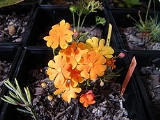
Dilleniaceae

Encyclopedia
Dilleniaceae is the botanical name
for a family
of flowering plants. Such a family has been universally recognized by taxonomists. It is known to gardeners for the genus Hibbertia
, which contains many commercially valuable garden species.
The family consists of about a dozen genera, of a few hundred species, found in the tropics and sub-tropics plus entire Australia
. The species are mostly woody plants, but range from herbaceous plants up to large trees.
The APG II system
, of 2003 (unchanged from the APG system
, of 1998), also recognizes this family, unplaced as to order, assigned to the clade core eudicots.
APG II debates either including it in order Caryophyllales
or reinstating the order Dilleniales
for just this one family, but decides to leave it unplaced.
Other genera recognized by Mabberley:
Only recognized by Takhtajan:
Botanical name
A botanical name is a formal scientific name conforming to the International Code of Botanical Nomenclature and, if it concerns a plant cultigen, the additional cultivar and/or Group epithets must conform to the International Code of Nomenclature for Cultivated Plants...
for a family
Family (biology)
In biological classification, family is* a taxonomic rank. Other well-known ranks are life, domain, kingdom, phylum, class, order, genus, and species, with family fitting between order and genus. As for the other well-known ranks, there is the option of an immediately lower rank, indicated by the...
of flowering plants. Such a family has been universally recognized by taxonomists. It is known to gardeners for the genus Hibbertia
Hibbertia
Hibbertia, or Guinea flower, is a genus of trees, shrubs, trailing shrubs and climbers of the family Dilleniaceae. The five-petalled flowers of all species are varying shades of yellow, with the exception of H. stellaris, H. miniata and H. selkii, a recently named species from the Stirling...
, which contains many commercially valuable garden species.
The family consists of about a dozen genera, of a few hundred species, found in the tropics and sub-tropics plus entire Australia
Australia
Australia , officially the Commonwealth of Australia, is a country in the Southern Hemisphere comprising the mainland of the Australian continent, the island of Tasmania, and numerous smaller islands in the Indian and Pacific Oceans. It is the world's sixth-largest country by total area...
. The species are mostly woody plants, but range from herbaceous plants up to large trees.
The APG II system
APG II system
The APG II system of plant classification is the second, now obsolete, version of a modern, mostly molecular-based, system of plant taxonomy that was published in April 2003 by the Angiosperm Phylogeny Group. It was a revision of the first APG system, published in 1998, and was superseded in 2009...
, of 2003 (unchanged from the APG system
APG system
The APG system of plant classification is the first, now obsolete, version of a modern, mostly molecular-based, system of plant taxonomy that was published in 1998 by the Angiosperm Phylogeny Group. It was superseded in 2003 by a revision, the APG II system, and then in 2009 by a further...
, of 1998), also recognizes this family, unplaced as to order, assigned to the clade core eudicots.
APG II debates either including it in order Caryophyllales
Caryophyllales
Caryophyllales is an order of flowering plants that includes the cacti, carnations, amaranths, ice plants, and many carnivorous plants. Many members are succulent, having fleshy stems or leaves.-Description:...
or reinstating the order Dilleniales
Dilleniales
Dilleniales is an order of flowering plants. The Cronquist system, of 1981, recognized such order and placed it in subclass Dilleniidae. It used the following circumscription:*order Dilleniales*: family Dilleniaceae*: family Paeoniaceae...
for just this one family, but decides to leave it unplaced.
Genera
Recognized by J. W. Horn:- Acrotrema
- Curatella
- Davilla
- Didesmandra
- DilleniaDilleniaDillenia is a genus of about 100 species of flowering plants in the family Dilleniaceae, native to tropical and subtropical regions of southern Asia, Australasia, and the Indian Ocean islands....
- Doliocarpus
- HibbertiaHibbertiaHibbertia, or Guinea flower, is a genus of trees, shrubs, trailing shrubs and climbers of the family Dilleniaceae. The five-petalled flowers of all species are varying shades of yellow, with the exception of H. stellaris, H. miniata and H. selkii, a recently named species from the Stirling...
- Pinzona
- SchumacheriaSchumacheriaSchumacheria is a genus of plant in family Dilleniaceae. It contains the following species :* Schumacheria alnifolia, Hook.f. & Thoms.* Schumacheria castanaefolia,...
- TetraceraTetraceraTetracera is a genus of flowering plants of the Dilleniaceae family.- Selected species :There are about 50 species in this genus.* Tetracera alnifolia Willd.* Tetracera asiatica Hoogland* Tetracera cowleyana F. M. Bailey...
Other genera recognized by Mabberley:
- Neodillenia (Genus dubium in Horn )
- Pachynema
Only recognized by Takhtajan:
- Neowormia
External links
- Dilleniaceae in L. Watson and M.J. Dallwitz (1992 onwards). The families of flowering plants: descriptions, illustrations, identification, information retrieval. Version: 3 May 2006. http://delta-intkey.com.
- at the University of Hawaii
- at PlantSystematics.org
- NCBI Taxonomy Browser
- links at CSDL