


Deserted medieval village

Encyclopedia
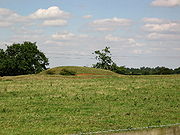
Abandoned village
An abandoned village is a village that has, for some reason, been deserted. In many countries, and throughout history, thousands of villages were deserted for a variety of causes...
which was abandoned during the Middle Ages
Middle Ages
The Middle Ages is a periodization of European history from the 5th century to the 15th century. The Middle Ages follows the fall of the Western Roman Empire in 476 and precedes the Early Modern Era. It is the middle period of a three-period division of Western history: Classic, Medieval and Modern...
, typically leaving no trace apart from earthworks
Earthworks (archaeology)
In archaeology, earthwork is a general term to describe artificial changes in land level. Earthworks are often known colloquially as 'lumps and bumps'. Earthworks can themselves be archaeological features or they can show features beneath the surface...
or cropmark
Cropmark
Cropmarks or Crop marks are a means through which sub-surface archaeological, natural and recent features may be visible from the air or a vantage point on higher ground or a temporary platform...
s. If there are fewer than three inhabited houses the convention is to regard the site as deserted; if there are more than three houses, it is regarded as a shrunken medieval village. There are estimated to be more than 3,000 DMVs in England alone.
Other deserted settlements
Not all sites are medieval; villages reduced in size or disappeared over a long period, from as early as Anglo-Saxon times to as late as the 1960s, for numerous different causes.Reasons for desertion
Over the centuries, settlements have been deserted for natural reasons including rivers changing course or siltSilt
Silt is granular material of a size somewhere between sand and clay whose mineral origin is quartz and feldspar. Silt may occur as a soil or as suspended sediment in a surface water body...
ing up, flooding (especially during the wet 13th and 14th centuries) as well as coastal and estuarine erosion
Erosion
Erosion is when materials are removed from the surface and changed into something else. It only works by hydraulic actions and transport of solids in the natural environment, and leads to the deposition of these materials elsewhere...
or being overwhelmed by windblown sand.
Many were thought to have been abandoned as a result of the deaths of their inhabitants from the Black Death
Black Death
The Black Death was one of the most devastating pandemics in human history, peaking in Europe between 1348 and 1350. Of several competing theories, the dominant explanation for the Black Death is the plague theory, which attributes the outbreak to the bacterium Yersinia pestis. Thought to have...
of the mid-14th century. While the plague
Bubonic plague
Plague is a deadly infectious disease that is caused by the enterobacteria Yersinia pestis, named after the French-Swiss bacteriologist Alexandre Yersin. Primarily carried by rodents and spread to humans via fleas, the disease is notorious throughout history, due to the unrivaled scale of death...
must have greatly hastened the population decline, which had already set in by the early 14th century in England because of soil exhaustion
Soils retrogression and degradation
Soil retrogression and degradation are two regressive evolution processes associated with the loss of equilibrium of a stable soil. Retrogression is primarily due to erosion and corresponds to a phenomenon where succession reverts back to pioneer conditions . Degradation is an evolution,...
and disease, most DMVs actually seem to date from the 15th century, when fields cultivated for cereal
Cereal
Cereals are grasses cultivated for the edible components of their grain , composed of the endosperm, germ, and bran...
s and vegetables by villagers were transformed into sheep pastures, often with ridge and furrow
Ridge and furrow
Ridge and furrow is an archaeological pattern of ridges and troughs created by a system of ploughing used in Europe during the Middle Ages. The earliest examples date to the immediate post-Roman period and the system was used until the 17th century in some areas. Ridge and furrow topography is...
surviving under grass, even until today. This change of land use
Land use
Land use is the human use of land. Land use involves the management and modification of natural environment or wilderness into built environment such as fields, pastures, and settlements. It has also been defined as "the arrangements, activities and inputs people undertake in a certain land cover...
by landowners to take advantage of the profitable wool trade led to hundreds of villages being deserted.
Later the aristocratic fashion for grand country mansion
Mansion
A mansion is a very large dwelling house. U.S. real estate brokers define a mansion as a dwelling of over . A traditional European mansion was defined as a house which contained a ballroom and tens of bedrooms...
s, parks and landscaped gardens led to whole villages being moved or destroyed to enable lords of the manor to satisfy the vogue – a process often called emparkment
Enclosure
Enclosure or inclosure is the process which ends traditional rights such as mowing meadows for hay, or grazing livestock on common land. Once enclosed, these uses of the land become restricted to the owner, and it ceases to be common land. In England and Wales the term is also used for the...
or enclosure
Enclosure
Enclosure or inclosure is the process which ends traditional rights such as mowing meadows for hay, or grazing livestock on common land. Once enclosed, these uses of the land become restricted to the owner, and it ceases to be common land. In England and Wales the term is also used for the...
.
Between about 1760 and 1835 parliamentary enclosures
Inclosure Act
The Inclosure or Enclosure Acts were a series of United Kingdom Acts of Parliament which enclosed open fields and common land in the country. They removed previously existing rights of local people to carry out activities in these areas, such as cultivation, cutting hay, grazing animals or using...
transformed the English countryside as the ancient open field system
Open field system
The open field system was the prevalent agricultural system in much of Europe from the Middle Ages to as recently as the 20th century in some places, particularly Russia and Iran. Under this system, each manor or village had several very large fields, farmed in strips by individual families...
of cultivation gave way to compact farms and enclosed fields
Enclosure
Enclosure or inclosure is the process which ends traditional rights such as mowing meadows for hay, or grazing livestock on common land. Once enclosed, these uses of the land become restricted to the owner, and it ceases to be common land. In England and Wales the term is also used for the...
. Bigger, more efficient farms resulted, but thousands of cottagers and small farmers were driven from the land and into the emerging big cities.
The notorious Highland Clearances
Highland Clearances
The Highland Clearances were forced displacements of the population of the Scottish Highlands during the 18th and 19th centuries. They led to mass emigration to the sea coast, the Scottish Lowlands, and the North American colonies...
led to a major depopulation of parts of Scotland during the late 18th and early 19th centuries.
Examples
Perhaps the best-known deserted medieval village in England is at Wharram PercyWharram Percy
Wharram Percy is a deserted medieval village site on the western edge of the chalk Wolds in North Yorkshire, England. The site is about one mile south of Wharram-le-Street and is clearly signposted from the B1248 Beverley to Malton road...
in North Yorkshire
North Yorkshire
North Yorkshire is a non-metropolitan or shire county located in the Yorkshire and the Humber region of England, and a ceremonial county primarily in that region but partly in North East England. Created in 1974 by the Local Government Act 1972 it covers an area of , making it the largest...
, because of the extensive archaeological
Archaeology
Archaeology, or archeology , is the study of human society, primarily through the recovery and analysis of the material culture and environmental data that they have left behind, which includes artifacts, architecture, biofacts and cultural landscapes...
excavations conducted there between its discovery in 1948 and 1990. Its ruined church and its former fishpond are still visible.
In Northamptonshire
Northamptonshire
Northamptonshire is a landlocked county in the English East Midlands, with a population of 629,676 as at the 2001 census. It has boundaries with the ceremonial counties of Warwickshire to the west, Leicestershire and Rutland to the north, Cambridgeshire to the east, Bedfordshire to the south-east,...
, where around 100 villages can be classified, there are articles relating to many in that county, such as Onley
Onley (lost settlement)
The lost village of Onley is located within the parish of Barby in the English county of Northamptonshire. The site is bordered on the north by the M45 motorway. On the east are Onley and Rye Hill prisons, and on the south-west is the A45 road...
, Althorp
Althorp (lost settlement)
The lost village of Althorp is within the grounds of the Althorp estate in the English county of Northamptonshire. The village is recorded in the Domesday Book. In the 15th century, the manor was held by the Catesby family who were probably responsible for clearing the settlement, for by 1505, the...
, Canons Ashby
Canons Ashby (lost settlement)
The lost village of Canons Ashby is located in ground to the north of Canons Ashby House in the English county of Northamptonshire. Today there is still a small village around the house but this is located away from the original settlement, since the original settlement is now just field occupied...
, Church Charwelton
Church Charwelton (lost settlement)
The lost village of Church Charwelton lies south-east of the village of Charwelton in the English county of Northamptonshire. Its site is on the north-east bank of the River Cherwell...
and Coton
Coton, Northamptonshire (lost settlement)
The lost village of Coton is located around the environs of the hamlet of Coton and Coton Manor House in the English county of Northamptonshire.-History:...
along with Faxton
Faxton
Faxton is an abandoned village and chapelry in the county of Northamptonshire in England.The last villager left in 1960 after the demolition of the parish church of St Denis. There is now just one house standing on this remote hilltop location, overlooking the rolling farmland...
, Glendon
Glendon
This article is about the English village. For the Glendon campus of York University, see Glendon College.The deserted village of Glendon is in the English county of Northamptonshire. Its location was on land to the east of Glendon Hall, now within the parish of Rushton...
, Snorscombe
Snorscombe
Snorscombe is a ruined hamlet, located to the south of Everdon in the English county of Northamptonshire. Its rural location, now on private land, makes it extremely hard to access.- History :The hamlet was once a thriving community...
, Wolfhampcote
Wolfhampcote
Wolfhampcote is an abandoned village and civil parish in the English counties of Warwickshire and Northamptonshire, which it straddles.The old village of Wolfhampcote is located west of the A45 road near Braunston in Northamptonshire, and can be reached by a track from the main A45 road, or by a...
and Wythmail.
Other examples are at Gainsthorpe
Gainsthorpe
Gainsthorpe is a deserted medieval village site in a field which is part of the present Gainsthorpe Farm in Lincolnshire, England. The site is in Hibaldstow parish located on a minor road west of the A15 road, south of Hibaldstow and 5 miles south-west of Brigg.It is now in the care of English...
, Lincolnshire and Old Wolverton in Milton Keynes
Milton Keynes
Milton Keynes , sometimes abbreviated MK, is a large town in Buckinghamshire, in the south east of England, about north-west of London. It is the administrative centre of the Borough of Milton Keynes...
.
See also
- Abandoned villageAbandoned villageAn abandoned village is a village that has, for some reason, been deserted. In many countries, and throughout history, thousands of villages were deserted for a variety of causes...
- Ghost townGhost townA ghost town is an abandoned town or city. A town often becomes a ghost town because the economic activity that supported it has failed, or due to natural or human-caused disasters such as floods, government actions, uncontrolled lawlessness, war, or nuclear disasters...
- Ghost estateGhost estateA ghost estate is an unoccupied housing estate built on the island of Ireland, most particularly the Republic of Ireland, during the period of economic growth when the Irish economy was known as the Celtic tiger. A massive surplus of housing, combined with the late-2000s recession, resulted in a...
- A modern phenomenon in rural Ireland - WalraversijdeWalraversijdeWalraversijde is an abandoned medieval fishing village on the Belgian coast, near Ostend. It was rediscovered in 1992 in a dune area, near a medieval dyke. Archeological research showed that it had been occupied, in two phases, between 1200 and 1600. Walraversijde has been studied more thoroughly...
– most researched deserted medieval fishing village in Europe