

Deinocheirus

Encyclopedia
Deinocheirus is a genus
of large theropod dinosaur
, possibly an ornithomimosaurian, which lived in what is now southern Mongolia
, during the late Cretaceous
Period (Nemegt Formation
, dating to around 70 million years ago).
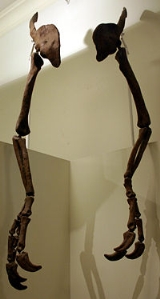
remains are a single pair of massive forelimbs and the remains of some ribs and vertebrae. They were found on 9 July 1965 during a Polish-Mongolian expedition to the Gobi by Professor Zofia Kielan-Jaworowska
at the Altan Ula III site in Ömnögovi Province
. The find was reported by her in 1966. Deinocheirus was named by Halszka Osmólska
and Ewa Roniewicz in 1970
. The type species
and only named species is Deinocheirus mirificus. The generic name is derived from Greek δεινός, deinos, "terrible", "horrible", and χείρ, cheir, "hand". The specific name is Latin
for 'unusual', 'peculiar'.
The holotype
specimen, ZPal MgD-I/6, was discovered on the desert surface in sandstone
dating to the early Maastrichtian
. It consists of a partial skeleton, most parts of which had already weathered away at the moment of discovery. Both forelimbs excluding the right claws, the complete shoulder girdle, centra of three dorsal vertebrae, five ribs, gastralia and two ceratobranchialia, supporting neck bones, could still be recovered.
, 688 mm ulna
and 770 mm hand — including up to 19.6 cm (7.7 in) long recurved claws. Each scapulocoracoid
of the shoulder girdle has a length of 153 centimetres. The neck must also have been massive with each half of the paired ceratobranchialia measuring 42 centimetres.
The gigantic size of these skeletal elements has generated much speculation about the magnitude of the animal as a whole. Osmólska and Roniewicz thought it could be best compared with the Ornithomimosauria
, as the structure of its arms is similar to the members of this group. Should Deinocheirus itself be a member this would make it by far the largest ornithomimosaur, indeed, one of the largest theropods. The describers estimated its size to be equal to the largest specimens of Tyrannosaurus
. Its weight was in 1988 estimated by Gregory S. Paul
to have been between six and twelve tonnes. Later estimates confirmed a number of roughly 9000 kg (19,841.6 lb). In 2010 Paul revised this to a length of ten metres and a weight of two tonnes.
In 2010, Phil Senter and H.J. Robins attempted to estimate the total height at the hip of Deinocheirus. By studying more completely known theropods, they found that the length of the scapula (shoulder blade), better than that of the humerus (upper arm bone), could be used to accurately predict hip height. Using the equation found over a range of theropods, Senter and Robins determined that Deinocheirus likely measured 3.3 m (10.8 ft) -3.6 m (11.8 ft) tall at the hip. This places it as possibly the tallest known theropod, taller than any contemporary predators such as Tarbosaurus
.
Though the arms of Deinocheirus have a considerable absolute size, being the longest of any known theropod with the exception of Therizinosaurus
, they are not very long relative to the shoulder girdle, the ratio being less than that with most ornithomimosaurs. The shoulder-blade is long and narrow. The humerus is relatively slender. The ulna and radius
too are elongated and not very firmly connected to each other in a syndesmosis
. The metacarpus is long compared to the fingers. The hand had a good mobility relative to the lower arm but was only capable of a limited flexing motion, unable to close in grasping. The fingers are about equal in length to each other, the first being the stoutest and the second the longest. Only the claw of the left second finger has been preserved in its entirety; it has a diameter of 196 millimetres and a length along its outer curvature of 323 millimetres.
, owing to the "gigantic size and thick-walled limb bones" but Osmólska and Roniewicz also speculated that it possibly "constitutes a link between Carnosauria and Coelurosauria
". Within Carnosauria, the family Deinocheiridae was tentatively, "faute de mieux", assigned to the superfamily Megalosauroidea
, basically because it was obviously not a tyrannosauroid
— tyrannosaurids having greatly reduced forelimbs endowed with only two extremely small fingers.
Peter Makovicky et al. pointed out that if Deinocheirus is an ornithomimosaur, it is a fairly primitive one, since it lacks some of the features typically seen in ornithomimosaurs. Basal traits include the recurved claws, the low humerus/scapula ratio, the lack of syndesmosis, a short posterior process of the coracoid and the combined length of the second and third phalanx of the third finger being greater than the length of the third phalanx. Yoshitsugu Kobayashi and Rinchen Barsbold added Deinocheirus to several recent cladistic
analyses of theropods and were unable to resolve its exact relationships but noted some support for it as a possible ornithomimosaur. Derived traits include the short hand, a flat metacarpus and a relative elongation of the claws.
 Early work generally envisioned Deinocheirus as a carnivore
that used its long forelimbs "in tearing dead or weakly agile prey asunder" (Osmólska & Roniewicz 1970: 15). David Lambert supported this view, describing the clawed hands of Deinocheirus as "horrifying weapons for attacking dinosaurs of almost any size ... capable of ripping open a sauropod's soft underbelly". G.S. Paul disagreed, suggesting that the claws are too blunt for killing but would have been good defensive weapons. The Russian paleontologist Rozhdestvensky
compared the forelimbs of Deinocheirus to sloth
s, leading him to hypothesize that Deinocheirus was a specialized climbing dinosaur, that fed on fruits and leaves and perhaps also eggs and any small animals found in trees. Rozhdestvensky imagined Deinocheirus with the trunk and hindlimbs no longer than the forelimbs, but there is no hard evidence for this and the climbing hypothesis has not received much support from other scientists.
Paul in 1988 suggested a herbivorous lifestyle for Deinocheirus. It shared its habitat
with several other giant, nine to thirteen meter long, herbivores uncovered in the Nemegt Formation, like the small titanosaur
sauropod Opisthocoelicaudia
, the lambeosaurine hadrosaurs Saurolophus
and Barsboldia
, and the bizarre even longer-clawed Therizinosaurus
. Trying to determine the respective niche
s for these animals Senter & Robins concluded that Deinocheirus due to its hip height had the largest vertical feeding range of them all, specialising in eating high foliage. Paul in 1988 had proposed it would have used its long neck to reach into trees and rip leaves, the arms assisting in pulling down branches.
ZPALNo.Mgd-I/6, the holotype of Deinocheirus mirificus, has abnormal pits, grooves and tubercles on the first and second phalanx of the left second finger that may be the result of injuries to the joint between the two bones.
Genus
In biology, a genus is a low-level taxonomic rank used in the biological classification of living and fossil organisms, which is an example of definition by genus and differentia...
of large theropod dinosaur
Dinosaur
Dinosaurs are a diverse group of animals of the clade and superorder Dinosauria. They were the dominant terrestrial vertebrates for over 160 million years, from the late Triassic period until the end of the Cretaceous , when the Cretaceous–Paleogene extinction event led to the extinction of...
, possibly an ornithomimosaurian, which lived in what is now southern Mongolia
Mongolia
Mongolia is a landlocked country in East and Central Asia. It is bordered by Russia to the north and China to the south, east and west. Although Mongolia does not share a border with Kazakhstan, its western-most point is only from Kazakhstan's eastern tip. Ulan Bator, the capital and largest...
, during the late Cretaceous
Cretaceous
The Cretaceous , derived from the Latin "creta" , usually abbreviated K for its German translation Kreide , is a geologic period and system from circa to million years ago. In the geologic timescale, the Cretaceous follows the Jurassic period and is followed by the Paleogene period of the...
Period (Nemegt Formation
Nemegt Formation
The Nemegt Formation is a geological formation dating from the Late Cretaceous sedimentary from the Gobi Desert of Mongolia. It overlies and sometimes forms folds with the Barun Goyot Formation. It consists of river channel sediments and contains fossils of fish, turtles, crocodilians, birds and a...
, dating to around 70 million years ago).
Discovery and naming
The only known fossilFossil
Fossils are the preserved remains or traces of animals , plants, and other organisms from the remote past...
remains are a single pair of massive forelimbs and the remains of some ribs and vertebrae. They were found on 9 July 1965 during a Polish-Mongolian expedition to the Gobi by Professor Zofia Kielan-Jaworowska
Zofia Kielan-Jaworowska
Zofia Kielan-Jaworowska is a Polish paleobiologist. In the mid-1960s Kielan-Jaworowska led a series of Polish-Mongolian paleontological expeditions to the Gobi Desert...
at the Altan Ula III site in Ömnögovi Province
Ömnögovi Province
Ömnögovi is an aimag of Mongolia, located in the south of the country, in the Gobi Desert. Ömnögovi is Mongolia's largest aimag. The capital is Dalanzadgad....
. The find was reported by her in 1966. Deinocheirus was named by Halszka Osmólska
Halszka Osmólska
Halszka Osmólska was a Polish paleontologist who had specialized in Mongolian dinosaurs.She was born in Poznań. A member of the 1965 and 1970 Polish–Mongolian expeditions to the Gobi Desert, she described many finds from these rocks, often with Teresa Maryańska...
and Ewa Roniewicz in 1970
1970 in science
The year 1970 in science and technology involved some significant events, listed below.-Astronomy and space exploration:* February 11 - Japan becomes the fourth country to launch a satellite into orbit....
. The type species
Type species
In biological nomenclature, a type species is both a concept and a practical system which is used in the classification and nomenclature of animals and plants. The value of a "type species" lies in the fact that it makes clear what is meant by a particular genus name. A type species is the species...
and only named species is Deinocheirus mirificus. The generic name is derived from Greek δεινός, deinos, "terrible", "horrible", and χείρ, cheir, "hand". The specific name is Latin
Latin
Latin is an Italic language originally spoken in Latium and Ancient Rome. It, along with most European languages, is a descendant of the ancient Proto-Indo-European language. Although it is considered a dead language, a number of scholars and members of the Christian clergy speak it fluently, and...
for 'unusual', 'peculiar'.
The holotype
Holotype
A holotype is a single physical example of an organism, known to have been used when the species was formally described. It is either the single such physical example or one of several such, but explicitly designated as the holotype...
specimen, ZPal MgD-I/6, was discovered on the desert surface in sandstone
Sandstone
Sandstone is a sedimentary rock composed mainly of sand-sized minerals or rock grains.Most sandstone is composed of quartz and/or feldspar because these are the most common minerals in the Earth's crust. Like sand, sandstone may be any colour, but the most common colours are tan, brown, yellow,...
dating to the early Maastrichtian
Maastrichtian
The Maastrichtian is, in the ICS' geologic timescale, the latest age or upper stage of the Late Cretaceous epoch or Upper Cretaceous series, the Cretaceous period or system, and of the Mesozoic era or erathem. It spanned from 70.6 ± 0.6 Ma to 65.5 ± 0.3 Ma...
. It consists of a partial skeleton, most parts of which had already weathered away at the moment of discovery. Both forelimbs excluding the right claws, the complete shoulder girdle, centra of three dorsal vertebrae, five ribs, gastralia and two ceratobranchialia, supporting neck bones, could still be recovered.
Description
The most well-preserved parts of Deinocheirus are its forelimbs, which measured 2.4 m (7.9 ft) long — a 938 mm humerusHumerus
The humerus is a long bone in the arm or forelimb that runs from the shoulder to the elbow....
, 688 mm ulna
Ulna
The ulna is one of the two long bones in the forearm, the other being the radius. It is prismatic in form and runs parallel to the radius, which is shorter and smaller. In anatomical position The ulna is one of the two long bones in the forearm, the other being the radius. It is prismatic in form...
and 770 mm hand — including up to 19.6 cm (7.7 in) long recurved claws. Each scapulocoracoid
Scapulocoracoid
The Scapulocoracoid is the unit of the pectoral girdle that contains the coracoid and scapula.The coracoid itself is a beak-shaped bone that is commonly found in most vertebrates with a few exceptions.The scapula is commonly known as the shoulder blade...
of the shoulder girdle has a length of 153 centimetres. The neck must also have been massive with each half of the paired ceratobranchialia measuring 42 centimetres.
The gigantic size of these skeletal elements has generated much speculation about the magnitude of the animal as a whole. Osmólska and Roniewicz thought it could be best compared with the Ornithomimosauria
Ornithomimosauria
The Ornithomimosauria, ornithomimosaurs or ostrich dinosaurs were theropod dinosaurs which bore a superficial resemblance to modern ostriches. They were fast, omnivorous or herbivorous dinosaurs from the Cretaceous Period of Laurasia...
, as the structure of its arms is similar to the members of this group. Should Deinocheirus itself be a member this would make it by far the largest ornithomimosaur, indeed, one of the largest theropods. The describers estimated its size to be equal to the largest specimens of Tyrannosaurus
Tyrannosaurus
Tyrannosaurus meaning "tyrant," and sauros meaning "lizard") is a genus of coelurosaurian theropod dinosaur. The species Tyrannosaurus rex , commonly abbreviated to T. rex, is a fixture in popular culture. It lived throughout what is now western North America, with a much wider range than other...
. Its weight was in 1988 estimated by Gregory S. Paul
Gregory S. Paul
Gregory Scott Paul is a freelance researcher, author and illustrator who works in paleontology, and more recently has examined sociology and theology. He is best known for his work and research on theropod dinosaurs and his detailed illustrations, both live and skeletal...
to have been between six and twelve tonnes. Later estimates confirmed a number of roughly 9000 kg (19,841.6 lb). In 2010 Paul revised this to a length of ten metres and a weight of two tonnes.
In 2010, Phil Senter and H.J. Robins attempted to estimate the total height at the hip of Deinocheirus. By studying more completely known theropods, they found that the length of the scapula (shoulder blade), better than that of the humerus (upper arm bone), could be used to accurately predict hip height. Using the equation found over a range of theropods, Senter and Robins determined that Deinocheirus likely measured 3.3 m (10.8 ft) -3.6 m (11.8 ft) tall at the hip. This places it as possibly the tallest known theropod, taller than any contemporary predators such as Tarbosaurus
Tarbosaurus
Tarbosaurus is a genus of tyrannosaurid theropod dinosaur that flourished in Asia about 70 million years ago, at the end of the Late Cretaceous Period. Fossils have been recovered in Mongolia, with more fragmentary remains found further afield in parts of China. Although many species have been...
.
Though the arms of Deinocheirus have a considerable absolute size, being the longest of any known theropod with the exception of Therizinosaurus
Therizinosaurus
Therizinosaurus is a genus of very large theropod dinosaur. Therizinosaurus lived in the late Cretaceous Period , and was one of the last and largest representatives of its unique group, the Therizinosauria...
, they are not very long relative to the shoulder girdle, the ratio being less than that with most ornithomimosaurs. The shoulder-blade is long and narrow. The humerus is relatively slender. The ulna and radius
Radius
In classical geometry, a radius of a circle or sphere is any line segment from its center to its perimeter. By extension, the radius of a circle or sphere is the length of any such segment, which is half the diameter. If the object does not have an obvious center, the term may refer to its...
too are elongated and not very firmly connected to each other in a syndesmosis
Syndesmosis
A syndesmosis is slightly movable articulation where the contiguous bony surfaces are united by an interosseous ligament, as in the inferior tibiofibular articulation...
. The metacarpus is long compared to the fingers. The hand had a good mobility relative to the lower arm but was only capable of a limited flexing motion, unable to close in grasping. The fingers are about equal in length to each other, the first being the stoutest and the second the longest. Only the claw of the left second finger has been preserved in its entirety; it has a diameter of 196 millimetres and a length along its outer curvature of 323 millimetres.
Classification
Deinocheirus is now considered by most paleontologists to be an ornithomimosaur, however, over the decades, scientists have not always agreed about the placement of Deinocheirus within Dinosauria. While Kielan-Jaworowska had initially assigned the find to the Megalosauridae, Osmólska and Roniewicz created a new family for Deinocheirus, the Deinocheiridae. The family Deinocheiridae was initially placed in the infraorder CarnosauriaCarnosauria
Carnosauria is a group of large predatory dinosaurs that lived during the Jurassic and Cretaceous periods. While it originally contained a wide assortment of giant theropods that were not closely related, the group has since been defined to encompass only the allosaurs and their closest kin...
, owing to the "gigantic size and thick-walled limb bones" but Osmólska and Roniewicz also speculated that it possibly "constitutes a link between Carnosauria and Coelurosauria
Coelurosauria
Coelurosauria is the clade containing all theropod dinosaurs more closely related to birds than to carnosaurs. In the past, it was used to refer to all small theropods, although this classification has been abolished...
". Within Carnosauria, the family Deinocheiridae was tentatively, "faute de mieux", assigned to the superfamily Megalosauroidea
Megalosauroidea
Megalosauroidea is a group of tetanuran theropod dinosaurs that lived from the Middle Jurassic to the Late Cretaceous period.-Classification:...
, basically because it was obviously not a tyrannosauroid
Tyrannosauroidea
Tyrannosauroidea is a superfamily of coelurosaurian theropod dinosaurs that includes the family Tyrannosauridae as well as more basal relatives. Tyrannosauroids lived on the Laurasian supercontinent beginning in the Jurassic Period...
— tyrannosaurids having greatly reduced forelimbs endowed with only two extremely small fingers.
Peter Makovicky et al. pointed out that if Deinocheirus is an ornithomimosaur, it is a fairly primitive one, since it lacks some of the features typically seen in ornithomimosaurs. Basal traits include the recurved claws, the low humerus/scapula ratio, the lack of syndesmosis, a short posterior process of the coracoid and the combined length of the second and third phalanx of the third finger being greater than the length of the third phalanx. Yoshitsugu Kobayashi and Rinchen Barsbold added Deinocheirus to several recent cladistic
Cladistics
Cladistics is a method of classifying species of organisms into groups called clades, which consist of an ancestor organism and all its descendants . For example, birds, dinosaurs, crocodiles, and all descendants of their most recent common ancestor form a clade...
analyses of theropods and were unable to resolve its exact relationships but noted some support for it as a possible ornithomimosaur. Derived traits include the short hand, a flat metacarpus and a relative elongation of the claws.
Paleobiology
Carnivore
A carnivore meaning 'meat eater' is an organism that derives its energy and nutrient requirements from a diet consisting mainly or exclusively of animal tissue, whether through predation or scavenging...
that used its long forelimbs "in tearing dead or weakly agile prey asunder" (Osmólska & Roniewicz 1970: 15). David Lambert supported this view, describing the clawed hands of Deinocheirus as "horrifying weapons for attacking dinosaurs of almost any size ... capable of ripping open a sauropod's soft underbelly". G.S. Paul disagreed, suggesting that the claws are too blunt for killing but would have been good defensive weapons. The Russian paleontologist Rozhdestvensky
Anatoly Konstantinovich Rozhdestvensky
Anatoly Konstantinovich Rozhdestvensky was a Russian paleontologist responsible for naming many dinosaurs, including Aralosaurus and Probactrosaurus....
compared the forelimbs of Deinocheirus to sloth
Sloth
Sloths are the six species of medium-sized mammals belonging to the families Megalonychidae and Bradypodidae , part of the order Pilosa and therefore related to armadillos and anteaters, which sport a similar set of specialized claws.They are arboreal residents of the jungles of Central and South...
s, leading him to hypothesize that Deinocheirus was a specialized climbing dinosaur, that fed on fruits and leaves and perhaps also eggs and any small animals found in trees. Rozhdestvensky imagined Deinocheirus with the trunk and hindlimbs no longer than the forelimbs, but there is no hard evidence for this and the climbing hypothesis has not received much support from other scientists.
Paul in 1988 suggested a herbivorous lifestyle for Deinocheirus. It shared its habitat
Habitat
* Habitat , a place where a species lives and grows*Human habitat, a place where humans live, work or play** Space habitat, a space station intended as a permanent settlement...
with several other giant, nine to thirteen meter long, herbivores uncovered in the Nemegt Formation, like the small titanosaur
Titanosaur
Titanosaurs were a diverse group of sauropod dinosaurs, which included Saltasaurus and Isisaurus. It includes some of the heaviest creatures ever to walk the earth, such as Argentinosaurus and Paralititan — which some believe have weighed up to 100 tonnes...
sauropod Opisthocoelicaudia
Opisthocoelicaudia
Opisthocoelicaudia was 12-metre-long sauropod dinosaur of the Late Cretaceous Period discovered in Mongolia in 1965 by Polish and Mongolian scientists in what is now the Gobi Desert...
, the lambeosaurine hadrosaurs Saurolophus
Saurolophus
Saurolophus is a genus of large hadrosaurine duckbill that lived about 69.5-68.5 million years ago, in the Late Cretaceous of North America and Asia; it is one of the few genera of dinosaurs known from multiple continents. It is distinguished by a spike-like crest which projects up and back...
and Barsboldia
Barsboldia
Barsboldia was a genus of large hadrosaurid dinosaur from the early Maastrichtian Nemegt Formation of Ömnogöv', Mongolia. It is known from a partial vertebral column, partial pelvis, and some ribs...
, and the bizarre even longer-clawed Therizinosaurus
Therizinosaurus
Therizinosaurus is a genus of very large theropod dinosaur. Therizinosaurus lived in the late Cretaceous Period , and was one of the last and largest representatives of its unique group, the Therizinosauria...
. Trying to determine the respective niche
Niche
Niche may refer to:*Niche , an exedra or an apse that has been reduced in size;*Niche , Colombian/Spanish football player, full name Víctor Manuel Micolta Armero*Niche , a British Thoroughbred racehorse...
s for these animals Senter & Robins concluded that Deinocheirus due to its hip height had the largest vertical feeding range of them all, specialising in eating high foliage. Paul in 1988 had proposed it would have used its long neck to reach into trees and rip leaves, the arms assisting in pulling down branches.
ZPALNo.Mgd-I/6, the holotype of Deinocheirus mirificus, has abnormal pits, grooves and tubercles on the first and second phalanx of the left second finger that may be the result of injuries to the joint between the two bones.