
All Topics  
Deadly nightshade

 
Deadly Nightshade

   Email Print
   Bookmark   Link


Deadly nightshade


Atropa belladonna or Atropa bella-donna, commonly known as belladonna or deadly nightshade, is a perennial
Perennial plant

A perennial plant or perennial is a plant that lives for more than two years. When used by gardeners or horticulturalists, this term applies specifically to perennial herbaceous plants....
 herbaceous plant in the family Solanaceae
Solanaceae

The Solanaceae is a family of flowering plants, that contains a number of important agricultural plants as well as many toxic plants. The name of the family comes from the Latin Solanum "the nightshade plant", but the further etymology of that word is unclear....
, native to Europe
Europe

Europe is, conventionally, one of the world's seven continents. Comprising the westernmost peninsula of Eurasia, Europe is generally divided from Asia to its east by the water divide of the Ural Mountains, the Ural , the Caspian Sea, and by the Caucasus Mountains to the southeast....
, North Africa
North Africa

North Africa or Northern Africa is the northernmost region of the African continent, separated by the Sahara from Sub-Saharan Africa.Geopolitically, the United Nations subregion of Northern Africa includes the following seven countries or territories:...
, and Western Asia. The foliage and berries are extremely toxic
Toxin

A toxin is a poisonous substance produced by living cells or organisms. For a toxic substance not produced by living organisms, "toxicant" is the more appropriate term, and "toxics" is an acceptable plural....
. It has tropane alkaloids, including scopolamine
Scopolamine

Scopolamine, known by the names levo-duboisine and hyoscine, is a tropane alkaloid Medication with muscarinic antagonist effects. It is obtained from plants of the family Solanaceae , such as henbane, jimson weed and Angel's Trumpets , and corkwood ....
 and hyoscyamine
Hyoscyamine

Hyoscyamine, pronounced hi-oh-SYE-uh-meen, is a chemical compound, a tropane alkaloid. It is the levorotary isomer to atropine. It is a secondary metabolite found in certain plants of the Solanaceae family, including henbane, mandrake , jimsonweed , and deadly nightshade ....
, that cause bizarre delirium
Delirium

Delirium is an acute and relatively sudden decline in attention-focus, perception, and cognition. In medical usage it is not synonymous with drowsiness, and may occur without it....
 and hallucination
Hallucination

A hallucination, in the broadest sense, is a perception in the absence of a stimulus . In a stricter sense, hallucinations are defined as perceptions in a conscious and awake state in the absence of external stimuli which have qualities of real perception, in that they are vivid, substantial, and located in external objective space....
s. The drug atropine
Atropine

Atropine is a tropane alkaloid extracted from deadly nightshade , jimsonweed , Mandrake and other plants of the family Solanaceae. It is a secondary metabolite of these plants and serves as a hard drug with a wide variety of effects....
 is derived from the plant.

The name "atropa" comes from the Greek fate of destiny called Atropos
Atropos

In Greek mythology, Atropos was one of the three Moirae, Goddesses of wikt:fate and destiny. Her Roman equivalent was Morta . Atropos was the oldest of the Three Fates, and was known as the "inflexible" or "inevitable." It was Atropos who chose the mechanism of death and ended the life of each mortal by cutting their thread with her "abhor...
, and the name "bella donna" is derived from Italian
Italian language

Italian is a Romance languages spoken by about 63 million people as a first language, primarily in Italy. In Switzerland, Italian is one of four Linguistic geography of Switzerlands....
 and means "beautiful woman".

Description
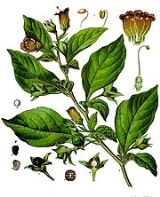
Atropa belladonna is a branching herbaceous
Herbaceous

A herbaceous plant is a plant that has leaf and stem that die down at the end of the growing season to the soil level. A herbaceous plant may be Annual plant, Biennial plant or Perennial plant....
 perennial, often growing as a subshrub
Subshrub

A subshrub is a horticultural rather than strictly botany category of woody perennial plant. It is distinguished from a shrub by its ground-hugging stems and lower height, with overwintering perennial woody growth typically less than 10–20 cm tall, or by being only weakly woody and/or persisting only for a few years....
, from a fleshy rootstock.


Discussion
Ask a question about 'Deadly nightshade'
Start a new discussion about 'Deadly nightshade'
Answer questions from other users
Full Discussion Forum


Encyclopedia


Atropa belladonna or Atropa bella-donna, commonly known as belladonna or deadly nightshade, is a perennial
Perennial plant

A perennial plant or perennial is a plant that lives for more than two years. When used by gardeners or horticulturalists, this term applies specifically to perennial herbaceous plants....
 herbaceous plant in the family Solanaceae
Solanaceae

The Solanaceae is a family of flowering plants, that contains a number of important agricultural plants as well as many toxic plants. The name of the family comes from the Latin Solanum "the nightshade plant", but the further etymology of that word is unclear....
, native to Europe
Europe

Europe is, conventionally, one of the world's seven continents. Comprising the westernmost peninsula of Eurasia, Europe is generally divided from Asia to its east by the water divide of the Ural Mountains, the Ural , the Caspian Sea, and by the Caucasus Mountains to the southeast....
, North Africa
North Africa

North Africa or Northern Africa is the northernmost region of the African continent, separated by the Sahara from Sub-Saharan Africa.Geopolitically, the United Nations subregion of Northern Africa includes the following seven countries or territories:...
, and Western Asia. The foliage and berries are extremely toxic
Toxin

A toxin is a poisonous substance produced by living cells or organisms. For a toxic substance not produced by living organisms, "toxicant" is the more appropriate term, and "toxics" is an acceptable plural....
. It has tropane alkaloids, including scopolamine
Scopolamine

Scopolamine, known by the names levo-duboisine and hyoscine, is a tropane alkaloid Medication with muscarinic antagonist effects. It is obtained from plants of the family Solanaceae , such as henbane, jimson weed and Angel's Trumpets , and corkwood ....
 and hyoscyamine
Hyoscyamine

Hyoscyamine, pronounced hi-oh-SYE-uh-meen, is a chemical compound, a tropane alkaloid. It is the levorotary isomer to atropine. It is a secondary metabolite found in certain plants of the Solanaceae family, including henbane, mandrake , jimsonweed , and deadly nightshade ....
, that cause bizarre delirium
Delirium

Delirium is an acute and relatively sudden decline in attention-focus, perception, and cognition. In medical usage it is not synonymous with drowsiness, and may occur without it....
 and hallucination
Hallucination

A hallucination, in the broadest sense, is a perception in the absence of a stimulus . In a stricter sense, hallucinations are defined as perceptions in a conscious and awake state in the absence of external stimuli which have qualities of real perception, in that they are vivid, substantial, and located in external objective space....
s. The drug atropine
Atropine

Atropine is a tropane alkaloid extracted from deadly nightshade , jimsonweed , Mandrake and other plants of the family Solanaceae. It is a secondary metabolite of these plants and serves as a hard drug with a wide variety of effects....
 is derived from the plant.

The name "atropa" comes from the Greek fate of destiny called Atropos
Atropos

In Greek mythology, Atropos was one of the three Moirae, Goddesses of wikt:fate and destiny. Her Roman equivalent was Morta . Atropos was the oldest of the Three Fates, and was known as the "inflexible" or "inevitable." It was Atropos who chose the mechanism of death and ended the life of each mortal by cutting their thread with her "abhor...
, and the name "bella donna" is derived from Italian
Italian language

Italian is a Romance languages spoken by about 63 million people as a first language, primarily in Italy. In Switzerland, Italian is one of four Linguistic geography of Switzerlands....
 and means "beautiful woman".

Description


Atropa Bella Donna1
Atropa belladonna is a branching herbaceous
Herbaceous

A herbaceous plant is a plant that has leaf and stem that die down at the end of the growing season to the soil level. A herbaceous plant may be Annual plant, Biennial plant or Perennial plant....
 perennial, often growing as a subshrub
Subshrub

A subshrub is a horticultural rather than strictly botany category of woody perennial plant. It is distinguished from a shrub by its ground-hugging stems and lower height, with overwintering perennial woody growth typically less than 10–20 cm tall, or by being only weakly woody and/or persisting only for a few years....
, from a fleshy rootstock. Plants grow to tall with long ovate leaves. The bell-shaped flower
Flower

A flower, sometimes known as a bloom or blossom, is the reproduction structure found in flowering plants . The biological function of a flower is to mediate the union of male sperm with female ovum in order to produce seeds....
s are dull purple with green tinges and faintly scented. The fruit
Fruit

The term fruit has different meanings dependent on context, and the term is not synonymous in food preparation and biology. In botany, which is the scientific study of plants, fruits are the ripened Ovary of flowering plants....
s are berries
Berry

In everyday English, a berry is a broad term for any small edible fruit. Most berries are juicy, round or semi-oblong, brightly coloured, sweet or sour, and don't have a stone or pit....
, which are green ripening to a shiny black, and approximately 1 cm in diameter. The berries are sweet and are consumed by animals that disperse the seeds in their droppings, even though the seeds contain toxic alkaloids. There is a pale yellow flowering form called Atropa belladonna var. lutea with pale yellow fruit.

Atropa belladona is rarely used in gardens, but when grown it is usually for its large upright habit
Habit (biology)

Habit, when used in the context of biology, refers to the instinctive actions of animals and the natural tendencies of plants.In zoology, this term is used most often to describe where an animal spends most of its life cycle....
 and showy berries. It is naturalized
Naturalisation (biology)

In biology, naturalisation is the process when foreign or cultivated plants or animals have spread into the wild, where they multiply by natural regeneration....
 in parts of North America
North America

North America is the northern continent of the Americas, situated in the Earth's northern hemisphere and almost totally in the western hemisphere....
, where it is often found in shady, moist locations with limestone
Limestone

File:Limestone Formation In Waitomo.jpgLimestone is a sedimentary rock composed largely of the mineral calcite . The deposition of limestone strata is often a by-product and indicator of biological activity in the geology record....
-rich soil
Soil

Soil is the naturally occurring, unconsolidated or loose covering on the Earth's surface. Soil is composed of particles of broken rock that have been altered by chemical and environmental processes including weathering and erosion....
s. It is considered a weed
WEED

WEED is a radio station broadcasting a Gospel format. Licensed to Rocky Mount, North Carolina, USA, it serves the area. The station is currently owned by Northstar Broadcasting Corporation....
 species in parts of the world, where it colonizes areas with disturbed soils. Germination
Germination

Germination is the process whereby growth emerges from a period of dormancy. The most common example of germination is the sprouting of a seedling from a seed of an flowering plant or gymnosperm....
 of the small seeds is often difficult, due to hard seed coats that cause seed dormancy
Dormancy

Dormancy is a period in an Organism Biological life cycle when growth, development, and physical activity is temporarily suspended. This minimizes metabolism and therefore helps an organism to conserve energy....
. Germination takes several weeks under alternating temperature conditions but can be sped up with the use of gibberellic acid
Gibberellic acid

Gibberellic acid stimulate rapid stem and root growth,2) induce mitotic division in the leaves of some plants,3) increase seed germination rate....
. The seedlings need sterile
Sterilization (microbiology)

Sterilization refers to any process that effectively kills or eliminates transmissible agents from a surface, equipment, article of food or medication, or biological culture medium....
 soil
Soil

Soil is the naturally occurring, unconsolidated or loose covering on the Earth's surface. Soil is composed of particles of broken rock that have been altered by chemical and environmental processes including weathering and erosion....
 to prevent damping off
Damping off

Damping off is the term used for a number of different fungus-caused ailments which can kill seeds or seedlings before or after they germinate....
 and resent root disturbance during transplanting.

Naming and taxonomy


The first botanical description was by Linnaeus in Species Plantarum
Species Plantarum

Species Plantarum was first published in 1753, as a two-volume work by Carl Linnaeus. Its prime importance is perhaps that it is the primary starting point of botanical nomenclature as it exists today....
 in 1753. It is in the nightshade family (Solanaceae
Solanaceae

The Solanaceae is a family of flowering plants, that contains a number of important agricultural plants as well as many toxic plants. The name of the family comes from the Latin Solanum "the nightshade plant", but the further etymology of that word is unclear....
), which it shares with potato
Potato

The potato is a starchy, tuberous crop from the perennial plant Solanum tuberosum of the Solanaceae family. The word potato may refer to the plant itself as well....
es, tomato
Tomato

The Tomato is an herbaceous, usually sprawling plant in the Solanaceae or nightshade family, as are its close cousins Nicotiana, potatoes, aubergine , chilli peppers, and the poisonous Atropa belladonna....
es, eggplants, jimsonweed, tobacco
Tobacco

Tobacco is an agricultural product processed from the fresh leaves of plants in the genus Nicotiana. It can be consumed, used as an organic pesticide, and in the form of nicotine tartrate it is used in some medicines....
, wolfberry
Wolfberry

Wolfberry - commercially called goji berry - is the common name for the fruit of two very closely related species: Lycium barbarum and L....
, and chili pepper
Chili pepper

Chili pepper is the fruit of the plants from the genus Capsicum, members of the Solanaceae, Solanaceae. Botany considers the plant a berry bush....
s. The common names for this species include belladonna, deadly nightshade, dwale, banewort, devil's cherries, naughty man's cherries, divale, black cherry, devil's herb, great morel, and dwayberry. It is one of two species to be known as deadly nightshade, the other is Solanum nigrum
Solanum nigrum

Solanum nigrum is a species in the Solanum genus, native to Eurasia and introduced in the Americas and Australasia.Description...
.

The name Atropa is thought to be derived from that of the Greek goddess Atropos
Atropos

In Greek mythology, Atropos was one of the three Moirae, Goddesses of wikt:fate and destiny. Her Roman equivalent was Morta . Atropos was the oldest of the Three Fates, and was known as the "inflexible" or "inevitable." It was Atropos who chose the mechanism of death and ended the life of each mortal by cutting their thread with her "abhor...
, one of the three Greek fates or destinies
Moirae

The Moirae or Moerae , in Greek mythology, were the white-robed personifications of destiny . The Greek word moira literally means a part or portion, and by extension one's portion in life or destiny....
 who would determine the course of a man's life by the weaving of threads that symbolized their birth, the events in their life and finally their death; with Atropos cutting these threads to mark the latter. The name "belladonna" comes from italian language, meaning "beautiful lady"; originating either from its usage as cosmetic for the face, or, more probably, from its usage to increase the pupil size in ladies.

Toxicity

Belladonna is one of the most toxic
Toxicity

Toxicity is the degree to which a substance is able to damage an exposed organism. Toxicity can refer to the effect on a whole organism, such as an animal, bacterium, or plant, as well as the effect on a substructure of the organism, such as a cell or an organ , such as the liver ....
 plants found in the Western hemisphere
Western Hemisphere

The Western Hemisphere, also Western hemisphere or western hemisphere, is a geography term for the half of the Earth that lies west of the Prime Meridian , the other half being the Eastern Hemisphere....
. All parts of the plant contain tropane alkaloids. The berries pose the greatest danger to children because they look attractive and have a somewhat sweet taste. The consumption of two to five berries by children and ten to twenty berries by adults can be lethal. The root of the plant is generally the most toxic part, though this can vary from one specimen to another. Ingestion of a single leaf of the plant can be fatal to an adult.

The active agents in Belladonna, atropine
Atropine

Atropine is a tropane alkaloid extracted from deadly nightshade , jimsonweed , Mandrake and other plants of the family Solanaceae. It is a secondary metabolite of these plants and serves as a hard drug with a wide variety of effects....
, hyoscine (scopolamine
Scopolamine

Scopolamine, known by the names levo-duboisine and hyoscine, is a tropane alkaloid Medication with muscarinic antagonist effects. It is obtained from plants of the family Solanaceae , such as henbane, jimson weed and Angel's Trumpets , and corkwood ....
), and hyoscyamine
Hyoscyamine

Hyoscyamine, pronounced hi-oh-SYE-uh-meen, is a chemical compound, a tropane alkaloid. It is the levorotary isomer to atropine. It is a secondary metabolite found in certain plants of the Solanaceae family, including henbane, mandrake , jimsonweed , and deadly nightshade ....
, have anticholinergic
Anticholinergic

An anticholinergic agent is a substance that blocks the neurotransmitter acetylcholine in the central nervous system and the peripheral nervous system....
 properties. The symptoms of belladonna poison
Poison

In the context of biology, poisons are Chemical substance that can cause disturbances to organisms, usually by chemical reaction or other activity on the molecular scale, when a sufficient quantity is absorbed by an organism....
ing include dilated pupils, sensitivity to light, blurred vision
Visual perception

Visual perception is the ability to interpret information from visible light reaching the eye. The resulting perception is also known as eyesight, sight or vision....
, tachycardia
Tachycardia

The word tachycardia comes from the Greek words tachys and kardia .Tachycardia typically refers to a heartrate that exceeds the range of the normal resting heartrate, based upon age:...
, loss of balance, staggering, headache, rash
Rash

A rash is a change of the skin which affects its color, appearance, or texture. A rash may be localized in one part of the body, or affect all the skin....
, flushing, dry mouth and throat, slurred speech, urinary retention
Urinary retention

Urinary retention also known as ischuria is a lack of ability to urinate. It is a common complication of Benign prostatic hyperplasia , although anticholinergics may also play a role, and requires a catheter or Prostatic stent....
, constipation
Constipation

Constipation, costiveness, or irregularity, is a condition of the digestive system in which a person experiences hard feces that are difficult to expel....
, confusion
Mental confusion

Confusion, of a pathological degree, usually refers to loss of orientation and often memory . Confusion as such is not synonymous with inability to focus attention, although severe inability to focus attention can cause, or greatly contribute to, confusion....
, hallucination
Hallucination

A hallucination, in the broadest sense, is a perception in the absence of a stimulus . In a stricter sense, hallucinations are defined as perceptions in a conscious and awake state in the absence of external stimuli which have qualities of real perception, in that they are vivid, substantial, and located in external objective space....
s, delirium, and convulsions. The plant's deadly symptoms are caused by atropine's disruption of the parasympathetic nervous system
Parasympathetic nervous system

The parasympathetic nervous system is a division of the autonomic nervous system , along with the sympathetic nervous system and enteric nervous system ....
's ability to regulate non-volitional/subconscious activities such as sweating, breathing, and heart rate. The antidote
Antidote

An antidote is a substance which can counteract a form of poison. The term ultimately derives from the Greek a?t?d?d??a? antididonai, "given against"....
 for belladonna poisoning is physostigmine
Physostigmine

Physostigmine is a parasympathomimetic, specifically, a reversible cholinesterase inhibitor alkaloid of the Calabar bean.The chemical was synthesized for the first time in 1935 by the chemists Percy Lavon Julian and Josef Pikl....
 or pilocarpine
Pilocarpine

Pilocarpine is a muscarine alkaloid obtained from the leaves of tropical American shrubs from the genus Pilocarpus. It is a non-selective muscarinic receptor agonist in the parasympathetic nervous system, which acts therapeutically at the muscarinic acetylcholine receptor M3 due to its topical application, e.g....
, the same as for atropine. Atropa belladonna is also toxic to many domestic animals, causing narcosis and paralysis. However, cattle and rabbit
Rabbit

Rabbits are small mammals in the family Leporidae of the order Lagomorpha, found in several parts of the world. There are seven different genus in the family taxonomy as rabbits, including the European rabbit , Cottontail rabbit , and the Amami rabbit ....
s seem to eat the plant without suffering harmful effects.

Uses


Cosmetics


The common name belladonna originates from its historic use by women - Bella Donna is Italian
Italian language

Italian is a Romance languages spoken by about 63 million people as a first language, primarily in Italy. In Switzerland, Italian is one of four Linguistic geography of Switzerlands....
 for beautiful lady. Drops prepared from the belladonna plant were used to dilate
Mydriasis

Mydriasis is an excessive dilation of the pupil due to disease, Physical trauma, or the use of drugs. Normally, the pupil dilates in the dark and constriction in the light to improve vividity at night and to protect the retina from sunlight damage during the day....
 women's pupil
Pupil

The pupil is the sphere that is located in the center of the Iris of the eye and that controls the amount of light that enters the eye. It appears black because most of the light entering the pupil is absorbed by the biological tissue inside the eye....
s, an effect considered attractive. Today it is known that the atropine
Atropine

Atropine is a tropane alkaloid extracted from deadly nightshade , jimsonweed , Mandrake and other plants of the family Solanaceae. It is a secondary metabolite of these plants and serves as a hard drug with a wide variety of effects....
 in belladonna acts as an antimuscarinic, blocking receptors in the muscles of the eye that constrict pupil size. Belladonna is currently rarely used cosmetically, as it carries the adverse effect
Adverse effect (medicine)

In medicine, an adverse effect is a harmful and undesired effect resulting from a medication or other intervention such as chemotherapy or surgery....
s of causing minor visual distortions, inability to focus on near objects, and increased heart rate. Prolonged usage was reputed to cause blindness.

Scientific medicine


There is currently insufficient scientific evidence to recommend the use of A. belladonna in its natural form for any condition, although some of its components, in particular l-atropine
Atropine

Atropine is a tropane alkaloid extracted from deadly nightshade , jimsonweed , Mandrake and other plants of the family Solanaceae. It is a secondary metabolite of these plants and serves as a hard drug with a wide variety of effects....
 which was purified from belladona in the 1830s, have accepted medical uses. Donnatal
Donnatal

Donnatal is a proprietary combination medication for the treatment of intestinal cramping due to various causes. It is classed as an anticholinergic antispasmodic drug....
 is a a prescription
Prescription drug

A prescription drug is a medication that is regulated by legislation to require a medical prescription before it can be obtained. The term is used to distinguish it from over-the-counter drugs which can be obtained without a prescription....
 pharmaceutical, approved in the United States by the FDA, that combines natural belladonna alkaloids in a specific, fixed ratio with phenobarbital to provide peripheral anticholinergic
Anticholinergic

An anticholinergic agent is a substance that blocks the neurotransmitter acetylcholine in the central nervous system and the peripheral nervous system....
/antispasmodic
Antispasmodic

An antispasmodic is a medication or an herb that suppresses spasms. These are usually caused by smooth muscle contraction, especially in tubular organs....
 action and mild sedation. According to its labeling
Package insert

A package insert or prescribing information is a document provided along with a prescription medication to provide additional information about that drug....
, it is possibly effective for use as adjunctive therapy in the treatment of irritable bowel syndrome
Irritable bowel syndrome

Irritable bowel syndrome , also called spastic colon, is a functional bowel disorder characterized by chronic abdominal pain, discomfort, bloating, and alteration of bowel habits in the absence of any organic cause....
 (irritable colon, spastic colon, mucous colitis) and acute enterocolitis
Enterocolitis

Enterocolitis is an inflammation of the Colon and small intestine. However, most conditions are categorized as one or the other of the following:...
. Scopolamine
Scopolamine

Scopolamine, known by the names levo-duboisine and hyoscine, is a tropane alkaloid Medication with muscarinic antagonist effects. It is obtained from plants of the family Solanaceae , such as henbane, jimson weed and Angel's Trumpets , and corkwood ....
, an alkaloid found in "A. Belladonna" is used in the treatment of motion sickness, often in the form of transdermal patches.

Traditional and alternative medicine

Atropa Bella Donna0
A. belladonna has been used in traditional treatments
Traditional medicine

The term traditional medicine describes medical knowledge systems, which developed over centuries within various societies before the era of modern medicine; traditional medicines include practices such as herbal medicine, Ayurvedic medicine, Unani medicine, acupuncture, spinal manipulation, Siddha Medicine, traditional Chinese medicine, S...
 for centuries for an assortment of conditions including headache, menstrual symptoms, peptic ulcer disease, histaminic reaction, inflammation, and motion sickness, with at least one 19th century eclectic medicine
Eclectic medicine

Eclectic medicine was a branch of American medicine which made use of herbalism along with other substances and physical therapy practices, popular in the latter half of the 19th and first half of the 20th centuries....
 journal explaining how to prepare a Belladona tincture for direct administration to patients. Homeopathic
Homeopathy

File:LedumPalustre15CH.jpgHomeopathy is a form of alternative medicine first expounded by Samuel Hahnemann in 1796, that treats a disease with heavily diluted preparations created from substances that would ordinarily cause effects similar to the disease's symptoms....
 remedies prepared from the belladonna plant have been sold as treatments for various conditions, although there is no scientific evidence to support the efficacy of this use. The most common preparation is diluted to the 30C level in homeopathic notation
Homeopathy

File:LedumPalustre15CH.jpgHomeopathy is a form of alternative medicine first expounded by Samuel Hahnemann in 1796, that treats a disease with heavily diluted preparations created from substances that would ordinarily cause effects similar to the disease's symptoms....
; it contains few or no molecules of the original plant.Although 30C is the most used preparation, there is a wide range of homeopathic dilutions for sale, starting at 3C dilution up to 200C and 50M. Dilutions from 3C to 12C may contain trace amounts of the plant, but dilutions greater than 12C are unlikely to contain molecules of Belladonna.

Recreational drug


Atropa belladonna, along with related plants such as jimson weed, has occasionally been used as a recreational drug because of the vivid hallucinations and delirium that it produces. These hallucinations are most commonly described as very unpleasant, however, and recreational use is considered extremely dangerous because of the high risk of unintentional fatal overdose
Drug overdose

The term drug overdose describes the ingestion or application of a drug or other substance in quantities greater than are recommended or generally practiced....
. In addition, the central nervous system effects of atropine include memory disruption, which may lead to severe confusion.

Poison


Macbeth of Scotland
Macbeth of Scotland

Mac Bethad mac Findla?ch , anglicised as Macbeth, and nicknamed R? Deircc, "the Red King" , was King of the Scots from 1040 until his death....
, when he was still one of the liutenants of King Duncan I of Scotland
Duncan I of Scotland

Donnchad mac Cr?n?in anglicised as Duncan I, and nicknamed An t-Ilgarach, "the Diseased" or "the Sick" was king of Kingdom of Scotland ....
, used it during a truce to poison the troops of the invading Harold Harefoot
Harold Harefoot

Harold Harefoot was King of England from 1035 to 1040. His cognomen "Harefoot" was for his speed, and the skill of his huntsmanship. He was the son of Canute the Great, King of England, Denmark, Norway, and some of the Kingdom of Sweden, through his handfast wife ?lfgifu of Northampton....
, King of England, to the point that his troops were unable to stand their ground and had to retreat to their ships.

Folklore

In the past, it was believed that witches used a mixture of belladonna, opium poppy
Opium poppy

The Opium Poppy, Papaver somniferum, is the type of poppy from which opium and many refined opiates, including morphine, thebaine, codeine, papaverine, and noscapine, are extracted....
, and other plants, typically poisonous (such as monkshood and poison hemlock) in flying ointment
Flying ointment

Flying ointment, also known as witches' flying ointment, green ointment, magic salve and lycanthropic ointment, is a Psychedelics, dissociatives and deliriants ointment said to be used by witches in the Early Modern period ....
 they applied to help them fly to gatherings with other witches. Carlo Ginzburg
Carlo Ginzburg

Carlo Ginzburg is a noted historian and pioneer of microhistory. He is most famous for his ground-breaking book, The Cheese and the Worms: The Cosmos of a Sixteenth Century Miller, which examined the beliefs of an Italian heretic, Menocchio, from Montereale Valcellina....
 and others have argued that flying ointments were preparations meant to encourage hallucinatory dreaming; a possible explanation for the inclusion of belladonna and opium poppy in flying ointments concerns the known antagonism between tropane alkaloids of belladonna (specifically scopolamine
Scopolamine

Scopolamine, known by the names levo-duboisine and hyoscine, is a tropane alkaloid Medication with muscarinic antagonist effects. It is obtained from plants of the family Solanaceae , such as henbane, jimson weed and Angel's Trumpets , and corkwood ....
) and opiate alkaloids in the opium poppy, Papaver somniferum (specifically morphine), which produces a dream-like waking state. This antagonism was known in folk medicine, discussed in eclectic (botanical) medicine formularies, and posited as the explanation of how flying ointments might have actually worked in contemporary writing on witchcraft. The antagonism between opiates and tropanes is the original basis of the Twilight Sleep
Twilight sleep

Twilight sleep is an amnesia condition characterized by insensibility to pain without loss of consciousness, induced by an injection of morphine and scopolamine, especially to relieve the pain of childbirth....
 that was provided to Queen Victoria to deaden pain as well as consciousness during childbirth, and which was later modified so that isolated alkaloids were used instead of plant materials. The belladonna herb was also notable for its unpredictable effects from toxicity.

See also


  • List of plants poisonous to equines
    List of plants poisonous to equines

    This is a list of plants which are poisonous to equines. Some may cause mild reactions, such as diarrhea, others can lead to serious problems including horse colic, laminitis, and neurological problems, which, in some circumstances, can be fatal....
  • List of poisonous plants
    List of poisonous plants

    This is a list of plants containing poisonous parts that pose a serious risk of disease, injury, or death to humans or animals....


External reading