
All Topics  
Cubic function


   Email Print
   Bookmark   Link


Cubic function


In mathematics
Mathematics

Mathematics is the study of quantity, structure, space, change, and related topics of pattern and form. Mathematicians seek out patterns whether found in numbers, space, natural science, computers, imaginary abstractions, or elsewhere....
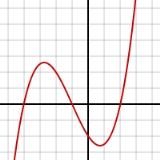
, a cubic function is a function
Function (mathematics)

The mathematical concept of a function expresses dependence between two quantities, one of which is known and the other which is produced. A function associates a single output to each input element drawn from a fixed Set , such as the real numbers , although different inputs may have the same output....
 of the form

where a is nonzero; or in other words, a polynomial
Polynomial

In mathematics, a polynomial is an expression constructed from variables and constants, using the operations of addition, subtraction, multiplication, and constant non-negative whole number exponents....
 of degree
Degree of a polynomial

When a polynomial is expressed as a sum or difference of term s , the exponent of the term with the highest exponent is the degree of the polynomial....
 three. The derivative
Derivative

In calculus, a branch of mathematics, the derivative is a measure of how a function changes as its input changes. Loosely speaking, a derivative can be thought of as how much a quantity is changing at a given point....
 of a cubic function is a quadratic function
Quadratic function

A quadratic function, in mathematics, is a polynomial function of the form , where . The graph of a function of a quadratic function is a parabola whose major axis is parallel to the y-axis....
. The integral of a cubic function is a quartic function
Quartic function

In mathematics, a quartic function is a function of the formwhere a is nonzero; or in other words, a polynomial of Degree of a polynomial of four....
.

Setting ƒ(x) = 0 and assuming a ? 0 produces a cubic equation
Equation

An equation is a mathematics Proposition, in table of mathematical symbols, that two things are exactly the same . Equations are written with an equal sign, as in...
 of the form:

With a = 0 the equation becomes a quadratic equation
Quadratic function

A quadratic function, in mathematics, is a polynomial function of the form , where . The graph of a function of a quadratic function is a parabola whose major axis is parallel to the y-axis....
. With a = b = 0 it becomes a linear equation
Linear function

In mathematics, the term linear function can refer to either of two different but related concepts: a first-degree polynomial function of one variable; or a map between two vector spaces that preserves vector addition and scalar multiplication....
.

Usually, the coefficients a, b,c, d are real numbers.


Discussion
Ask a question about 'Cubic function'
Start a new discussion about 'Cubic function'
Answer questions from other users
Full Discussion Forum


Recent Posts


Encyclopedia


In mathematics
Mathematics

Mathematics is the study of quantity, structure, space, change, and related topics of pattern and form. Mathematicians seek out patterns whether found in numbers, space, natural science, computers, imaginary abstractions, or elsewhere....
, a cubic function is a function
Function (mathematics)

The mathematical concept of a function expresses dependence between two quantities, one of which is known and the other which is produced. A function associates a single output to each input element drawn from a fixed Set , such as the real numbers , although different inputs may have the same output....
 of the form

where a is nonzero; or in other words, a polynomial
Polynomial

In mathematics, a polynomial is an expression constructed from variables and constants, using the operations of addition, subtraction, multiplication, and constant non-negative whole number exponents....
 of degree
Degree of a polynomial

When a polynomial is expressed as a sum or difference of term s , the exponent of the term with the highest exponent is the degree of the polynomial....
 three. The derivative
Derivative

In calculus, a branch of mathematics, the derivative is a measure of how a function changes as its input changes. Loosely speaking, a derivative can be thought of as how much a quantity is changing at a given point....
 of a cubic function is a quadratic function
Quadratic function

A quadratic function, in mathematics, is a polynomial function of the form , where . The graph of a function of a quadratic function is a parabola whose major axis is parallel to the y-axis....
. The integral of a cubic function is a quartic function
Quartic function

In mathematics, a quartic function is a function of the formwhere a is nonzero; or in other words, a polynomial of Degree of a polynomial of four....
.

Setting ƒ(x) = 0 and assuming a ? 0 produces a cubic equation
Equation

An equation is a mathematics Proposition, in table of mathematical symbols, that two things are exactly the same . Equations are written with an equal sign, as in...
 of the form:

With a = 0 the equation becomes a quadratic equation
Quadratic function

A quadratic function, in mathematics, is a polynomial function of the form , where . The graph of a function of a quadratic function is a parabola whose major axis is parallel to the y-axis....
. With a = b = 0 it becomes a linear equation
Linear function

In mathematics, the term linear function can refer to either of two different but related concepts: a first-degree polynomial function of one variable; or a map between two vector spaces that preserves vector addition and scalar multiplication....
.

Usually, the coefficients a, b,c, d are real numbers. However, most of the theory is also valid if they belong to a field
Field (mathematics)

In abstract algebra, a field is an algebraic structure with notions of addition, subtraction, multiplication and division , satisfying certain axioms....
 of characteristic other than two or three.

Solving a cubic equation amounts to finding the root
Root (mathematics)

In mathematics, a root of a complex-valued Function is a member of the Domain of such that vanishes at , that is,In other words, a "root" of a function is a value for that produces a result of zero ....
s of a cubic function.

History

Cubic equations were known to the ancient Indians
Indian mathematics

Indian mathematics—which here is the mathematics that emerged in South Asia from ancient times until the end of the 18th century—had its beginnings in the Bronze Age Indus Valley civilization and the Iron Age Vedic culture ....
 and ancient Greeks
Greek mathematics

Greek mathematics, as that term is used in this article, is the mathematics written in Greek language, developed from the 6th century BC to the 5th century AD around the Eastern shores of the Mediterranean....
 since the 5th century BC, and even earlier to the ancient Babylonians
Babylonian mathematics

Babylonian mathematics refers to any mathematics of the peoples of Mesopotamia , from the days of the early Sumerians to the fall of Babylon in 539 BC....
 who were able to solve certain cubic equations, and ancient Egyptians
Egyptian mathematics

Egyptian mathematics refers to the style and methods of mathematics performed in Ancient Egypt....
, who dealt with the problem of doubling the cube
Doubling the cube

Doubling the cube is one of the three most famous geometry problems unsolvable by compass and straightedge construction. It was known to the Egyptian mathematics, Greek mathematics, and Indian mathematics....
, and attempted to solve it using compass and straightedge constructions. Hippocrates
Hippocrates

Hippocrates of Cos II or Hippokrates of Kos - ancient Greek: ; Hippokr?tes was an Ancient Greece physician of the Age of Pericles, and was considered one of the most outstanding figures in the history of medicine....
, Menaechmus
Menaechmus

Menaechmus was an ancient Greek mathematician and list of geometers born in Alopeconnesus , who was known for his friendship with the renowned philosopher Plato and for his apparent discovery of conic sections and his solution to the then-long-standing problem of doubling the cube using the parabola and hyperbola....
 and Archimedes
Archimedes

Archimedes of Syracuse was a Greek mathematics, physicist, engineer, inventor, and astronomer. Although few details of his life are known, he is regarded as one of the leading scientists in classical antiquity....
 are believed to have come close to solving this problem using intersecting conic sections, though historians such as Reviel Netz dispute whether the Greeks were thinking about cubic equations or just problems that can lead to cubic equations.

In the 11th century, the Persian poet
Persian literature

Persian literature spans two and a half millennia, though much of the pre-Islamic material has been lost. Its sources has been within historical greater Iran including present-day Iran as well as reigions of Central Asia where the Persian language has been the national language through history....
-mathematician, Omar Khayyám
Omar Khayyám

Omar Khayyam was a Persian peoples polymath: Islamic mathematics, Iranian philosophy, Islamic astronomy and above all Persian literature.He has also become established as one of the major mathematicians and astronomers of the medieval period....
 (1048–1131), made significant progress in the theory of cubic equations. In an early paper he wrote regarding cubic equations, he discovered that a cubic equation can have more than one solution, that it cannot be solved using earlier compass and straightedge constructions, and found a geometric
Geometry

Geometry arose as the field of knowledge dealing with spatial relationships. Geometry was one of the two fields of pre-modern mathematics, the other being the study of numbers....
 solution which could be used to get a numerical answer by consulting trigonometric tables
Generating trigonometric tables

In mathematics, tables of trigonometric functions are useful in a number of areas. Before the existence of pocket calculators, trigonometric tables were essential for navigation, science and engineering....
. In his later work, the Treatise on Demonstration of Problems of Algebra, he wrote a complete classification of cubic equations with general geometric solutions found by means of intersecting conic section
Conic section

File:Conic sections with plane.svgIn mathematics, a conic section is a curve obtained by intersecting a cone with a plane . A conic section is therefore a restriction of a quadric surface to the plane ....
s.

In the 12th century, another Persian mathematician, Sharaf al-Din al-Tusi (1135–1213), wrote the Al-Mu'adalat (Treatise on Equations), which dealt with eight types of cubic equations with positive solutions and five types of cubic equations which may not have positive solutions. He used what would later be known as the "Ruffini
Ruffini's rule

In mathematics, Ruffini's rule allows the rapid division of any polynomial by a binomial of the form xr. It was described by Paolo Ruffini in 1809....
-Horner
Horner scheme

In numerical analysis, the Horner scheme or Horner algorithm, named after William George Horner, is an algorithm for the efficient evaluation of polynomials in Monomial basis....
 method" to numerically
Numerical analysis

Numerical analysis is the study of algorithms for the problems of continuous mathematics .One of the earliest mathematical writings is the Babylonian tablet YBC 7289, which gives a sexagesimal numerical approximation of , the length of the diagonal in a unit square....
 approximate the root
Root (mathematics)

In mathematics, a root of a complex-valued Function is a member of the Domain of such that vanishes at , that is,In other words, a "root" of a function is a value for that produces a result of zero ....
 of a cubic equation. He also developed the concepts of a derivative
Derivative

In calculus, a branch of mathematics, the derivative is a measure of how a function changes as its input changes. Loosely speaking, a derivative can be thought of as how much a quantity is changing at a given point....
 function and the maxima and minima
Maxima and minima

In mathematics, maxima and minima, known collectively as extrema, are the largest value or smallest value , that a function takes in a point either within a given neighbourhood or on the function domain in its entirety ....
 of curves in order to solve cubic equations which may not have positive solutions. He understood the importance of the discriminant
Discriminant

In algebra, the discriminant of a polynomial with real number or complex number coefficients is a certain expression in the coefficients of the polynomial which is equal to zero if and only if the polynomial has a multiple Root in the complex numbers....
 of the cubic equation and used an early version of Cardano's formula to find algebraic solutions to certain types of cubic equations.

In the early 16th century, the Italian mathematician Scipione del Ferro
Scipione del Ferro

Scipione del Ferro was an Italy mathematics who first discovered a method to solve the cubic equation....
 (1465–1526) found a method for solving a class of cubic equations, namely those of the form x3 + mx = n. In fact, all cubic equations can be reduced to this form if we allow m and n to be negative, but negative numbers
Negative and non-negative numbers

A negative number is a real number that is inequality 0 , such as -3. A positive number is a real number that is greater than zero, such as 2....
 were not known to him at that time. Del Ferro kept his achievement secret until just before his death, when he told his student Antonio Fiore about it.

In 1530, Niccolò Tartaglia (1500–1557) received two problems in cubic equations from Zuanne da Coi and announced that he could solve them. He was soon challenged by Fiore, which led to a famous contest between the two. Each contestant had to put up a certain amount of money and to propose a number of problems for his rival to solve. Whoever solved more problems within 30 days would get all the money. Tartaglia received questions in the form x3 + mx = n, for which he had worked out a general method. Fiore received questions in the form x3 + mx2 = n, which proved to be too difficult for him to solve, and Tartaglia won the contest.

Later, Tartaglia was persuaded by Gerolamo Cardano
Gerolamo Cardano

Gerolamo Cardano or Girolamo Cardano was an Italy Renaissance mathematician, physician, astrologer and gambler....
 (1501–1576) to reveal his secret for solving cubic equations. In 1539, Tartaglia did so only on the condition that Cardano would never reveal it and that if he did reveal a book about cubics, that he would give Tartaglia time to publish. Some years later, Cardano learned about Ferro's prior work and published Ferro's method in his book Ars Magna
Ars Magna (Gerolamo Cardano)

The Ars Magna is an important book on Algebra written by Gerolamo Cardano. It was first published in 1545 under the title Artis Magn?, Sive de Regulis Algebraicis Liber Unus ....
 in 1545, meaning Cardano gave Tartaglia 6 years to publish his results (with credit given to Tartaglia for an independent solution). Cardano's promise with Tartaglia stated that he not publish Tartaglia's work, and Cardano felt he was publishing del Ferro's, so as to get around the promise. Nevertheless, this led to a challenge to Cardano by Tartaglia, which Cardano denied. The challenge was eventually accepted by Cardano's student Lodovico Ferrari
Lodovico Ferrari

Lodovico Ferrari was an Italy mathematician.Born in Milan, Italy, grandfather, Bartholomew Ferrari was forced out of Milan to bologna, He settled in Bologna, Italy and he began his career as the servant of Gerolamo Cardano....
 (1522–1565). Ferrari did better than Tartaglia in the competition, and Tartaglia lost both his prestige and income .

Cardano noticed that Tartaglia's method sometimes required him to extract the square root of a negative number. He even included a calculation with these complex number
Complex number

In mathematics, the complex numbers are an extension of the real numbers obtained by adjoining an imaginary unit, denoted i, which satisfies:...
s in Ars Magna, but he did not really understand it. Rafael Bombelli
Rafael Bombelli

Rafael Bombelli was an Italy mathematician.Born in Bologna, he is the author of a treatise on algebra and is a central figure in the understanding of imaginary numbers....
 studied this issue in detail and is therefore often considered as the discoverer of complex numbers.

Roots of a cubic function


The nature of the roots

Every cubic equation with real
Real number

In mathematics, the real numbers may be described informally in several different ways. The real numbers include both rational numbers, such as 42 and −23/129, and irrational numbers, such as pi and the square root of two; or, a real number can be given by an infinite decimal representation, such as 2.4871773339...., where the digits co...
 coefficients has at least one solution x among the real numbers; this is a consequence of the intermediate value theorem
Intermediate value theorem

In mathematical analysis, the intermediate value theorem states that for each value between the least upper bound and greatest lower bound of the of a continuous function there is a corresponding value in its domain mapping to the original....
. We can distinguish several possible cases using the discriminant
Discriminant

In algebra, the discriminant of a polynomial with real number or complex number coefficients is a certain expression in the coefficients of the polynomial which is equal to zero if and only if the polynomial has a multiple Root in the complex numbers....
, The following cases need to be considered.
  • If ? > 0, then the equation has three distinct real root
    Root (mathematics)

    In mathematics, a root of a complex-valued Function is a member of the Domain of such that vanishes at , that is,In other words, a "root" of a function is a value for that produces a result of zero ....
    s.
  • If ? < 0, then the equation has one real root and a pair of complex conjugate
    Complex conjugate

    In mathematics, the complex conjugate of a complex number is given by changing the sign of the imaginary part. Thus, the conjugate of the complex number...
     roots.
  • If ? = 0, then (at least) two roots coincide. It may be that the equation has a double real root and another distinct single real root; alternatively, all three roots coincide yielding a triple real root. A possible way to decide between these subcases is to compute the resultant
    Resultant

    In mathematics, the resultant of two monic polynomials and over a Field_ is defined as the productof the differences of their roots, where and take on values in the algebraic closure of ....
     of the cubic and its second derivative: a triple root exists if and only if this resultant vanishes.


See also: multiplicity of a root of a polynomial

General formula of roots

For the general cubic equation , the general formula of roots are:

Cardano's method

The solutions can be found with the following method due to Scipione del Ferro
Scipione del Ferro

Scipione del Ferro was an Italy mathematics who first discovered a method to solve the cubic equation....
 and Tartaglia
Tartaglia

Tartaglia may refer to:*Tartaglia , Commedia dell'arte stock character*Niccol? Fontana Tartaglia , Venetian mathematician and engineer*Warren Tartaglia , American jazz musician...
, published by Gerolamo Cardano
Gerolamo Cardano

Gerolamo Cardano or Girolamo Cardano was an Italy Renaissance mathematician, physician, astrologer and gambler....
 in 1545.

We first divide the standard equation by the leading coefficient to arrive at an equation of the form The substitution eliminates the quadratic term, giving the co-called depressed cubic where Thomas Harriot
Thomas Harriot

Thomas Harriot was an English astronomy, mathematician, ethnographer, and translator. Some sources give his surname as Harriott or Hariot or Heriot. He is sometimes credited with the introduction of the potato to Great Britain and Ireland....
 (1560 – 1621) provided the following way to solve the depressed cubic.

Substituting and multiplying both sides by gives .

We introduce two variables u and v linked by the condition and substitute this in the depressed cubic (2), giving .

At this point Cardano imposed a second condition for the variables u and v which, combined with (3) gives

This can be seen as a quadratic equation
Quadratic equation

In mathematics, a quadratic equation is a polynomial equation of the second degree of a polynomial. The general form iswhere a ? 0. The letters a, b, and c are called coefficients: the quadratic coefficient a is the coefficient of x2, the linear coefficient b is the coefficient of x, and c i...
 in u3. When we solve this equation, we find that and thus Since t = v + u, t = x + a/3, and v = −p/3u, we find Note that there are six possibilities in computing u with (4), since there are two possibilities for the square root , and three for the cubic root (the principal root and the principal root multiplied by ). The sign of the square root however does not affect the resulting t (a simple calculation shows that −p/3u = v), although care must be taken in two special cases to avoid divisions by zero:

First, if p = q = 0, then we have the triple real root
Second, if p = 0 and q ? 0, then
Third, if p ? 0 and q = 0 then
in which case the three roots are
where


Summary
In summary, for the cubic equation
the solutions for x are given by
where


The expression above for u can generate up to three values (there are three cubic roots related by a factor which is one of the two complex cubic roots of one, and two square roots of any sign ; but these 6 expressions can generate only 3 pairs). This also applies to the final solutions for x.

Alternate method
An alternate method to obtain the same results is as follows.

We know that

Since u and v must satisfy , it can be shown that

Writing out the three cube roots we get

Remembering t = u + v we get only three possible values for t because only three combinations of u and v are possible if is to remain valid as it must — so

and x is obtained from

Note that the above methods do apply if p and q are complex. This solution avoids the addition of an inverted cubic radical in the solution, and also resolves the ambiguity of signs for the square roots in the first solution given above.

Summary

To simplify the expressions above, it is customary to define this resolution in several steps by defining intermediate variables. Let
and


Then the discriminant of the quadratic equation of or is
,


Let's also define a constant that represents a generator for the three cubic roots of unity:


Then the solutions for x = t - A can be simply defined for k in 0, 1, 2 in :
where are the two possible values for or .

In the case p and q are both real, the following cases can be distinguished, according to the sign of the discriminant.
  1. If D is strictly positive then there is one real and two complex roots.
  2. If D is null then there is one real root (a triple root) or two real roots (a single and a double root.)
  3. If D is strictly negative then there are three real roots (Casus irreducibilis
    Casus irreducibilis

    In algebra, casus irreducibilis is one of the cases that may arise in attempting to solve a cubic equation with integer coefficients with roots that are expressed with nth root....
    ).


Lagrange resolvents

The symmetric group
Symmetric group

In mathematics, the symmetric group on a Set X, denoted by SX, or Sym, is the group whose underlying set is the set of all bijective function s from X to X, in which the group operation is that of Function composition, i.e., two such functions f and g can be composed to yield a new bijective function ,...
 S3 has the cyclic group
Cyclic group

In group theory, a cyclic group or monogenous group is a group that can be generating set of a group by a single element, in the sense that the group has an element g such that, when written multiplicatively, every element of the group is a power of g ....
 of order three as a normal subgroup
Normal subgroup

In mathematics, more specifically in abstract algebra, a normal subgroup is a special kind of subgroup. Normal subgroups are important because they can be used to construct quotient groups from a given group ....
, which suggests making use of the discrete Fourier transform
Discrete Fourier transform

In mathematics, the discrete Fourier transform is one of the specific forms of Fourier analysis. It transforms one function into another, which is called the frequency domain representation, or simply the DFT, of the original function ....
 of the roots, an idea due to Lagrange
Joseph Louis Lagrange

Joseph-Louis Lagrange, born Giuseppe Lodovico Lagrangia was an Italy mathematician and astronomer, who lived most of his life in Prussia and France, making significant contributions to all fields of mathematical analysis, to number theory, and to classical mechanics and celestial mechanics....
. Suppose that r0, r1 and r2 are the roots of equation (1), and define , so that ? is a primitive third root of unity
Root of unity

In mathematics, the nth roots of unity, or Abraham de Moivre numbers, are all the complex numbers that yield 1 when exponentiation to a given power n....
. We now set The roots may then be recovered from the three si by inverting the above linear transformation, giving We already know the value s0 = −a, so we only need to seek values for the other two. However, if we take the cubes, a cyclic permutation leaves the cubes invariant, and a transposition of two roots exchanges s13 and s23, hence the polynomial is invariant under permutations of the roots, and so has coefficients expressible in terms of (1). Using calculations involving symmetric functions or alternatively field extensions, we can calculate (5) to be The roots of this quadratic equation are where D is the discriminant. Taking cube roots give us s1 and s2, from which we can recover the roots ri of (1).

Factorization

If r is any root of (1), then we may factor using r to obtain Hence if we know one root we can find the other two by solving a quadratic equation, giving for the other two roots.

Root-finding formula


The formula for finding the roots of a cubic function, based on Cardano's method, is fairly complicated. Therefore, it is common to use the rational root test
Rational root theorem

In algebra, the rational root theorem states a constraint on solutions to the polynomial equationwith integer coefficients.Let a'0 and a'n be nonzero....
 or a numerical solution instead.

If we have with and , let

and

we define the discriminant
Discriminant

In algebra, the discriminant of a polynomial with real number or complex number coefficients is a certain expression in the coefficients of the polynomial which is equal to zero if and only if the polynomial has a multiple Root in the complex numbers....
:

There are two distinct cases::in which case there is one real root and 2 imaginary. We define:
and
in which case we have 3 real roots. We express the complex quantity in polar form:
and we define:
and


In both cases, the solutions are

Solution in terms of Chebyshev radicals


If we have a cubic equation which is already in depressed form, we may write it as . Substituting we obtain or equivalently From this we obtain solutions to our original equation in terms of the Chebyshev cube root
Chebyshev cube root

In mathematics, in the theory of special functions, the Chebyshev cube root is a particular inverse function of the Chebyshev polynomial of third degree....
  as If now we start from a general equation and reduce it to the depressed form under the substitution x = ta/3, we have and , leading to

This gives us the solutions to (1) as
The case of a cubic equation with real coefficients

Suppose the coefficients of (1) are real. If s is the quantity q/r from the section on real roots, then s = t2; hence 0 < s < 4 is equivalent to −2 < t < 2, and in this case we have a polynomial with three distinct real roots, expressed in terms of a real function of a real variable, quite unlike the situation when using cube roots. If s > 4 then either t > 2 and is the sole real root, or t < −2 and is the sole real root. If s < 0 then the reduction to Chebyshev polynomial form has given a t which is a pure imaginary number; in this case is the sole real root. We are now evaluating a real root by means of a function of a purely imaginary argument; however we can avoid this by using the function

which is a real function of a real variable with no singularities along the real axis. If a polynomial can be reduced to the form with real t, this is a convenient way to solve for its roots.

Derivative

The derivative
Derivative

In calculus, a branch of mathematics, the derivative is a measure of how a function changes as its input changes. Loosely speaking, a derivative can be thought of as how much a quantity is changing at a given point....
  will yield when . Bearing its resemblance to the quadratic formula, this formula can be used to find the critical points
Critical point (mathematics)

In mathematics, a critical point is a Point on the domain of a function of a function where:* one dimension: the derivative is equality to 0 or a point where the function ceases to be differentiable....
 of a cubic function. It turns out that, if , then the cubic function will have two critical points — a local maximum
Maxima and minima

In mathematics, maxima and minima, known collectively as extrema, are the largest value or smallest value , that a function takes in a point either within a given neighbourhood or on the function domain in its entirety ....
 and a local minimum
Maxima and minima

In mathematics, maxima and minima, known collectively as extrema, are the largest value or smallest value , that a function takes in a point either within a given neighbourhood or on the function domain in its entirety ....
; if , then there is one critical point, and it will yield the inflection point
Inflection point

In differential calculus, an inflection point, or point of inflection is a point on a curve at which the curvature changes Negative and non-negative numbers....
; if , then there are no critical points; the cubic is then strictly monotonic.

Bipartite cubics

The graph of

where is called a bipartite cubic. This is from the theory of elliptic curve
Elliptic curve

In mathematics, an elliptic curve is a differentiable manifold, algebraic variety#Projective varieties algebraic curve of genus #Algebraic geometry one, on which there is a specified point O....
s.

One can graph a bipartite cubic on a graphing device by graphing the function

corresponding to the upper half of the bipartite cubic. It is defined on

See also

  • Linear equation
    Linear equation

    A linear equation is an algebraic equation in which each term is either a constant or the product of a constant and a single variable.Linear equations can have one or more variables....
  • Quadratic equation
    Quadratic equation

    In mathematics, a quadratic equation is a polynomial equation of the second degree of a polynomial. The general form iswhere a ? 0. The letters a, b, and c are called coefficients: the quadratic coefficient a is the coefficient of x2, the linear coefficient b is the coefficient of x, and c i...
  • Quartic equation
  • Quintic equation
    Quintic equation

    In mathematics, a quintic equation is a polynomial equation of Degree of a polynomial five. It is of the form:where .......
  • Polynomial
    Polynomial

    In mathematics, a polynomial is an expression constructed from variables and constants, using the operations of addition, subtraction, multiplication, and constant non-negative whole number exponents....
  • Newton's method
    Newton's method

    In numerical analysis, Newton's method is perhaps the best known method for finding successively better approximations to the zeroes of a Real number-valued function ....
  • Spline (mathematics)
    Spline (mathematics)

    In mathematics, a spline is a special Function defined piecewise by polynomials.In interpolation problems, spline interpolation is often preferred to polynomial interpolation because it yields similar results, even when using low degree polynomials, while avoiding Runge's phenomenon for higher degrees....
  • Viete


External links

  • at
  • .
  • on MacTutor archive.* at some local site. Only takes natural coefficients.
  • With interactive animation, slider controls for coefficients
  • at Holistic Numerical Methods Institute
  • American Math Monthly 114:1 (2007) 29--39
  • by Eric W. Weisstein
    Eric W. Weisstein

    Eric W. Weisstein is an encyclopedist who created and maintains MathWorld and Eric Weisstein's World of Science . He currently works for Wolfram Research, Inc....
    , The Wolfram Demonstrations Project, 2007.
