
|
|
|
|
Quadratic function
|
| |
|
| |
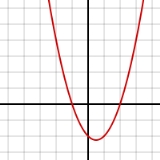
A quadratic function, in mathematics, is a polynomial function of the form , where . The graph of a quadratic function is a parabola whose major axis is parallel to the y-axis.
The expression in the definition of a quadratic function is a polynomial of degree 2 or a 2nd degree polynomial, because the highest exponent of is 2.
If the quadratic function is set equal to zero, then the result is a quadratic equation.

Discussion
Ask a question about 'Quadratic function'
Start a new discussion about 'Quadratic function'
Answer questions from other users
|
Recent Posts

Encyclopedia
A quadratic function, in mathematics, is a polynomial function of the form , where . The graph of a quadratic function is a parabola whose major axis is parallel to the y-axis.
The expression in the definition of a quadratic function is a polynomial of degree 2 or a 2nd degree polynomial, because the highest exponent of is 2.
If the quadratic function is set equal to zero, then the result is a quadratic equation. The solutions to the equation are called the roots of the equation or the zeros of the function.
Origin of word The adjective quadratic comes from the Latin word quadratum for square. A term like x2 is called a square in algebra because it is the area of a square with side x.
In general, a prefix quadr(i)- indicates the number 4. Examples are quadrilateral and quadrant. Quadratum is the Latin word for square because a square has four sides.
Roots The two roots of the quadratic equation , where are
This formula is called the quadratic formula.
- Let '
- If ', then there are two distinct roots since is a positive real number.
- If , then the two roots are equal, since is zero.
- If , then the two roots are complex conjugates, since is imaginary.
By letting and or vice versa, one can factor as .
Forms of a quadratic function
A quadratic function can be expressed in three formats:
- is called the general form or polynomial form,
- is called the factored form, where and are the roots of the quadratic equation, it is used in logistic map
- is called the standard form or vertex form where and are the x and y coordinates of the vertex.
To convert the general form to factored form, one needs only the quadratic formula to determine the two roots and . To convert the general form to standard form, one needs a process called completing the square. To convert the factored form (or standard form) to general form, one needs to multiply, expand and/or distribute the factors.
Graph
Regardless of the format, the graph of a quadratic function is a parabola (as shown above).
- If , the parabola opens upward.
- If , the parabola opens downward.
The coefficient a controls the speed of increase (or decrease) of the quadratic function from the vertex, bigger positive a makes the function increase faster and the graph appear more closed.
The coefficients b and a together control the axis of symmetry of the parabola (also the x-coordinate of the vertex).
The coefficient b alone is the declivity of the parabola as it crosses the y-axis.
The coefficient c controls the height of the parabola, more specifically, it is the point were the parabola crosses the y-axis.
x–intercepts The x-intercepts of the graph are the same as the roots of the quadratic function (see above).
Vertex The vertex of a parabola is the place where it turns, hence, it's also called the turning point. If the quadratic function is in standard form, the vertex is . By the method of completing the square, one can turn the general form: to
-
so the vertex of the parabola in the general form will be
-
If the quadratic function is in factored form
the average of the two roots, i.e.,
-
is the x-coordinate of the vertex, and hence the vertex is
-
The vertex is also the maximum point if or the minimum point if .
The vertical line
-
that passes through the vertex is also the axis of symmetry of the parabola.
- Maximum and minimum points
- The maximum or minimum of the function is always obtained at the vertex, the following method is another derivation of the same fact using calculus, the advantage of this method is that it works for more general functions.
- Taking as sample quadratic equation, to find its maximum or minimum points (which depends on , if , it has a minimum point, if , it has a maximum point) we have to first, take its derivative:
- Then, we find the roots of :
-
- So, is the value of . Now, to find the value, we substitute on :
-
- Thus, the maximum or minimum point coordinates are:
-
The square root of a quadratic function
The square root of a quadratic function gives rise either to an ellipse or to a hyperbola.If then the equation describes a hyperbola. The axis of the hyperbola is determined by the ordinate of the minimum point of the corresponding parabola . If the ordinate is negative, then the hyperbola's axis is horizontal. If the ordinate is positive, then the hyperbola's axis is vertical. If then the equation describes either an ellipse or nothing at all. If the ordinate of the maximum point of the corresponding parabola
is positive, then its square root describes an ellipse, but if the ordinate is negative then it describes an empty locus of points.
Bivariate quadratic function
A bivariate quadratic function is a second-degree polynomial of the form
Such a function describes a quadratic surface. Setting equal to zero describes the intersection of the surface with the plane , which is a locus of points equivalent to a conic section.
Minimum/maximum If the function has no maximum or minimum, its graph forms an hyperbolic paraboloid.
If the function has a minimum if A>0, and a maximum if A<0, its graph forms an elliptic paraboloid.
The minimum or maximum of a bivariate quadratic function is obtained at where:
If and the function has no maximum or minimum, its graph forms a parabolic cylinder.
If and the function achieves the maximum/minimum at a line. Similarly, a minimum if A>0 and a maximum if A<0, its graph forms a parabolic cylinder.
See also
External links
|
| |
|
|
