


Crisco

Encyclopedia
Shortening
Shortening is any fat that is solid at room temperature and used to make crumbly pastry. The reason it is called shortening is because it prevents cross-linkage between gluten molecules. Cross linking is what causes doughs to be sticky. Seeing as cake is not meant to be sticky, shortening is used...
produced by the J. M. Smucker Co. popular in the United States. Introduced in June 1911 by Procter & Gamble
Procter & Gamble
Procter & Gamble is a Fortune 500 American multinational corporation headquartered in downtown Cincinnati, Ohio and manufactures a wide range of consumer goods....
, it was the first shortening to be made entirely of vegetable oil. While the term Crisco is commonly used as a synonym for all shortening, Procter and Gamble markets olive, cooking, and baking oil and a cooking spray
Cooking spray
Cooking spray is a spray form of an oil as a lubricant, lecithin as an emulsifier, and a propellant such as food-grade alcohol, nitrous oxide, carbon dioxide or propane. Cooking spray is applied to frying pans and other cookware to prevent food from sticking. Traditionally, cooks used butter,...
under that trademark
Trademark
A trademark, trade mark, or trade-mark is a distinctive sign or indicator used by an individual, business organization, or other legal entity to identify that the products or services to consumers with which the trademark appears originate from a unique source, and to distinguish its products or...
.
History
HydrogenationHydrogenation
Hydrogenation, to treat with hydrogen, also a form of chemical reduction, is a chemical reaction between molecular hydrogen and another compound or element, usually in the presence of a catalyst. The process is commonly employed to reduce or saturate organic compounds. Hydrogenation typically...
of organic substances in gas form was discovered by Sabatier
Paul Sabatier (chemist)
Paul Sabatier FRS was a French chemist, born at Carcassonne. He taught science classes most of his life before he became Dean of the Faculty of Science at the University of Toulouse in 1905....
in the late 19th century and while in liquid form was patented by Normann
Wilhelm Normann
Wilhelm Normann was a German chemist who introduced the hydrogenation of fats in 1901, creating what later became known as trans fats...
in 1903. Procter & Gamble's business manager John Burchenal was contacted by and hired chemist
Chemist
A chemist is a scientist trained in the study of chemistry. Chemists study the composition of matter and its properties such as density and acidity. Chemists carefully describe the properties they study in terms of quantities, with detail on the level of molecules and their component atoms...
Edwin C. Kayser, former chemist for Joseph Crosfield and Sons (who had acquired Normann's patent so as to produce soap), who patented two processes to hydrogenate cottonseed oil
Cottonseed oil
Cottonseed oil is a cooking oil extracted from the seeds of cotton plant of various species, mainly Gossypium hirsutum and Gossypium herbaceum...
, which ensures the fat remains solid at normal storage temperatures
Room temperature
-Comfort levels:The American Society of Heating, Refrigerating and Air-Conditioning Engineers has listings for suggested temperatures and air flow rates in different types of buildings and different environmental circumstances. For example, a single office in a building has an occupancy ratio per...
. Their initial intent was to completely harden oils for use as raw material for making soap. After rejecting the name "Cryst" due to negative religious connotations, the product was eventually called Crisco, a modification of the phrase "crystallized cottonseed oil".
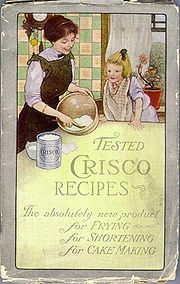
Further success came from the marketing technique of giving away free cookbooks with every recipe calling for Crisco. Crisco vegetable oil was introduced in 1960. In 1976, Procter & Gamble introduced sunflower oil
Sunflower oil
Sunflower oil is the non-volatile oil expressed from sunflower seeds. Sunflower oil is commonly used in food as a frying oil, and in cosmetic formulations as an emollient. Sunflower oil was first industrially produced in 1835 in the Russian Empire.- Composition :Sunflower oil is mainly a...
under the trade name Puritan Oil, which was marketed as a lower-cholesterol
Cholesterol
Cholesterol is a complex isoprenoid. Specifically, it is a waxy steroid of fat that is produced in the liver or intestines. It is used to produce hormones and cell membranes and is transported in the blood plasma of all mammals. It is an essential structural component of mammalian cell membranes...
alternative. In 1988, Puritan Oil became 100% canola oil.
Procter & Gamble
Procter & Gamble
Procter & Gamble is a Fortune 500 American multinational corporation headquartered in downtown Cincinnati, Ohio and manufactures a wide range of consumer goods....
divested
Divestment
In finance and economics, divestment or divestiture is the reduction of some kind of asset for either financial or ethical objectives or sale of an existing business by a firm...
the Crisco (oil and shortening) brand (along with Jif peanut butter
Jif (peanut butter)
Jif is a brand of peanut butter made by The J.M. Smucker Co., which purchased the brand from Procter & Gamble in 2001. The original Creamy Jif peanut butter debuted in 1958. In 1974, Extra Crunchy Jif was introduced, followed by Simply Jif in 1991, a peanut butter variant with low-sodium and less...
) in a spinoff
Spin out
A spin-out, also known as a spin-off or a starburst, refers to a type of corporate action where a company "splits off" sections of itself as a separate business....
to their stockholders, followed by an immediate merger with the J. M. Smucker Co. in 2002.
Changes in fat content
In April 2004, Smucker introduced "Crisco Zero Grams Trans FatTrans fat
Trans fat is the common name for unsaturated fat with trans-isomer fatty acid. Because the term refers to the configuration of a double carbon-carbon bond, trans fats are sometimes monounsaturated or polyunsaturated, but never saturated....
Per Serving All-Vegetable Shortening," which contained fully hydrogenated palm oil blended with liquid vegetable oils to yield a shortening much like the original Crisco. From January 24, 2007, all Crisco shortening products were reformulated to contain less than one gram of trans fat per serving; the separately marketed trans-fat free version introduced in 2004 was consequently discontinued. , Crisco consists of a blend of soybean oil
Soybean oil
Soybean oil is a vegetable oil extracted from the seeds of the soybean . It is one of the most widely consumed cooking oils. As a drying oil, processed soybean oil is also used as a base for printing inks and oil paints...
, fully hydrogenated cottonseed oil
Cottonseed oil
Cottonseed oil is a cooking oil extracted from the seeds of cotton plant of various species, mainly Gossypium hirsutum and Gossypium herbaceum...
, and partially hydrogenated soybean and cottonseed oils. According to the product information label, one 12 g serving of Crisco contains 3 g of saturated fat
Saturated fat
Saturated fat is fat that consists of triglycerides containing only saturated fatty acids. Saturated fatty acids have no double bonds between the individual carbon atoms of the fatty acid chain. That is, the chain of carbon atoms is fully "saturated" with hydrogen atoms...
, 0 g of trans fat, 6 g of polyunsaturated fat
Polyunsaturated fat
In nutrition, polyunsaturated fat, or polyunsaturated fatty acid, are fatty acids in which more than one carbon–carbon double bond exists within the representative molecule. That is, the molecule has two or more points on its structure capable of supporting hydrogen atoms not currently part of the...
, and 2.5 g of monounsaturated fat
Monounsaturated fat
In biochemistry and nutrition, monounsaturated fats or MUFA are fatty acids that have one double bond in the fatty acid chain and all of the remainder of the carbon atoms in the chain are single-bonded...
. It is claimed that this reformulated Crisco has the same cooking properties and flavor as the original version of the product.
According to the FDA, "Food manufacturers are allowed to list amounts of trans fat with less than 0.5 gram (1/2 g) per serving as 0 (zero) on the Nutrition Facts panel."
Some nutritionists argue that while the formula has been changed to remove the trans fatty acids, the fully hydrogenated oil used to replace them may not be good for health. Crisco and similar low-trans-fat products are formed by the interesterification of a mixture of fully hydrogenated oils and partially hydrogenated oils. The composition of the resultant triglycerides is random, and may contain combinations of fatty acids not commonly found in nature. A recent study showed that interesterified fat increased volunteers' blood sugar
Blood sugar
The blood sugar concentration or blood glucose level is the amount of glucose present in the blood of a human or animal. Normally in mammals, the body maintains the blood glucose level at a reference range between about 3.6 and 5.8 mM , or 64.8 and 104.4 mg/dL...
by 20 percent while simultaneously lowering the body's HDL cholesterol.
Kream Krisp
While Kayser's patents were filed in 1910 and granted in 1915, with Crisco appearing on the market in 1911, Hugh Moore, chief chemist for the Berlin Mills CompanyBrown Company
The Brown Company was a pulp and papermaking company based in Berlin, New Hampshire. They closed their doors after World War II.-History:The company began as a large sawmill at the head of Berlin Falls in 1852 as the H. Winslow Company, then later changed its name to the Berlin Mills Company....
in Berlin, New Hampshire
Berlin, New Hampshire
Berlin is a city along the Androscoggin River in Coos County in northern New Hampshire, United States. The population was 10,051 at the 2010 census. It includes the village of Cascade. Located on the edge of the White Mountains, the city's boundaries extend into the White Mountain National Forest...
, filed his patents by 1914 and they were granted in 1914 and 1916, with the vegetable shortening later trademarked in 1915 as Kream Krisp appearing on the market in 1914. Procter & Gamble
Procter & Gamble
Procter & Gamble is a Fortune 500 American multinational corporation headquartered in downtown Cincinnati, Ohio and manufactures a wide range of consumer goods....
became aware of the competition by February 1915 and Burchenal contacted Berlin Mills
Brown Company
The Brown Company was a pulp and papermaking company based in Berlin, New Hampshire. They closed their doors after World War II.-History:The company began as a large sawmill at the head of Berlin Falls in 1852 as the H. Winslow Company, then later changed its name to the Berlin Mills Company....
claiming that they were infringing on P&G's patents and suggesting they meet to discuss the issue. When this failed P&G filed suit against Berlin Mills
Brown Company
The Brown Company was a pulp and papermaking company based in Berlin, New Hampshire. They closed their doors after World War II.-History:The company began as a large sawmill at the head of Berlin Falls in 1852 as the H. Winslow Company, then later changed its name to the Berlin Mills Company....
, the litigation being known as "Procter and Gamble vs. the Brown Company" (Berlin Mills Co. v. Procter & Gamble Co., 254 U.S. 156 (1920)), since in 1917 the Berlin Mills
Brown Company
The Brown Company was a pulp and papermaking company based in Berlin, New Hampshire. They closed their doors after World War II.-History:The company began as a large sawmill at the head of Berlin Falls in 1852 as the H. Winslow Company, then later changed its name to the Berlin Mills Company....
Co. became the Brown Company
Brown Company
The Brown Company was a pulp and papermaking company based in Berlin, New Hampshire. They closed their doors after World War II.-History:The company began as a large sawmill at the head of Berlin Falls in 1852 as the H. Winslow Company, then later changed its name to the Berlin Mills Company....
.
Sexual lubricant
As a sexual lubricant, it has been popular for some 40 years, as it is long-lasting, cheap, and does not exude a strong odor. However, as with other oil-based lubricants such as VaselineVaseline
Vaseline is a brand of petroleum jelly based products owned by Anglo-Dutch company Unilever. Products include plain petroleum jelly and a selection of skin creams, soaps, lotions, cleansers, deodorants and personal lubricants....
, it can degrade latex
Latex
Latex is the stable dispersion of polymer microparticles in an aqueous medium. Latexes may be natural or synthetic.Latex as found in nature is a milky fluid found in 10% of all flowering plants . It is a complex emulsion consisting of proteins, alkaloids, starches, sugars, oils, tannins, resins,...
and is unsuitable for use with latex condom
Condom
A condom is a barrier device most commonly used during sexual intercourse to reduce the probability of pregnancy and spreading sexually transmitted diseases . It is put on a man's erect penis and physically blocks ejaculated semen from entering the body of a sexual partner...
s.
The UK band Frankie goes to Hollywood
Frankie Goes to Hollywood
Frankie Goes to Hollywood were a British dance-pop band popular in the mid-1980s. The group was fronted by Holly Johnson , with Paul Rutherford , Peter Gill , Mark O'Toole , and Brian Nash .The group's debut single "Relax" was banned by the BBC in 1984 while at number six in the charts and...
had a song on their Welcome to the Pleasuredome
Welcome to the Pleasuredome
Welcome to the Pleasuredome was the debut album by Frankie Goes to Hollywood, first released in the UK in October 1984 by ZTT/Island Records. Originally issued as a vinyl double album, it was assured of a UK chart entry at number one due to reported advance sales of over one million...
album called Krisco Kisses related to the product's use in the gay scene.