
All Topics  
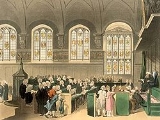
Court of Chancery

 
Court of Chancery

   Email Print
   Bookmark   Link


Court of Chancery


The Court of Chancery was one of the courts of equity
Court of equity

A chancery court, equity court or court of equity is a court that is authorized to apply principles of Equity , as opposed to law, to Legal case brought before it....
 in England and Wales
Courts of the United Kingdom

The United Kingdom does not have a single, unified judicial system, but separate judicial systems serving England and Wales, Scotland and Northern Ireland....
.

Overview
The High Court of Chancery was the court that developed from the Lord Chancellor
Lord Chancellor

The Lord High Chancellor of Great Britain, or Lord Chancellor, is a senior and important functionary in the government of the United Kingdom....
's jurisdiction. Unlike the courts of law, which were rigidly based on formal causes of action, the Lord Chancellor had jurisdiction to determine cases, on behalf of the King, according to equity or fairness rather than according to the strict letter of the law.


Discussion
Ask a question about 'Court of Chancery'
Start a new discussion about 'Court of Chancery'
Answer questions from other users
Full Discussion Forum


Encyclopedia


Court of Chancery Edited
The Court of Chancery was one of the courts of equity
Court of equity

A chancery court, equity court or court of equity is a court that is authorized to apply principles of Equity , as opposed to law, to Legal case brought before it....
 in England and Wales
Courts of the United Kingdom

The United Kingdom does not have a single, unified judicial system, but separate judicial systems serving England and Wales, Scotland and Northern Ireland....
.

Overview


The High Court of Chancery was the court that developed from the Lord Chancellor
Lord Chancellor

The Lord High Chancellor of Great Britain, or Lord Chancellor, is a senior and important functionary in the government of the United Kingdom....
's jurisdiction. Unlike the courts of law, which were rigidly based on formal causes of action, the Lord Chancellor had jurisdiction to determine cases, on behalf of the King, according to equity or fairness rather than according to the strict letter of the law. Gradually the rules of equity became formalized, but they preserved important innovations, such as injunction
Injunction

An injunction is an equitable remedy in the form of a court order, whereby a party is required to do, or to refrain from doing, certain acts. The party that fails to adhere to the injunction faces civil or criminal penalties and may have to pay damages or accept sanctions for failing to follow the court's order....
s and trusts
Trust law

In common law legal systems, a trust is an arrangement whereby property is managed by one person for the benefit of another. A trust is created by a settlor, who entrusts some or all of his or her property to people of his choice ....
. See equity (law). Records of the court are kept by The National Archives.

It is a frequent misconception, however, that the Court of Chancery's primary principle of decision in the fifteenth and early-sixteenth century was Equity. The Courts of Chancery were courts of the King's conscience, decisions were not bound by the doctrine of stare decisis
Stare decisis

Stare decisis is the legal principle under which judges are obligated to follow the precedents established in prior decisions.In the United States, which uses a common law system in its federal courts and most of its state courts, the United States Court of Appeals for the Ninth Circuit has stated:...
 so the powers of the chancellors equity were not bound by the blinkers of due process as in the common law courts. Due to this fact the Court of Chancery lost favor with many people as the court gained a reputation for being inconsistent, an old proverb illustrates this "equity varies with the length of the chancellor's foot". The year-book reports reveal that the court was primarily a court of Conscience
Conscience

Conscience is an ability or a Power that distinguishes whether one's actions are right or wrong. It leads to feelings of remorse when one does things that go against his/her moral values, and to feelings of rectitude or integrity when one's actions conform to our moral values....
 in its early days. Conscience—a term of art—connoted the moral law applied to prevent peril to the soul
Soul

In many religions and parts of philosophy, the soul is the immaterial part of a person. It is usually thought to consist of one's thoughts and Personality psychology, and can be synonymous with the spirit, mind or self....
 of the wrongdoer through mortal sin
Mortal sin

Mortal sin, according to the beliefs of Roman Catholicism, and some Protestant denominations, is a sin that, unless confessed and absolved , condemns a person's soul to Hell after death....
. The crucial twist to a modern mind is that the remedy was given to the plaintiff not to return him to his rightful position but to look after the wrongdoer's soul. The benefit to the plaintiff was only incidental. This is also the explanation for specific performance
Specific performance

In the law of Judicial_remedy, an order of specific performance is an order of the court which requires a party to perform a specific act, usually what is stated in a contract....
, which compels the sinner to put matters right, if he is to save his soul. The concept of Equity—which generally softens the harsh effects of written laws—did not take on a primary role until later in the Court's history.

The High Court of Chancery was merged with the courts of law in 1873, and the judges given the power to administer law and equity. It survives as the Chancery Division of the High Court.

Chancery courts in other common law jurisdictions


Most other common law
Common law

Common law refers to law and the corresponding Legal systems of the world developed through legal opinion of courts and similar tribunals , rather than through statute law or Executive ....
 jurisdiction
Jurisdiction

In law, jurisdiction is the practical authority granted to a formally constituted legal body or to a political leader to deal with and make pronouncements on legal matters and, by implication, to administer justice within a defined area of responsibility....
s either (1) abolished chancery courts and merged the powers of the courts of equity with the courts of law, thus making it possible for one to seek equitable relief at the same time as legal relief or (2) made the equitable jurisdiction the responsibility of a separate chancery division of the court of general jurisdiction. However, four American states (Delaware
Delaware

Delaware is a U.S. state located on the East Coast of the United States in the Mid-Atlantic States region of the United States. The state takes its name from Thomas West, 3rd Baron De La Warr, a British nobleman and Virginia's first colonial governor, after whom Cape Henlopen was originally named....
, Mississippi
Mississippi

Mississippi is a U.S. state located in the Deep South of the United States. Jackson, Mississippi is the state capital and largest city. The state's name comes from the Mississippi River, which flows along its western boundary, and takes its name from the Anishinaabe language word misi-ziibi ....
, Tennessee
Tennessee

Tennessee is a U.S. state located in the Southern United States United States. In 1796, it became the sixteenth state to join the United States....
, and New Jersey
New Jersey

New Jersey is a state in the Mid-Atlantic States and Northeastern United States regions of the United States. It is bordered on the north by New York, on the east by the Hudson River and the Atlantic Ocean, on the southwest by Delaware, and on the west by Pennsylvania....
), have retained separate Courts of Chancery. Judges who sit on these courts are called Chancellors.

In New York state, the Court of Chancery was abolished by the Constitution of 1846, which took effect in 1848. The last Chancellor was Reuben Hyde Walworth, who served as New York's highest judge from 1828 to 1848.

One important distinction between chancery courts and law courts (at least in the United States, where juries still commonly hear civil cases) is that generally a jury trial is not possible in equitable actions (whether in a merged court or a court of equity) as only a judge can dispense equity. The right to a trial by jury "[i]n Suits at common law" in United States federal courts
United States federal courts

The United States federal courts comprises the Judiciary of government organized under the United States Constitution and Law of the United States of the federal government of the United States....
 is preserved by the Seventh Amendment to the United States Constitution
United States Constitution

The Constitution of the United States of America is the supreme law of the United States. It is the foundation and source of the legal authority underlying the existence of the United States of America; the Federal Government of the United States; and all the State & local governments and Territorial Administrative bodies contained therein....
. A jury, while it can answer questions of fact, has no power to answer questions that involve interpretation of the law.

The Delaware Court of Chancery
Delaware Court of Chancery

The Delaware Court of Chancery is a court of Equity in the United States state of Delaware. It is one of Delaware's three constitutional courts, along with the Delaware Supreme Court and Superior Court of Delaware....
 has been particularly important in developing corporate law
Corporate law

Corporate law is the law of the most dominant kind of business enterprise in the modern world. Corporate law is the study of how shareholders, Board of directors, employees, creditors, and other stakeholders such as consumers, the community and the environment interact with one another under the internal rules of the firm....
 in the United States, as it is the primary court for disputes between Delaware corporation
Delaware corporation

Delaware General Corporation Law is the statute governing corporate law in the U.S. state of Delaware. Delaware is well known as a corporate haven....
s.

Literary references


In the context of Charles Dickens
Charles Dickens

Charles John Huffam Dickens, Royal Society of Arts , pen-name "Boz", was the most popular English people novelist of the Victorian era, as well as a vigorous Reform movement....
's interest in the Court of Chancery, see the book: 'Charles Dickens as a Legal Historian' by William Searle Holdsworth
William Searle Holdsworth

Sir William Searle Holdsworth, Order of Merit, King's Counsel, Doctor of Civil Law, LLD, British Academy, was Vinerian Professor of English Law at Oxford University and a legal historian, amongst whose works is the 12 volume History of English Law....
 (Published in 1928 by Yale University Press). This has very detailed descriptions of the working of the Court of Chancery.

In Charles Dickens
Charles Dickens

Charles John Huffam Dickens, Royal Society of Arts , pen-name "Boz", was the most popular English people novelist of the Victorian era, as well as a vigorous Reform movement....
's novel Bleak House
Bleak House

Bleak House is the ninth novel by Charles Dickens, published in twenty monthly installments between March 1852 and September 1853. It is held to be one of Dickens's finest and most complete novels, containing one of the most vast, complex and engaging arrays of minor characters and sub-plots in his entire canon....
, the interminable chancery case of Jarndyce and Jarndyce
Jarndyce and Jarndyce

Jarndyce and Jarndyce is a fictional court case in Court of Chancery in the novel Bleak House by Charles Dickens.The case concerns the fate of a large inheritance....
 is a major element of the plot.

In Agatha Christie
Agatha Christie

Agatha Mary Clarissa, Lady Mallowan, Order of the British Empire , commonly known as Agatha Christie, was an English people crime writer of novels, short stories and Play ....
's novel And Then There Were None
And Then There Were None

And Then There Were None is a work of detective fiction by Agatha Christie and first published in the UK by the Collins Crime Club on November 6, 1939 in literature under the title of Ten Little Niggers and in US by Dodd, Mead and Company in January 1940 in literature under the title of And Then There Were None....
, one verse of the rhyme quoted throughout the book is "Five little Indian boys going in for law; one got in Chancery and then there were four".

Mabel, in the Gilbert and Sullivan
Gilbert and Sullivan

'Gilbert and Sullivan' refers to the Victorian era partnership of librettist W. S. Gilbert and composer Arthur Sullivan . Together, they wrote fourteen comic operas between 1871 and 1896, of which H.M.S....
 opera The Pirates of Penzance
The Pirates of Penzance

The Pirates of Penzance, or The Slave of Duty, is a comic opera in two acts, with music by Arthur Sullivan and libretto by W. S. Gilbert. It is one of the Savoy Operas....
, claims that she and her sisters are not only "Wards in Chancery", but also that their father is a Major-General.

"Pretty young maids in Chancery" (wards of court) also appear in Gilbert and Sullivan's subsequent opera Iolanthe
Iolanthe

Iolanthe, or The Peer and the Peri, is a comic opera with music by Arthur Sullivan and libretto by W. S. Gilbert. It is one of the Savoy operas and the seventh collaboration of the fourteen between Gilbert and Sullivan....
, with reference to the "Highly susceptible Chancellor".

In Herman Melville
Herman Melville

Herman Melville was an American novelist, short story writer, essayist and poet. His first three books gained much attention, the first becoming a bestseller, but after a fast-blooming literary success in the late 1840s, his popularity declined precipitously in the mid-1850s and never recovered during his lifetime....
's Bartleby the Scrivener
Bartleby the Scrivener

"Bartleby, the Scrivener: A Story of Wall Street" is a novelette by American author Herman Melville . The story first appeared, anonymously, in Putnam's Magazine in two parts....
: A Tale of Wall Street
, the narrator held the office of "Master in Chancery," which he laments is "extinct" at the time of writing.

John Galsworthy
John Galsworthy

John Galsworthy Order of Merit was an England novelist and playwright. Notable works include The Forsyte Saga and its sequels, A Modern Comedy and End of the Chapter....
's "In Chancery", the second novel of The Forsyte Saga
The Forsyte Saga

The Forsyte Saga is a series of three novels and two interludes published between 1906 and 1921 by John Galsworthy. They chronicle the vicissitudes of the leading members of an upper-middle-class Great Britain family....
, centres largely on the proceedings of two divorce cases of the late 19th century.

See also

  • Chancery Division (one of the three divisions of the High Court of Justice of England and Wales)
  • Inns of Chancery
    Inns of Chancery

    The Inns of Chancery were buildings which housed associations of lawyers in London from the late Middle Ages to the 19th century. The origins of the Inns of Chancery are obscure, but initially they may have been used by clerks in the Court of Chancery, as the Lord Chancellor's office was known....
  • Chancellery
    Chancellery

    Chancellery is the office of the chancellor, sometimes also referred to as the chancery. Both of those words have other meanings as well.Chancellery can specifically refer to:...
  • Equity (law)
  • Equitable remedy
    Equitable remedy

    In law, equitable remedies are the remedies developed and granted by the old courts of Equity , such as the Court of Chancery in England, and still available today in common law jurisdictions....
  • Chancery Lane
    Chancery Lane

    Chancery Lane is the street which has been the western boundary of the City of London since 1994 having previously been divided between Westminster and Camden....
  • Chancery Lane tube station
    Chancery Lane tube station

    Chancery Lane is a London Underground station in central London. It is on the Central Line between St. Paul's tube station and Holborn tube station stations....
  • subpoena ad testificandum
    Subpoena ad testificandum

    A subpoena ad testificandum is a court summons to appear and give oral testimony for use at a hearing or trial. The subpoena developed as a creative writ, the "writ subpoena", from the Court of Chancery....
  • subpoena duces tecum
    Subpoena duces tecum

    This article deals with the law of subpoena duces tecum as it exists in the United States. A subpoena duces tecum is specific form of a subpoena issued by a court ordering the parties named to appear and produce tangible evidence for use at a hearing or trial....
  • Delaware Court of Chancery
    Delaware Court of Chancery

    The Delaware Court of Chancery is a court of Equity in the United States state of Delaware. It is one of Delaware's three constitutional courts, along with the Delaware Supreme Court and Superior Court of Delaware....
  • Henry de Bracton
    Henry de Bracton

    Henry of Bracton, also Henry de Bracton, also Henrici Bracton,or Henry Bratton also Henry Bretton was an England jurist....


External links

  • by Clovis Juarez Kemmerich (article in Portuguese)
  • surname index ro Russell's Reports, vol. 2.