

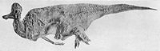
Corythosaurus

Encyclopedia
Corythosaurus is a genus
of duck-billed dinosaur
from the Upper Cretaceous
Period, about 77-76.5 million years ago. It lived in what is now North America
. Its name means "helmet lizard", from the Greek
κορυθως/korythos meaning "helmet" and σαυρος/sauros meaning "lizard", because the crest shape resembled a Corinthian soldier's helmet
).
in Red Deer River
, Alberta
, Canada
. As well as an almost complete skeleton, the find was remarkable because much of the creature's fossilized skin had also survived. In 1916, the Canadian (Canadian Pacific Lines) ship Mount Temple was carrying two specimens and other fossils from today's Dinosaur Provincial Park, Alberta, Canada to Britain. It was sunk by the German surface raider SMS Möwe
, sending its 75 million year old cargo to the bottom of the North Atlantic, where it rests to this day.
There were originally up to seven species described including C. casaurius, C. bicristatus, C. brevicristatus, C. excavatus, C. frontalis, and C. intermedius. In 1975 Peter Dodson studied the differences between the skulls and crests of different species of lambeosaurine dinosaurs. He found that the differences in size and shape may have actually been related to the gender and age of the animal. Now only one species is recognized, C. casuarius.
 Corythosaurus is classified as a hadrosaurid
, in the subfamily Lambeosaurinae
. It is related to other hadrosaurs such as Hypacrosaurus
, Lambeosaurus
and Olorotitan
, with the exception of Olorotitan
they all share similar looking skulls and crests. However, recent research has suggested that Olorotitan
is Corythosaurus closest known relative even though it doesn't share as many skull characteristics as other lambeosaurs.
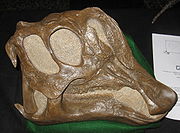
Over 20 skulls have been found from this dinosaur. As with other lambeosaurs, the animal bore a tall, elaborate bony crest atop its skull, which contained the elongate nasal passages. The nasal passages extended into the crest, first into separate pockets in the sides, then into a single central chamber and onward into the respiratory system.
Any vocalization would travel through these elaborate chambers, and probably get amplified. Scientists speculate that Corythosaurus could make loud, low pitched cries "[L]ike a wind or brass instrument." The sounds could serve to alert other Corythosaurus to the presence of food or a potential threat from a predator.
It was once thought that this dinosaur lived mostly in the water, due to the appearance of webbed hands and feet. However, it was later discovered that the so-called "webs" were in fact deflated padding, much like that found on many modern mammals.
Fossils have been found in the upper Oldman Formation
and lower Dinosaur Park Formation
of Canada
.
Comparisons between the scleral ring
s of Corythosaurus and modern birds and reptiles suggest that it may have been cathemeral
, active throughout the day at short intervals.
even though it is one of the most abundant Judithian
dinosaurs in the region. Large herbivores like the hadrosaurs living in North America during the Late Cretaceous had "remarkably small geographic ranges" despite their large body size and high mobility. This restricted distribution strongly contrasts with modern mammalian faunas whose large herbivores' ranges "typical[ly] ... span much of a continent."
Genus
In biology, a genus is a low-level taxonomic rank used in the biological classification of living and fossil organisms, which is an example of definition by genus and differentia...
of duck-billed dinosaur
Dinosaur
Dinosaurs are a diverse group of animals of the clade and superorder Dinosauria. They were the dominant terrestrial vertebrates for over 160 million years, from the late Triassic period until the end of the Cretaceous , when the Cretaceous–Paleogene extinction event led to the extinction of...
from the Upper Cretaceous
Cretaceous
The Cretaceous , derived from the Latin "creta" , usually abbreviated K for its German translation Kreide , is a geologic period and system from circa to million years ago. In the geologic timescale, the Cretaceous follows the Jurassic period and is followed by the Paleogene period of the...
Period, about 77-76.5 million years ago. It lived in what is now North America
North America
North America is a continent wholly within the Northern Hemisphere and almost wholly within the Western Hemisphere. It is also considered a northern subcontinent of the Americas...
. Its name means "helmet lizard", from the Greek
Ancient Greek
Ancient Greek is the stage of the Greek language in the periods spanning the times c. 9th–6th centuries BC, , c. 5th–4th centuries BC , and the c. 3rd century BC – 6th century AD of ancient Greece and the ancient world; being predated in the 2nd millennium BC by Mycenaean Greek...
κορυθως/korythos meaning "helmet" and σαυρος/sauros meaning "lizard", because the crest shape resembled a Corinthian soldier's helmet
Corinthian helmet
The Corinthian helmet originated in ancient Greece and took its name from the city-state of Corinth. It was a helmet made of bronze which in its later styles covered the entire head and neck, with slits for the eyes and mouth. A large curved projection protected the nape of the neck...
).
Discovery and species
The first specimen was discovered in 1912 by Barnum BrownBarnum Brown
Barnum Brown , a paleontologist born in Carbondale, Kansas, and named after the circus showman P.T. Barnum, discovered the second fossil of Tyrannosaurus rex during a career that made him one of the most famous fossil hunters working from the late Victorian era into the early 20th century.Sponsored...
in Red Deer River
Red Deer, Alberta
Red Deer is a city in Central Alberta, Canada. It is located near the midpoint of the Calgary-Edmonton Corridor and is surrounded by Red Deer County. It is Alberta's third-most-populous city – after Calgary and Edmonton. The city is located in aspen parkland, a region of rolling hills...
, Alberta
Alberta
Alberta is a province of Canada. It had an estimated population of 3.7 million in 2010 making it the most populous of Canada's three prairie provinces...
, Canada
Canada
Canada is a North American country consisting of ten provinces and three territories. Located in the northern part of the continent, it extends from the Atlantic Ocean in the east to the Pacific Ocean in the west, and northward into the Arctic Ocean...
. As well as an almost complete skeleton, the find was remarkable because much of the creature's fossilized skin had also survived. In 1916, the Canadian (Canadian Pacific Lines) ship Mount Temple was carrying two specimens and other fossils from today's Dinosaur Provincial Park, Alberta, Canada to Britain. It was sunk by the German surface raider SMS Möwe
SMS Möwe
SMS Möwe was an merchant raider of the Imperial German Navy which operated against Allied shipping during World War I....
, sending its 75 million year old cargo to the bottom of the North Atlantic, where it rests to this day.
There were originally up to seven species described including C. casaurius, C. bicristatus, C. brevicristatus, C. excavatus, C. frontalis, and C. intermedius. In 1975 Peter Dodson studied the differences between the skulls and crests of different species of lambeosaurine dinosaurs. He found that the differences in size and shape may have actually been related to the gender and age of the animal. Now only one species is recognized, C. casuarius.
Classification
Hadrosaurid
Hadrosaurids or duck-billed dinosaurs are members of the family Hadrosauridae, and include ornithopods such as Edmontosaurus and Parasaurolophus. They were common herbivores in the Upper Cretaceous Period of what are now Asia, Europe and North America. They are descendants of the Upper...
, in the subfamily Lambeosaurinae
Lambeosaurinae
Lambeosaurinae is a group of crested hadrosaurid dinosaurs.-Classification:Lambeosaurines have been split into Parasaurolophini and Corythosaurini . Corythosaurini and Parasaurolophini as terms entered the formal literature in Evans and Reisz's 2007 redescription of Lambeosaurus magnicristatus...
. It is related to other hadrosaurs such as Hypacrosaurus
Hypacrosaurus
Hypacrosaurus was a genus of duckbill dinosaur similar in appearance to Corythosaurus. Like Corythosaurus, it had a tall, hollow rounded crest, although not as large and straight...
, Lambeosaurus
Lambeosaurus
Lambeosaurus is a genus of hadrosaurid dinosaur that lived about 76 to 75 million years ago, in the Late Cretaceous Period of North America. This bipedal/quadrupedal, herbivorous dinosaur is known for its distinctive hollow cranial crest, which in the best-known species resembled a hatchet...
and Olorotitan
Olorotitan
Olorotitan was a genus of lambeosaurine duckbilled dinosaur from the middle or latest Maastrichtian-age Late Cretaceous Tsagayan Formation beds located in Kundur, Amur Region, Far Eastern Russia. The remains, consisting of a nearly complete skeleton, were described by Pascal Godefroit et al. in...
, with the exception of Olorotitan
Olorotitan
Olorotitan was a genus of lambeosaurine duckbilled dinosaur from the middle or latest Maastrichtian-age Late Cretaceous Tsagayan Formation beds located in Kundur, Amur Region, Far Eastern Russia. The remains, consisting of a nearly complete skeleton, were described by Pascal Godefroit et al. in...
they all share similar looking skulls and crests. However, recent research has suggested that Olorotitan
Olorotitan
Olorotitan was a genus of lambeosaurine duckbilled dinosaur from the middle or latest Maastrichtian-age Late Cretaceous Tsagayan Formation beds located in Kundur, Amur Region, Far Eastern Russia. The remains, consisting of a nearly complete skeleton, were described by Pascal Godefroit et al. in...
is Corythosaurus closest known relative even though it doesn't share as many skull characteristics as other lambeosaurs.
Paleobiology
Corythosaurus weighed in at 4 tonnes and measured roughly 10 metres (33 ft) from nose to tail. Like other hadrosaurs it had a toothless beak, the back of the jaws contained a dental battery composed of hundreds of small, interlocking teeth. These were used to crush and grind plant matter and were continually replaced as they wore away.Over 20 skulls have been found from this dinosaur. As with other lambeosaurs, the animal bore a tall, elaborate bony crest atop its skull, which contained the elongate nasal passages. The nasal passages extended into the crest, first into separate pockets in the sides, then into a single central chamber and onward into the respiratory system.
Any vocalization would travel through these elaborate chambers, and probably get amplified. Scientists speculate that Corythosaurus could make loud, low pitched cries "[L]ike a wind or brass instrument." The sounds could serve to alert other Corythosaurus to the presence of food or a potential threat from a predator.
It was once thought that this dinosaur lived mostly in the water, due to the appearance of webbed hands and feet. However, it was later discovered that the so-called "webs" were in fact deflated padding, much like that found on many modern mammals.
Fossils have been found in the upper Oldman Formation
Oldman Formation
The Oldman Formation is the middle member of the Judith River Group, a major geologic unit in southern Alberta. The formation is widely recognized as bearing a great number of well preserved dinosaur skeletons, as well as other fossils.-Age:...
and lower Dinosaur Park Formation
Dinosaur Park Formation
The Dinosaur Park Formation is the uppermost member of the Judith River Group, a major geologic unit in southern Alberta. It was laid down over a period of time between about 76.5 and 75 million years ago. The formation is made up of deposits of a high-sinuosity fluvial system, and is capped...
of Canada
Canada
Canada is a North American country consisting of ten provinces and three territories. Located in the northern part of the continent, it extends from the Atlantic Ocean in the east to the Pacific Ocean in the west, and northward into the Arctic Ocean...
.
Comparisons between the scleral ring
Sclerotic ring
Sclerotic rings are rings of bone found in the eyes of several groups of vertebrate animals, except for mammals and crocodilians. They can be made up of single bones or small bones together. They are believed to have a role in supporting the eye, especially in animals whose eyes are not spherical,...
s of Corythosaurus and modern birds and reptiles suggest that it may have been cathemeral
Cathemeral
A cathemeral organism is one that has sporadic and random intervals of activity during the day or night in which food is acquired, socializing with other organisms occurs, and any other activities necessary for livelihood are performed...
, active throughout the day at short intervals.
Paleobiogeography
Thomas M. Lehman has observed that Corythosaurus hasn't been discovered outside of southern AlbertaAlberta
Alberta is a province of Canada. It had an estimated population of 3.7 million in 2010 making it the most populous of Canada's three prairie provinces...
even though it is one of the most abundant Judithian
Judithian
The Judithian was a North American faunal stage lasting from 83.5 to 70.6 million years ago. It overlaps with the Campanian global stage.-Fauna:Dinosaur faunas of the Judithian age may represent the peak of dinosaur evolution in North America...
dinosaurs in the region. Large herbivores like the hadrosaurs living in North America during the Late Cretaceous had "remarkably small geographic ranges" despite their large body size and high mobility. This restricted distribution strongly contrasts with modern mammalian faunas whose large herbivores' ranges "typical[ly] ... span much of a continent."