
Home      Discussion      Topics      Dictionary      Almanac
Signup       Login
Common Lilac

Common Lilac

Overview
Syringa vulgaris (Lilac or Common Lilac) is a species of Syringa in the olive family Oleaceae
Oleaceae
The Oleaceae, or olive family, is a plant family containing 24 extant genera and around 600 species of mesophytic shrubs, trees and occasionally vines. As shrubs, members of this family may be twine climbers, or scramblers.-Leaves:...

, native to the Balkan Peninsula in southeastern Europe
Europe
Europe is, by convention, one of the world's seven continents. Comprising the westernmost peninsula of Eurasia, Europe is generally divided from Asia to its east by the water divide of the Ural Mountains, the Ural River, the Caspian Sea, the Caucasus Mountains , and the Black Sea to the southeast...

, where it grows on rocky hills.

It is a large deciduous
Deciduous
Deciduous means falling off at maturity or tending to fall off and is typically used in reference to trees or shrubs that lose their leaves seasonally and to the shedding of other plant structures such as petals after flowering or fruit when ripe...

 shrub
Shrub
A shrub or bush is a horticultural rather than strictly botanical category of woody plant, distinguished from a tree by its multiple stems and lower height, usually less than 5-6 m tall. A large number of plants can be either shrubs or trees, depending on the growing conditions they experience...

 or multi-stemmed small tree
Tree
A tree is a perennial woody plant. It is most often defined as a woody plant that has many secondary branches supported clear of the ground on a single main stem or trunk with clear apical dominance. A minimum height specification at maturity is cited by some authors, varying from 3 m to...

, growing to 6–7 m high, producing secondary shoots ("suckers") with stem diameters of up to 20 cm from the base or roots, which in the course of decades may produce a small clonal thicket.
Discussion
Ask a question about 'Common Lilac'
Start a new discussion about 'Common Lilac'
Answer questions from other users
Full Discussion Forum
 
Encyclopedia
Syringa vulgaris (Lilac or Common Lilac) is a species of Syringa in the olive family Oleaceae
Oleaceae
The Oleaceae, or olive family, is a plant family containing 24 extant genera and around 600 species of mesophytic shrubs, trees and occasionally vines. As shrubs, members of this family may be twine climbers, or scramblers.-Leaves:...

, native to the Balkan Peninsula in southeastern Europe
Europe
Europe is, by convention, one of the world's seven continents. Comprising the westernmost peninsula of Eurasia, Europe is generally divided from Asia to its east by the water divide of the Ural Mountains, the Ural River, the Caspian Sea, the Caucasus Mountains , and the Black Sea to the southeast...

, where it grows on rocky hills.

Description


It is a large deciduous
Deciduous
Deciduous means falling off at maturity or tending to fall off and is typically used in reference to trees or shrubs that lose their leaves seasonally and to the shedding of other plant structures such as petals after flowering or fruit when ripe...

 shrub
Shrub
A shrub or bush is a horticultural rather than strictly botanical category of woody plant, distinguished from a tree by its multiple stems and lower height, usually less than 5-6 m tall. A large number of plants can be either shrubs or trees, depending on the growing conditions they experience...

 or multi-stemmed small tree
Tree
A tree is a perennial woody plant. It is most often defined as a woody plant that has many secondary branches supported clear of the ground on a single main stem or trunk with clear apical dominance. A minimum height specification at maturity is cited by some authors, varying from 3 m to...

, growing to 6–7 m high, producing secondary shoots ("suckers") with stem diameters of up to 20 cm from the base or roots, which in the course of decades may produce a small clonal thicket. The bark
Bark
Bark is the outermost layers of stems and roots of woody plants. Plants with bark include trees, woody vines and shrubs. Bark refers to all the tissues outside of the vascular cambium and is a nontechnical term. It overlays the wood and consists of the inner bark and the outer bark. The inner...

 is grey to grey-brown, smooth on young stems, longitudinally furrowed and flaking on older stems. The leaves
Leaf
In botany, a leaf is an above-ground plant organ specialized for photosynthesis. For this purpose, a leaf is typically flat and thin. There is continued debate about whether the flatness of leaves evolved to expose the chloroplasts to more light or to increase the absorption of carbon dioxide. In...

 are simple, 4–12 cm long and 3–8 cm broad, light green to glaucous, oval to cordate, with pinnate leaf venation, a mucronate apex
Meristem
A meristem is the tissue in all plants consisting of undifferentiated cells and found in zones of the plant where growth can take place....

 and an entire margin. They are arranged in opposite pairs or occasionally in whorls of three. The flower
Flower
A flower, sometimes known as a bloom or blossom, is the reproductive structure found in flowering plants . The biological function of a flower is to mediate the union of male sperm with female ovum in order to produce seeds...

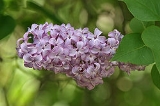
s have a tubular base to the corolla 6–10 mm long with an open four-lobed apex 5–8 mm across, usually lilac
Lilac
Syringa is a genus of about 20–25 species of flowering plants in the olive family , native to Europe and Asia.They are deciduous shrubs or small trees, ranging in size from 2–10 m tall, with stems up to 20–30 cm diameter...

 to mauve
Mauve
Mauve is a pale lavender-lilac color, one of many in the range of purples....

, occasionally white. They are arranged in a dense, terminal panicle
Panicle
A panicle is a compound raceme, a loose, much-branched indeterminate inflorescence with pedicellate flowers attached along the secondary branches ....

 8-18 cm long. The fruit
Fruit
The term fruit has different meanings dependent on context, and the term is not synonymous in food preparation and biology. Fruits are the means by which flowering plants disseminate seeds, and the presence of seeds indicates that a structure is most likely a fruit, though not all seeds come from...

 is a dry, smooth brown capsule
Capsule (fruit)
In botany a capsule is a type of simple, dry fruit produced by many species of flowering plants. A capsule is a dehiscent structure composed of two or more carpels, that, at maturity, split apart to release the seeds within...

, 1–2 cm long, splitting in two to release the two winged seed
Seed
A seed , referred to as a kernel in some plants, is a small embryonic plant enclosed in a covering called the seed coat, usually with some stored food. It is the product of the ripened ovule of gymnosperm and angiosperm plants which occurs after fertilization and some growth within the mother plant...

s.

Garden history


Lilacs— both Syringa vulgaris and S. x persica, the finer, smaller "Persian Lilac", now considered a natural hybrid— were introduced into European gardens at the end of the sixteenth century, from Ottoman
Ottoman Empire
The Ottoman Empire or Ottoman State , also known by its contemporaries as the Turkish Empire or Turkey , was an empire that lasted from 1299 to November 1, 1922 The Ottoman Empire or Ottoman State (Ottoman Turkish: دَوْلَتِ عَلِیَّهِ عُثْمَانِیَّه Dawlet-il ʿAliyyat-il ʿOs̠māniyye, Modern Turkish:...

 gardens, not through botanists exploring the Balkan habitats of S. vulgaris. The Holy Roman Emperor's ambassador, Ogier Ghiselin de Busbecq
Ogier Ghiselin de Busbecq
Ogier Ghiselin de Busbecq was a Flemish writer, herbalist and diplomat in the employ of three generations of Austrian monarchs...

, is generally credited with supplying lilac slips to Carolus Clusius, about 1562. Well-connected botanists, like the great herbalist John Gerard
John Gerard
John Gerard was an English herbalist famous for his herbal garden. After being educated in Willaston near Nantwich he started to study medicine and travelled widely as a ship's surgeon. From 1577 on, he supervised the gardens of William Cecil, Lord Burghley in London...

, soon had the rarity in their gardens: Gerard notes that he had lilacs growing “in very great plenty” in 1597, but lilacs were not mentioned by Shakespeare, and John Loudon
John Claudius Loudon
John Claudius Loudon was a Scottish botanist, garden and cemetery designer, and garden magazine editor.-Background:...

 was of the opinion that the Persian lilac had been introduced into English gardens by John Tradescant the elder
John Tradescant the elder
John Tradescant the elder , father of John Tradescant the younger, was an English naturalist, gardener, collector and traveller, probably born in Suffolk, England. He began his career as head gardener to the Earl of Salisbury at Hatfield House, who initiated Tradescant in travelling by sending him...

. Tradescant's Continental source for information on the lilac, and perhaps ultimately for the plants, was Pietro Andrea Mattioli
Pietro Andrea Mattioli
Pietro Andrea Gregorio Mattioli was a doctor and naturalist born in Siena.He received his MD at the University of Padua in 1523, and subsequently practiced the profession in Siena, Rome, Trento and Gorizia, becoming personal doctor of Ferdinand II, Archduke of Austria in Prague and Ambras Castle...

, as one can tell from a unique copy of Tradescant's plant list in his Lambeth
Lambeth
Lambeth is a place in the London Borough of Lambeth, although the area is now more commonly known as Waterloo, after the railway station whose viaduct separates the former centre of the village from the River Thames...

 garden, an adjunct of his Musaeum Tradescantianum
Musaeum Tradescantianum
The Musaeum Tradescantianum was the first museum open to the public to be established in England. Located at Lambeth in south London, it comprised a collection of curiosities assembled by John Tradescant the elder and his son in a building called The Ark, and a botanical collection in the grounds...

; it was printed, though probably not published, in 1634: it lists Lilac Matthioli. That Tradescant's "lilac of Mattioli's" was a white one is shown by Elias Ashmole
Elias Ashmole
Elias Ashmole , was a celebrated English antiquary, politician, officer of arms, astrologer and student of alchemy. Ashmole supported the royalist side during the English Civil War, and at the restoration of Charles II he was rewarded with several lucrative offices.Ashmole was an antiquary with a...

's manuscript list, Trees found in Mrs Tredescants Ground when it came into my possession (1662): "Syringa alba".

In the American colonies lilacs were introduced in the eighteenth century. Peter Collinson, F.R.S.,
Peter Collinson FRS
Peter Collinson was a Fellow of the Royal Society, an avid gardener, and the middleman for an international exchange of scientific ideas in mid-18th century London...

 wrote to the Pennsylvania gardener and botanist John Bartram
John Bartram
John Bartram was an early American botanist, horticulturalist, and explorer. Carolus Linnaeus said he was the "greatest natural botanist in the world."...

, proposing to send him some, and remarked that John Custis
John Custis
John Custis was a member of the Governor's Council in the British colony of Virginia. The son of John Custis , who was also a Council member, and Margaret Michael Custis, Custis was born in Northampton County, Virginia...

 of Virginia had a fine "collection", which Ann Leighton interpreted as signifying Common and Persian Lilacs, in both purple and white, "the entire range of lilacs possible" at the time.

Cultivation


Common Lilac is a very common ornamental plant
Ornamental plant
Ornamental plants are typically grown in the flower garden or as house plants. Most commonly they are grown for the display of their flowers. Other common ornamental features include leaves, scent, fruit, stem and bark. In some cases, unusual features may be considered ornamental, such as the...

 in gardens and parks, because of the attractive, sweet smell of its flowers. Most garden plants are cultivar
Cultivar
A cultivar is a cultivated plant that has been selected and given a unique name because of desired characteristics; it is usually distinct from similar plants and when propagated it retains those characteristics....

s ("French Lilacs") with flowers varying from white to dark lilac; some have double flowers with the stamens replaced by extra petals. The cultivar 'Aurea' has yellowish foliage. The majority of garden cultivars do not exceed 4-5 m tall.

In late summer, lilacs are attacked by powdery mildew
Powdery mildew
Powdery mildew is a fungal disease that affects a wide range of plants. Powdery mildew diseases are caused by many different species of fungi in the order Erysiphales. It is one of the easier diseases to spot, as its symptoms are quite distinctive. Infected plants display white powder-like spots on...

, specifically Erysiphe syringae, one of the Erysiphaceae
Erysiphaceae
The Erysiphaceae are fungal family of the order Erysiphales. The family contains many of the powdery mildews.-Genera:*Arthrocladiella*Blumeria*Brasiliomyces*Bulbomicrosphaera*Bulbouncinula*Caespitotheca...

. There is no fall color and the seed clusters have no aesthetic appeal.

Common lilac tends to flower profusely in alternate years, a habit that can be improved by deadheading the flower clusters after the color has faded and before seeds, few of which are fertile, form. At the same time twiggy growth on shoots that have flowered more than once or twice can be cut to a strong, outward-growing side shoot.

It is widely naturalised
Naturalisation (biology)
In biology, naturalisation is the process when foreign or cultivated plants or animals have spread into the wild, where they multiply by natural regeneration....

 in western and northern Europe. In a sign of its complete naturalization in North America, it has been selected as the state flower of the state of New Hampshire
New Hampshire
New Hampshire is a state in the New England region of the northeastern United States of America. The state was named after the southern English county of Hampshire. It borders Massachusetts to the south, Vermont to the west, Maine and the Atlantic Ocean to the east, and the Canadian province of...

, because it "is symbolic of that hardy character of the men and women of the Granite State". Additional hardiness, for Canadian gardens, was bred for in a series of S. vulgaris hybrids by Isabella Preston, who introduced many of the later-blooming varieties, whose later-developing flower-buds are better protected from late spring frosts; the Syringa x prestoniae hybrids range primarily in the pink and lavender shades.