

Oleaceae

Encyclopedia
Oleaceae are a family
containing 24 extant genera
and around 600 species
of mesophytic shrub
s, tree
s and occasionally vine
s. As shrubs, members of this family may be twine
climbers, or scramblers.
or ternate
), without stipule
. Alternate or whorled arrangements are rarely observed, with some Jasminum species presenting spiral configuration. The laminas are pinnately-veined and can be serrate, dentate or entire at margin. Domatia
are observed in certain taxa. The leaves may be either deciduous
or evergreen
, with evergreen species predominating in warm temperate and tropical regions, and deciduous species predominating in colder regions.
s are most often bisexual
and actinomorphic, occurring in raceme
s or panicle
s, and often fragrant. The calyx, which may or may not be present, and the corolla are gamosepalous and four-lobed. The androecium has 2 stamen
s inserted in the perigynous zone and alternate with the lobes. The stigmas are two-lobed.
The gynoecium
consists of a compound pistil with two carpels. The ovary
is superior with two locule
s, each of which bearing two axillary ovule
s. Sometimes the base of the ovary is circled by a nectary disk. The plants are most often hermaphrodite
but sometimes polygamomonoecious
.
, drupe
s, capsules
or samaras
.
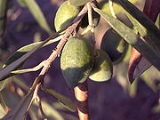
(Olea europaea) is important for its fruit and the oil
extracted from it, the ashes
(Fraxinus) are valued for tough wood
, and forsythia
, lilac
s, jasmine
s, osmanthus
es, privet
s, and fringetrees are valued as ornamental plant
s in garden
s and landscaping
.
Family (biology)
In biological classification, family is* a taxonomic rank. Other well-known ranks are life, domain, kingdom, phylum, class, order, genus, and species, with family fitting between order and genus. As for the other well-known ranks, there is the option of an immediately lower rank, indicated by the...
containing 24 extant genera
Genus
In biology, a genus is a low-level taxonomic rank used in the biological classification of living and fossil organisms, which is an example of definition by genus and differentia...
and around 600 species
Species
In biology, a species is one of the basic units of biological classification and a taxonomic rank. A species is often defined as a group of organisms capable of interbreeding and producing fertile offspring. While in many cases this definition is adequate, more precise or differing measures are...
of mesophytic shrub
Shrub
A shrub or bush is distinguished from a tree by its multiple stems and shorter height, usually under 5–6 m tall. A large number of plants may become either shrubs or trees, depending on the growing conditions they experience...
s, tree
Tree
A tree is a perennial woody plant. It is most often defined as a woody plant that has many secondary branches supported clear of the ground on a single main stem or trunk with clear apical dominance. A minimum height specification at maturity is cited by some authors, varying from 3 m to...
s and occasionally vine
Vine
A vine in the narrowest sense is the grapevine , but more generally it can refer to any plant with a growth habit of trailing or scandent, that is to say climbing, stems or runners...
s. As shrubs, members of this family may be twine
Twine
Twine is a light string or strong thread composed of two or more smaller strands or yarns twisted together. More generally, the term can be applied to any thin cord....
climbers, or scramblers.
Leaves
The family is characterized by opposite leaves that may be simple or compound (either pinnatePinnate
Pinnate is a term used to describe feather-like or multi-divided features arising from both sides of a common axis in plant or animal structures, and comes from the Latin word pinna meaning "feather", "wing", or "fin". A similar term is pectinate, which refers to a comb-like arrangement of parts...
or ternate
Leaf shape
In botany, leaf shape is characterised with the following terms :* Acicular : Slender and pointed, needle-like* Acuminate : Tapering to a long point...
), without stipule
Stipule
In botany, stipule is a term coined by Linnaeus which refers to outgrowths borne on either side of the base of a leafstalk...
. Alternate or whorled arrangements are rarely observed, with some Jasminum species presenting spiral configuration. The laminas are pinnately-veined and can be serrate, dentate or entire at margin. Domatia
Domatia
Domatia are tiny chambers produced by plants that house arthropods.Domatia differ from galls in that they are produced by the plant rather than being induced by their inhabitants...
are observed in certain taxa. The leaves may be either deciduous
Deciduous
Deciduous means "falling off at maturity" or "tending to fall off", and is typically used in reference to trees or shrubs that lose their leaves seasonally, and to the shedding of other plant structures such as petals after flowering or fruit when ripe...
or evergreen
Evergreen
In botany, an evergreen plant is a plant that has leaves in all seasons. This contrasts with deciduous plants, which completely lose their foliage during the winter or dry season.There are many different kinds of evergreen plants, both trees and shrubs...
, with evergreen species predominating in warm temperate and tropical regions, and deciduous species predominating in colder regions.
Flower
The flowerFlower
A flower, sometimes known as a bloom or blossom, is the reproductive structure found in flowering plants . The biological function of a flower is to effect reproduction, usually by providing a mechanism for the union of sperm with eggs...
s are most often bisexual
Plant sexuality
Plant sexuality covers the wide variety of sexual reproduction systems found across the plant kingdom. This article describes morphological aspects of sexual reproduction of plants....
and actinomorphic, occurring in raceme
Raceme
A raceme is a type of inflorescence that is unbranched and indeterminate and bears pedicellate flowers — flowers having short floral stalks called pedicels — along the axis. In botany, axis means a shoot, in this case one bearing the flowers. In a raceme, the oldest flowers are borne...
s or panicle
Panicle
A panicle is a compound raceme, a loose, much-branched indeterminate inflorescence with pedicellate flowers attached along the secondary branches; in other words, a branched cluster of flowers in which the branches are racemes....
s, and often fragrant. The calyx, which may or may not be present, and the corolla are gamosepalous and four-lobed. The androecium has 2 stamen
Stamen
The stamen is the pollen producing reproductive organ of a flower...
s inserted in the perigynous zone and alternate with the lobes. The stigmas are two-lobed.
The gynoecium
Gynoecium
Gynoecium is most commonly used as a collective term for all carpels in a flower. A carpel is the ovule and seed producing reproductive organ in flowering plants. Carpels are derived from ovule-bearing leaves which evolved to form a closed structure containing the ovules...
consists of a compound pistil with two carpels. The ovary
Ovary
The ovary is an ovum-producing reproductive organ, often found in pairs as part of the vertebrate female reproductive system. Ovaries in anatomically female individuals are analogous to testes in anatomically male individuals, in that they are both gonads and endocrine glands.-Human anatomy:Ovaries...
is superior with two locule
Locule
A locule is a small cavity or compartment within an organ or part of an organism ....
s, each of which bearing two axillary ovule
Ovule
Ovule means "small egg". In seed plants, the ovule is the structure that gives rise to and contains the female reproductive cells. It consists of three parts: The integument forming its outer layer, the nucellus , and the megaspore-derived female gametophyte in its center...
s. Sometimes the base of the ovary is circled by a nectary disk. The plants are most often hermaphrodite
Hermaphrodite
In biology, a hermaphrodite is an organism that has reproductive organs normally associated with both male and female sexes.Many taxonomic groups of animals do not have separate sexes. In these groups, hermaphroditism is a normal condition, enabling a form of sexual reproduction in which both...
but sometimes polygamomonoecious
Plant sexuality
Plant sexuality covers the wide variety of sexual reproduction systems found across the plant kingdom. This article describes morphological aspects of sexual reproduction of plants....
.
Fruit
Oleaceae fruit can be berriesBerry
The botanical definition of a berry is a fleshy fruit produced from a single ovary. Grapes are an example. The berry is the most common type of fleshy fruit in which the entire ovary wall ripens into an edible pericarp. They may have one or more carpels with a thin covering and fleshy interiors....
, drupe
Drupe
In botany, a drupe is a fruit in which an outer fleshy part surrounds a shell of hardened endocarp with a seed inside. These fruits develop from a single carpel, and mostly from flowers with superior ovaries...
s, capsules
Capsule (fruit)
In botany a capsule is a type of simple, dry fruit produced by many species of flowering plants. A capsule is a structure composed of two or more carpels that in most cases is dehiscent, i.e. at maturity, it splits apart to release the seeds within. A few capsules are indehiscent, for example...
or samaras
Samara (fruit)
A samara is a type of fruit in which a flattened wing of fibrous, papery tissue develops from the ovary wall. A samara is a simple dry fruit and indehiscent . It is a winged achene...
.
Uses
Many members of the family are economically significant. The oliveOlive
The olive , Olea europaea), is a species of a small tree in the family Oleaceae, native to the coastal areas of the eastern Mediterranean Basin as well as northern Iran at the south end of the Caspian Sea.Its fruit, also called the olive, is of major agricultural importance in the...
(Olea europaea) is important for its fruit and the oil
Olive oil
Olive oil is an oil obtained from the olive , a traditional tree crop of the Mediterranean Basin. It is commonly used in cooking, cosmetics, pharmaceuticals, and soaps and as a fuel for traditional oil lamps...
extracted from it, the ashes
Ash tree
Fraxinus is a genus flowering plants in the olive and lilac family, Oleaceae. It contains 45-65 species of usually medium to large trees, mostly deciduous though a few subtropical species are evergreen. The tree's common English name, ash, goes back to the Old English æsc, while the generic name...
(Fraxinus) are valued for tough wood
Wood
Wood is a hard, fibrous tissue found in many trees. It has been used for hundreds of thousands of years for both fuel and as a construction material. It is an organic material, a natural composite of cellulose fibers embedded in a matrix of lignin which resists compression...
, and forsythia
Forsythia
Forsythia is a genus of flowering plants in the family Oleaceae . There are about 11 species, mostly native to eastern Asia, but one native to southeastern Europe. The common name is also Forsythia; the genus is named after William Forsyth.-Growth:They are deciduous shrubs typically growing to a...
, lilac
Lilac
Syringa is a genus of about 20–25 species of flowering woody plants in the olive family , native to woodland and scrub from southeastern Europe to eastern Asia, and widely and commonly cultivated in temperate areas elsewhere....
s, jasmine
Jasmine
Jasminum , commonly known as jasmines, is a genus of shrubs and vines in the olive family . It contains around 200 species native to tropical and warm temperate regions of the Old World...
s, osmanthus
Osmanthus
Osmanthus is a genus of about 30 species of flowering plants in the family Oleaceae, mostly native to warm temperate Asia but one species occurring in North America . It is sometimes included in Nestegis.They range in size from shrubs to small trees, 2-12 m tall...
es, privet
Privet
Privet was originally the name for the European semi-evergreen shrub Ligustrum vulgare, and later also for the more reliably evergreen Ligustrum ovalifolium , used extensively for privacy hedging. It is often suggested that the name privet is related to private, but the OED states that there is no...
s, and fringetrees are valued as ornamental plant
Ornamental plant
Ornamental plants are plants that are grown for decorative purposes in gardens and landscape design projects, as house plants, for cut flowers and specimen display...
s in garden
Garden
A garden is a planned space, usually outdoors, set aside for the display, cultivation, and enjoyment of plants and other forms of nature. The garden can incorporate both natural and man-made materials. The most common form today is known as a residential garden, but the term garden has...
s and landscaping
Landscaping
Landscaping refers to any activity that modifies the visible features of an area of land, including:# living elements, such as flora or fauna; or what is commonly referred to as gardening, the art and craft of growing plants with a goal of creating a beautiful environment within the landscape.#...
.
Selected genera
- AbeliophyllumAbeliophyllumAbeliophyllum is a monotypic genus of flowering plants in the olive family, Oleaceae. It consists of one species, Abeliophyllum distichum Nakai , endemic to Korea, where it is endangered in the wild, occurring at only seven sites...
– White Forsythia - ChionanthusChionanthusChionanthus is a genus of about 80 species of flowering plants in the family Oleaceae.The genus has a wide distribution primarily in the tropics and subtropics, but with two species extending north into temperate regions, one in eastern Asia and one in eastern North America...
– fringetree - Comoranthus
- Dimetra
- FontanesiaFontanesiaFontanesia is a genus of flowering plants in the family Oleaceae, usually treated as comprising a single species Fontanesia philliraeoides, though some authors split this into two species...
- ForestieraForestieraForestiera is a genus of about 20 species of flowering plants in the olive family, Oleaceae. Members of the genus are often called swampprivets. Most are shrubs.-Selected species:...
– swamp-privet - ForsythiaForsythiaForsythia is a genus of flowering plants in the family Oleaceae . There are about 11 species, mostly native to eastern Asia, but one native to southeastern Europe. The common name is also Forsythia; the genus is named after William Forsyth.-Growth:They are deciduous shrubs typically growing to a...
– forsythia - Fraxinus – ash
- Haenianthus
- Hesperelaea †
- Jasminum – jasmine
- LigustrumLigustrumLigustrum is a genus of about forty species of erect, deciduous or evergreen shrubs, sometimes forming small or medium-sized trees. They are now all known by the common name of privet.-Selected species:...
– privet - MenodoraMenodoraMenodora is a genus of perennial plants and shrubs in the olive family Oleaceae. Its 23 species are found in the temperate Americas and in southern Africa...
- Myxopyrum
- NestegisNestegisNestegis is a genus of flowering plant in the olive family, Oleaceae. There are a small number of species in the genus: three species are endemic to New Zealand, one can be found on New Zealand and Norfolk Island, another is restricted to Hawaii, one in Australia...
- NoronhiaNoronhiaNoronhia is a genus of 41 species of flowering plants in the family Oleaceae, all but one native to Madagascar, the remaining species native to the Comoros Islands north of Madagascar.The species are deciduous or evergreen trees....
- NotelaeaNotelaeaNotelaea is a genus of Australian plants of the family Oleaceae.Species include:*Notelaea ipsviciensis W.K.Harris*Notelaea johnsonii P.S.Green*Notelaea ligustrina Vent.*Notelaea linearis Benth.*Notelaea lloydii Guymer...
- NyctanthesNyctanthesNyctanthes is a genus of flowering plants in the family Oleaceae, native to southeastern Asia. It is currently accepted as containing two species; other species previously included in this genus have been transferred to other genera, most of them to Jasminum.They are shrubs or small trees growing...
- OleaOleaOlea is a genus of about 40 species in the family Oleaceae, native to warm temperate and tropical regions of southern Europe, Africa, southern Asia and Australasia. They are evergreen trees and shrubs, with small, opposite, entire leaves...
– olive - OsmanthusOsmanthusOsmanthus is a genus of about 30 species of flowering plants in the family Oleaceae, mostly native to warm temperate Asia but one species occurring in North America . It is sometimes included in Nestegis.They range in size from shrubs to small trees, 2-12 m tall...
– osmanthus - PhillyreaPhillyreaPhillyrea is a genus of two species of flowering plants in the family Oleaceae, native to the Mediterranean region, the Canary Islands and Madeira....
– mock-privet - PicconiaPicconiaPicconia is a genus of flowering plants in the family Oleaceae.-Species:*Picconia azorica - endemic to the archipelago of the Azores*Picconia excelsa - tree up to 15m; Madeira, Canaries...
- PriogymnanthusPriogymnanthusPriogymnanthus is a genus of two species of flowering plants in the family Oleaceae native to tropical South America, in Bolivia, Brazil, Ecuador, and Paraguay.They are deciduous or semi-deciduous trees, closely related to Chionanthus.Species...
- Schrebera
- Syringa – lilac